BIS218 10: Axis formation, neural induction and neural tube patterning
 Call Kai
 Learn
Learn Practice Test
 Spaced Repetition
 Match
Match Flashcards
 Knowt Play
1/23

There's no tags or description
Looks like no tags are added yet.
Name | Mastery | Learn | Test | Matching | Spaced | Call with Kai |
|---|
No analytics yet
Send a link to your students to track their progress
24 Terms
What is the Spemann-Mangold Organizer made up of? What does it give rise to?
Mesodermal progenitor cells that during gastrulation give rise to anterior endoderm, prechordal mesoderm and notochord
What does the neural plate differentiate into?
Head anteriorly and spine posteriorly
How was the Spemann-Mangold Organizer discovered?
Tissue grafting (of organizer) experiments on Xenopus blastula
Translocating dorsal cells to ventral side > induces neurulation in epidermis > host embryo becomes conjoined twins (second body axis produces)
What is the difference between an early and late organizer?
Different inductive properties
Early organizer translocation > complete second axis (head and trunk)
Late organizer translocation > partial second axis (trunk only)
How does the organizer pattern the A-P axis?
It migrates anteriorly into the embryo and under the ectoderm - generating A-P axis as it moves
What is the difference between early, mid and late gastrula-stage organizers?
Different inducing potential because they express different signalling molecules over time.
What do the molecules secreted by the organizer do?
Inhibit Wnt and BMP signalling pathway activities
Early organizer tissue - Wnt antagonists & BMP antagonists > head & brain
Mid and late organizer tissue - BMP antagonists > trunk and spinal cord
What are some BMP antagonists? What do they do?
Noggin, Chordin and Cerberus
Act on ectoderm to suppress epidermal fate and induce neural fate in the neural plate
What does Cerberus do?
Inhibits both Wnt8 and BMP4 activity > anteriorization and dorsalisation of neural plate tissue > head induction
Can form second head "Cerberus"
What is the double gradient model of embryonic axis formation?
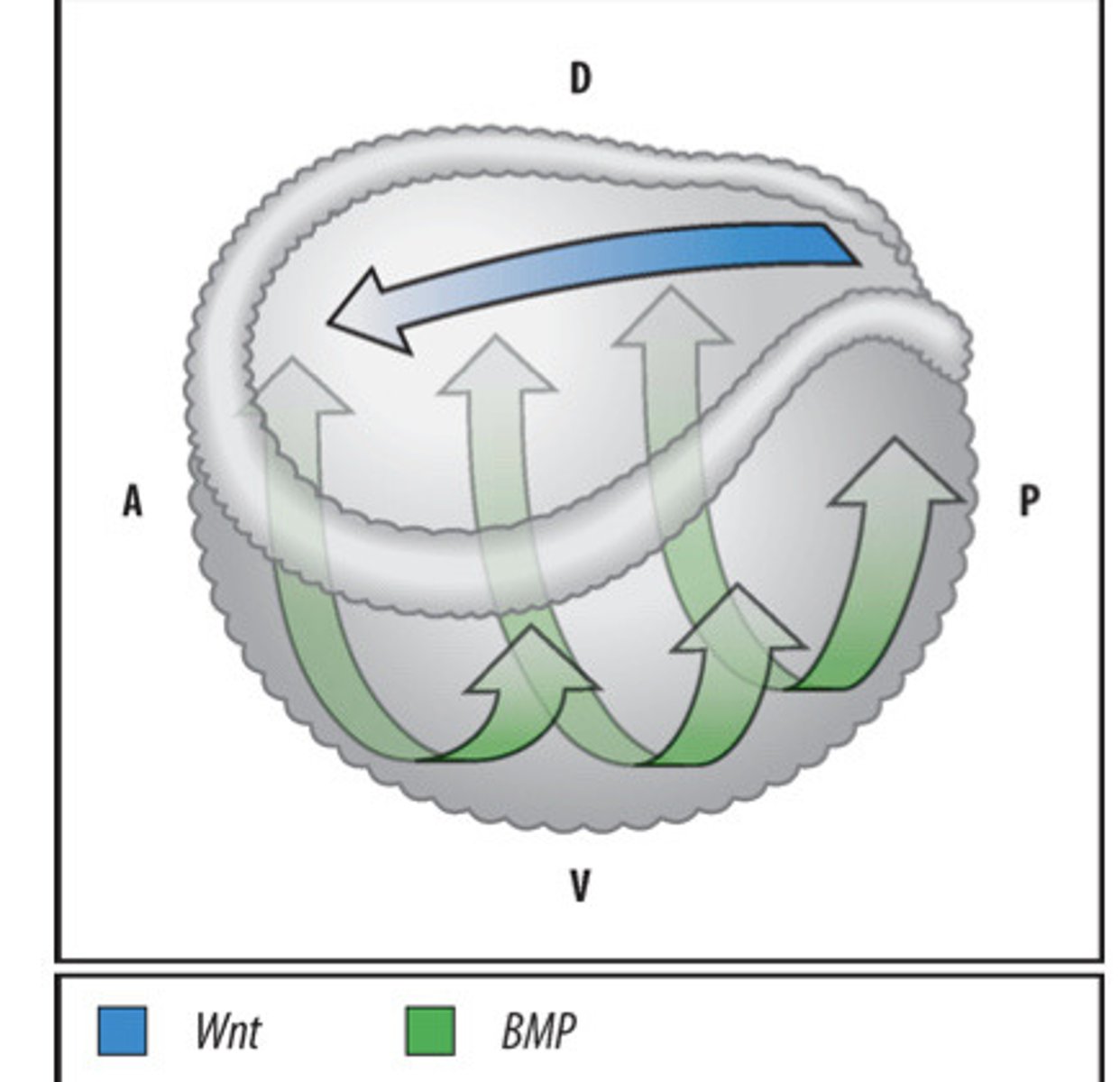
Spemann-Mangold Organizer generates dorsal-ventral gradient of BMP signalling throughout the embryo - lowest in neural plate and dorsal axial mesoderm. Also generates anterior-posterior gradient of Wnt signalling in the neural plate - lowest in anterior neural plate.
What is induction?
Change in cell fate mediated by an extrinsic/ non-cell autonomous signal
What is the difference between induction and cell-autonomous differentiation?
Induction uses extrinsic signalling, cell-autonomous differentiation is intrinsic due to components
Dual inhibition of Wnt and BMP signalling promotes...
brain formation in the anterior neural plate
BMP inhibition without Wnt inhibition promotes...
spinal cord formation
How is the brain and spinal cord further A-P patterned?
Early organizer forms prechordal mesoderm > induces anterior transcription factors in neural plate.
Mid organizer forms notochord > represses anterior TFs and promotes posterior TFs.
Late organizer elongates notochord > further posteriorizes neural plate > neural tube > spinal column
What is the activation-transformation model of neural plate/tube A-P patterning?
Activation: Early organizer secretes Wnt antagonists and BMP antagonists > neuroectoderm adopts forebrain fate.
Transformation: reduced secretion of Wnt antagonists > posterior neural plate multiple posteriorizing factor gradients > neural plate elongates and transitions to neural tube.
What is retinoic acid?
A diffusible (vitamin A derivative) ligand for nuclear retinoic acid receptor transcription factors
What are FGFs?
Fibroblast Growth Factors signal ETS transcription factors in nucleus via a cascade of serine-threonine kinases
Anterior-Posterior regionalisation of the neural plate is achieved by two opposing gradients of antagonistic signals ...
Anteriorizing factors (Bmp and Wnt antagonists) and posteriorizing factors (FGFs, Wnts, retinoic acid)
> activation of different Hox genes in different positions > regional specification
Specific combinations of Hox TF expression in the neural tube specify ....
the distinct domains of the spinal cord
How is the neural tube formed?
Flat neural plate > neural furrow > elevation of neural folds > folds bend inwards > folds fuse > neural tube > neural crest cells migrate (give rise to PNS and head tissues)
What are the 2 opposing signals along the neural tube D-V axis?
BMP proteins > dorsal neuronal fates, roof plate and dorsal half of neural tube
Shh > ventral neuronal fates, floor plate and ventral half of the neural tube
How do BMP and shh induce different fates differently?
Different members of BMP family are expressed in different domains > different dorsal neuronal fates. Different concentrations of Shh induce different ventral neuronal fates.
How does different concentrations of Shh induce different neuronal fates?
Regulates expression of homeodomain TFs e.g. Pax7, Pax6 and Nkx6. TFs define distinct neural identities when progenitors terminally differentiate into neurons.