L5 Global burden of chronic diseases
 Call Kai
 Learn
Learn Practice Test
 Spaced Repetition
 Match
Match Flashcards
 Knowt Play
1/16

There's no tags or description
Looks like no tags are added yet.
Name | Mastery | Learn | Test | Matching | Spaced | Call with Kai |
|---|
No analytics yet
Send a link to your students to track their progress
17 Terms
Define global burden of chronic disease
The current burden of chronic diseases reflects past exposure to the risk factors. Future burden will be affected by current exposures.
causative factors = Truth
Associated factors = risk
When was the Global Burden Disease (GBD) study started ? How was it studied ?
Start in 1990
Health effects of more than 100 diseases and injuries for 8 regions of the world was studied
A new metric – Disability - adjusted life year (DALY) was introduced
What are the categories of the burden (cause) of disease that lead to death and DALY ?
Group I
communicable, maternal and perinatal condition (meaning in the 1 st week after birth) and nutritional disorder
Group II
non - communicable diseases
Group III
injuries, including road traffic accidents (RTA), falls, self - inflicted injuries and violence
State the formula of DALY
Disability-adjusted life year = Years of life lost (YLLs) 早死幾多年 + Years lived with disability (YLDs)
DALYs = YLLs + YLDs
DALYs = (N x L) + (I x L x DW)
Years of life lost (YLLs) = premature mortality
Years lived with disability (YLDs) = Morbidity 發病率, years lived in less than ideal health
What is the meaning of the calculated DALY means ?
One DALY equals one lost year of healthy life . DALYs allow us to estimate the total number of years lost due to specific causes and risk factors at the country, regional, and global levels. It can be thought of as a measurement of the “gap” between current health status and an ideal health situation where the entire population lives to an advanced age, free of disease and disability.
state the 2 principle of DALY
Principle #1: The only differences in the rating of a death or disability should be due to age and sex, not to income, culture, location, social class.
Principle #2: Everyone in the world has right to best life expectancy in world
What is disability weight ?
(will be given in exam)
weight factor that reflects the severity of the disease on a scale from 0 (perfect health) to 1 (equivalent to death).
Used in YLD calculation
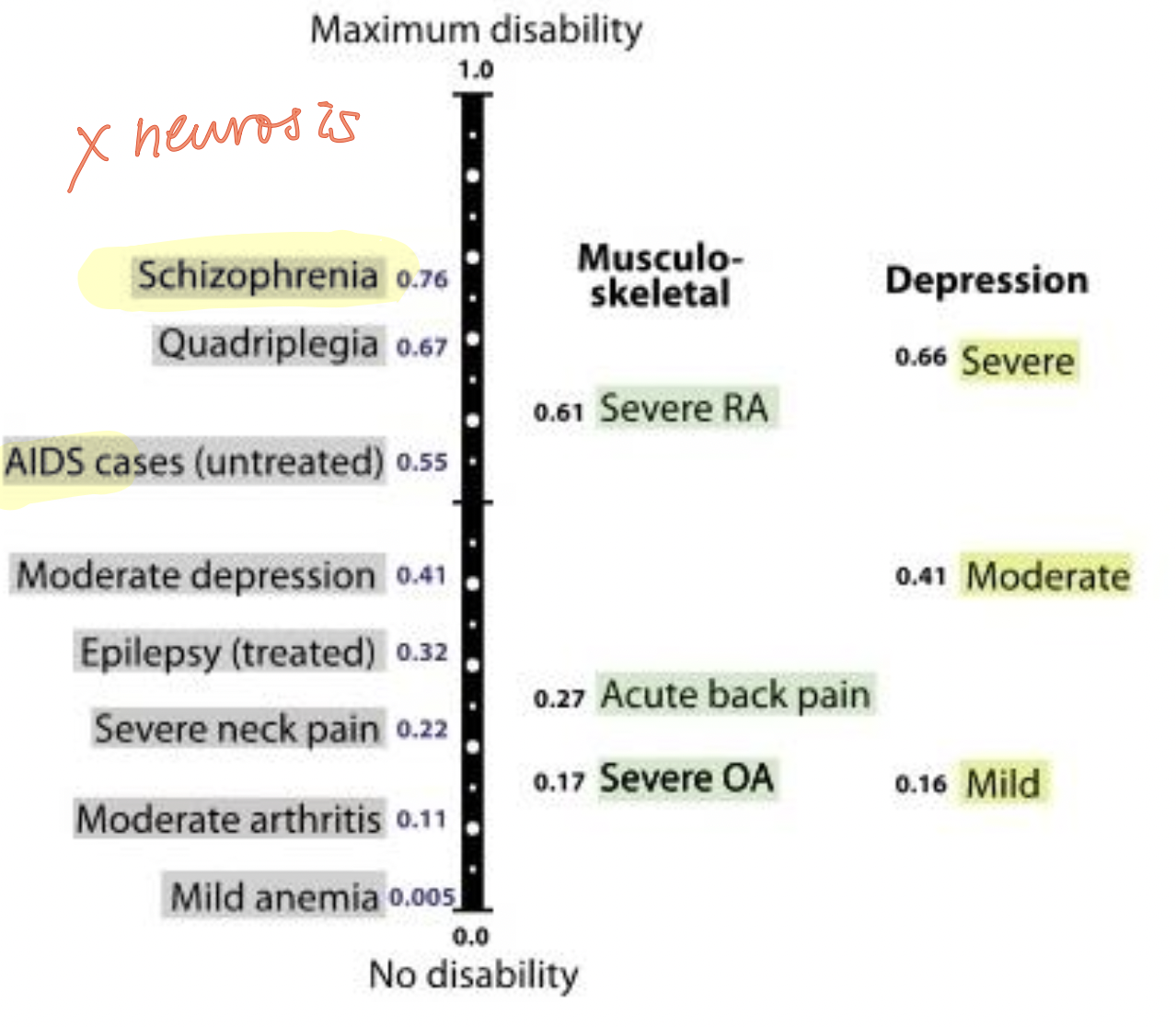
Why it might be difficult to give a standardize disability weight ?
because experience of disability varies so much based on:
Individual
Living conditions
Level of community support, Access to health care
State the formula of YLD (year lived with disability)
YLD = I x L x DW
I = number of incident cases
L = average duration of the disease until remission (years)
?/52 = weeks
?/365 = days
?/12 = months
DW = disability weight
State the formula of YLL (Years of life lost)
YLL = N x L
N = number of deaths ppl
L = standard life expectancy at age of which death occurs in years (早死咗幾多年)
Calculate the DALY for the follow situation:
100,000 adults are stricken by lightening for 2 years with a disability weighting of 0.6 ; 20% die at 80 years old.
Assume at 80 years old death prematurely, you have 8 more years to live
DALYs = (N x L) + (I x L x DW)
(100000 × 0.2 × 8) + (100000 × 2 × 0.6) = 280000
[If ask in MC, choose the closest ans, won’t have the exact ans.]
What is the benefits and purpose of using DALY ?
DALYs allow us to estimate the total number of years lost due to specific causes and risk factors at the country, regional, and global levels.
It takes account into both the years of life lost and the possibility of having burden of living with disease / disability without resulting in dying earlier than expected
It allows for comprehensive, consistent and comparable information on diseases and injuries as a health indicator allowing surveillance and evaluate overall health
Allow direct comparison of burden across diseases
Summing burden across diseases
Permit comparing treated and untreated conditions
Compare different disease interventions: Treatment expansion vs Prevention campaigns
With the objective data of the affected population, health policy & funding can be properly used in dealing with the situation.
Which disease ranked the first in both cause of death and DALY in Sub-Saharan Africa in 2013 ?
HIV/ AIDS
List the Chronic Diseases, which is the largest cause of death
Cardiovascular disease (17 million deaths)
Cancer (7 million)
Chronic lung diseases ( 1 million)
Diabetes Mellitus ( 1 million)
What is the leading modifiable risks factors for non-communicable disease ?
Tobacco use
Unhealthy diets
Lack physical activity
alcohol use
Define what is global shift in disease burden
Definition: The ongoing transition in the primary causes of illness and death worldwide, characterized by:
Decline in infectious diseases (e.g., malaria, HIV, tuberculosis) and maternal/childhood conditions.
Rise in non-communicable diseases (NCDs) (e.g., heart disease, cancer, diabetes) and injuries.
This shift is driven by socioeconomic development, aging populations, and globalization.
Define what is epidemiological transition
Definition: A theory describing the long-term shift in disease patterns and causes of death within populations, driven by socioeconomic development, demographic changes, and public health advancements. It explains how societies transition from high mortality from infectious diseases to dominance of non-communicable diseases (NCDs).