Module 2: Solid Mechanics Fundamentals - Material Behaviour & Computational Engineering
 Call Kai
 Learn
Learn Practice Test
 Spaced Repetition
 Match
Match Flashcards
 Knowt Play
1/10

There's no tags or description
Looks like no tags are added yet.
Name | Mastery | Learn | Test | Matching | Spaced | Call with Kai |
|---|
No analytics yet
Send a link to your students to track their progress
11 Terms
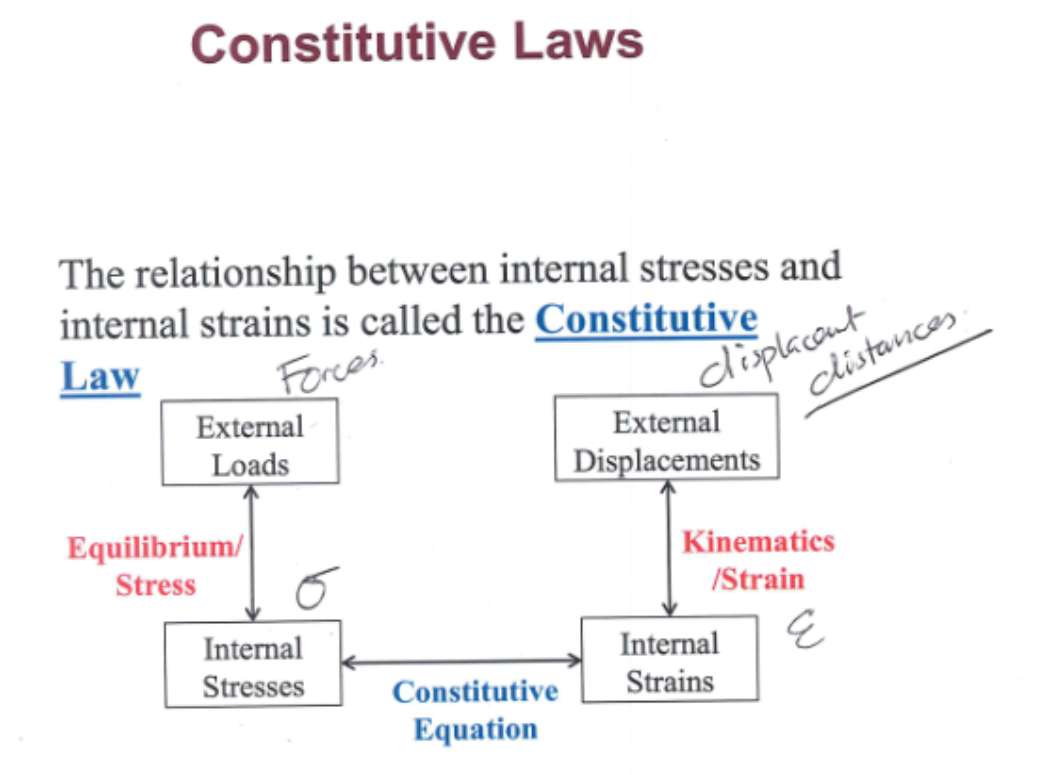
a constitutive law is the mathematical bridge that links internal stresses directly to internal strains to define how a specific material behaves
the stress pillar: connects external loads (forces) to internal stresses via equilibrium
the strain pillar: connects external displacements (distances) to internal strains via kinematics
what are constitutive properties
a material whose mechanical properties are completely identical in all directions
pulling or compressing the material from any angle yields the exact same stiffness and response
what does isotropic mean
a material whose mechanical properties vary depending on the direction of the applied force
this is a hallmark feature of many biological tissues (like muscle, tendons, or bone) because their internal microstructural fibers align in specific directions, making them stronger or stiffer along the fibers than across them
what does anisotropic mean
a material that has a uniform composition throughout
its material properties do not change from one localised point to another within the structure
what does homogenous mean
a material that undergoes no change in volume when deformed (ΔV=0)
under pressure, the material may change shape, but its total volume remains exactly constant
what does incompressible mean
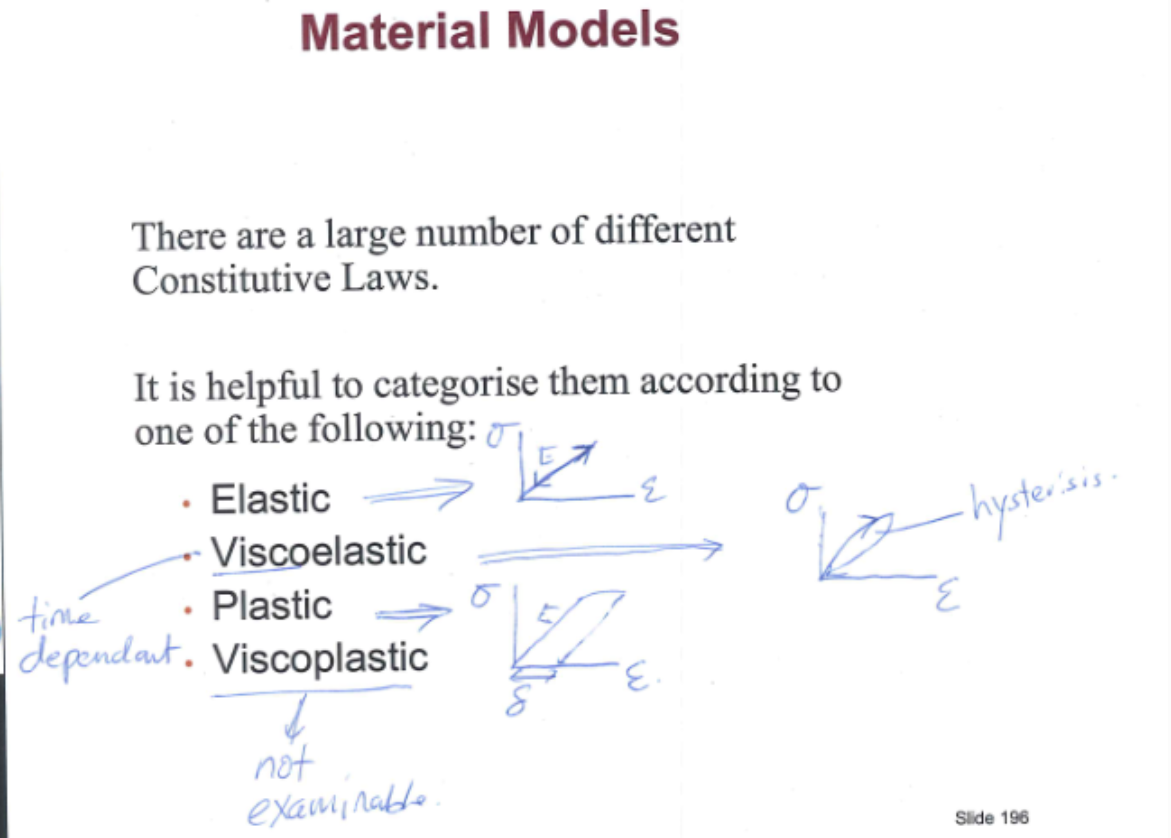
elastic → material that deforms under a load but returns completely to its original shape immediately upon unloading
non-linear elastic → a material that returns fully to its original shape when the load is removed, but the relationship between stress and strain is not a straight line
the stiffness changes dynamically as the material stretches (often exhibiting “strain-stiffening” where it gets stiffer the more it is deformed)
viscoelastic → a time-dependent and rate-dependent material behaviour that combines fluid-like (viscous) and solid-like (elastic) traits
it features rate effects (behaves differently depending on how fast it is loaded)
it exhibits hysteresis (energy loss)
it sometimes results in permanent deformation, but it does not have a strict yield stress
plasticity (plastic) → a material behaviour characterised by permanent, non-reversible deformation once a specific threshold — the yield stress — is exceeded
when the deforming force is exceeded, when the deforming force is removed, the material fails to return to its original dimensions and retains a permanent change in shape, it does not depend on the rate of loading
what are the three models of materials
Material Type | Permanent Deformation | Rate Effects | Hysteresis / Energy Loss | Yield Stress |
Elastic | $\times$ (No) | $\times$ (No) | $\times$ (No) | $\times$ (No) |
Viscoelastic | Sometimes | $\checkmark$ (Yes) | $\checkmark$ (Yes) | $\times$ (No) |
Plastic | $\checkmark$ (Yes) | $\times$ (No) | $\checkmark$ (Yes) | $\checkmark$ (Yes) |
Viscoplastic (Not Assessed) | $\checkmark$ (Yes) | $\checkmark$ (Yes) | $\checkmark$ (Yes) | $\checkmark$ (Yes) |
summary table of material modes
the loss of mechanical energy over a single complete loading and unloading cycle
what is hysteresis
uniaxial test:
a sample is gripped at two ends and pulled (tension) or pushed (compression) along a single axis
key use: it is the simplest and most common test used to find basic material properties like Young’s modulus, yield strength, and ultimate tensile strength
biaxial test:
a flat, usually square sample is clamped on all four sides and pulled simultaneously along two perpendicular axes (x and y)
key use: crucial for testing soft biological tissues (like skin, heart valves, or pericardium) that experience multi-directional forces in the body, allowing researches to observe anisotropic behaviour and fibre alignment
simple shear test:
a material sample is anchored to a fixed bottom plate while a parallel force is applied to the top plate, causing the material layers to slide sideways relative to one another. this changes the internal angles of the material without altering its volume
key use: measures a material’s resistance to twisting or sliding forces (Shear Modulus)
indentation test:
a hard object of a unknown geometry is pressed into the surface of a material with a specific force, the depth or area of the leftover dimple is measured
key use: used to determine the localised hardness and stiffness of a material surface without destroying the entire component
confined compression test:
a material sample is placed inside a rigid, hollow ring or well that completely prevents it from expanding laterally (sideways), and a porous or solid piston compresses it from the top
key use: frequently used for highly hydrated soft tissues like articular cartilage, because the sides are restricted, it forces water to exude out of the tissue, making it excellent for measuring viscoelasticitiy and fluid permeability
micro and nano-indentation
description: this uses the exact mechanical concept as a standard indentation test, but operates on an extremely miniature scale using microscopic tips and incredibly precise force sensors (down to micron or nanometer depths)
key use: used to measure the mechanical properties of microscopic structures, single cells thin-film coating, or individual localised phases within bone tissue
3-point bending:
a long, beam-like sample is supported horizontally at two points near its outer ends, and a downward vertical force is applied exactly in the middle. this creates a combination of tension on the bottom surface and compression on the top surface
key use: excellent for determining the structural stiffness and flexural strength of rigid biological materials like long bone samples or engineering implants
name and describe some tests for determining material behaviour - uniaxial test; biaxial test; simple shear test; indentation test; confined compression test; inflation test; micro and nano-indentation, 3-point bending
non-linearity:
look for: curve that bends, flattens, or steepens rather than forming a straight line
curves upward as it stiffens, bends downwards if it softens
hysteresis:
look for: a distinct loop formed between two paths during a complete cycle
loading path rises higher while the unloading path sags lower
viscoelasticity:
look for: signs of time-dependency, often split into two classic experimental tests: creep or stress relaxation
stress relaxation occurs if graph shows strain held perfectly constant over time — look for a stress curve that starts high and decays downwards to a lower plateau
creep occurs if stress is held constant over time, look for a strain curve that gradually creeps upward over time
anisotropy:
look for: multiple, entirely separate curves plotted on the same axis scale representing different structural directions
rate effects:
look for: a family of curves spread out on a stress-strain plot, with each curve explicitly labeled by a different speed or rate
as the loading rate increases, the curves will shift upward, showing higher peak stresses and a steeper initial slope (increased dynamic stiffness)
Given a figure showing experimental data from particular tests on materials, say whether you can identify any non-linearity, hysteresis, viscoelasticity, anisotropy, or rate effects.
mesh refinement: splitting geometry into elements; refine smaller at stress concentration until results stop changing (convergence)
material properties: inputting mathematical constitutive equations into the mesh elements
boundary conditions: applying constraints (locking movement) and loads (external forces/pressures)
simplifications: using 2D (plane stress for thin objects; plane strain for thick objects) or symmetry (halving mirrored models) to flash computing time
material failure: setting an internal stress/strain threshold (e.g., Von Mises stress) to flag when and where structural breaking occurs
validation: replicating the model’s boundary conditions in a physical experiment to ensure digital data matches real-world curves
Understand and be able to explain the key features of a computational engineering model including geometric features (mesh refinement), material properties, boundary conditions (forces and fixed conditions), model simplification (2D and symmetry), model material failure, and model validation against experiment.