Week 3 - General senses - Pain

0.0(0)
Studied by 0 people
call kaiCall Kai
learnLearn
examPractice Test
spaced repetitionSpaced Repetition
heart puzzleMatch
flashcardsFlashcards
GameKnowt Play
Card Sorting

1/15

encourage image

There's no tags or description

Looks like no tags are added yet.

Last updated 8:36 AM on 4/15/26
Name
Mastery
Learn
Test
Matching
Spaced
Call with Kai

No analytics yet

Send a link to your students to track their progress

16 Terms

1
New cards

General senses breakdown

  • General sensereceptor

  • Touch, proprioception, vibrationmechanoreceptors

  • Temperaturethermoceptors

  • Painnociceptors

2
New cards

Pain: Definition

“An unpleasant sensory and emotional experience associated with actual or potential tissue damage or described in terms of such damage.”

  • Important to survival

  • Protective mechanism - notifies tissue damage, preventing further damage

3
New cards

Pain: Nociception stimulus

Triggers:

  • Initial damage from external causes (e.g blunt trauma) or internal causes (e.g inner tumor)

  • Ongoing disease causing tissue damage

2 Pain types: based on duration of pain

  1. Acute pain - Disappears when tissue damage is gone

  2. Chronic pain - Longer lasting, can linger even after the disappearance of injury

Pain and psychology are intertwined: Optimism & pessimism can decrease or increase pain respectively. Cultural values can lead to stoicism or downplaying of pain.

4
New cards

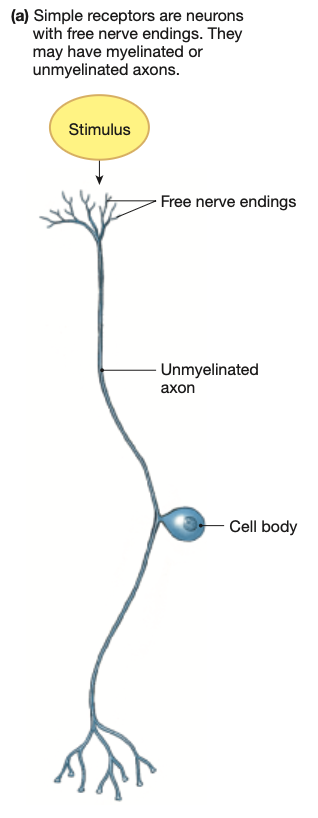
Pain: Nociceptors

Free nerve endings.

Pain receptors are spread thoughout the ENTIRE body SANS for the brain.

4 Pain types: based on type of painful stimuli:

  • Thermal

  • Chemical

  • Mechanical

  • Polymodal (two or more of the above)

Can be triggered by the stimulus itself OR by chemicals released by neighbouring cells from tissue damage (cytokines)
<p><strong>Free nerve endings.</strong></p><p>Pain receptors are spread thoughout the ENTIRE body SANS for the <strong>brain.</strong></p><p><mark data-color="red" style="background-color: red; color: inherit;">4 Pain types: based on </mark><strong><em><u><mark data-color="red" style="background-color: red; color: inherit;">type of painful stimuli:</mark></u></em></strong></p><ul><li><p>Thermal</p></li><li><p>Chemical</p></li><li><p>Mechanical</p></li><li><p>Polymodal (two or more of the above)</p></li></ul><p>Can be triggered by the <strong>stimulus itself </strong>OR by chemicals released by neighbouring cells from tissue damage (<strong>cytokines</strong>)</p>
5
New cards

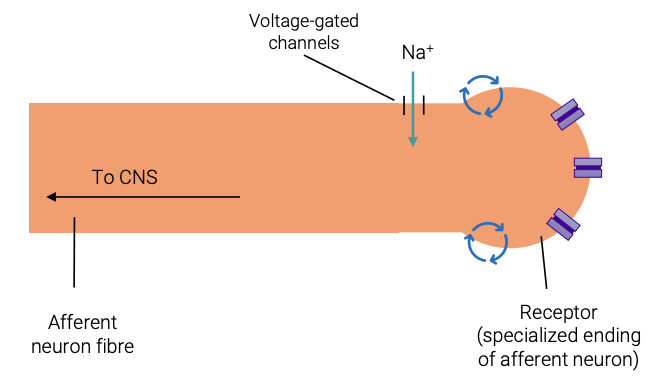
Pain: Nociceptor activation

  1. Initial tissue damage from injury or ongoing disease

  2. Mechanical/electrical/thermal/chemical stimuli or cytokines from damaged cells cause the opening of ion channels within the neuron’s cell membrane

  3. Positive ions flow into the cell, causing depolarisation

  4. If threshold potential reached, action potentials are generated from the opening of Na+ voltage-gated ion channels

  5. Signals sent to CNS

  6. Pain perceived

<ol><li><p>Initial tissue damage from injury or ongoing disease</p></li><li><p><mark data-color="green" style="background-color: green; color: inherit;">Mechanical/electrical/thermal/chemical stimuli or cytokines</mark> from damaged cells cause the <mark data-color="green" style="background-color: green; color: inherit;">opening of ion channels</mark> within the neuron’s cell membrane</p></li><li><p>Positive ions flow into the cell, causing <strong><mark data-color="purple" style="background-color: purple; color: inherit;">depolarisation</mark></strong></p></li><li><p>If threshold potential reached, action potentials are generated from the opening of <strong><mark data-color="green" style="background-color: green; color: inherit;">Na+ voltage-gated ion channels</mark></strong></p></li><li><p>Signals sent to CNS</p></li><li><p>Pain perceived</p></li></ol><p></p>
6
New cards

Pain: Example - Capsaicin

  • Triggers thermal nociceptors

  • Capsaicin binds to chemically-activated ion channels on nociceptors sensitive to temperatures above 37 degrees.

    • Hence, leads to “burning sensation” and “hotness”

    • Capsaicin stays bound to the membrane for a long time, leading to a large amount of action potentials being sent for a long duration

      • In this period, pain from OTHER stimuli is sensed less intensely

      • Hence, capsaicin is a topical analgesic (painkiller)

7
New cards

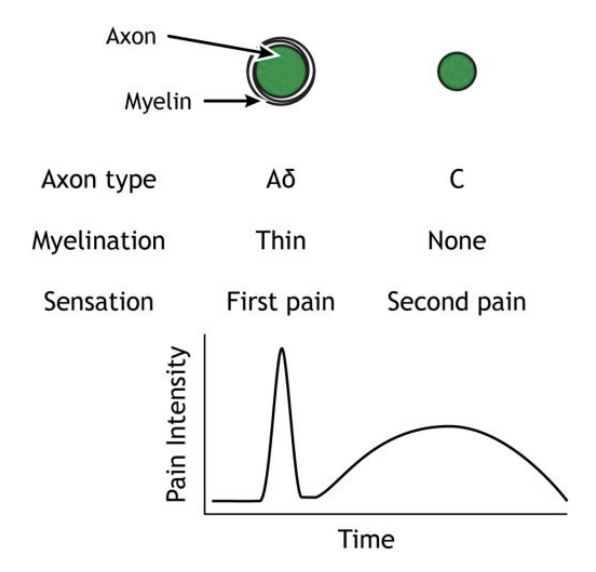
Pain: 2 nociceptor types: based on phases after immediate injury:

2 Nociceptor types (a.k.a 2 types of Pain receptors)

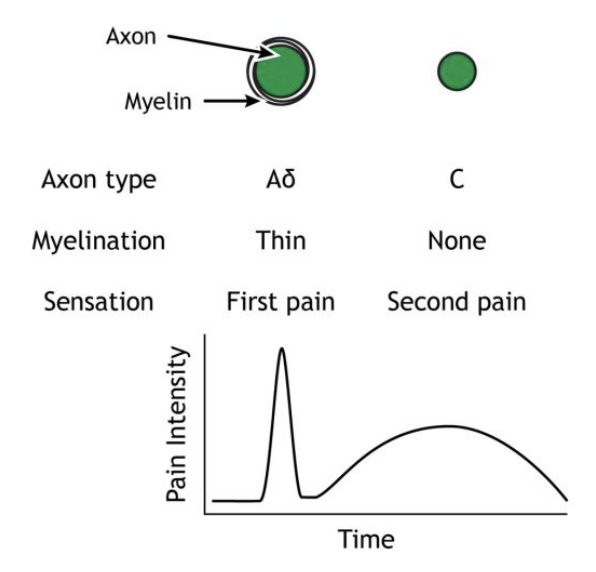
  1. Aδ fibers. (“a-delta”) - FIRST pain

  2. Type C fibres - SECOND pain

8
New cards

Pain: Nociceptor types - Aδ fibers

  • Activates in response to intense pressure, cuts on the skin, or extreme hot & cold temperatures

  • Small receptive fields = identifies precise location of injury

  • “First pain” - Initial tense, sharp and localised pain

    • Neurons are lightly myelinated, small in diameter

      • Myelin increases action potential speed, small diameter lower speed - signals transmitted slowly
<ul><li><p>Activates in response to intense pressure, cuts on the skin, or extreme hot &amp; cold temperatures</p></li><li><p>Small receptive fields = identifies precise location of injury</p></li><li><p>“First pain” - Initial tense, sharp and localised pain</p><ul><li><p>Neurons are <em>lightly myelinated</em>, small in diameter</p><ul><li><p>Myelin increases action potential speed, small diameter lower speed - signals transmitted <strong>slowly</strong></p></li></ul></li></ul></li></ul><p></p>
9
New cards

Pain: Nociceptor types - Type C fibres

  • Activates in response to all painful stimuli

  • Large receptive fields = provides course/rough info on location of injury

  • “Second pain” - Mild burning or aching pain, more widespread

    • Neurons are unmyelinated, very small in diameter

      • No myelin decreases action potential speed, extreme slim diameter further slows speed - signals transmitted very slowly

  • Over 70% of pain signals sent by Type C fibres
<ul><li><p>Activates in response to all painful stimuli</p></li><li><p>Large receptive fields = provides course/rough info on  location of injury</p></li><li><p>“Second pain” - Mild burning or aching pain, more widespread</p><ul><li><p>Neurons are <em>unmyelinated</em>, very small in diameter</p><ul><li><p>No myelin decreases action potential speed, extreme slim diameter further slows speed - signals transmitted <strong>very slowly</strong></p></li></ul></li></ul></li><li><p>Over 70% of pain signals sent by Type C fibres</p></li></ul><p></p>
10
New cards

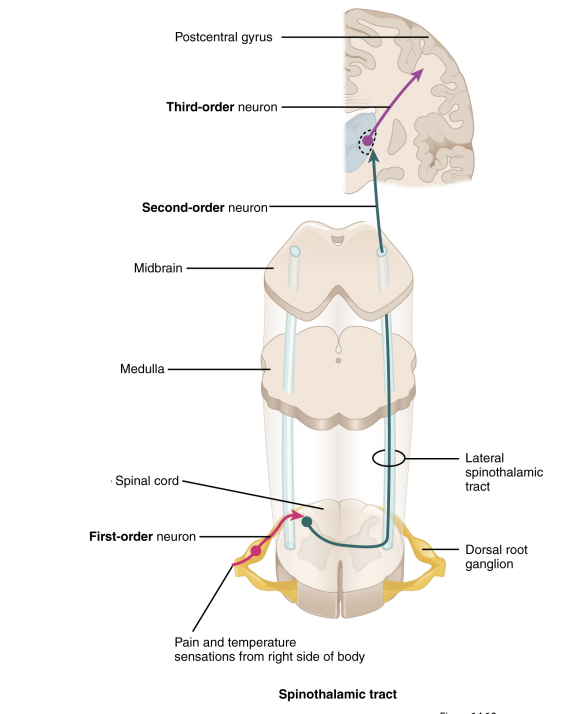
Pain: Neural pathways - Spinothalamic tract

  1. Thermoreceptor stimulated

First-order neuron:

  1. Action potential travels to the spinal cord,

  2. Immediately synapses at the spinal cord on the side of sensation

Second-order neuron:

  1. Decussates in spinal cord, crossing over to the other side and up the spinal cord (travels contralateral to the sensation)

  2. Synapses in the thalamus

Third-order neuron:

  1. Travels to the various region in the brain

    1. Somatosensory cortex (“sensory homunculus”)

    2. Anterior cingulate cortex

    3. Frontal lobe

<ol><li><p>Thermoreceptor stimulated</p></li></ol><p><strong><em><u>First-order neuron:</u></em></strong></p><ol><li><p>Action potential travels to the spinal cord,</p></li><li><p>Immediately synapses at the spinal cord <strong>on the side of sensation</strong></p></li></ol><p><strong><em><u>Second-order neuron:</u></em></strong></p><ol><li><p>Decussates in spinal cord, crossing over to the other side and up the spinal cord (travels contralateral to the sensation)</p></li><li><p>Synapses in the <strong>thalamus</strong></p></li></ol><p><strong><em><u>Third-order neuron:</u></em></strong></p><ol><li><p>Travels to the <strong>various region in the brain</strong></p><ol><li><p><mark data-color="purple" style="background-color: purple; color: inherit;">Somatosensory cortex (“sensory homunculus”)</mark></p></li><li><p><mark data-color="purple" style="background-color: purple; color: inherit;">Anterior cingulate cortex</mark></p></li><li><p><mark data-color="purple" style="background-color: purple; color: inherit;">Frontal lobe</mark></p></li></ol></li></ol><p></p>
11
New cards

Pain: Neural inhibition - Gate-control theory

Not all pain signals make it to the brain, some are stopped halfway by inhibition (i.e painkillers). There are many locations where inhibition can occur:

  • Opioid interneurons

  • Descending pathways (PAG = periaqueductal gray matter)

Gate-control theory: Both of these inhibitory systems work in tandem to prevent excess pain signals from reaching the brain, becoming a “gate” that must be opened with enough force to warrant notifying the brain.

  • Prevents harmless signals from being perceived as pain

12
New cards

Pain: Neural inhibition - Opioid interneurons

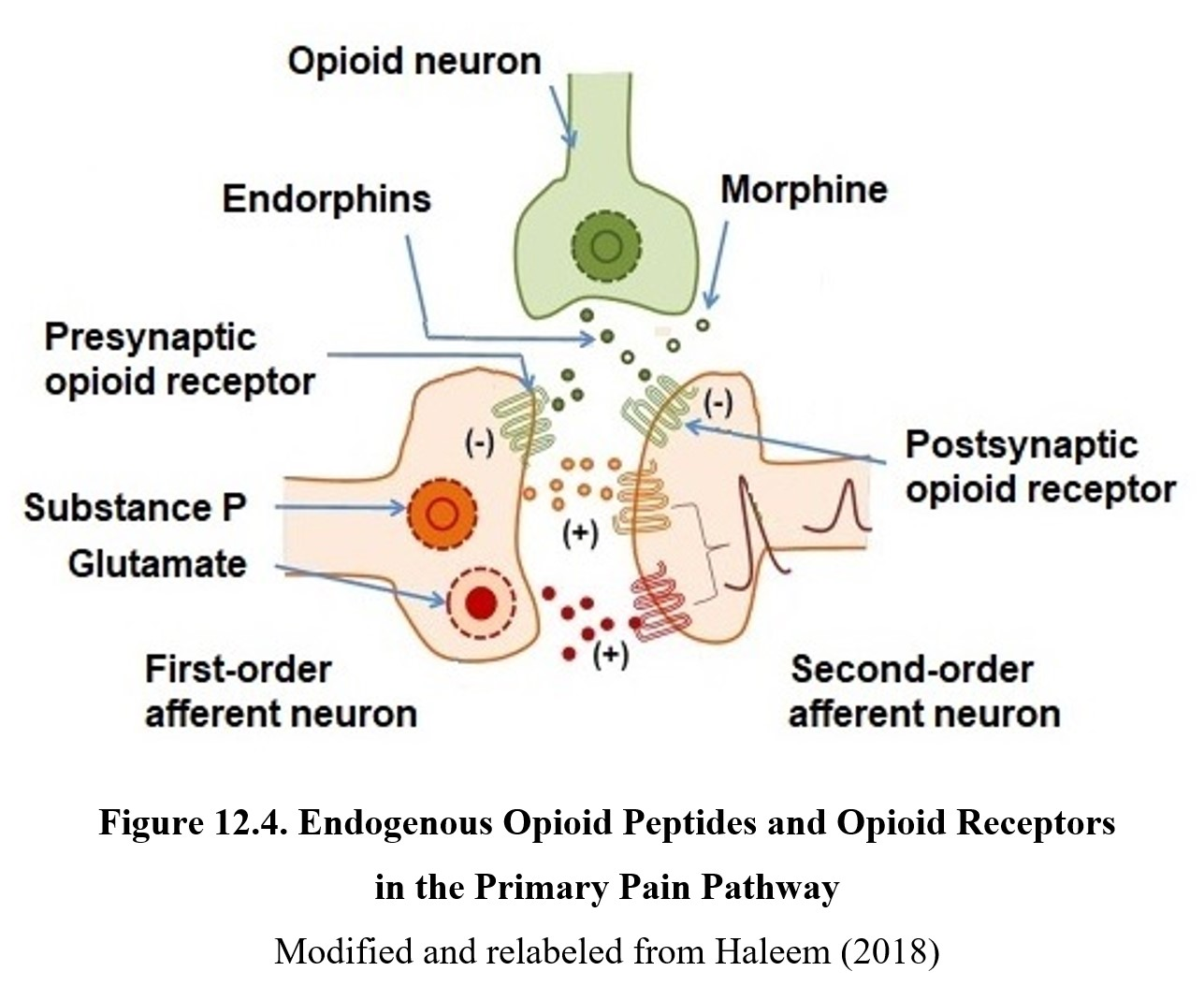
Opioid: Chemical with pain-relieving effects

  • Littered throughout the spinal cord are opioid interneurons that when activated, release opioids which inhibit pain signals

  • Prevents transmission of pain signals between the first & second order neurons on the spinothalamic tract.
<p><strong><mark data-color="green" style="background-color: green; color: inherit;">Opioid</mark></strong>: Chemical with pain-relieving effects</p><ul><li><p>Littered throughout the <mark data-color="yellow" style="background-color: yellow; color: inherit;">spinal cord</mark> are <strong><u><mark data-color="purple" style="background-color: purple; color: inherit;">opioid interneurons</mark></u></strong> that when activated, release opioids which inhibit pain signals</p></li><li><p>Prevents transmission of pain signals between the <strong><em><u><mark data-color="purple" style="background-color: purple; color: inherit;">first &amp; second order neurons</mark></u></em></strong> on the <strong><em><mark data-color="purple" style="background-color: purple; color: inherit;">spinothalamic tract</mark></em></strong>.</p></li></ul><p></p>
13
New cards

Pain: Neural inhibition - PAG (Periaqueductal gray matter)

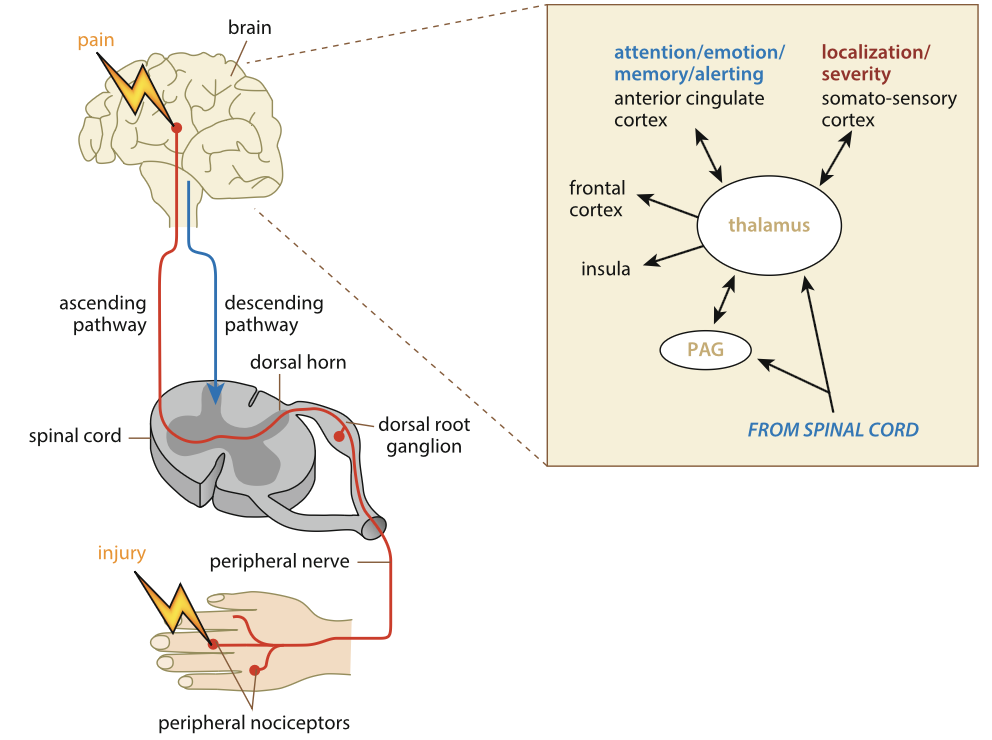
PAG (Periaqueductal gray matter): Found in the brain stem, origin of descending inhibitory pathway from the brain. Descending neural pathway from brain to spinal cord.

  • When pain signals reach the brain, neurons in the PAG are activated

  • PAG neurons send inhibitory signals down the spinal cord

  • Prevents further pain signals from reaching the brain

  • Acts on the second-order neuron in the spinothalamic tract
<p><strong><em><mark data-color="purple" style="background-color: purple; color: inherit;">PAG (Periaqueductal gray matter)</mark>:</em></strong> Found in the <mark data-color="yellow" style="background-color: yellow; color: inherit;">brain stem</mark>, origin of descending inhibitory pathway from the brain. Descending neural pathway from brain to spinal cord.</p><ul><li><p>When pain signals reach the brain, neurons in the PAG are activated</p></li><li><p>PAG neurons send inhibitory signals <strong><mark data-color="yellow" style="background-color: yellow; color: inherit;">down the spinal cord</mark></strong></p></li><li><p>Prevents further pain signals from reaching the brain</p></li><li><p>Acts on the <strong><em><u><mark data-color="purple" style="background-color: purple; color: inherit;">second-order neuron</mark></u></em></strong> in the <strong><mark data-color="purple" style="background-color: purple; color: inherit;">spinothalamic tract</mark></strong></p></li></ul><p></p>
14
New cards

Pain: Pain threshold & tolerance

EVERYONE has the SAME pain threshold.

  • e.g 44-46 degrees is sensed as painfully hot for all humans

Pain tolerance can vary widely.

  • Just because you can tolerate something, does not mean it is not being sensed regardless

  • Persistent pain stimuli can decreases pain tolerance (e.g chronic pain)

  • Cultural and psychological factors

  • Tolerance increases with age and modified by emotions and mental state

    • Pain and psychology are intertwined

15
New cards

Pain: 2 Pain types: based on location of painful stimuli:

  • Somatic pain: Skin, muscles, joints

    • Superficial somatic pain: sharp, prickling pain, localised on the epidermis, tends to be brief in duration

    • Deep somatic pain: burn, itch or ache, localised to joints, muscles and deeper dermis layers, longer lasting, can be chronic (arthritis)

  • Visceral pain: Inner organs

    • Dull aching, gnawing, vague burning (like hunger)

    • Stimuli can be extreme stretching of tissue, ischemia (restriction of blood supply to tissues), muscle spasms, noxious chemicals

16
New cards

Pain: Somatic & visceral pain: Referred pain

Both somatic & visceral pain share many neural pathways. Visceral pain is much less common and hence, the brain can often mistake visceral pain for the much more common, somatic pain.

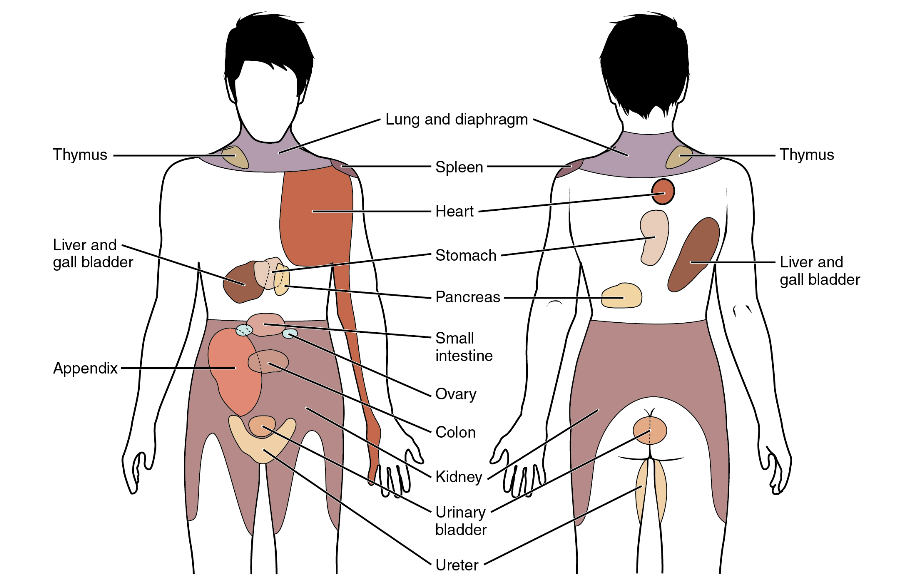
Referred pain = somatic pain perceived when stimulus is actually visceral.

  • Lack of acuity in the brain mixes up perception of somatic & visceral pain

Crucial for mapping the body, helping clinicians identify visceral pain before major damage occurs.

  • e.g males experiencing shoulder pain, may actually have visceral heart pain

  • Diagram: map of somatic pain that correlates to visceral pain
<p>Both <mark data-color="red" style="background-color: red; color: inherit;">somatic &amp; visceral pain</mark> share many neural pathways. <strong>Visceral pain</strong> is much less common and hence, the brain can often <mark data-color="green" style="background-color: green; color: inherit;">mistake</mark> visceral pain for the much more common, <strong>somatic pain</strong>.</p><p><strong><em><u>Referred pain</u></em></strong> = somatic pain perceived when stimulus is actually visceral.</p><ul><li><p>Lack of acuity in the brain mixes up perception of <mark data-color="red" style="background-color: red; color: inherit;">somatic &amp; visceral pain</mark></p></li></ul><p><em><u>Crucial for mapping the body, helping clinicians identify visceral pain before major damage occurs.</u></em></p><ul><li><p>e.g males experiencing <strong>shoulder pain</strong>, may actually have <strong>visceral heart pain</strong></p></li><li><p>Diagram: map of somatic pain that correlates to visceral pain</p></li></ul><p></p>