POM III - Overview of PM&R - Exam 2
 Call Kai
 Learn
Learn Practice Test
 Spaced Repetition
 Match
Match Flashcards
 Knowt Play
1/83

There's no tags or description
Looks like no tags are added yet.
Name | Mastery | Learn | Test | Matching | Spaced | Call with Kai |
|---|
No analytics yet
Send a link to your students to track their progress
84 Terms
Physical Medicine and Rehab
Branch of medicine that focuses on improving functional ability and quality of life of people with physical impairments
Trained physicians complete a 4-year residency
Physicians are called physiatrists
PM&R Basics
Understanding the physical changes that occur with:
-congenital abnormalities
-complications from an injury, disease, amputation
Restoring or improving how that person functions daily
Acute Rehab Goals
Stabilize the problem
Prevent secondary complications
Restore lost functionality
restore lost or maintain functionality
what is the goal of chronic rehab?
Geriatric Rehab Goals
recovery of lost physical, psychological, or social skills so that the person may become:
-more independent
-live in personally satisfying environments
-maintain meaningful social interactions
PM&R - Patient Types
Geriatric patients
Athletes
Amputees
Stroke patients
Cardiac patients
COPD patients
COVID patients
Rehab Settings
Acute inpatient rehab
Sub-acute rehab (skilled nursing facility - SNF)
Long term care unit
Day rehab
Home health
Outpatient - PT, OT, Speech therapy
Physiatrist
Physician who specializes in PM&R
May have sub-specialty --> neuromuscular medicine, pain medicine, pediatric rehab medicine, spinal cord injury, sports medicine, brain injury, hospice and palliative medicine
Focus on treatment of function; aim to improve patient's QOL
Internal Classification of Function, Disability, and Health
Developed by WHO
Measures health and disability of individuals and populations
Three components: body functions and structure, activities and participation, severity and environmental factors
WHODAS 2.0
Assessment instrument for health and disability
Helps to standardize disability levels
Can be used in all cultures and adult populations
Linked to the ICF
WHODAS 2.0 - Domains
Cognition - understanding and communicating
Mobility - moving and getting around
Self-care - hygiene, dressing, eating, staying along
Getting along - interacting with other people
Life activities - domestic responsibilities, leisure, work, school
Participation - joining in community activities
WHODAS 2.0 36-item Version
More detailed
Overall score and domain-specific functioning scores
Can be administered via interviewer, self, or proxy
Takes about 20 min
Domain Scores: none, mild, moderate, severe, extreme
full disability
what does a score of 100 mean on the 36-item WHODAS 2.0?
Functional Capacity Eval
Evaluates ability to perform work activities related to employment
Measures physical and cognitive demands of their job
Standardized tests to eval RTW status
Typically admin by PT or OT
1:1; takes 4-6 hours to complete
Functional Capacity Eval Uses
Workman's comp cases
Disability applications
Victims of catastrophic accident
Functional Capacity Eval Components
Client interview
Medical record review
MSK screening
Functional Tests
Graded material-handling activities (lifting, carrying, pushing, pulling)
Positional Tolerance Activities -> sitting, standing, walking, stooping
Functional Capacity Eval - Report
Overall physical demand labor
summary of job-specific physical activities
summary of performance consistency and overally voluntary effort
job match information
adaptations to enhance performance
treatment recommendations
Rehab Interventions
Exercise
Assistive Technology
Environmental modification
Modifications to pain
Orders for PT/OT
Order should state "eval and treat"
EMR or order sheet from PT/OT office
Duration/frequency must be specified
Diagnosis with ICD10 code required
Can include goals of treatment
May specify therapy provider feels is necessary
PT/OT Certification
Required for Medicare
Physician/APP approval of plan of care
Indicates service was provided with direction from provider and was necessary
First appt within 30 days of initial order
Recertification every 90 days
PT/OT Certification Acceptable Documentation
Physicians/APP progress note
Physician/APP order
Plan of care signed and dated by physician/APP
Exercise
reduces overall morbidity and mortality
Modified for medical disorders
Resistive exercise and power training improve function in frail older adults
Early mobilization during hospitalization can improve outcomes
Assistive Technology
Mobility aides
Canes
10% older adults use canes
Crutches
Walkers
Wheelchairs
Bathroom and Self-care aides
Prosthetics and orthotics
Environmental Modification
Enhance access and utility of living spaces
OT expertise
PT can help with assessment of mobility/impairment if environment needs changes
Pain Modifications
Heat/cold
TENS (transcutaneous electrical nerve stimulation)
Iontophoresis
Phonophoresis
Iontophoresis
electric current forces therapeutic med into tissues
soft-tissue MSK injuries
Phonophoresis
Ultrasound forces therapeutic med into tissues
soft-tissue MSK injuries
Dysphagia Coping Mods
Special feeding techniques -> chin tuck, swallow twice
Dietary mods -> softened foods, thickened foods
SLP assessment to clarify etiology and treat accordingly
Functional Decline
Bed rest + Reduced Mobility --> physical deconditioning and muscle weakness
Immobility associated with incr risk for falls, delirium, skin breakdown, VTE
most medical conditions do NOT necessitate immobility
Functional Decline Prevention - Patient
Prevent prolonged periods of bed rest
Choosing housing that will meet future needs
Functional Decline Prevention - Clinician
Eval need for rehab
Intervene when patient presents with a fall
Encourage physical activity
Avoid bed rest orders unless medically required
Ensure nursing staff works on mobilization
Gait Cycle
Repetitive pattern of walking or running movement
Complete Gait Cycle/Stride
One foot makes initial contact with the ground
Progressing through each phase of gait
ending when the same foot makes contact again
with running, a float phase is added
Stance Phase
Foot on the ground
Contact, including foot strike and early stance
Mid-stance
Terminal or late stance, including push off and transition to swing phase
Swing Phase
Foot is off the ground, transitioning between stance phases
Early swing, including acceleration of non-stance leg
Mid-swing
Late swing, including deceleration of non-stance leg
Float Phase
Running gait only when neither foot is on the ground
Occurs after completion of push off
Gait Observation
Strength: 30 second chair stand test
Mobility: timed up and go
Balance: 4 stage Balance test
Gait symmetry
Stride length
Step height
Width of stance
Gait Analysis
Standard, systematic approach
Posture -- observe for asymmetry
Visual Analysis
Have patient walk normally
Use assistive devices as necessary
Ideally, observe without shoes in bare feet
Observe from front, back, and sides
Observe from proximal to distal
Gait Analysis - Why
Abnormal patterns to confirm pathologic conditions or injury
Rule out pathologic conditions
Runners
Popular
ID poor running mechanics that may contribute or predispose to injury
Gait Abnormalities Causes
Inadequate muscle strengths
Inadequate sensation in the foot
Inadequate muscle strength in the leg to maintain extension of the leg
Inability to relax the muscles of the leg as the body moves over the extended leg
Cerebellum disorders
Malingering patient
have wide swings side to side
will lurch from the hips
Cerebellar Dz
Patient will lurch from the knees
Unless intoxicated, patients will consistently deviate to one side
Do not assume cerebellum is healthy because patient can successfully perform testing
All patients should have ambulation observed
Foot Drop Gait
Hip is flexed excessively to avoid dragging toe
At initial Contact, foot slaps the ground
Foot drop Causes
Ankle dorsiflexor weakness -> peroneal nerve injury, peripheral neuropathy, L4-5 radiculopathy
Plantar flexor spasticity
Plantar flexion contracture
Antalgic Gait
Any abnormality resulting from pain
Self protective mechanism
Antalgic Gait - Hip
Patient leans laterally over affected hip in stance phase
Antalgic Gait - Knee
Patient maintains knee in slight flexion
Antalgic Gait - Ankle
Normal heel to toe motion absent
Plantar Flexor Weakness
Excessive forward motion of tibia in mid to terminal stance
Prevents normal heel rise
Shortens step length of contra-lateral leg
Shortened stance phase on affected leg
Impairs toe off
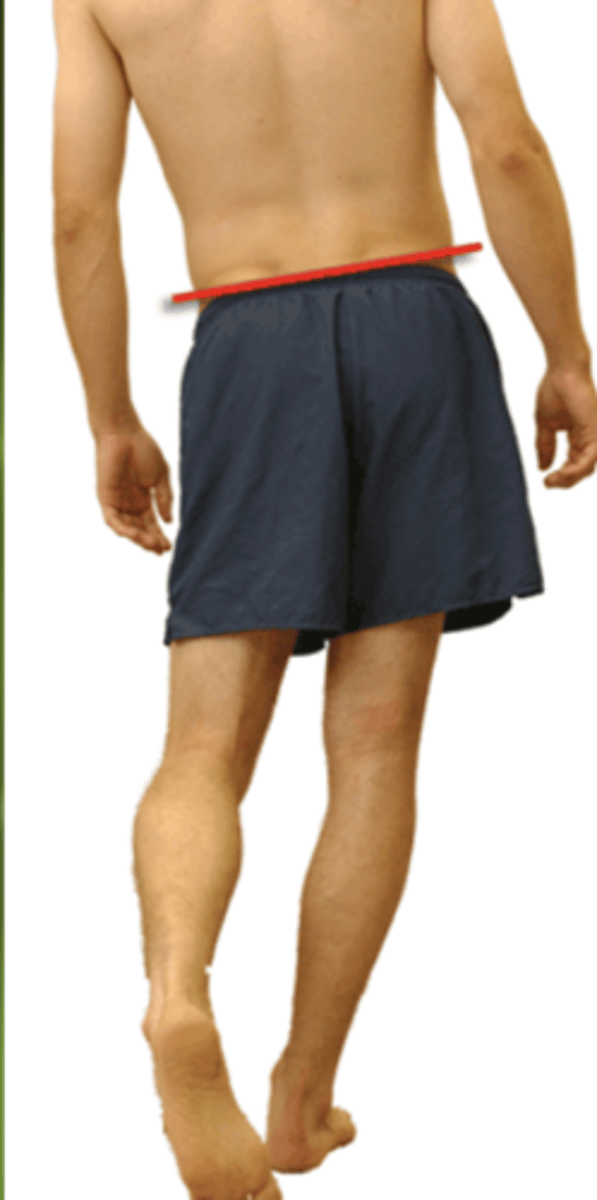
Gluteus Medius Gait
weakness causes pelvis to tilt excessively during single leg stance
result of muscle weakness, not pain
Uncompensated Glut Med Gait
lateral protrusion of pelvis during stance
Steppage gait on contralateral side
Compensated Glut Med Gait
Excess trunk lean (Trendelenberg)
Bilateral weakness - waddling gait
Hemiparetic Gait
Increased LE extensor tone with decreased ankle dorsiflexion and knee flexion
Patient circumducts leg during swing phase
Decreased ankle dorsiflexion leads to decreased heel strike
Stance phase on hemiparetic leg is shortened with decreased weight shift over leg
Spastic Gait
Increased adductor tone at hips pulls knees together
Increased extensor tone creates difficulty advancing legs
Results in circumducted quality to gait
Great effort noted to advance legs
Parkinsonian Gait
Flexed hips, knees, and trunk
Decreased stride length
Decreased base of support
Decreased arm string
Festination
Shuffling
Short, rapid steps
Freezing
Cardiac Rehab Goals
Increased functional capacity
Reduce risk factors
Improve QOL
Improve outlook and emotional stability
Increase knowledge about disease and increase self management
Cardiac Rehab Components
Exercise counseling and training
Education for heart-healthy living
Counseling to reduce stress
Class A Risk - Exercise Training
Healthy
No apparent increased risk of CV complications with exercise
Class B Risk - Exercise Training
Stable heart disease
Low risk for complications with exercise
Class C Risk - Exercise Training
Multiple MIs
Severe angina
Restricted exercise capacity
Mod/high risk of complications with exercise
Class D Risk - Exercise Training
Unstable cardiac disease
Exercise is CI
Phase I Cardiac Rehab
Within 14 days of cardiac event
Hospital - 6 wks post event
Goal: early mobilization and ROM, decrease effects of inactivity
Light activity: should be able to hold a convo during exercise
Phase II Cardiac Rehab
6 wks after cardiac event
Ambulatory setting
Goal: educate patient on how to exercise safely in a structured environment
Often has exercise stress test prior to starting
Phase III Cardiac Rehab
Independent cardiac rehab program
Supervised by PT
2-3x/week
Phase IV Cardiac Rehab
Completely independent exercise in a gym or health club venue
Pulmonary Rehab Indications
Asthma
COPD
Pulm HTN
CF
Pulm Fibrosis
Lung transplant patients
Pneumonia
COVID
Pulm Rehab Goals
Improve pulmonary function
Reduce exacerbations
Educate patients
Improve upper body strength and exercise tolerance
Improve QOL
Pulm Rehab Components
Nutrition education/intervention
Education: smoking cessation, use of inhalers, devices
Breathing retraining -> shallow breathing leads to increase in dead space ventilation
Chest physiotherapy
Airway secretion elim
Supplemental O2
Respiratory Muscle Rest - Components
Noninvasive intermittent positive-pressure ventilation (NVS)
Nocturnal bilevel positive airway pressure (PAP)
Noninvasive intermittent positive-pressure ventilation (NVS)
reduces dyspnea, improves gas exchange, increases minute ventilation, greater exercise tolerance
Nocturnal bilevel positive airway pressure
can normalize ABGs, improve QOL, 12-min walking distance, resp muscle endurance; decrease dyspnea
Resp muscle training
incentive spirometry
inspiratory resistive exercises
Stroke Rehab Goals
Prevent, recognize, and manage risk factors, medical, comorbidities, and secondary complications
Training to achieve maximal independence in functional tasks
Facilitating psychological and social adaptation and coping, by the patient and family
Promoting resumption of prior life roles and reintegration into the community
Improve QOL
PT - Paralysis/Plegia
Maintain passive ROM with stretching and formal strengthening exercises
Training to form ADLs independently
Use of specialized equipment if necessary
PT - Spasticity
Stretching
Proper positioning through splints
Use of vibration or electrical stimulation
Use of oral/injectable meds
Speech Therapy - Stroke Rehab
Aphasia
Dysarthria
Swallowing
Visuo-Spatial training - Stroke Rehab
One-sided neglect
-tendency to ignore one side of the environment or body
-affects approx 1/3 of stroke patients
-Can lead to falls failure to dress/clean a portion of the body, reading impairment
-Teach patient to compensate for neglect via cues and reminders
Cognitive Training - Stroke Rehab
>1/3 of stroke survivors
-Treatment plan tailored to patients' needs
-Attention
-Concentration
-Processing Speed
-Memory
-Executive functions (planning, organizing, sequencing, prioritization, reasoning, problem solving, judgment)
Physical Therapist
-Evaluate and treat pain issues
-Focuses on improving ability to perform movement of the human body
-Evaluate/treat muscle performance
-Evaluate/treat joint structure and function
-Evaluate for assistive devices
-Provide family training and education
-Fall reduction education
-Home assessment
-Education = doctorate degree
Occupational Therapist
-Address ADLs
-Address gross and fine motor skills
-Address visuo-spatial skills
-Address sequencing and planning
-Evaluate for upper extremity orthotics
-Evaluate strength and ROM
-Family training and education
-Education = masters or doctorate degree
Speech Language Pathologist
-Address communication
-Address cognition
-Address swallow function
-Works on oral stimulation and exercises
-Evaluates for adaptive communication devices
-Family training and education
Recreational Therapist
-Address recreational activities
-Evaluate need for adaptive devices to participate in premorbid recreational activities
-Family training and education
Vocational Therapist
-Evaluate work skills
-Develop skills needed for the workplace
-Explore vocational and avocational alternatives
-Assist in job placement