lec 8 - drosohpila part 2
 Call Kai
 Learn
Learn Practice Test
 Spaced Repetition
 Match
Match Flashcards
 Knowt Play
1/59

There's no tags or description
Looks like no tags are added yet.
Name | Mastery | Learn | Test | Matching | Spaced | Call with Kai |
|---|
No analytics yet
Send a link to your students to track their progress
60 Terms
segments
repeated blocks/repeated unis that our body is built from
segmentation
body patterning into segments
segmentation is [variable/conerved]
conserved
importance of the heidelberg screen
first and clearest dissection of how segmentation works
revealed principles that apply far beyond insects
when is the body plan laid out in drosophila
early on in development of pre-fertilized egg
name the axes and the corresponding structure in drosophila
anterior - head
posterior - tail
dorsal - naked cuticle
ventral - cuticle with teeth-like denticles
role of cuticle preps
in-situ hybridization allowed researchers to see gene expression patterns in the embryo
heidelberg screen - researchers didn’t know if the 580 mutation-causing phenotypes were all in different genes. how did they find out
decided to use complementation testing
complementation group
a set of mutations that when crossed to each other, fail to complement and hence are in the same gene
explain how to find complementation groups
cross flies with the same phenotype - they all have single recessive mutations
if the offspring show WT, they complement, meaning they have different gene mutations that lead to the same outcome
the offspring only has one copy of each defective gene
if the offspring shows mutant, they do not complement, meaning that they have the same gene mutation
the offspring has 2 copies of the defective gene
maternal vs zygotic genes - definitions and fxn
maternal
mRNA/proteins deposited in the egg by the mother
establish initial positional info
zygotic
activated by embryo
refine and elaborate body planning
what are the 3 classes of zygotic genes
gap genes
pair rule genes
segment polarity genes
gap genes - mutation phenotype, fxn, example
phenotype = lose a large segment in the body
fxn - define broad regions
ex: knirps
pair rule genes - mutation phenotype, fxn, example
phenotype = lose paired/alternating segments of the body
fxn - refine gap gene domains into repeating units
ex: paired
segment polarity genes - mutation phenotype, fxn, example
phenotype - lose one side of each segment (ex: lose only anterior side)
fxn - refine pair rule segments into anterior and posterior
ex: gooseberry (and also Hh and Wnt!)
heirarchy of refinement
maternal genes → gap genes → pair rule genes → segment polarity genes
types of maternal gene mutations
bicoid - loss of anterior region
nanos - loss of posterior region
torso - loss of terminal regions
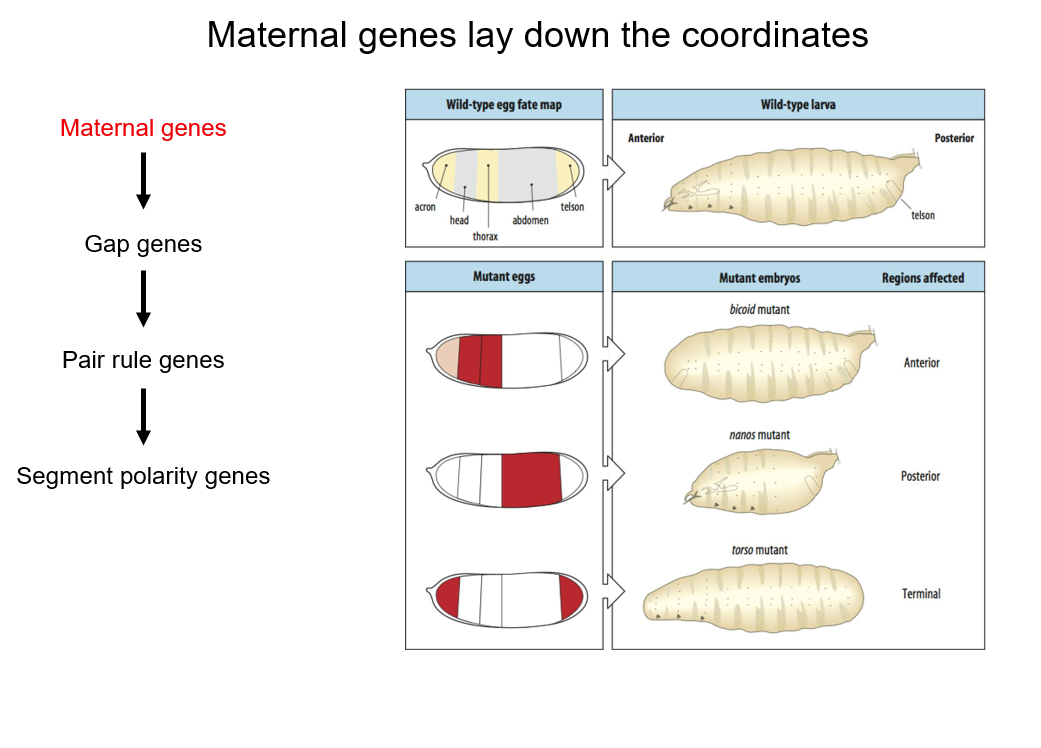
what is bicoid and what does it determine
maternal gene - DNA-binding TF maternally loaded into developing oocyte
determines anterior
how does bicoid pattern the anterior (head)
acts as a morphogen - forms an anterior→posterior gradient
name some experiements that prove bicoid acts as a morphogen
WT anterior cytoplasm injected into anterior bicoid -/- embryos rescues head development
WT anterior cytoplasm injected into middle of bicoid -/- embryos produces ectopic head structures (in the middle) and mirror image thoracic segments
the more bicoid genes you add, the further the segments are pushed back/the larger the anterior head region is
why does injecting bicoid into the middle of a bicoid -/- embryo create 2 heads with mirror-image thoraxes
molecules diffuse both ways, so heads also appear both ways based on the concentration gradient
how is the bicoid gradient read
french flag model
creates regional gene expression domains
lower concentration of bicoid - higher affinity binding sites
high concentration of bicoid - low affiniy binding sites (need high concentration of bicoid to be activated
first class of zygotic segmentation genes
gap genes
how do gap genes know where to activate
read maternal gene gradients to define domains of gene expression
where is hunchback expressed
anteriorly (like bicoid)
where is kruppel located
band in the middle
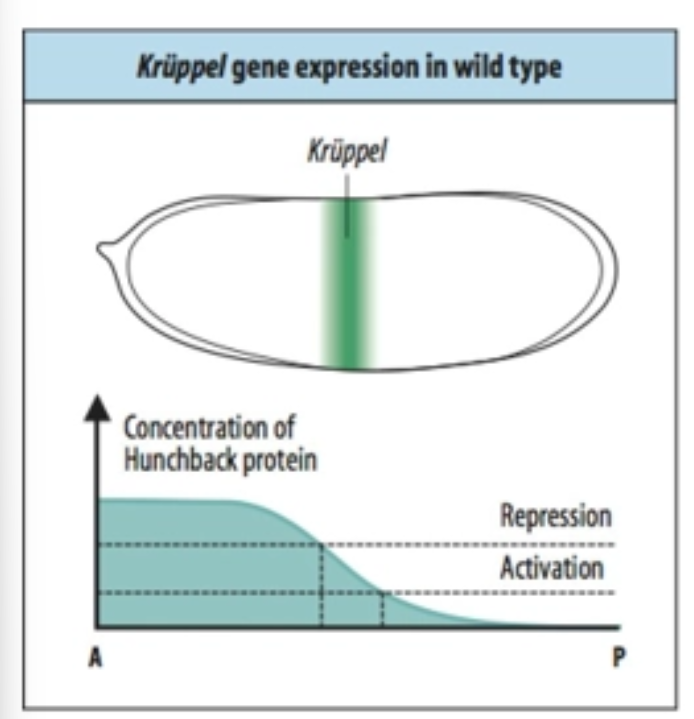
explain how kruppel and hunchback are related
huntchback acts anteriorly, gives an A/P gradient
high hunchback ⊣ kruppel
no hunchback ⊣ kruppel
low hunchback → kruppel
kruppel stays in the middle
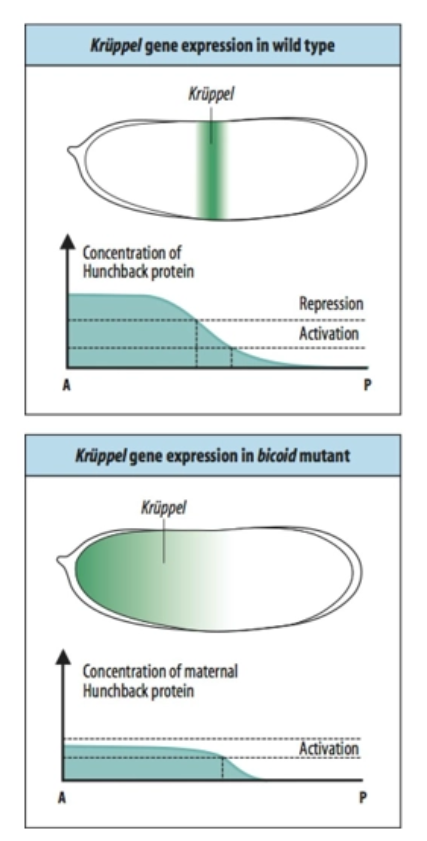
what happens to kruppel expression in a bicoid -/- mutant
bicoid mutation partially inhibits hunchback
low hunchback → kruppel
kruppel is expressed anteriorly
gap genes activate ___ genes
pair rule genes
pair rule genes expression pattern
alternating stripes
expression of pair rule genes is controlled ___
stripe-by-stripe
each pair rule stripe is controlled _____ by _____
independently
a different combo of gap genes
multiple gap genes with different concentrations throughout the embryo - pair rule genes read the specific combination and concentration of gap genes that exist in that stripe area
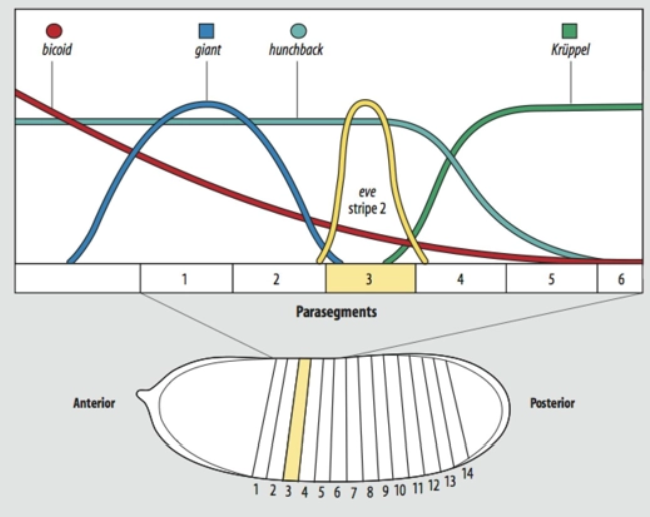
pair rule - stripe formation depends on
interaction between positively and negatively acting TFs
segment polarity genes control
patterning within a segment (anterior/posterior of each segment)
parasegment
the posterior half of one segment + the anterior half of the next consecutive segment.
will later shift to form adult morphological segments
Wg/Wnt mutation
Hh mutation
no segment polarity, every segment has only anterior regions (covered in denticles)
no segment polarity, covered in denticles, end up with spike-like pattern
how are parasegment boundaries formed
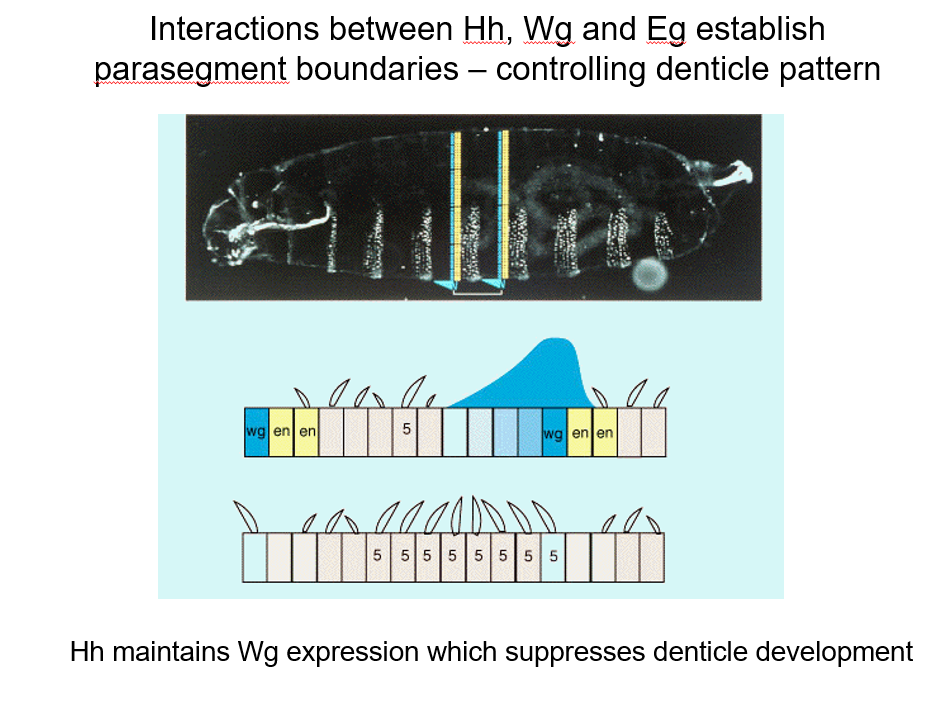
Hh and Wg/Wnt feedback onto each other to maintain each other’s expression and refine segment borders
engrailed stimulates Hh production
how are denticle patterns formed
Hh maintains Wg expression which supresses denticle development - where there is Wg activation, there is no denticles, but engrailed right next to it promotes Hh signaling afterwards
selector genes
give each segment an identity (“who am i” information)
how do selector genes give segments their identity
they are TFs, turn on a bunch of other downstream genes
ex: gene specifying a leg turns on all the downstream genes required for making a leg
key selector genes
hox/homeotic genes
hox genes patterning is
HIGHLY conserved, pattern from A→P in a conserved way
one parasegment is controlled by
a specific hox gene
hox genes are expressed along the anterior body in what order
the same order as genes are within a genome
selector genes are controlled by
combo of gap and pair-rule genes
antennapedia experiment
antennapedia = hox genes for legs
put it in the head, fly produces legs on the head
selector genes v segment polarity genes
same level
segment polarity tells them which way to go, selector tells them what they will become
germ banding
how much of the egg is pre-patterned
large vs intermediate vs small germ band
large = whole is pre-patterned
intermediate = partly pre-patterned, rest of patterning develops during segmentation
short - not pre-patterned (outside of AP/DV)
drosophila is ____ germ band
long
pros and cons of long germ banding
pro - fast development
con - compliacted, maternal/gap/pair rule control for every segment
intermediate germ band insect - how does it pattern itself
start with head and thoracic segments, uses an ancestral version of drosophila
patterns some but not all of egg
add abd segments sequentially
posterior disc buds off over time
what are the receptors/ligands involved in segment addition
notch/delta - activates downstream pathways to make a segment
describe the segmentation clock
negative feedback loop with delay
delta ligand binds/activates to notch (and activates downstream segment patterning pathways)
active notch activates Her (hairy enhancer of split related) which represses delta production
repressed delta turns off notch
delta production starts agin
how does the segmentation clock work
notch activation causes down regulation of delta
time lag in response causes oscillation between strong and weak signaling levels
propagation of signal between cells causes wave of activation
allows for segment addition
what does the delta mutation cause
specification of somite patterns/segmentation clock to get messed up
what type of organisms are the segmentation clock used for
intermediate germ organisms and small germ organisms
intermediate germ - most patterning is set up, with segmentation clock in the tail end
ex: tribloium (and other beetles)
small germ - little to no patterning is set up, segmentation clock happens throughout
ex: strigamia (and other mirapods)
most ____ use segmentation clocks
vertebrates
genes of the _____ pathway create vertebrate bones
notch/delta
notch/delta segmentation clock - when in evolution was it created
a long time ago - ancient evolutionary idea