Developing winning products for emerging markets McKinsey
 Call Kai
 Learn
Learn Practice Test
 Spaced Repetition
 Match
Match Flashcards
 Knowt Play
1/10

There's no tags or description
Looks like no tags are added yet.
Name | Mastery | Learn | Test | Matching | Spaced | Call with Kai |
|---|
No analytics yet
Send a link to your students to track their progress
11 Terms
[to read] Main exam idea
The key idea: in emerging markets, winning products are not just cheaper versions of developed-market products. Companies must challenge assumptions about design, development, and manufacturing because customers are very price-conscious but still demanding.
Small example:
A company cannot just take a European washing machine, remove some features, and sell it cheaper in India. It must ask: What does the local consumer actually need? Smaller size? Less water use? Lower repair cost? Different packaging?
Exam logic:
Do not say: “Emerging-market product strategy = low price.”
Correct: low price + right local value + right features + right cost structure.
[to read abotu locals] Local knowledge is difficult, even for local companies
The Indian truck example is important. The truck was designed for higher utilization, but it failed because the company did not properly account for poor roads and infrastructure. Buyers did not see the benefit as worth the price. Another local truck also failed because customers overloaded it, damaging engines and ruining reliability perception.
Small example:
A truck may be technically efficient at 80 km/h, but if Indian roads make trucks move slowly and stop often, the “efficient design” is not valuable.
Exam trap:
This is not only a “foreign companies misunderstand emerging markets” problem. Even domestic companies can misunderstand local usage.
Core concept: “design to value”. Name 3 lessons
“Design to value” means designing the product around what customers truly value and what they are willing to pay for, instead of blindly copying existing global products. The article gives 3 lessons:
Shake up your thinking.
Start from scratch.
Design for manufacturability.
Small example:
If consumers care most about battery life, do not spend money improving the screen, packaging, and extra features. Focus resources on battery life and remove low-value costs.
Lesson 1.1: Shake up your thinking
Because emerging markets change fast, traditional research can be too slow or expensive. Companies should use collision workshops: meetings where suppliers, marketers, engineers, and other people discuss customer problems together. The point is to break normal thinking and generate better hypotheses.
Small example from the reading:
A wheel manufacturer learned that customers saw its wheels as too heavy. Engineers then used better steel, made the wheels lighter, used less material, and reduced total costs.
Exam logic:
The important part is not the wheel itself. The important part is: customer insight + cross-functional discussion = better product design.
Lesson 1.2: Look outside your own industry
Companies can get product ideas from adjacent industries, not only from direct competitors. A fan maker copied painting techniques from the automotive industry and saved 4% in paint costs. A farm-equipment company copied ideas from another vehicle category to make a rice-transplanting machine simpler and cheaper.
Small example:
A low-cost appliance company may learn packaging or coating methods from car manufacturers, even though cars are not its direct competitors.
Exam trap:
Innovation in emerging markets is not always high-tech. Sometimes it is a small process/design change that reduces cost without hurting customer value.
Lesson 2.1: Start from scratch
The article strongly rejects the idea of selling stripped-down global products. Top companies identify the one or two features that matter most and focus on them. They do not treat all features as equally important.
Small example:
For small farmers, tire durability mattered most because they drove on both roads and soil. So the company redesigned the tires instead of adding unnecessary extra features.
Exam logic:
Good emerging-market product design asks:
“What feature creates the most value for this local customer?”
Not:
“How do we make our global product cheaper?”
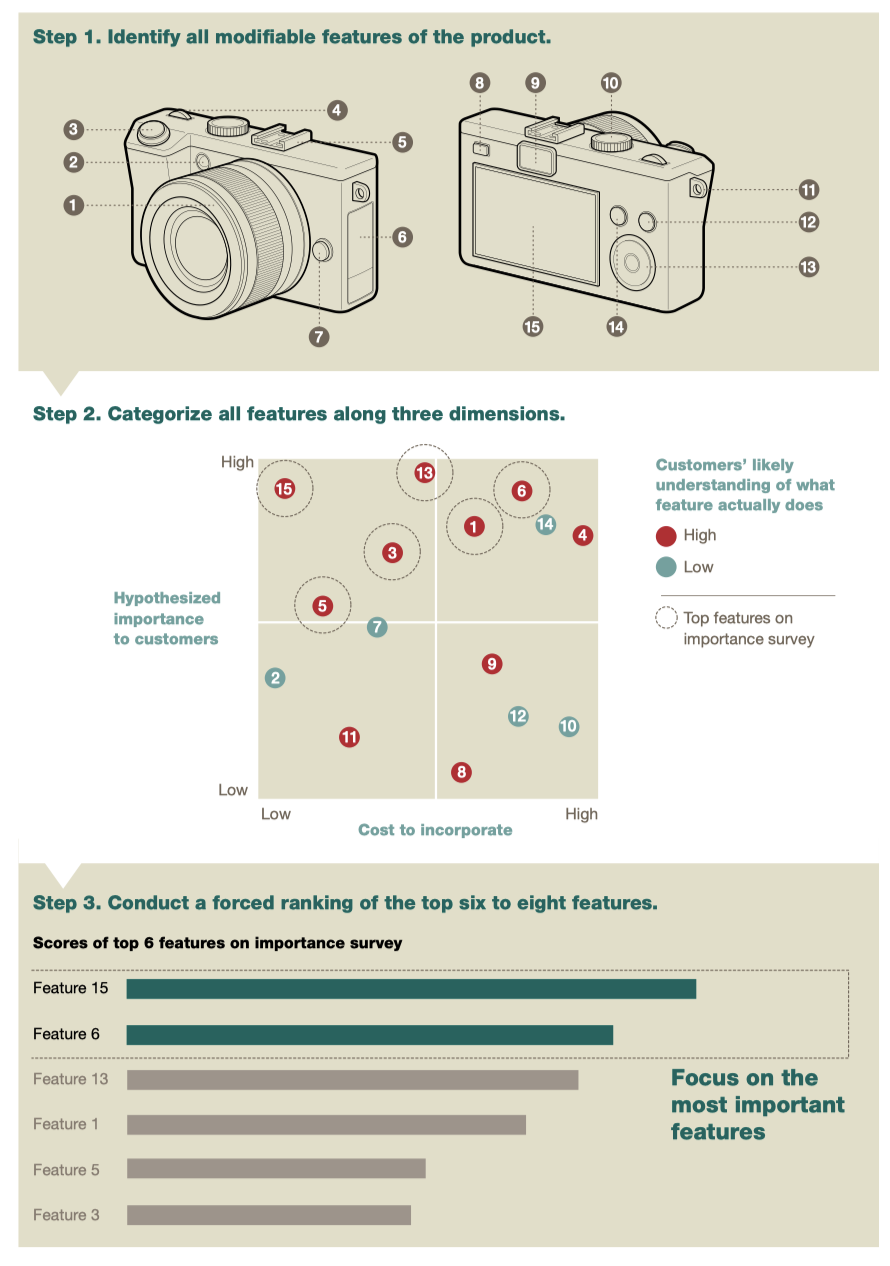
Lesson 2.2: Feature prioritization framework
Identify all modifiable features.
Categorize features by customer importance, cost to incorporate, and customer understanding.
Force-rank the top 6–8 features and focus on the most important ones.
Small example:
For a camera, customers may care about battery life and image quality but not understand or value a complex technical sensor feature. So the company should not spend too much cost on the feature customers do not value.
Exam trap:
More features ≠ better product.
In emerging markets, unnecessary features can destroy affordability.
Lesson 2.3: Technical superiority can fail if it does not match market value
The electrical mini-circuit-breaker example is important. The product was technically better for India’s power fluctuations, but customers preferred older, cheaper “use and throw” fuse technology. The company had to redesign using older technology to become competitive.
Small example:
A safer, advanced device can fail if customers see it as too expensive or too complicated compared with a cheap replacement product.
Exam logic:
Technically better does not always mean commercially better.
Lesson 2.4: Zero-based design
Zero-based design means redesigning the product from the ground up instead of adjusting the existing product. In the article, a global consumer-products company discovered that a local competitor had a cheaper formulation with the same effectiveness. After redesigning formulation, packaging, and pump bottle, the company improved margin by 40%.
Small example:
Instead of discounting shampoo, redesign the formula, bottle, and dosage so it gives the same result at lower cost.
Exam trap:
Zero-based design is not “cut quality.”
It means remove unnecessary cost while keeping the value customers actually care about.
Lesson 3: Design for manufacturability
Companies must design products with local manufacturing realities in mind. This means changing the product so it is easier and cheaper to produce locally, while still meeting customer and safety needs.
Small example from the reading:
A company changed the design of a drive-shaft assembly so it could be produced with cheaper hot-forging equipment instead of expensive cold-forging machines. This reduced material costs by 10% and allowed more local sourcing.
Exam logic:
Product adaptation is not only about the consumer-facing product. It also includes the manufacturing process.
[to read] Final
For emerging markets, companies should not simply sell cheaper, stripped-down versions of global products. They need design to value: understand what local customers truly value, prioritize only the most important features, and remove unnecessary costs. The reading’s 3 key lessons are: shake up your thinking, start from scratch, and design for manufacturability. The main exam logic is that emerging-market customers are highly price-conscious but still demanding, so success depends on matching local usage, infrastructure, purchasing power, and manufacturing realities—not just lowering the price.