chem sem 2
 Call Kai
 Learn
Learn Practice Test
 Spaced Repetition
 Match
Match Flashcards
 Knowt Play
1/64

There's no tags or description
Looks like no tags are added yet.
Name | Mastery | Learn | Test | Matching | Spaced | Call with Kai |
|---|
No analytics yet
Send a link to your students to track their progress
65 Terms
moles to moles
multiply by mole ratio
grams to grams
divide by molar mass a , mole ratio, multiply by molar mass b
liters to liters
divide by 22.4, mole ratio, multiply by 22.4
particles to particles
divide by avogrados number, mole ratio, multiply by avogadros number
just remember abt mole maps
converting to moles, moles on top, converting to other, moles on bottom
percent yield
actual / theoretical x 100
how to find empirical formula
perent to mass'
mass to mole
divide by small
multiply till whole
how to find molecular formula
calculate empirical formula
divide molar mass by emp formula
multiply # by each subscript of emp formula
finding limiting reactant, finding product from limiting
balance equation
pick reactant and convert to other (a —> b)
mol b needed> mol b given, b is limiting
mol b needed< mol b given, a is limiting
mol limiting reactant (in problem) —> mol product
mol product —> g of product
acids
dissolves in water to contain more H+ ions
acid properties
ph below 7
sour taste
react w metal to produce hydrogen gas
react. w bases to produce salt and water
will turn blue litmus paper red
can corrode metals and burn skin
bases
dissolves in water to produce more hydroxide ions OH-
base properties
ph above 7
bitter taste
slippery feel
can neutralize acids
turn red litmus paper blue
can corrod metals and burn skin
neutral substance
substance that is neither acidic nor basiic, containing ewual # of H+ ions and OH- ions. will be exactly ph 7
arrhenius acid
produces hydrogen ions H+ in water
arrhenius base
produces hydroxide ions OH- in water
bronsted lowry
acid: donates protons
base: accepts protons
general neutralization reaction
occurs when equimolar solutions of acids and bases react and create neutral solution
acid + base —> salt + water
logarithm
power to which a number (base) to produce given #. based on power of 10
titration
process of adding known amt of solution to known concentration, determines concentration of another solution
point of neutralization
point of titration
equivalence point
when # of moles of hydrogen same as moles of hydroxide
standard solution
solution of known concentration, indicators used to determune when enough standard solution added
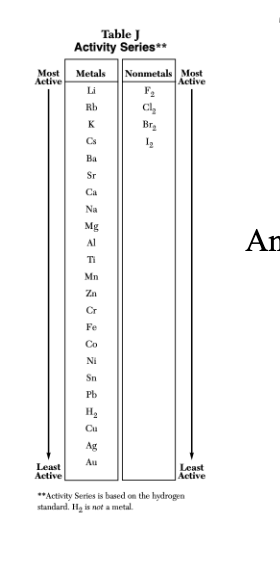
how does table J work
Table J, ranks elements based on their chemical reactivity, allowing you to quickly predict if a single replacement reaction will spontaneously or nonspontaneously
Metals ranked from most active (top) to least active (bottom)
An uncombined metal will spontaneously replace a mental ion in a solution if it is higher on the table than the metal it is replacing.
If the single element is lower the reaction is not spontaneous
electrochemical cells
Electrochemical cells are a device where redox reactions may produce electrical energy, or in which electrical energy is used to produce a chemical reaction.
anode
The electrode at which Oxidation occurs
Spontaneously loses electrons
Salt bridge prevents the build up of charge (Balance charges)
cathode
The electrode at which Reduction occurs.
Spontaneous reactions
Cathode: less active
Spontaneously gains electrons
Electrolyte
a conductive solution inside which the electrodes are immersed.
electrode
an electrical conductor that connects the metallic parts of a circuit to a non-metallic part of a system
Salt bridge
allows for a flow of ions between two cells, Electrons flow from anode to cathode
voltaic/galvonic electrochemical cell
Works when an externally applied current drives non– spontaneous chemical reactions (Uses spontaneous redox reaction to generate electrical current) (similar to a battery)
The salt bridge is a kind of electrochemical cell called a galvanic cell
electrolytic
world when an externally applied current dries non- spontaneous chemical reactions (Similar to a car alteration) Measured in volts
Both has anode and cathode
Electrolysis is a nonspontaneous, induced redox reaction in an electrolytic cell.
The reaction will not move forward unless you add energy
properties of gases
low density
highly compressive
lots of empty space
expand or contract
pressure units
1 atm = 101.325 KPa
1 atm = 101,325 pascals
1 atm = 760 mmHg
1 atm = 760 torr
boyles law
P1V1=P2V2
temp = constant
pressure increase as volume decrease
charles law
V1 / T1 = V2 / T2
pressure = constant
temp increases as volume increases
gay-lussacs law
P1 / T1 = P2 / T2
volume = constant
temp increases as pressure increases
avogadros law
V1 / n1 = V2 / n2
temp + pressure = constant
n = moles
combined gas law
P1V1 / T1 = P2V2 / T2
ideal gas law
PV = nRT
R = 0.0821 (gas constant)
n = moles
daltons law of article pressure
Dalton's law is that the total pressure of a gas mixture equals the sum of each gas’s pressure.
Formula: Ptotal = P1 + P2 + P3 ….
EX: If a tank has nitrogen = 78 kPa, oxygen = 21 kPa, carbon dioxide = 2 kPa
The Total pressure: 78 + 21 + 2 = 101 kPa
kinetic molecular theory
Explains why gasses behave the way they do
Gas particles move constantly and randomly.
Gas particles travel in straight lines until they collide.
Gas particles are very small compared to the space between them.
Gas particles have no strong attractions or repulsions.
Collisions are elastic, meaning no net energy is lost.
Temperature measures average kinetic energy.
Main idea: higher temperature = faster particles = more kinetic energy
organic chemistry
study of structure + properties of compounds containing carbon
functional groups
branch of elements that give an organic compound chemical and physical properties
alcohols
contains -OH at any end. name ends in “ol”
carboxylic acid
contains C=O bond. Name ends in “oic acid”
ketones
C=O bonds located between carbons. name will end in “one”
Aldehyde
carbonyl group at the end of molecule. name will end in “al”
ether
oxygen placed between carbon atoms. name end in “ether”
ester
made of carbonyl group with an adjacent oxygen. name will end in ester
amine
has nitrogen at its center. can be primary, secondary, or tertiary
hydrocarbon (saturated and unsaturated)
chemical compound consisting entirely og hydrogen and carbon
saturated: consists of only one single carbon-carbon bond
unsaturated: at least one double or triple bond between carbon
alkane
saturated hydrocarbon, not very reactive since consists only single bonds
rules to naming an alkane
parent chain
identify alkyl groups attatched
# chain so attatched groups have lowest possible #’s
use prefixes to indicate amt of attatched groups
list diff substitutents in alphabetical order'
certain prefixes ignored (-di -tri - tetra, secondary +tertiary)
hydrocarbon prefixes
1- meth 2- eth
3- prop 4- but
5- pent 6- hexa
7- hepta 8- oct
9- non 10- dec
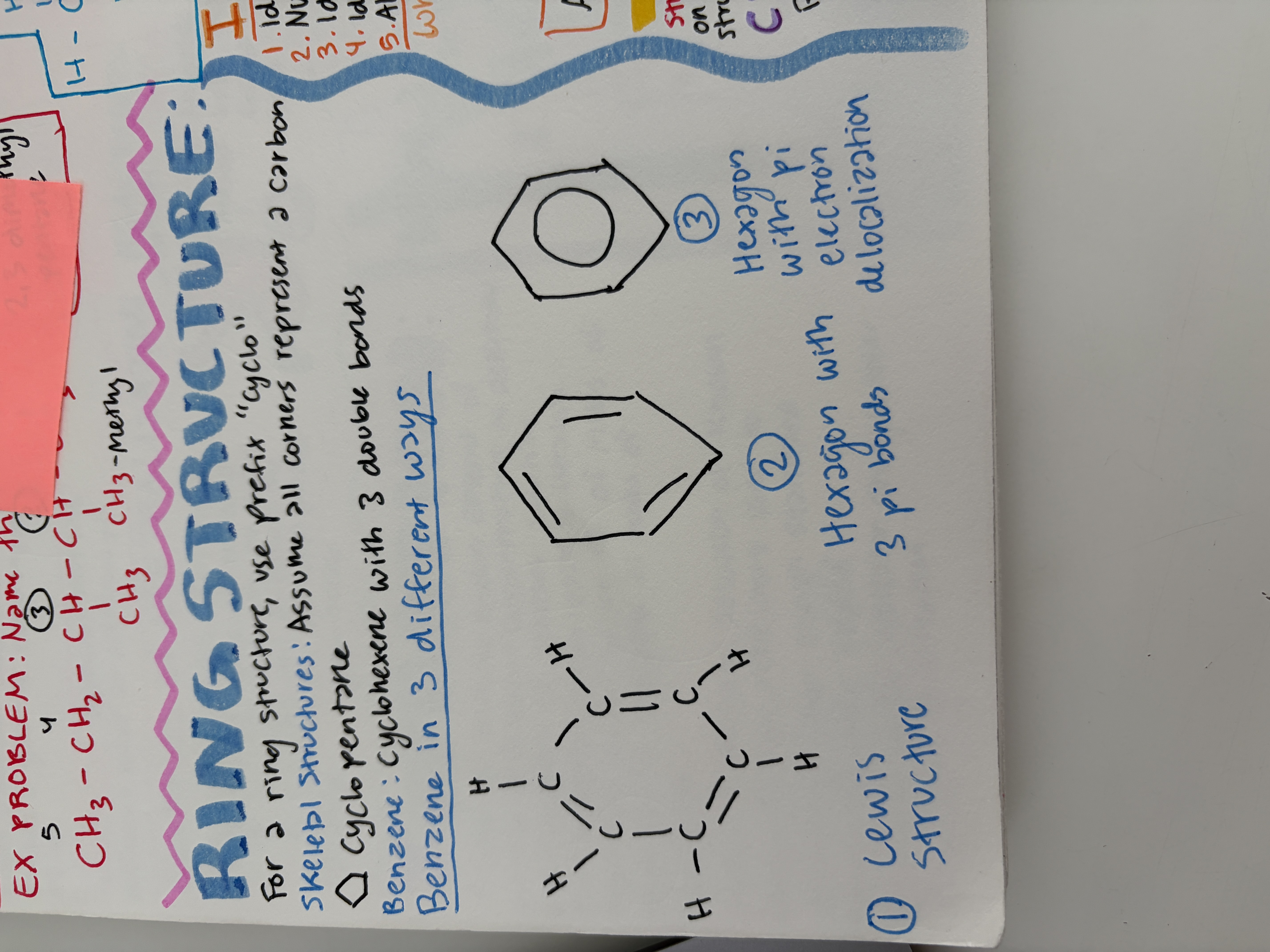
ring structure
IUPAC rules
identify parent chain
number chain
identify suffix
identify substitutents
alphabetitize and assemble
alkene vs alkyne
alkene: unsaturated double bonds
alkyne: unsaturated triple bonds
structural isomer
can take on more than one unique structural formula
geometric isomer
cis- same side
trans- opposite side
Alkyl group
Made of Carbon and Hydrogen, also defined as an alkane that is missing 1 hydrogen
Methyl
A fundamental, stable functional group in organic chemistry, consisting of one carbon atom bonded to three hydrogen atom
Ethyl
A functional group containing two carbon atoms (-CH₂CH₃) derived from ethane. It is not a standalone chemical itself but rather a building block that attaches to larger molecules
amide
consists of carbonyl (C=O) directly bonded to a nitrogen atom (MUST HAVE OXYGEN DOUBLE BONDED RIGHT NEXT TO NITROGEN)
how to write half reactions
Reduction - half reaction (Gaining electrons)
Fe+3 + 3e- Fe
Oxidation half reaction (losing electrons)
Fe Fe+3 + 3e-