Lecture 2 Species
 Call Kai
 Learn
Learn Practice Test
 Spaced Repetition
 Match
Match Flashcards
 Knowt Play
1/44

There's no tags or description
Looks like no tags are added yet.
Name | Mastery | Learn | Test | Matching | Spaced | Call with Kai |
|---|
No analytics yet
Send a link to your students to track their progress
45 Terms
Species Diversity
a measure of all the various species within an area, community, or region
Species have ___ ___, both within and among populations
genetic diversity
T/F: All species are not created equal
True
Do members in a species share a vast majority of their genetics?
Yes
What does natural selection act on and how?
An individual.
If they can survive and be successful they will reproduce.
An individual can acclimate, but can not adapt
Population
A group of individuals of the same species occupying a specific area and time
Do individuals in a population have a high or low potential to interact with one another
high
T/F Individuals in a population or genetically similar
T
Populations are long-lasting ___ and are capable of ___ and ___
entities
change and adaptation
Species in the simplest sense are?
different kinds of organisms
Individuals of the same species share genetic similarity and can potentially interbreed
A species has a ____ ____ and is often comprised of ____
geographic range, populations
Who created taxonomy and when?
Carolus Linnaeus (1707-1778)
What is binomial nomenclature?
Hierarchical organization of life based from most to least inclusive.
What are the 8 levels of hierarchical organization of life and what is their order?
Domain, Kingdom, Phylum, Class, Order, Family, Genus, Species
Dear Kim Please Come Over For Gay Sec
Do Keep Pots Clean Or Family Gets Sick
What are the three Domains?
Eukaryota
Bacteria
Archaea
What does the Eukarya domain include?
Animalia, Plants, Fungi, and Protists
(Meat, Potatoes, Mushrooms, and the little things that you can’t eat)
What is the different between the taxonomy of a black bear and brown bear?
Black bear: Ursus americanus
Brown bear: Ursus arctos
List out the taxonomy levels of a brown bear
Domain: Eukarya
Kingdom: Animalia
Phylum: Chordata - backbone
Class: Mammalia
Order: Carnivora
Family: Ursidae (Family of bears)
Genus: Ursus (True bears, not including panda)
Species: Ursus arctos (brown bear)
List the taxonomy of a wolf
Domain: Eukarya
Kingdom: Animalia
Phylum: Chordata - backbone
Class: Mammalia
Order: Carnivora
Family: Canidae (Family of dogs)
Genus: Canis
Species: Canis lupus
List the taxonomy levels for a human
Domain: Eukarya
Kingdom: Animalia
Phylum: Chordata - backbone
Class: Mammalia
Order: Primates
Family: Hominidae (Family of Great Apes)
Genus: Homo
Species: Homo sapiens (wise man)
What is homology? Give an example
Possessing extensive homologies such as characters (traits) shared from their common ancestor
Ex: Polar bear (Ursus maritimus) and Brown bear (Ursus arctos)
What is the morphological species concept
A group of individuals that is morphologically (form or structure) or physiologically distinct from other groups in some important characteristic
Ex: Polar bears and brown bears are different species due to their own traits
** What is the Biological Species Concept and who was it coined by?
Ernst Mayr (1940)
Species are groups of actually or potentially interbreeding populations which are reproductively isolated from other such groups
What is the problem with the Biological Species Concept meaning?
this concept means that two species are the same and not separate species if they were to interbreed and have shared alleles.
Ex: A polar bear and brown bear breeding a grolar bear
Species are branches in ___ __ ____
lines of decent
Who thought that species were evolutionary lines of descent
Charles Darwin (1859)
T/F: All species will eventually go extinc. Explain why
T
The vast majority of species have gone extinct. What is left is new species from their lineage
Species are usually composed of groups of populations each having ____ and _____ _____
spatial and temporal cohesion
How does the spatial and temporal cohesion define a species?
As an evolving entity with a definitive beginning and end/ place of origin and a final refuge
What do sexual species show and what does it mean?
genetic reticulation - pattern of genetics exchanged, often every generation
Define speciation
the process whereby two or more species evolve from single ancestral population
What does speciation represent?
a process of splitting (cladogenesis - create of new clade or group) in the reticulation
Is separation in speciation always a clean split?
No
Who actually coined the idea for evolution and natural selection and was the father of biogeography?
Alfred Russel Wallace
What is the evoluntionary species concept? Prof does not like this one
An entity, composed of organisms, that maintains its (genetic) identity from the such entities through time and over space, and that has its own independent evolutionary fate and historical
What is a reticulated species
a species that is derived from two species. Common in flowering plants, but also occurs in animals.
Ex: a different colored flower that reproduces through asexual reproduction to make more of its own species.
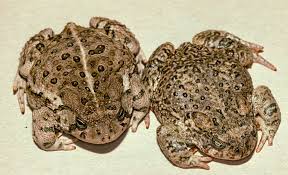
What is the given example of a reticulated species?
The hybridization of Woodhouse toads and Arizona toads
Name the three species concepts and what is the problem with them?
Morphological species concept
Biological species concept
Evolutionary species concept
Forming separate evolutionary lineages where it take a while to form separately is a problem.
What are the taxonomic units below the species level? Hint: 6
Varity
Ecotype
Phylogroup
Evolutionary significant unit
Subspecies
Distinct population segment
Who uses variety as a taxonomic unit?
Use by plant taxonomists or botanists
Who uses ecotype as a taxonomic unit?
used by mostly ecologists
Who uses phylogroup as a taxonomic unit?
used by phylogeographers. it identifies genetic pattern differences
Who uses evolutionary significant unit as a taxonomic unit?
Craig Moritz, but it was considered wrong by many and pissed lots of people off
Who uses subspecies as a taxonomic unit?
used by animal taxonomists/ biologists
what is the distinct population segment regulation and who implemented it ?
Implemented by the US Fish and Wildlife Service in 1973.
“A vertebrate population (mammal, bird, reptile, amphibian, fish) or group of populations that is discrete from other populations of the species and significant in relation to the entire species.