BIOC 4331 Lecture 45-46 (AA Catabolism and Urea Cycle)

0.0(0)
Studied by 0 people
call kaiCall Kai
learnLearn
examPractice Test
spaced repetitionSpaced Repetition
heart puzzleMatch
flashcardsFlashcards
GameKnowt Play
Card Sorting

1/30

encourage image

There's no tags or description

Looks like no tags are added yet.

Last updated 12:59 AM on 5/3/26
Name
Mastery
Learn
Test
Matching
Spaced
Call with Kai

No analytics yet

Send a link to your students to track their progress

31 Terms

1
New cards
What are nitrate assimilation and nitrogen fixation?
  • Nitrate assimilation = NO3 → NH4+ in plants/fungi/bacteria

  • Nitrogen fixation = N2 → NH4+ by prokaryotes only

  • Animals cannot do either and depend on plants/microbes for organic nitrogen
2
New cards
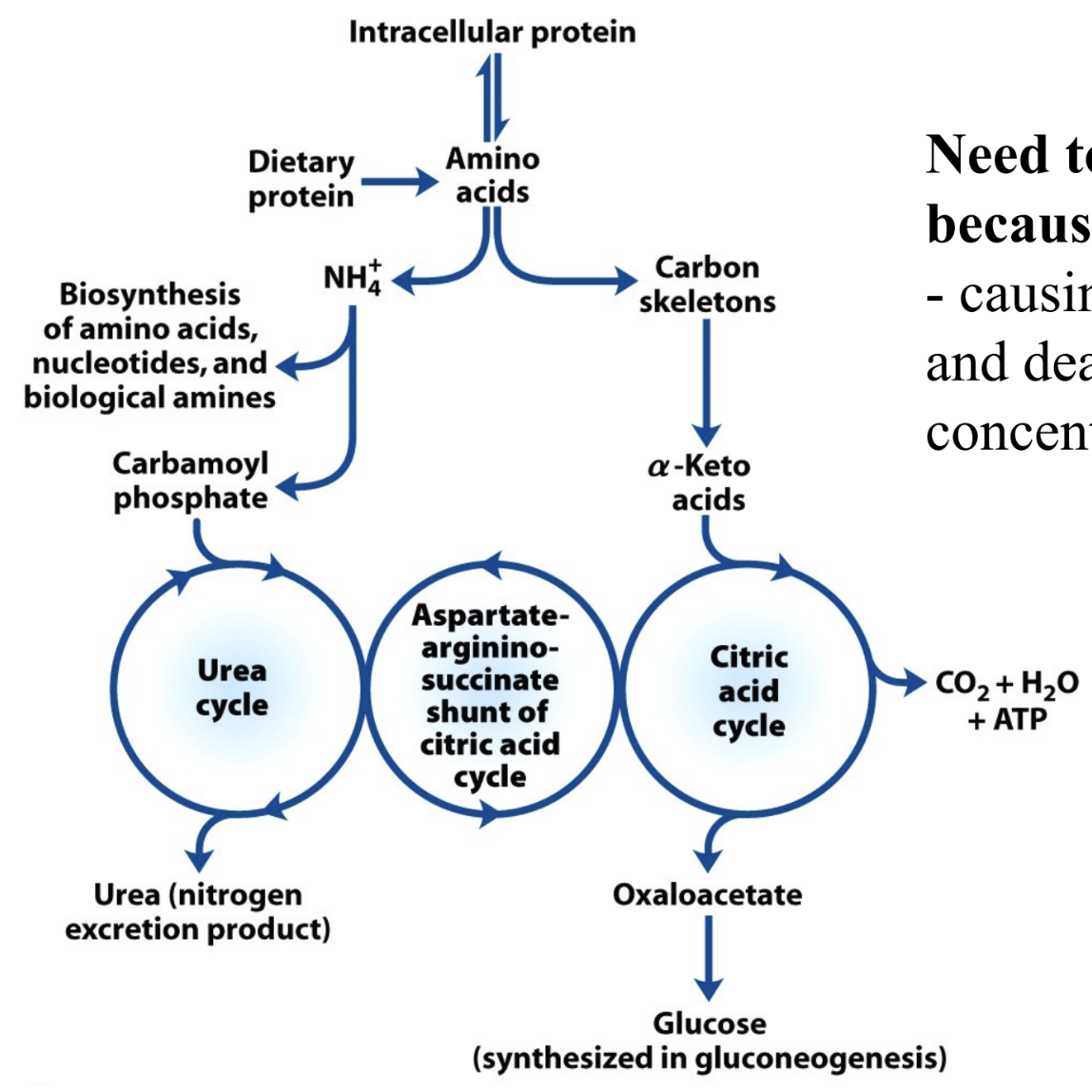
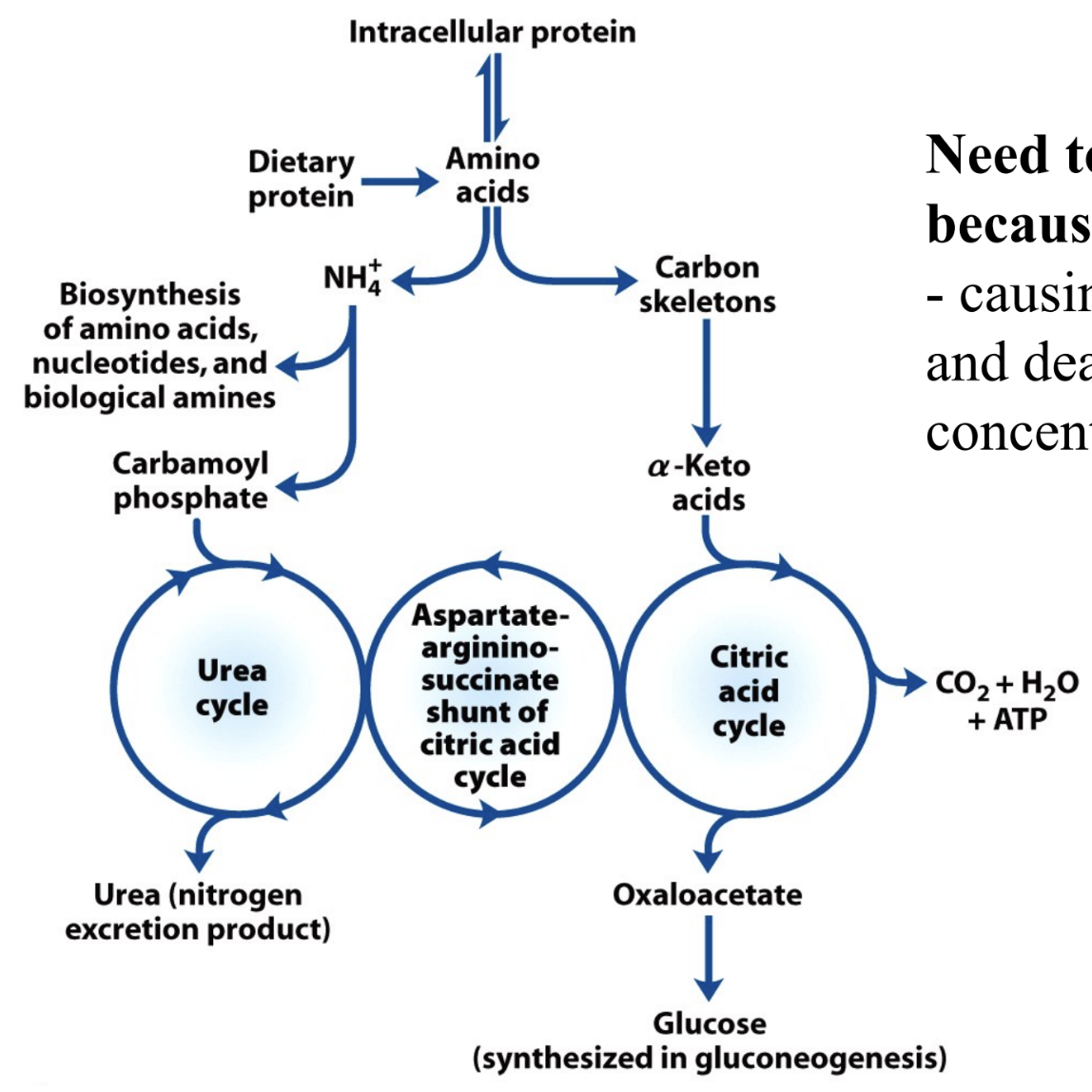
Why must mammals detoxify NH4+?
  • NH4+ is toxic → cerebral edema, coma, death

  • Mammals convert excess amino nitrogen mainly into urea for urine excretion
3
New cards
What are the two fates of amino acid catabolism?
  • Amino group → NH4+ → urea

  • Carbon skeleton α-keto acidsTCA cycle → for energy, glucose, or fat/ketones
4
New cards
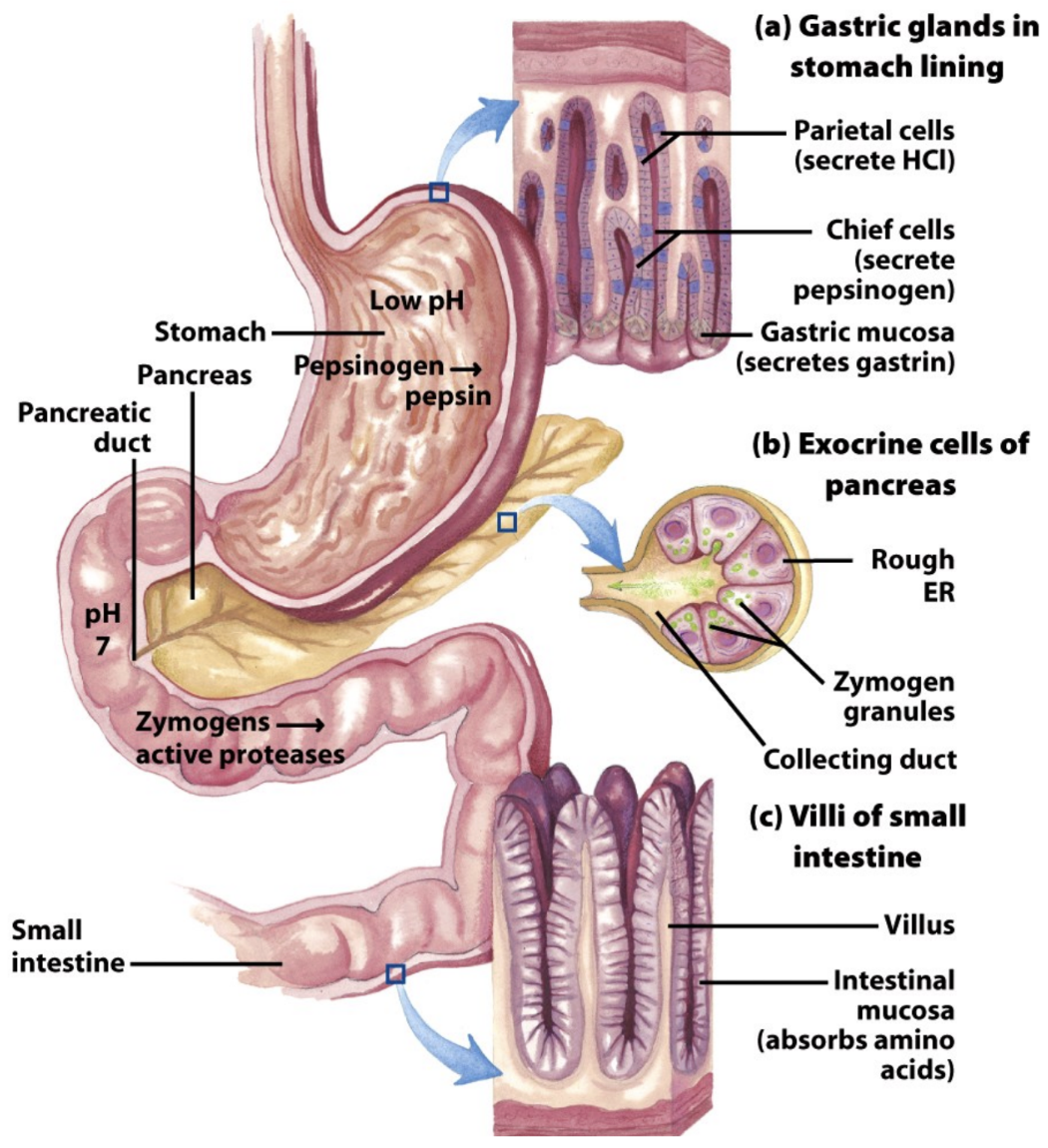
How does protein digestion work?
  1. Protein causes release gastrinparietal cells secrete HCl + chief cells secrete pepsinogen

  2. Acid activates pepsin

  3. Secretin released into blood → Triggers pancrease to release HCO3into intestine (neutralize pH)

  4. Pancreatic protease zymogens digest proteins

  5. AAs absorbed by transporters

5
New cards

Why are digestive proteases secreted as zymogens, and what causes acute pancreatitis?

  • Zymogens prevent autodigestion

  • Acute pancreatitis = blocked pancreatic duct → zymogens activate into active enzymesproteases digest/degrade pancreas

6
New cards
<p>Where are amino groups mainly <strong>metabolized</strong>, and which AAs are key?</p>

Where are amino groups mainly metabolized, and which AAs are key?

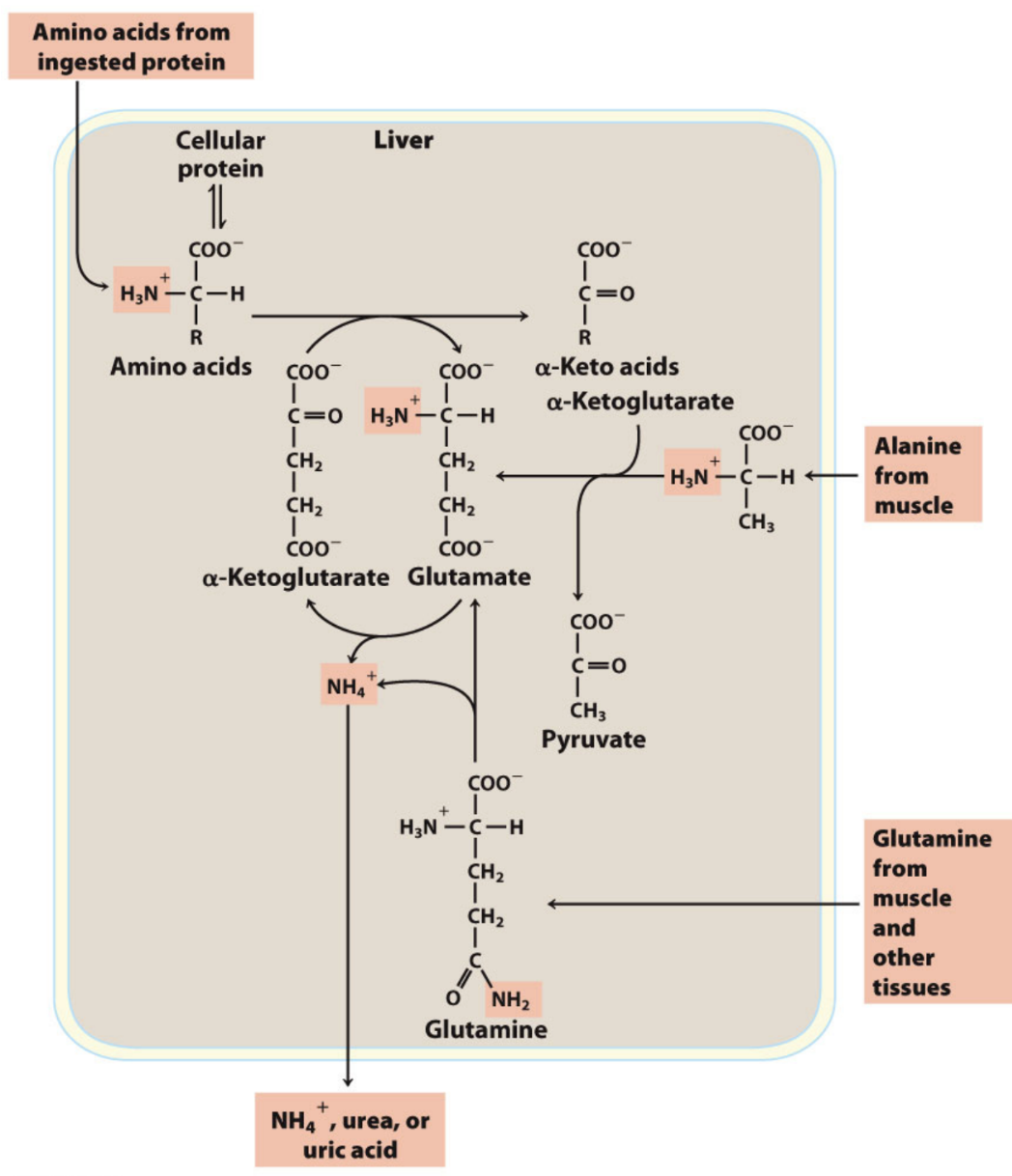
  • Liver

  • Glutamate (E), glutamine (Q), alanine (A), and aspartate (D)
7
New cards
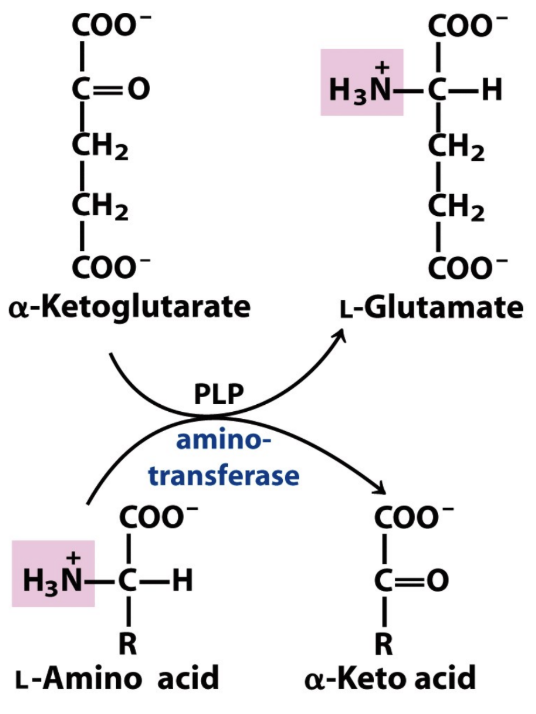
What is transamination?
  • Reversible aminotransferase reaction transferring amino groups to α-ketoglutarate → glutamate + α-keto acid

  • Enzymes named by donor

8
New cards
<p>What cofactor do aminotransferases use?</p>

What cofactor do aminotransferases use?

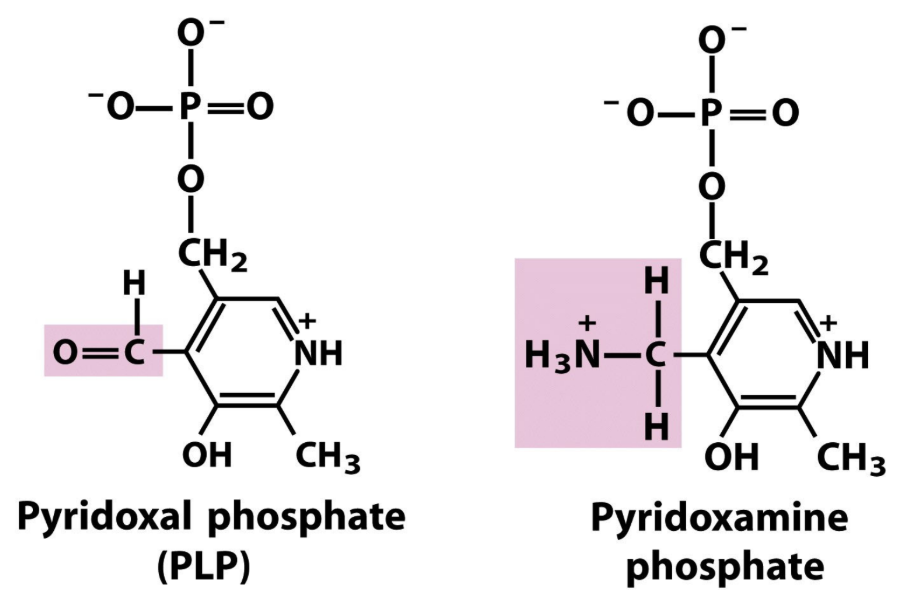
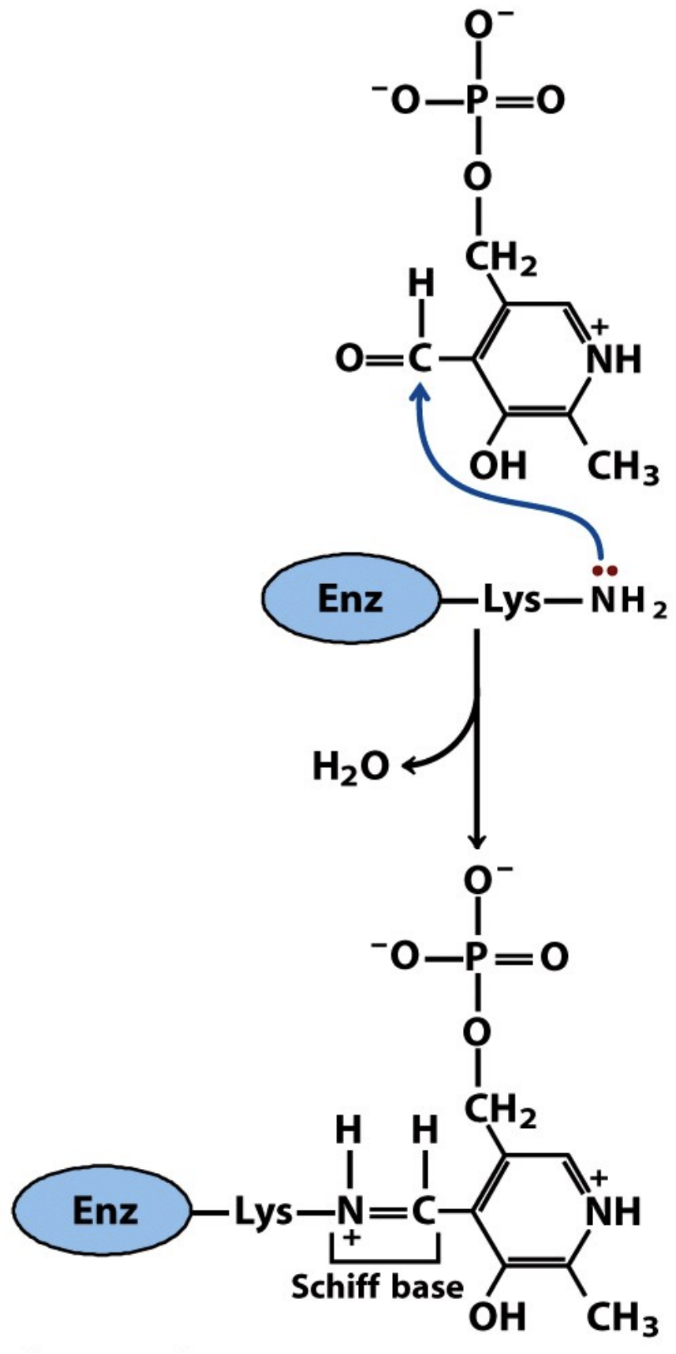
  • Pyridoxal phosphate (PLP), the vitamin B6/pyrido-xine coenzyme

    • Prosthetic group of aminotransferases

  • PLP binds enzyme Lys by Schiff base linkage and becomes PMP after accepting an amino group
<ul><li><p><strong>Pyridoxal phosphate (PLP)</strong>, the <strong>vitamin B6/pyrido-xine</strong> coenzyme</p><ul><li><p><strong>Prosthetic group of aminotransferases</strong></p></li></ul></li></ul><ul><li><p>PLP binds enzyme Lys by <strong>Schiff base linkage</strong> and becomes PMP after accepting an amino group</p></li></ul><p></p>
9
New cards
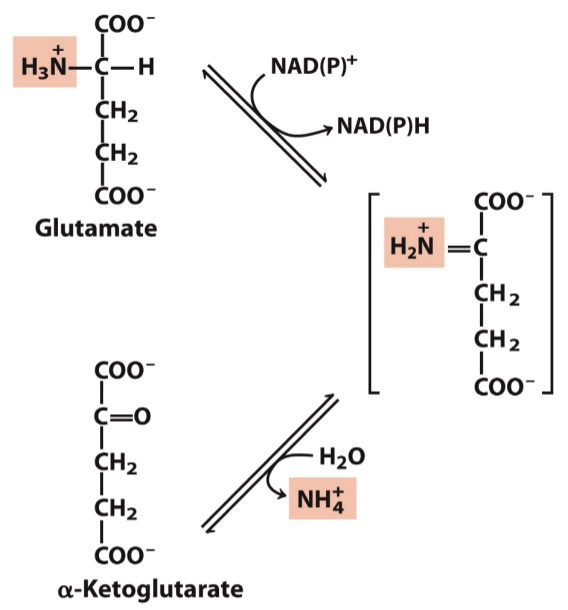
Why is glutamate central in nitrogen metabolism?

Glutamate collects amino groups and acts as a universal amino donor
10
New cards
What does glutamate dehydrogenase do?
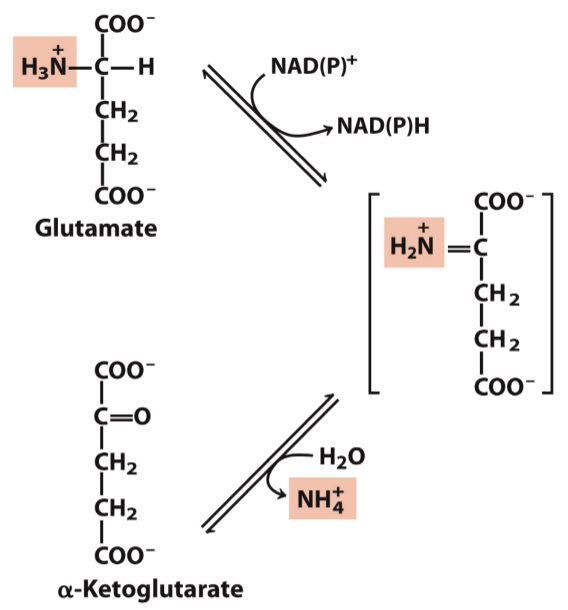
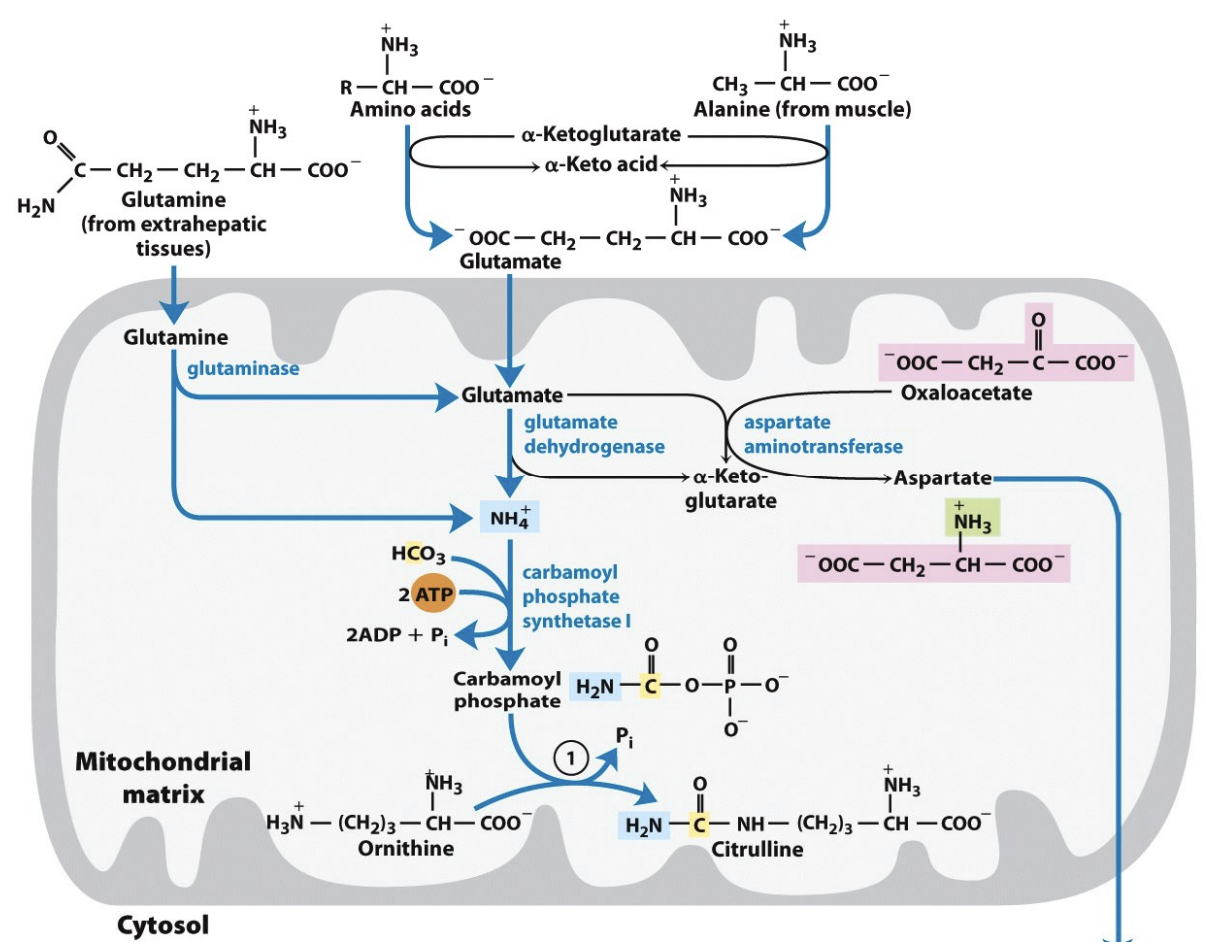
  • In liver mitochondria, oxidative deamination: glutamate → α-ketoglutarate + NH4+

  • Can use either NAD+ or NADP+ as the cofactor
11
New cards
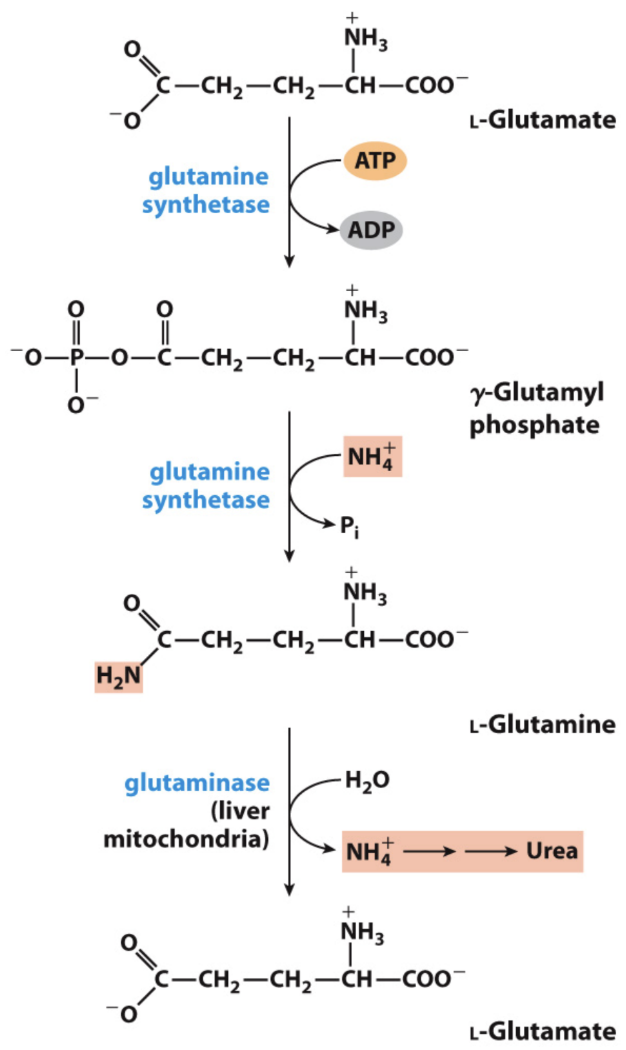
<p>How is ammonia safely transported from most <strong>tissues</strong>?</p>

How is ammonia safely transported from most tissues?

  • Excess NH4+ + glutamate → glutamine by glutamine synthetase

  • Glutamine travels to liver

  • Liver mitochondrial glutaminase releases NH4+
12
New cards
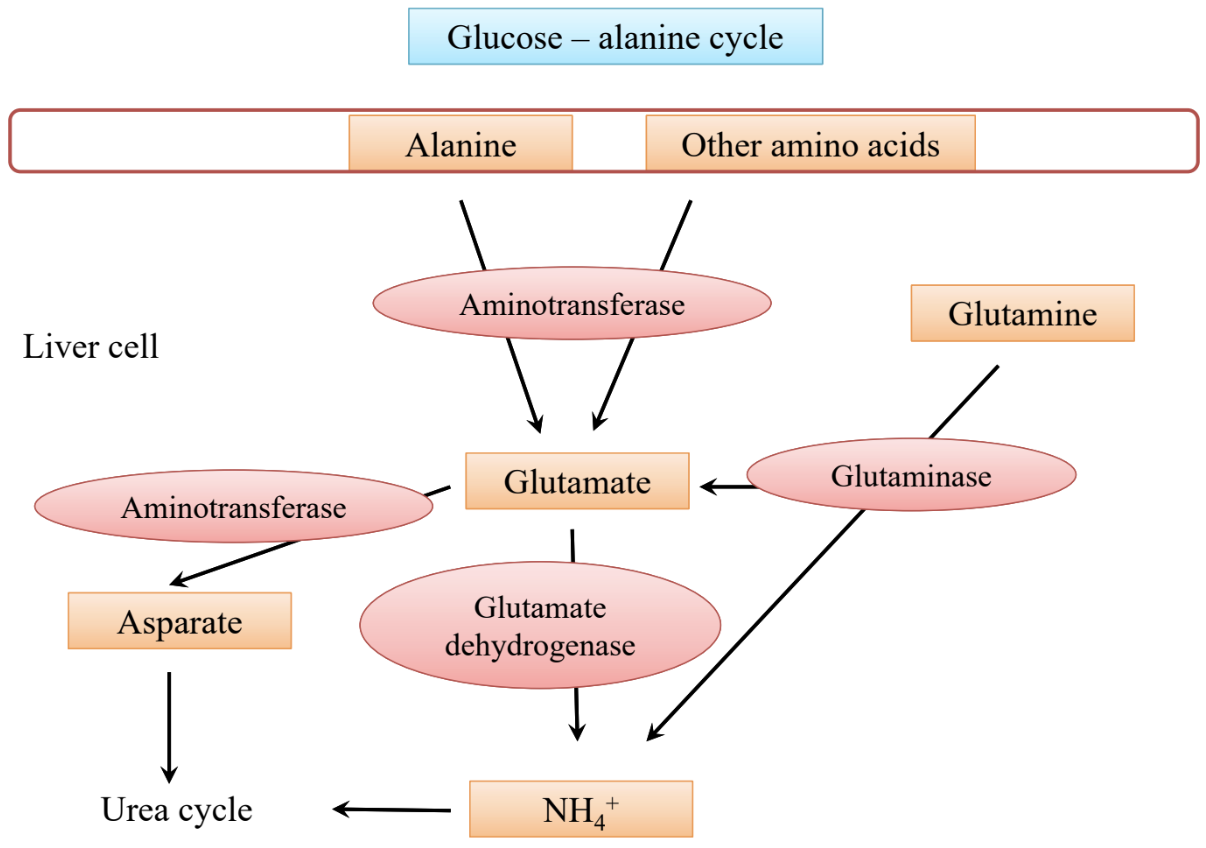
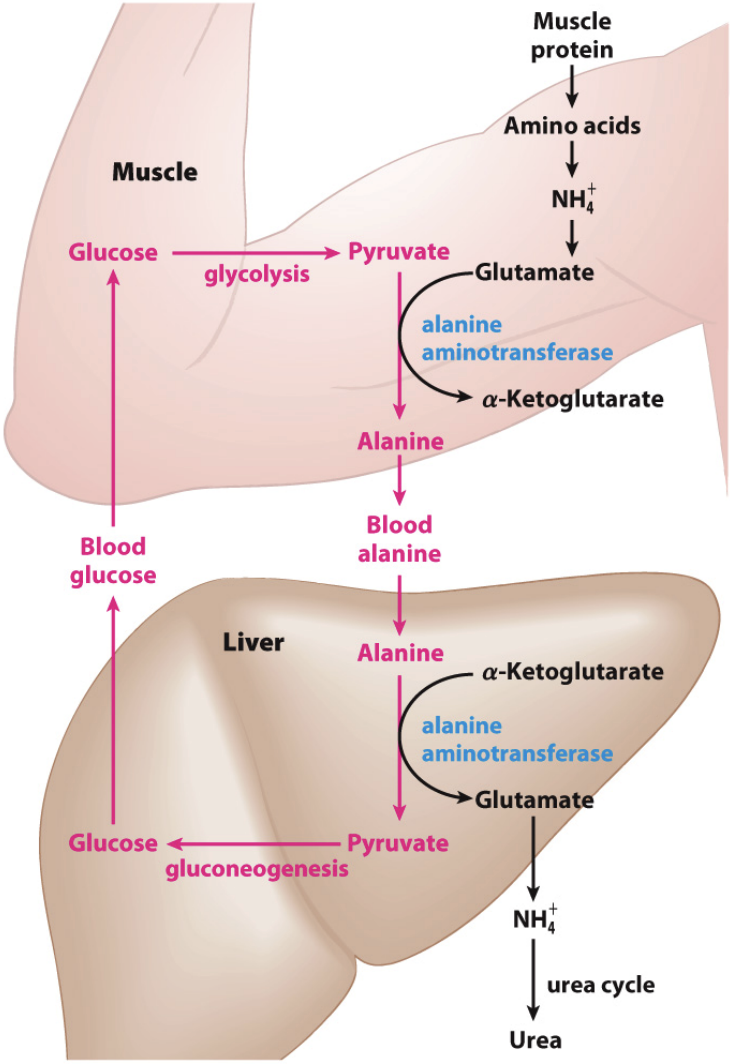
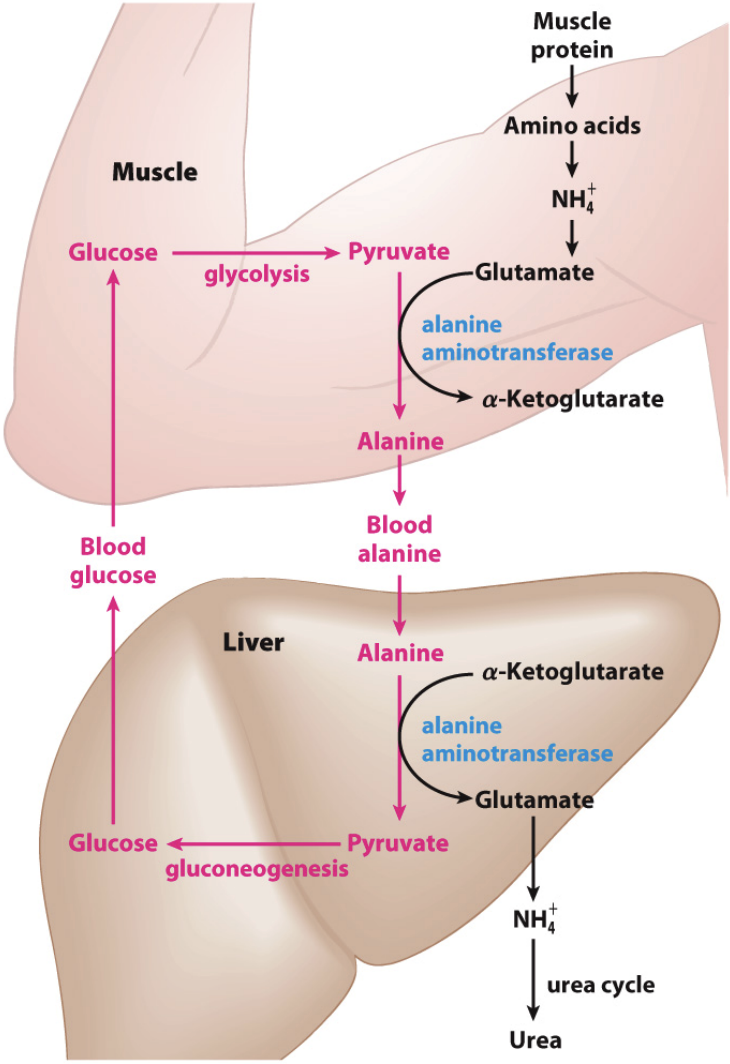
What is the glucose-alanine cycle?
  • Muscle pyruvate accepts amino groups → alanine

  • Alanine carries nitrogen + pyruvate carbon from skeletal muscle → to liver

  • Liver makes urea + glucose, returning glucose to muscle
13
New cards
How is the glucose-alanine cycle related to the Cori cycle?
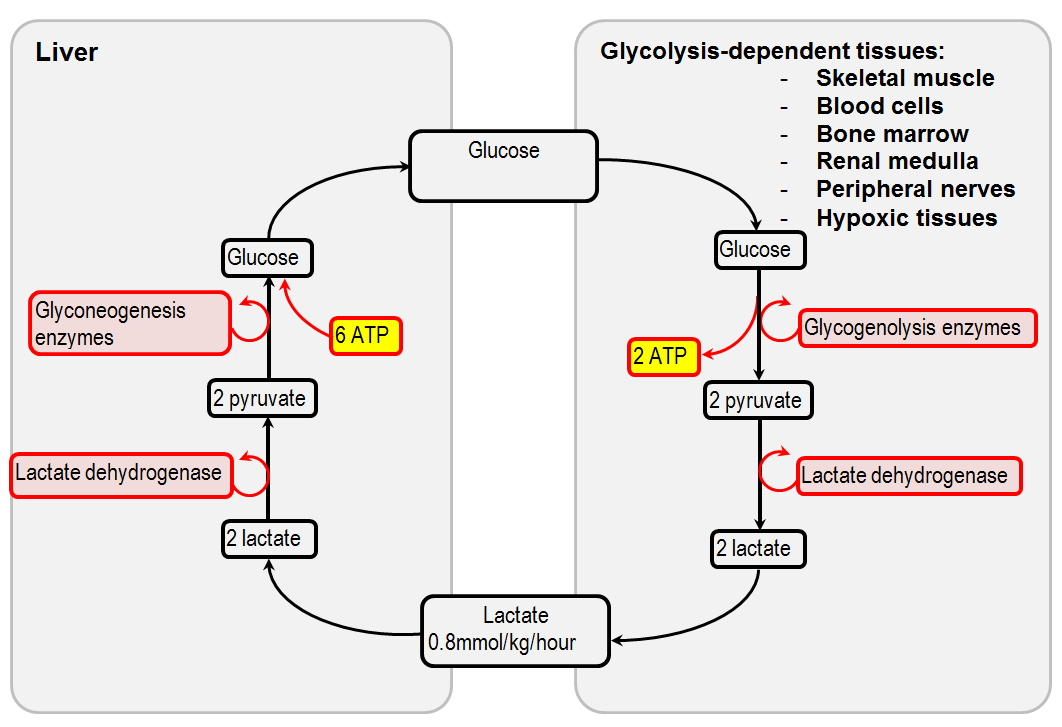
  • Both send muscle carbon to liver for gluconeogenesis

  • Alanine also carries nitrogen

<ul><li><p>Both send <strong>muscle carbon to liver</strong> for <strong>gluconeogenesis</strong></p></li><li><p><strong>Alanine also carries nitrogen</strong></p></li></ul><p></p>
14
New cards
How does aspartate feed the urea cycle?
  • Oxaloacetate + glutamate → aspartate + α-ketoglutarate

  • Aspartate donates the second nitrogen to urea

15
New cards
What are the major nitrogen excretion forms?
  • Ammonia = aquatic animals

  • Urea = terrestrial vertebrates/sharks

  • Uric acid = birds/reptiles

  • Urea/uric acid safely package excess nitrogen
16
New cards
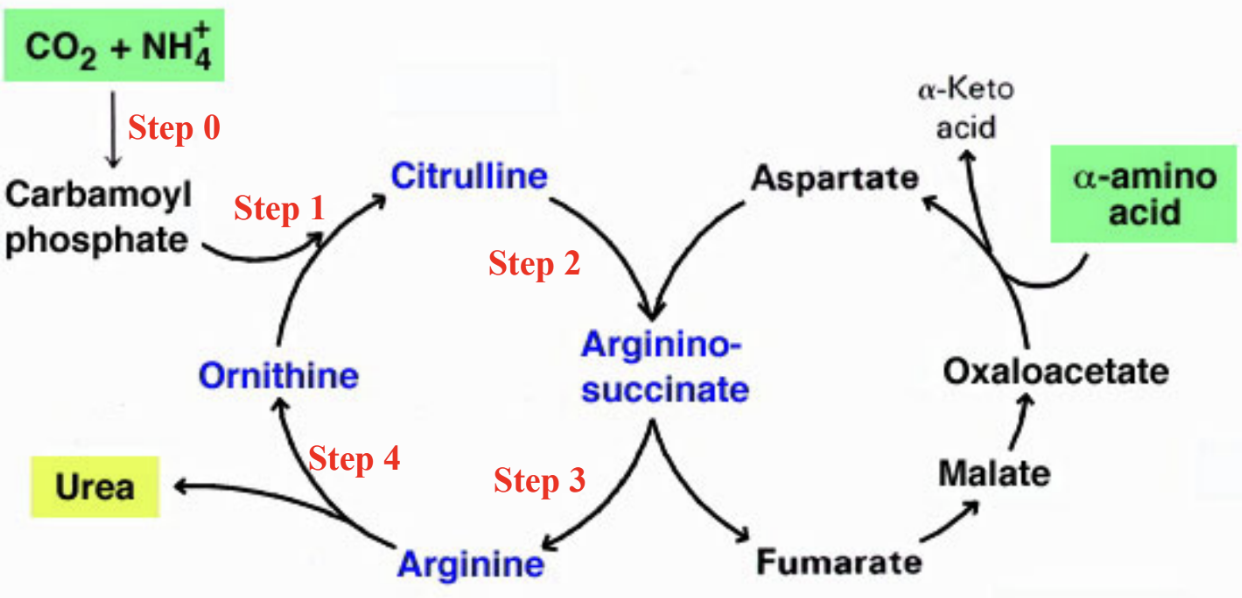
What is the purpose and location of the urea cycle?
  • Converts toxic NH4+ + CO2 → arginine → urea

  • Occurs in liver, partly mitochondrial matrix and partly cytosol
17
New cards
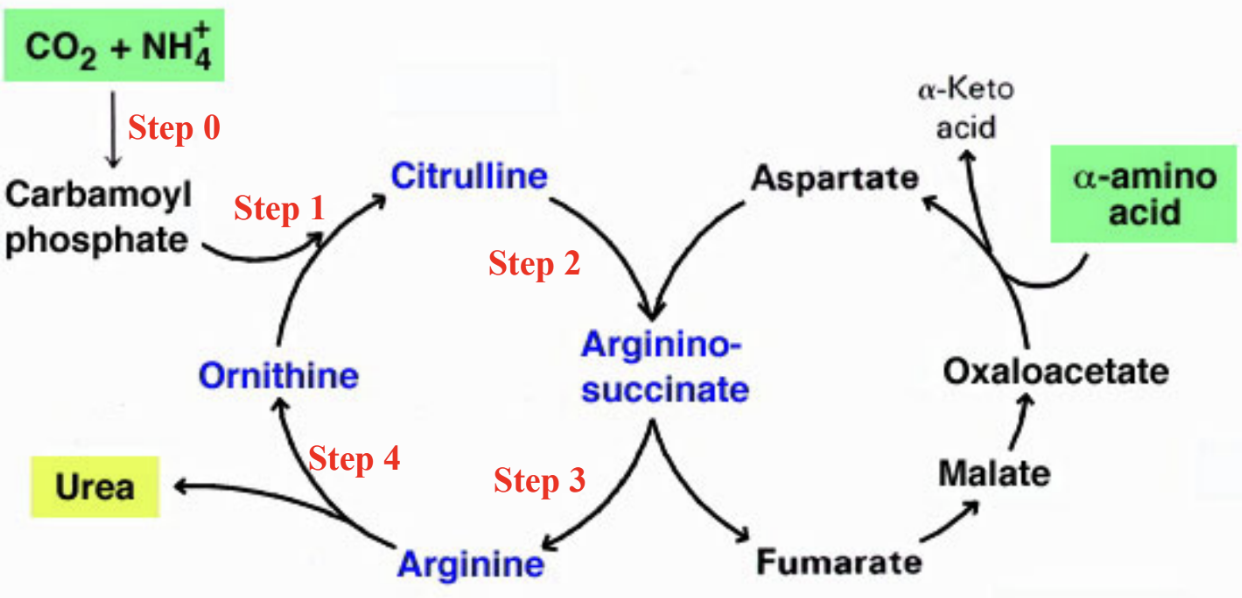
What are the two direct nitrogen sources in urea?
  • Free NH4+ enters as carbamoyl phosphate

  • Aspartate donates the second nitrogen

18
New cards
What indirect carriers feed nitrogen into the urea cycle?
  • Glutamine (blood)

  • Glutamate

  • Alanine (muscle)

  • All feed NH4+ or aspartate formation

19
New cards
How much energy does the urea cycle use?
3 ATP total, but 4 high-energy phosphate bonds per urea
20
New cards
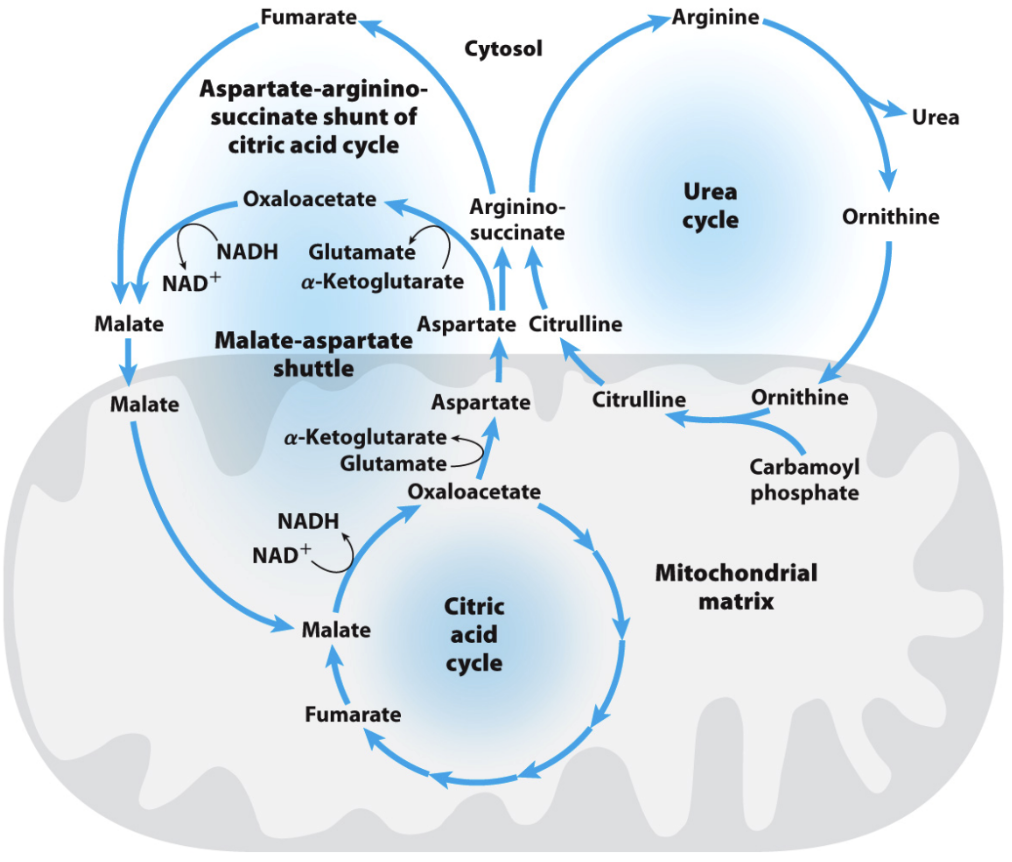
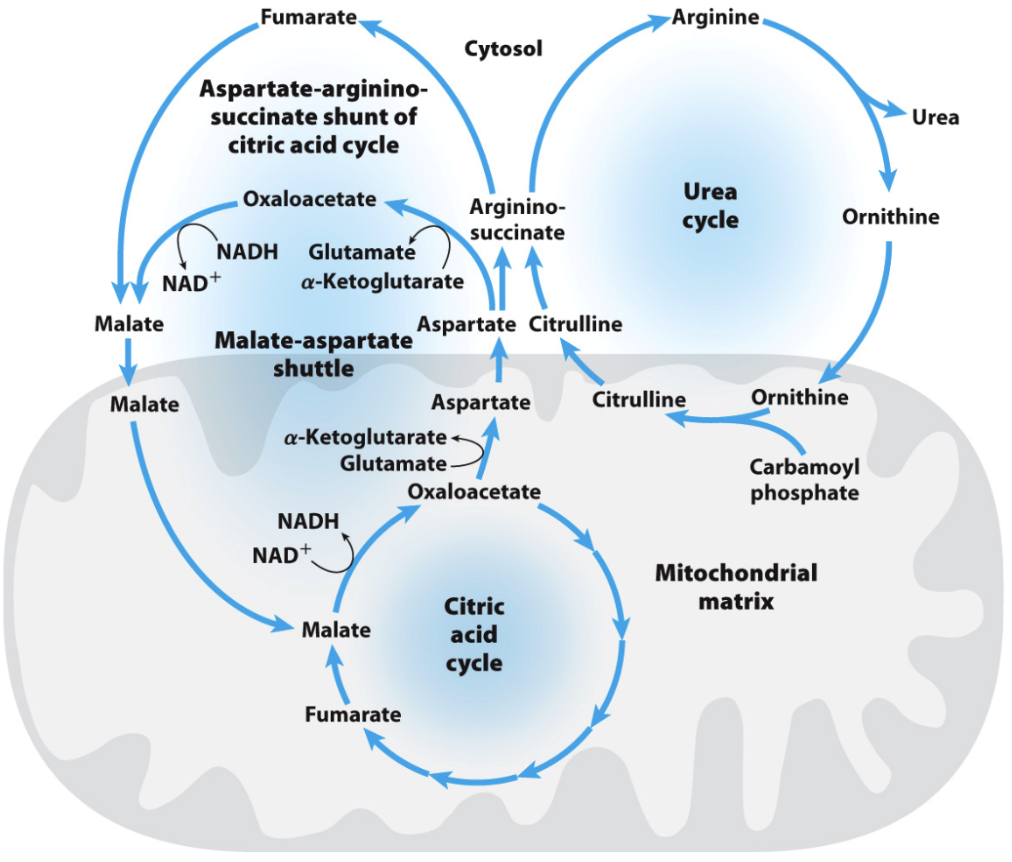
What is the aspartate-argininosuccinate shunt?

Link between urea cycle and TCA cycle using fumarate, malate, OAA, and aspartate
21
New cards
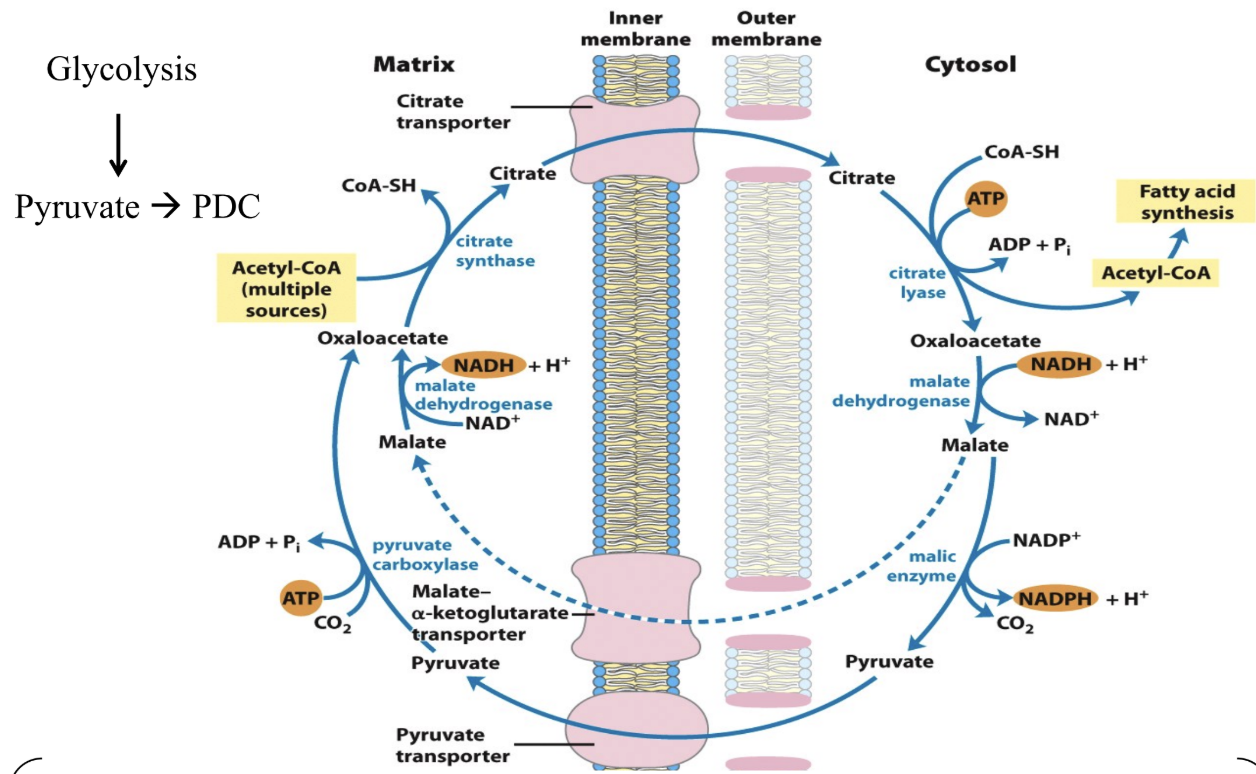
How does the malate-aspartate shuttle connect to urea/gluconeogenesis?

Moves OAA equivalents; aspartate feeds urea cycle, and cytosolic OAA supports gluconeogenesis

22
New cards

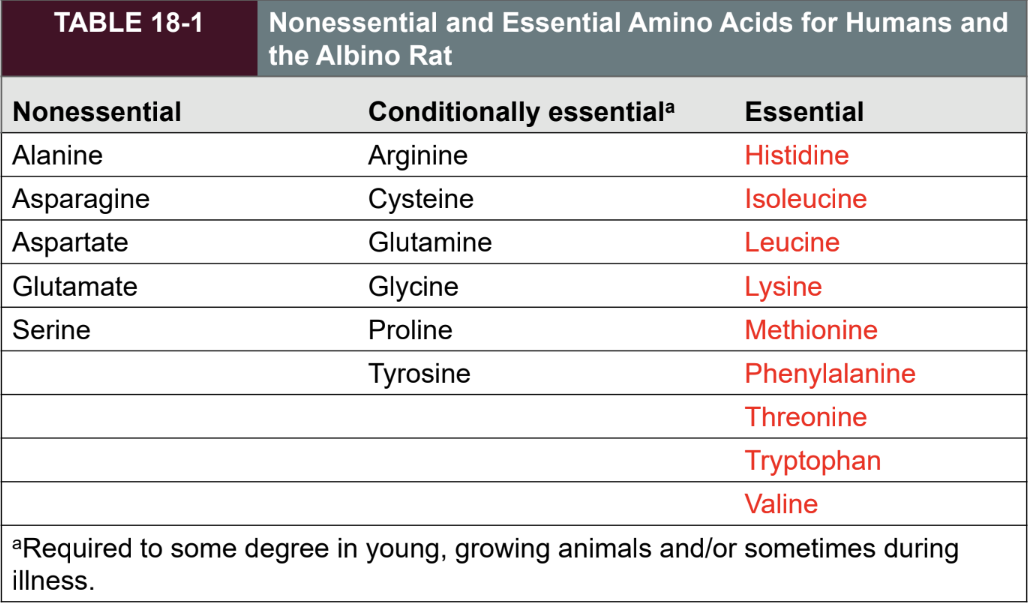
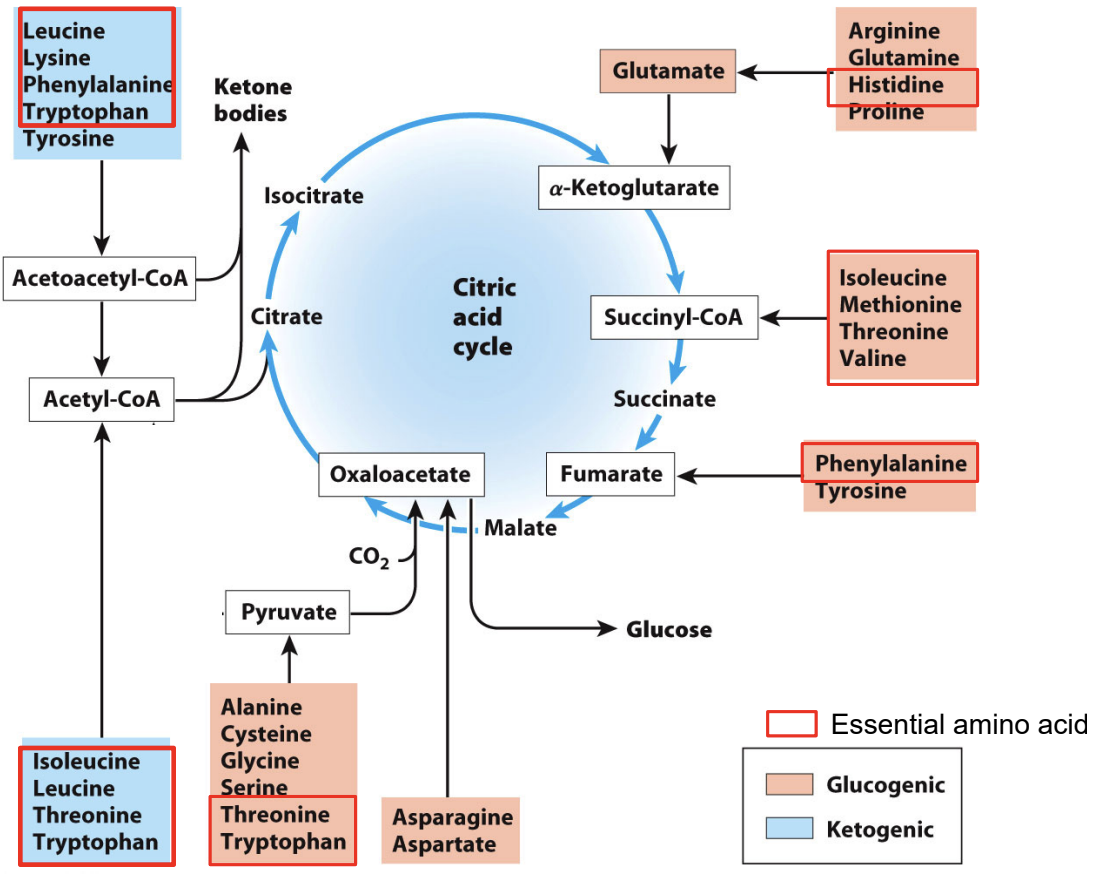
Which amino acids are essential for humans? Draw them.

  • Histidine — His/H

  • Isoleucine — Ile/I

  • Leucine — Leu/L

  • Lysine — Lys/K

  • Methionine — Met/M

  • Phenylalanine — Phe/F

  • Threonine — Thr/T

  • Tryptophan — Trp/W

  • Valine — Val/V

<ul><li><p><strong>Histidine — His/H</strong></p></li><li><p><strong>Isoleucine — Ile/I</strong></p></li><li><p><strong>Leucine — Leu/L</strong></p></li><li><p><strong>Lysine — Lys/K</strong></p></li><li><p><strong>Methionine — Met/M</strong></p></li><li><p><strong>Phenylalanine — Phe/F</strong></p></li><li><p><strong>Threonine — Thr/T</strong></p></li><li><p><strong>Tryptophan — Trp/W</strong></p></li><li><p><strong>Valine — Val/V</strong></p></li></ul><p></p>
23
New cards
<p>Which amino acids are <strong>glucogenic</strong>, <strong>ketogenic</strong> or <strong>both</strong>?</p>

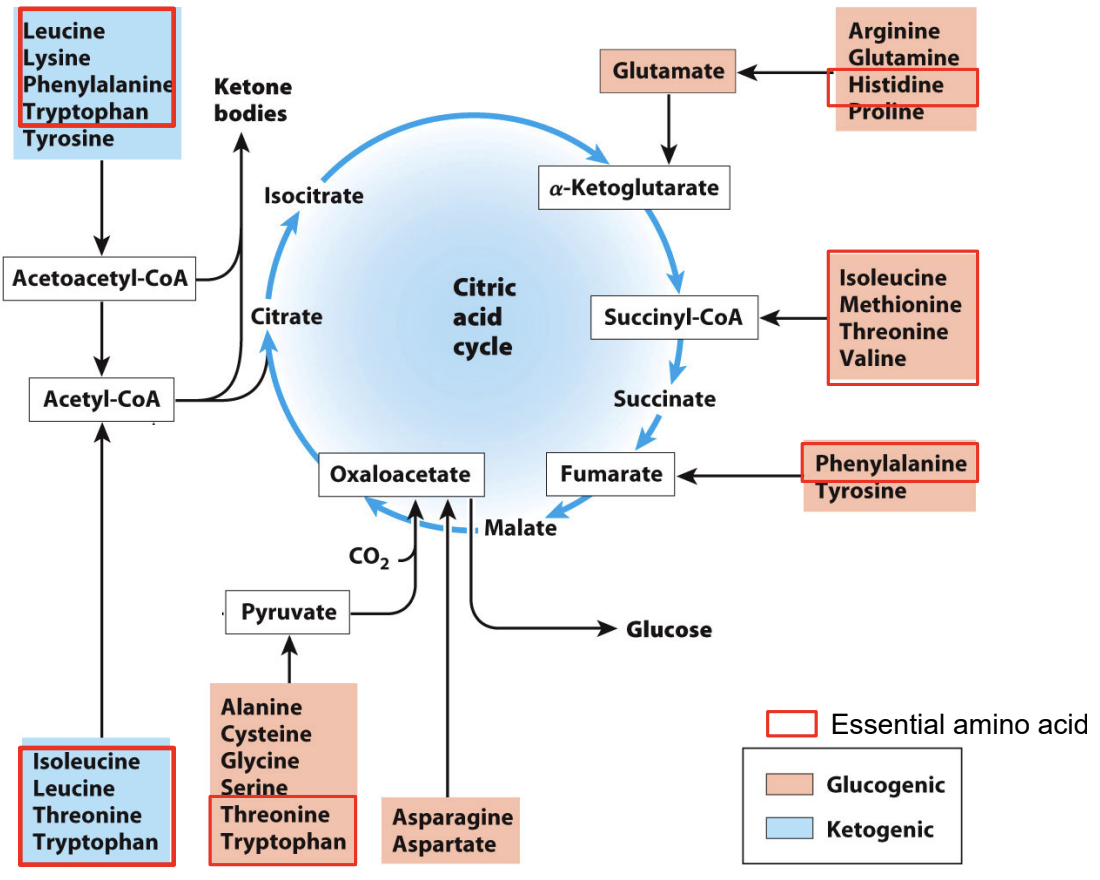
Which amino acids are glucogenic, ketogenic or both?

Glucogenic: Histidine, Methionine, Valine

Ketogenic: Leucine, Lysine

Both: Isoleucine, Threonine, Tryptophan, Tryosine, Phenylalanine
24
New cards
What makes an amino acid glucogenic vs ketogenic?
  • Glucogenic → pyruvate/TCA intermediates → glucose

  • Ketogenic → acetyl-CoA/acetoacetate → ketone bodies
25
New cards
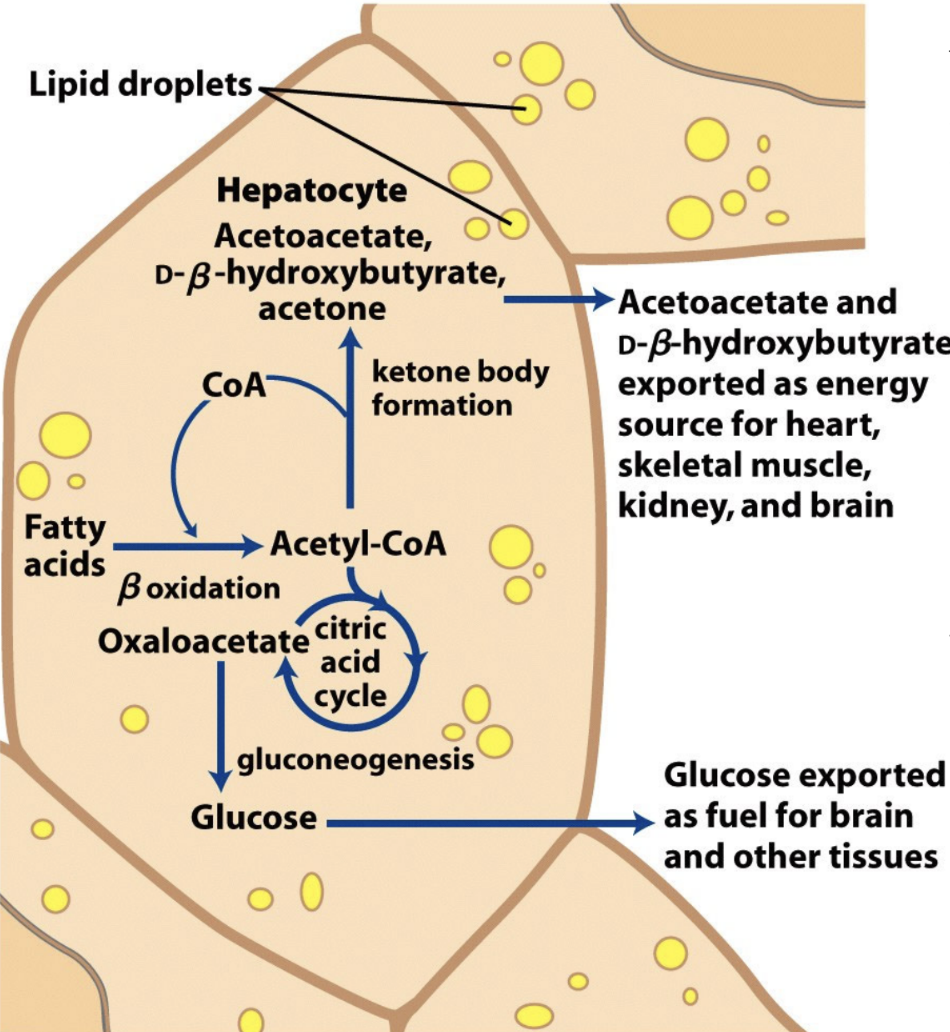
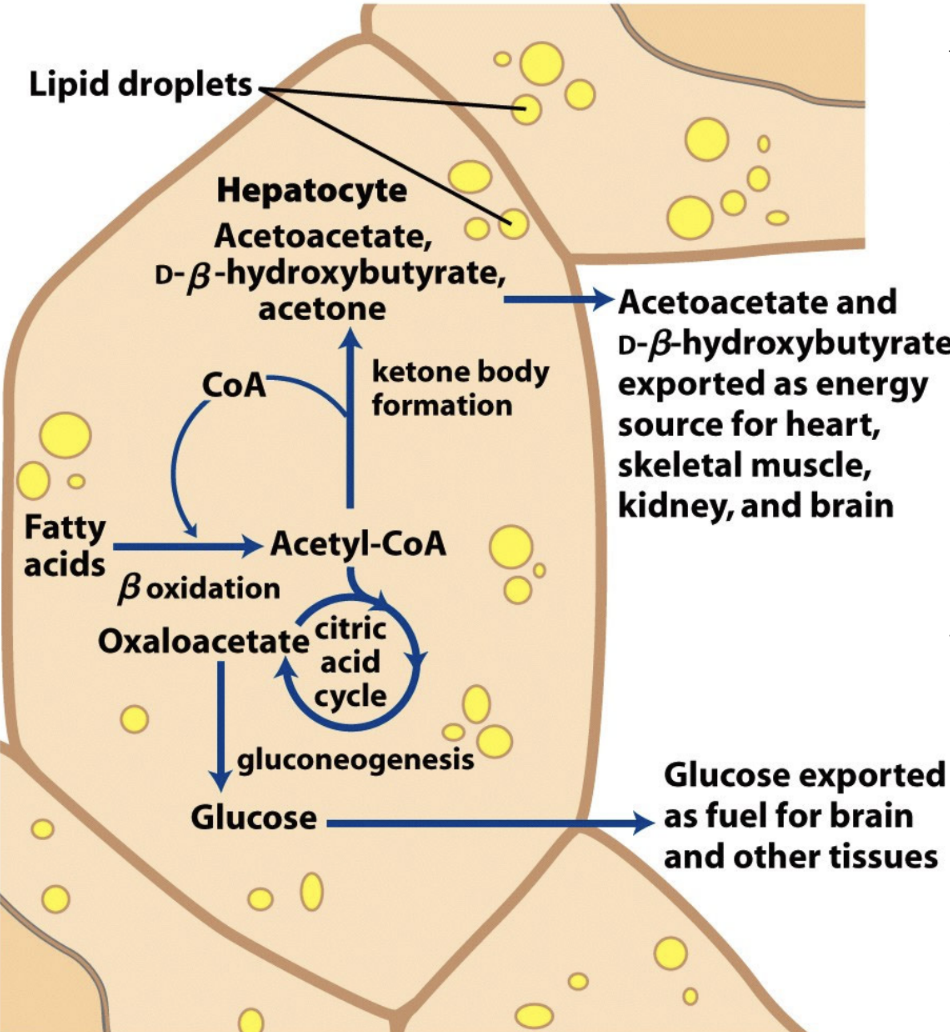
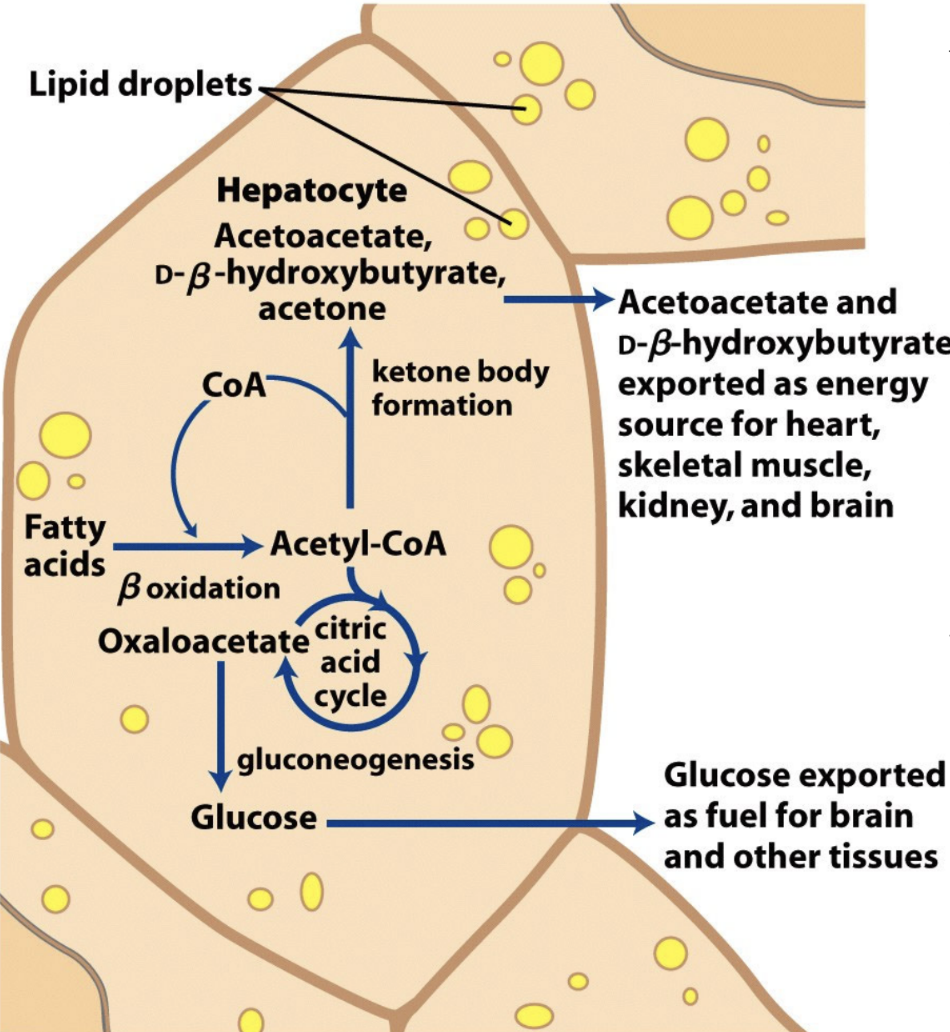
Why is acetyl-CoA converted to ketones during starvation/diabetes?
  1. OAA is limiting b/c gluconeogenesis

  2. High mito NADH (from β oxidation) inhibits TCA cycle, so acetyl-CoA accumulates → ketones
26
New cards
Which enzymes are inhibited by high mitochondrial NADH from β-oxidation?
  • PDH

  • Isocitrate dehydrogenase

  • α-ketoglutarate dehydrogenase

27
New cards
What ketone bodies are made/exported during starvation?
  • Acetoacetate

  • β-hydroxybutyrate

  • Exported as fuel for heart, muscle, kidney, and brain

  • Acetone is also formed (breathed out)

28
New cards
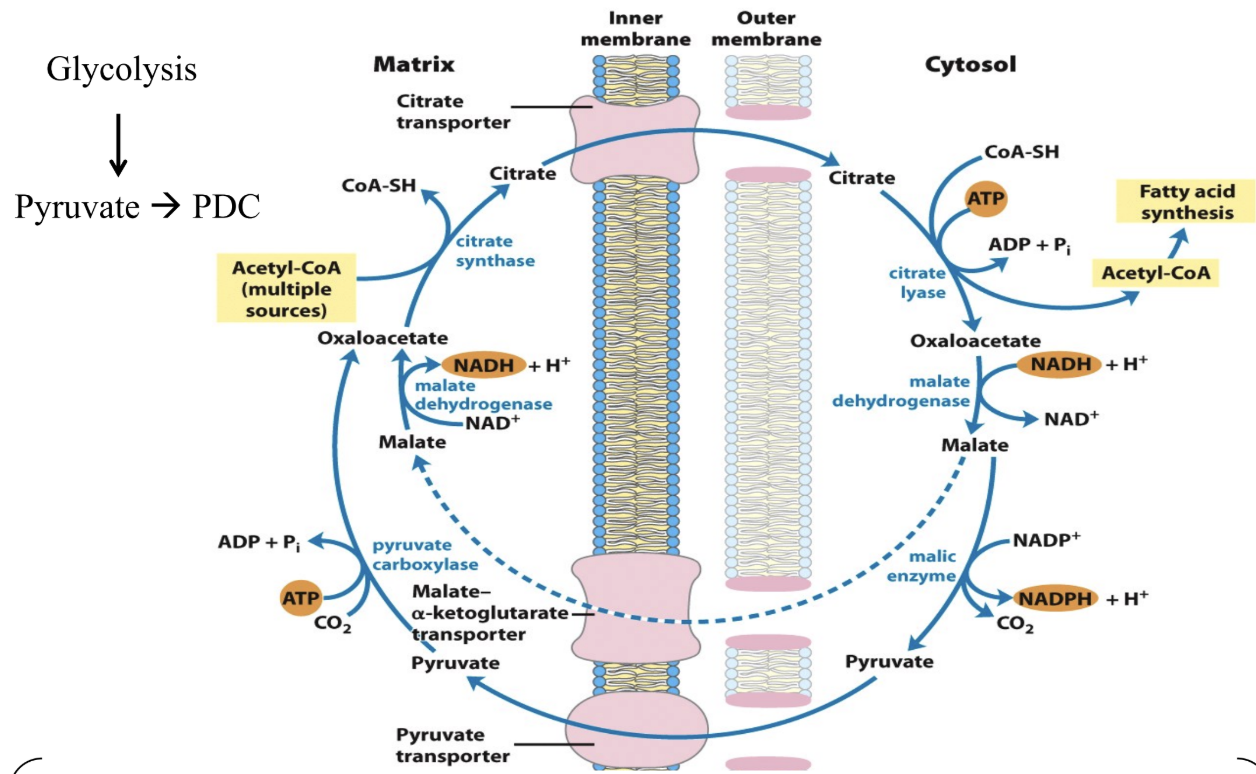
What is the main OAA carbon flow during starvation/diabetes?

OAA[mito] → aspartate (via malate-aspartate shuttle) → OAA[cyto] → gluconeogenesis
29
New cards
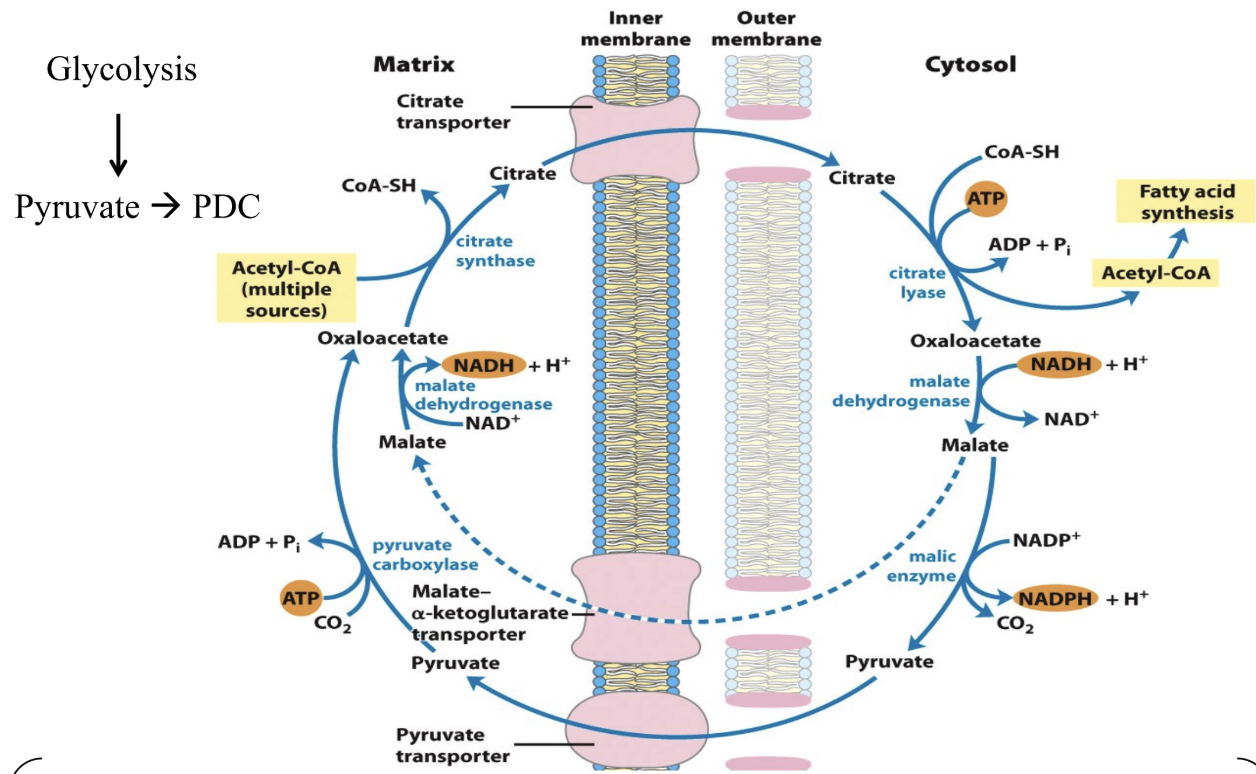
What is the citrate shuttle normally used for?

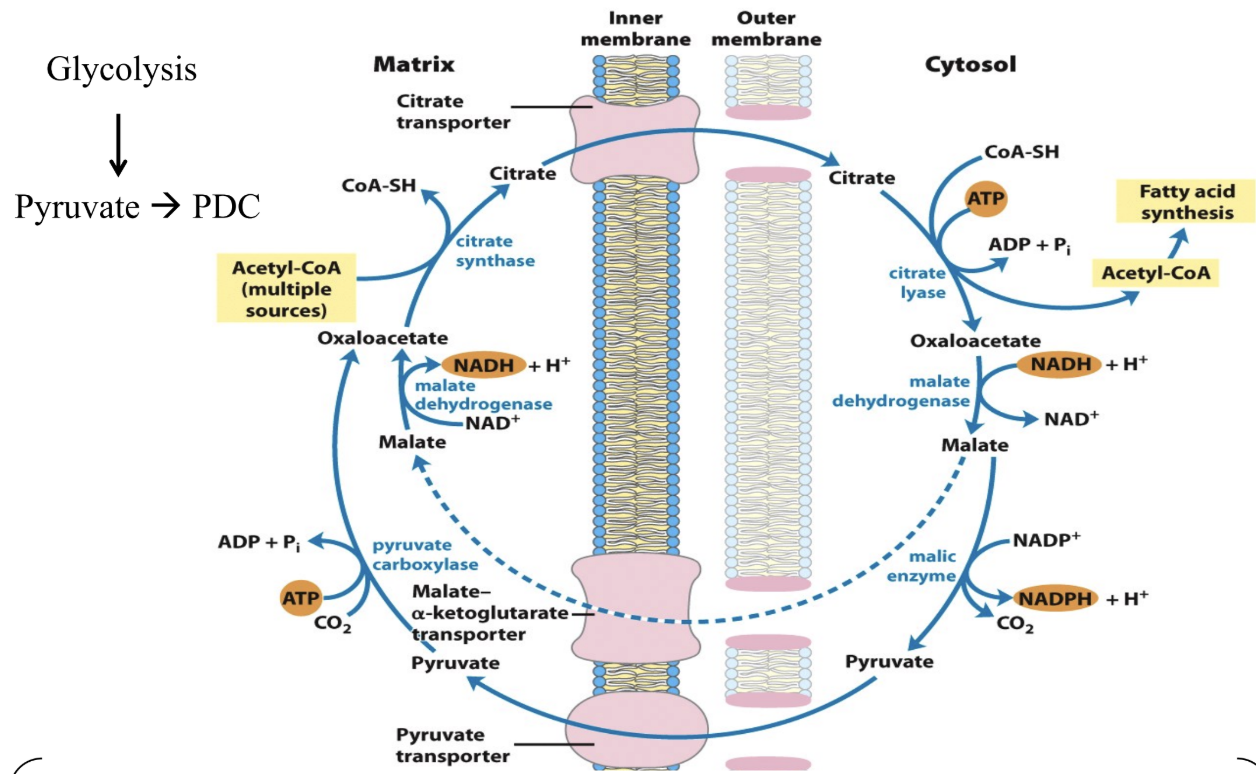
Exports acetyl-CoA equivalents to cytosol for fatty acid synthesis and helps generate NADPH
30
New cards
Why is the citrate shuttle NOT a major OAA source for gluconeogenesis in starvation?
  • Acetyl-CoA goes to ketone bodies during starvation

  • Little citrate forms in the liver because high NADH (from β-oxidation) downregulates the TCA cycle
31
New cards
How are citric acid cycle enzymes regulated by energy?
  • High ATP/NADH inhibit

  • Low ATP/AMP activate

  • Products cause product inhibition