Canadian Law 101-Modules 1 to 7
 Call Kai
 Learn
Learn Practice Test
 Spaced Repetition
 Match
Match Flashcards
 Knowt Play
1/329

There's no tags or description
Looks like no tags are added yet.
Name | Mastery | Learn | Test | Matching | Spaced | Call with Kai |
|---|
No analytics yet
Send a link to your students to track their progress
330 Terms
What is law considered in society?
A force that affects both big and small aspects of life. Some grant rights and privileges; other set out obligations
What are the two main categories of law?
Public Law and Private (Civil) Law.
What does Public Law govern?
The relationship between individuals and society, including criminal, constitutional, and administrative law.
What does Private (Civil) Law govern?
The relationships individuals have with each other, including corporations, contract law, and tort law.
Why do we need laws in society?
To ensure society is functional and predictable, leading to consistent outcomes for the same conduct.
Three Branches of Government
Executive, Legislative, Judicial
What is the legislative branch responsible for?
Passing legislation.
Delegated Authority in Canada
Municipality are not true source of legislation, as they act on authority of provincial government
What is the life cycle of legislation?
Bill - First Reading - Second Reading - Committee Stage - Final Reading. Federal legislation goes through this cycle twice as it is Bicameral.
What is required for a bill to become an Act?
It must pass final reading and receive Royal Assent from the Governor General.
What can an Act do?
Create new laws, change existing laws, or remove existing laws
What are regulations in the context of legislation?
Specific details attached to Acts that can be changed more quickly than the Acts themselves, and contain more specific details.
What is Driedger's Modern Principle of Statutory Interpretation?
A method to interpret unclear legislation using three approaches: plain meaning, contextual(does interpretation conflict with other sections or acts), and purposive(mischief sought to be prevented).
Common Law
Type of Law that comes from judicial branch and judges. Canada is mostly common law, except for Quebec which is civil system/code.
Are judges elected or appointed?
Appointed;permanent till judge is 75
What is the difference between Binding Precedent and Persuasive Precedent?
Binding Precedent must be followed by lower courts, while Persuasive Precedent is not mandatory.
What is Ratio Decidendi?
The part of a court's decision that is binding and establishes a legal principle.
What is Obiter Dictum?
Parts of a court decision that are not binding.
What is the principle of Parliamentary Supremacy?
Legislation can overrule common law since the judiciary does not have a democratic mandate.
What does the Rule of Law signify?
That rules are not arbitrary and nobody is above the law. Tenet of system. Can also refer to separation of powers.
How does common law differ from civil law?
Common law is based on precedent, while civil law is based on a comprehensive statement of rules.
Does lawful equal moral?
Not always. Illegal things can mean criminality, but can also cover more such an ambiguous contract without clear definition.
What is the process for creating a law(federally)?
Proposed law is drafted, approved by cabinet, presented as a bill, debated, and must be approved by both chambers before receiving Royal Assent.
What is the Canada Gazette?
The official newspaper of the Government of Canada that publishes formal public notices and proposed regulations.
What is the role of judges in the common law system?
To interpret laws and apply precedents to resolve disputes.
What is the significance of judicial independence?
It ensures that judges can make decisions free from external pressures, particularly from the executive branch.
What are the types of Public Law?
Constitutional Law, Criminal Law, Administrative Law, and Taxation Law.
What are the types of Private Law?
Contracts, torts, law of property, and family law.
What is the role of the Judicial Advisory Committee in Canada?
To recommend senior lawyers for judicial appointments.
What happens during the Committee Stage of legislation?
The bill is studied in depth, including public hearings, and potential changes can be made.
Regulation Creation steps
-Relevant organisations conduct analysis
-Stakeholder engagement
-Further refinement
-Draft regulations developed by department of justice
-Minster/treasury boards reviews and approves with or without changes
-Approved regulations published in Canada Gazette
What is the purpose of stakeholder engagement in regulation creation?
To seek views on possible policy approaches before finalizing regulatory proposals.
What is the final step in the regulation creation process?
The final regulations are approved and published in the Canada Gazette.
What is the primary purpose of the Canadian Constitution?
To provide a comprehensive legal framework for the governance of Canada. It also has the rules of the game, and the ideals and aspirations
Components of the Canadian Constitution
- the Constitution Act, 1867
- formal amendments to the Constitution Act, 1867
- organic Canadian statutes
- the Constitution Act, 1982
- judicial decisions
- constitutional conventions
-Indigenous Constitutionalism and Treaty Relationships
What does the term 'Constitutional Supremacy' refer to?
The principle that the Constitution of Canada is the supreme law, overriding any inconsistent laws.
What is the Constitution Act, 1982 known for?
It established the Constitution as the supreme law and included the Canadian Charter of Rights and Freedoms (CCRF).
What are the two main components of the Canadian Constitution?
The Constitution Act, 1867 and the Constitution Act, 1982.
What is meant by 'Parliamentary Supremacy'?
The principle that Parliament is the ultimate authority in Canada, but it is limited by constitutional supremacy.
How does the judiciary play a role in constitutional supremacy(Constituional Remedies)?
The judiciary acts as the guardian of the Constitution, able to strike down laws that violate it.
What is 'Federalism' in the context of Canada?
A system where political power is shared between the federal and provincial governments. Each ave separate spheres of jurisdiction.
Controversies that federalism generates?
Diversity vs Unity, Constitutional Politics, Jurisdiction, Role of the courts, overlapping jurisdiction
What does the term 'Federal Paramountcy' mean?
Federal law prevails over provincial law in cases of conflict.
What was the significance of the BNA Act of 1867?
It created the Dominion of Canada and outlined the division of powers between federal and provincial governments.
What is the role of the Governor General (GG) in Canada?
The GG represents the monarch and has the authority to summon the House of Commons.
What are the four underlying constitutional principles of Canada?
Federalism, Democracy, Constitutionalism and the Rule of Law, and Respect for Minorities.
What does the CCRF guarantee?
It guarantees rights such as democratic rights, fundamental freedoms, and equality.
What is the 'living tree' doctrine in constitutional law?
The idea that the Constitution can grow and adapt within natural limits through case law and amendments.

What is the significance of the 'notwithstanding clause'?
It allows governments to pass laws that may violate certain rights in the CCRF, under specific conditions.
What is the role of the Senate in Canada's political system?
To provide representation for provinces and minorities, as well as a sober second thought, modeled after the British system,
What does 'jurisdiction' refer to in the context of federalism?
The power to enact laws within specific areas of governance.
What is the process for amending the Constitution?
Amendments require consent from both the federal government and all provinces, as outlined in the Constitution Act, 1982.
What does 'ultra vires' mean?
A term used to describe laws or actions taken beyond the legal authority granted by the Constitution.
Why is the concept of 'overlapping jurisdiction' significant?
It addresses the complexities that arise when federal and provincial laws conflict.
What is the constitutional role of the provinces regarding natural resources?
Provinces have significant powers over their natural resources, including production and exportation.
What does the term 'Indigenous Constitutionalism' refer to?
The recognition and integration of Indigenous rights and treaty relationships within the constitutional framework.
What is the significance of the phrase 'the mirror reflecting national soul' in relation to the Constitution?
It suggests that the Constitution embodies the values and identity of the Canadian nation.
What is the role of courts in policing the federal division of powers?
Courts interpret the Constitution to determine the validity of laws and ensure compliance with federalism.
What is the impact of the Charter on the Canadian system of government?
It transformed the system from parliamentary supremacy to constitutional supremacy.
What does 'responsible government' mean in the context of the Canadian Constitution?
A system where the executive is accountable to the legislature and must maintain its confidence.
What is the significance of the 'final British Act of 1982' in terms of Canada controlling itself?
It allowed Canada to amend its Constitution without British involvement, marking a step towards full sovereignty.
Federal Powers Include:
Regulation of trade and commence, EI, Defence, Currency and Banks, Indigenous Issues, and most criminal law
Provincial Powers Include:
Taxation with province, hospitals, prisons, licences, property right
Reasons for Union of Canada
-Protection and coexistence of English Ontario and French Quebec
-Protect against American Invasion
-Federalism allows for strong central government while maintaining autonomy
Judicial Process
Judges decisions add to the 'common law'
Trial Courts
Court of first instance. Single judge, receive evidence (witness testimony, written affidavits). Examples include provincial court and tax court of Canada.
Appeal Courts
Review trial decisions, multiple judges (odd number panel). Includes Alberta Court of Appeal, Supreme Court of Canada.
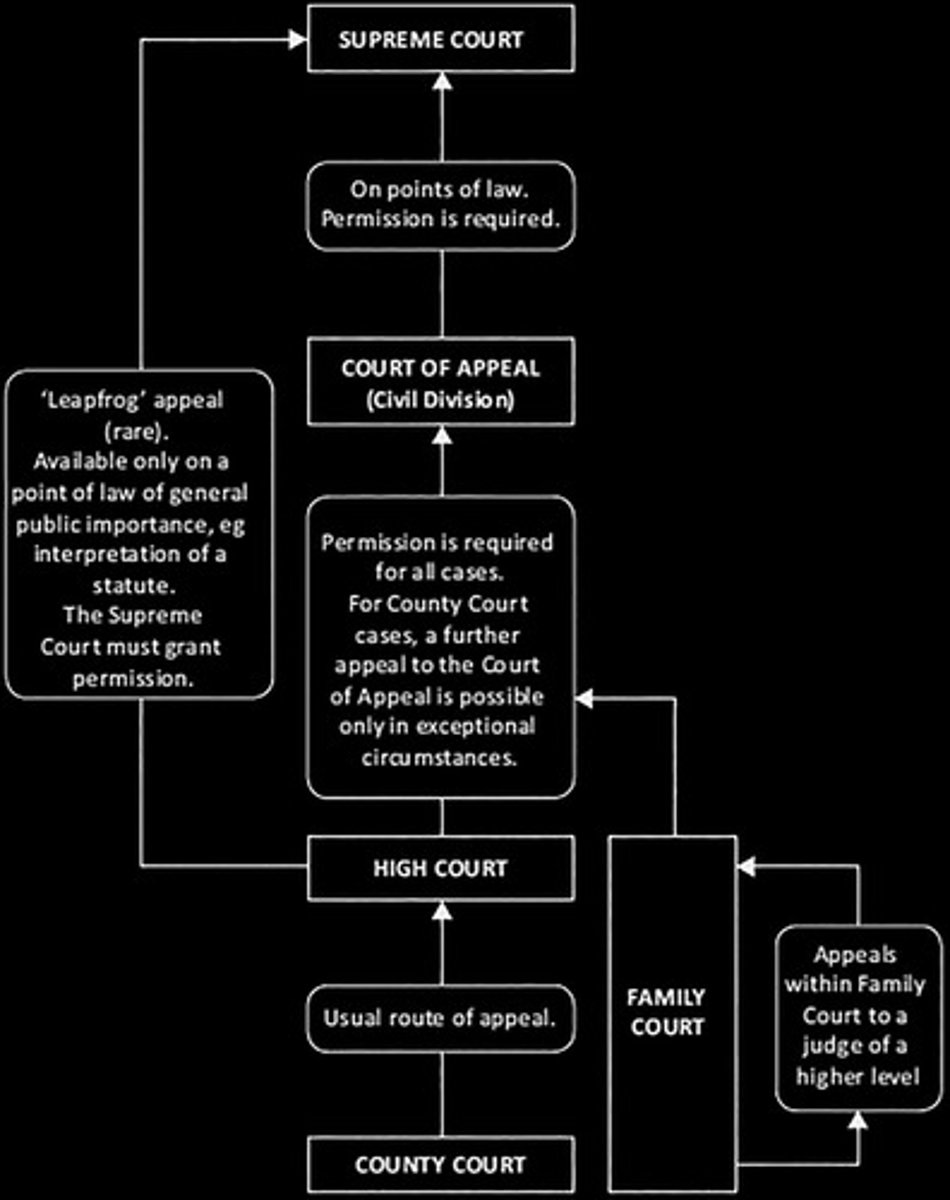
Provincial Superior Courts
Both trial and appellate function. In Alberta called Alberta Court of King's Bench.
Standard of Review
Appeals don't just redo the trial; rather, there needs to be an error of sufficient size in the threshold of review. Palpable and overriding error, or correction error.
High Standard of Review
Large error is required - palpable and overriding.
Low Standard of Review
Small error justifies intervention - correctness.
Deference
How readily the appellate court will intervene. High deference is reluctant to overturn. Low deference is easier to overturn.
Stare Decisis
Stand by things decided.
Open Court Principle
The public should be able to access hearings and documents. Increases transparency and accountability. Not absolute - can be overridden by other concerns.
Publication Bans
Court issues this to prevent identifying info from leaking. Applies to news outlets and to court itself.
Alternative Dispute Resolution
Going to court produces winners and losers, but a middle of the road solutions might be preferable.Includes mediation, negotiation, arbitration.

Administrative Tribunals
Law applied by decision-makers outside a courtroom. Receive evidence, apply law, and fairly similar to judges.
How do administrative tribunals differ from courts?
AT derive authority from legislation, decision makers are not necessarily lawyers and have term appointments, and decisions do not form precedents.
Civil Litigation Process
Pleadings - Discovery - Trial - Decision - Enforcement, or appeal then enforcement.
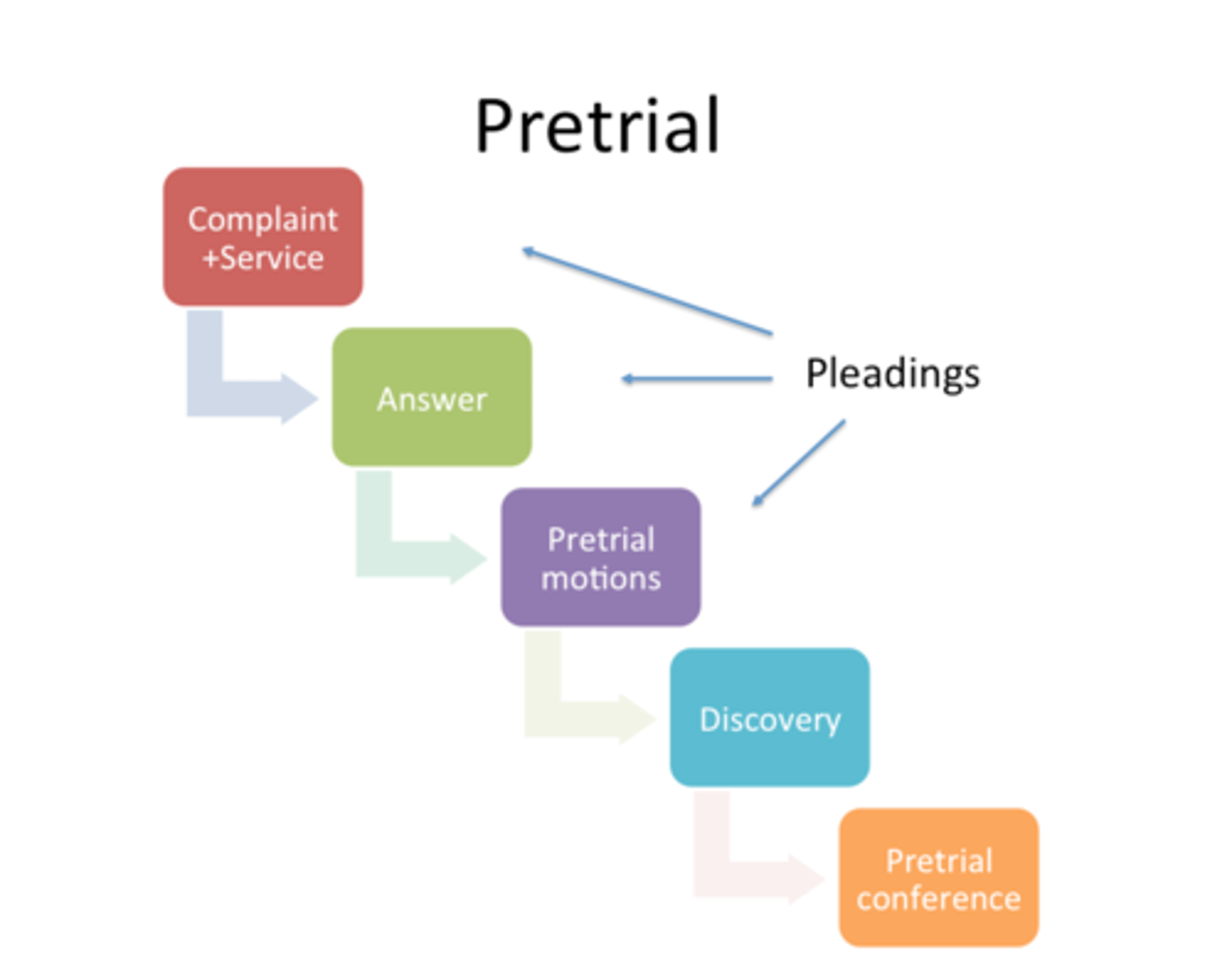
Pleading
Sets out a complaint against the defendant and remedy the plaintiff is seeking.
Discovery
Clarifies claim against defendant and lets each side examine evidence other side intends to use.
Trial(Civil)
Plaintiff must present facts to support claim that defendant is liable.
Decision(Civil)
Judge considers all evidence then makes a decision - including remedies if needed.
Enforcement
Court order requiring one person to pay money to someone else.
Plantiff
Person who brings a lawsuit
Defendant
an individual or group being sued or charged with a crime
judgement
Court order requiring one person to pay money to someone else
Judgment Debtor
The person who owes money as per the court order.
Judgment Creditor
The person to whom money is owed as per the court order.
Why may a court grant as a judgment?
As a remedy or to the winning party to cover costs
Options for Enforcing a Judgement
Seize and sell personal property, sell real property, garnish a payment
Civil Enforcement Agency
A licensed organization responsible for carrying out court orders related to the seizure and sale of property, such as in enforcing judgments.

Garnishment
Creditor intercepts payment (includes wages, banks) of payor to debtor.
Exempt Property
Property is exempt from seizure, sale, or garnishment, even if the debtor owes money to the creditor.
Judgment Proof
Person has no property against which a judgment creditor can enforce.
Contempt
Punishment if a court order requires something and person refuses to comply.
Legal Advice
Does something meet legal requirements? Have your rights been breached? Do you have a claim? Should you plead guilty?
Code of Conduct for Lawyers
Competence, Confidentiality, Conflicts, Integrity.
Competence(code of conduct)
Lawyer must perform all legal services undertaken on a client's behalf to standard of competent lawyer.
Confidentiality(code of conduct)
A lawyer must hold in strict confidence all info concerning business and affairs of a client.