Group 7 Language Review
 Call Kai
 Learn
Learn Practice Test
 Spaced Repetition
 Match
Match Flashcards
 Knowt Play
1/22

There's no tags or description
Looks like no tags are added yet.
Name | Mastery | Learn | Test | Matching | Spaced | Call with Kai |
|---|
No analytics yet
Send a link to your students to track their progress
23 Terms
What is Communication?
Sending and receiving information. Can be both verbal and nonverbal.
What are the components of language?
Symbolic, Abstract, Syntax, Generative
Which animals did we discuss in class as examples of language acquisition?
All the above. (Alex the parrot, koko the gorilla, kanzi the bonobo)
his is a man who knows how to Zib. Yesterday, he did the same thing. Yesterday, he ________.
Zibbed
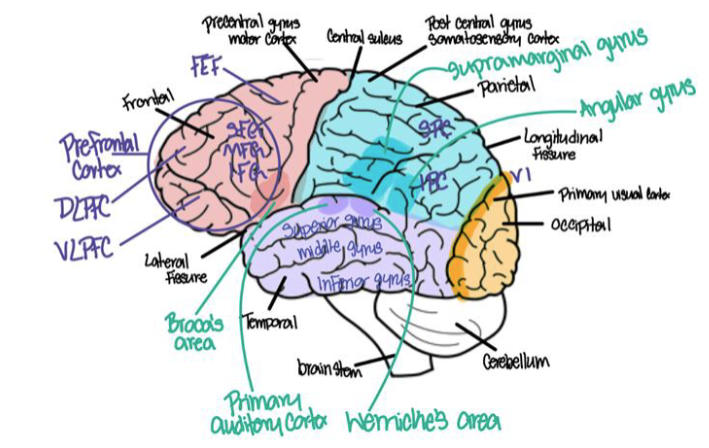
Important Neuroanatomy for Language
All of the above. (primary auditory cortex, wernicke’s area, broca’s area)
What is Arcuate Fasciculus?
Extensive band of white matter fibers that connect Broca’s area and Wernicke’s area
Define Aphasia
Impairment in expression, comprehension,and/or manipulation of sounds or other language components
In which areas of the brain do strokes most commonly occur?
Middle Cerebral Artery
Which is NOT an Aphasia type?
Dissociation Aphasia
In the article “Dissociation between singing and speaking in expressive aphasia: The role of song familiarity”. What was the main finding about patients with expressive aphasia?
Patients could sing familiar songs more fluently than they could speak, suggesting different neural pathways “GS showed a pronounced increase in the number of correctly reproduced words during singing as compared to speaking excerpts of familiar lyrics.”
Which of the following correctly describes Broca’s Aphasia?
Difficulty expressing thoughts; language comprehension is mostly in tact
How do we test for aphasia?
Behavioral tests such as the Boston Diagnostic Examination (cookie theft)
Which of the following is NOT a way to treat aphasia?
Improving nutrition/diet
What is the best way to communicate with someone who has aphasia?
Speak in short, simple sentences
What are the essential skills for reading?
Phonological Awareness, Vocabulary, Comprehension
hat assessment tests individuals ability to read words “automatically” or as a whole?
RAN (Rapid Automatic Naming)
What are the 2 pathways for reading and their functions?
Dorsal Pathway (aka indirect) - Sounding Out Words; Ventral Pathway (aka direct) - Whole word recognition
What is the neuronal recycling hypothesis?
The idea that organization of the brain has anatomical constraints; therefore, we use cortical areas that “originally” had another function
What is Dyslexia?
Learning disability for reading and writing
What percentage of children are affected by Dyslexia?
10%
What region of the brain is required for phonological processing?
Left parietal-temporal lobe
What region of the brain is required for whole word recognition?
Left occipital-temporal lobe
Labeled brain