Electricity - Aqa spec
 Call Kai
 Learn
Learn Practice Test
 Spaced Repetition
 Match
Match Flashcards
 Knowt Play
1/63

There's no tags or description
Looks like no tags are added yet.
Name | Mastery | Learn | Test | Matching | Spaced | Call with Kai |
|---|
No analytics yet
Send a link to your students to track their progress
64 Terms
What must a closed circuit include for electrical charge to flow?
A source of potential difference
What is a closed circuit?
A complete circuit that allows electrons to flow continuously from a power source, through components and back to the source
What’s an IV curve?
A graph showing the relationship between current through an electronic device and the voltage across the battery
What is an open circuit?
Electrical circuit where the path is broken or disconnected, preventing the flow of electric current
What is electric current?
A flow of electrical charge
What dos the size of electric current measure?
The rate of flow of electrical charge
What is charge measured in?
Coulombs
What is current measured in?
Amperes, Amps
What is time measured in?
Seconds
What is the relationship of current and a single closed loop?
It has the same value at any point in a single closed loop
The current through a component depends on…
the resistance OF the component and the potential difference ACROSS the component
What’s the relationship between resistance and current
Inversely proportional
What is potential difference measured in?
Volts
What is resistance measured in?
Ohms
What is the relationship of current and potential difference across an ohmic conductor?
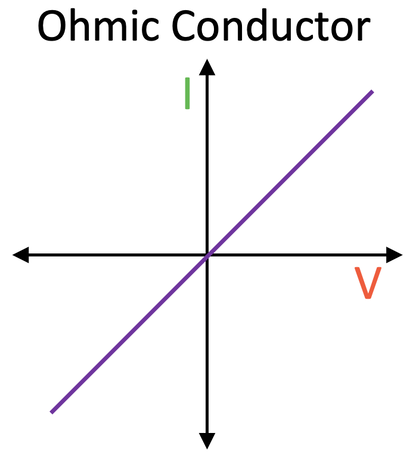
They are directly proportional at a constant temperature
What does it mean for the resistance if the current and pd are directly proportional?
The resistance remains constant as the current changes
What is an ohmic conductor?
A material that obeys Ohms law, meaning current flowing through is directly proportional to the voltage applied across it
What does the graph look like showing the relationship between current and potential difference across an ohmic conductor?
What is different about the resistance in lamps, diodes, thermistors and LDRs compared to Ohmic conductors?
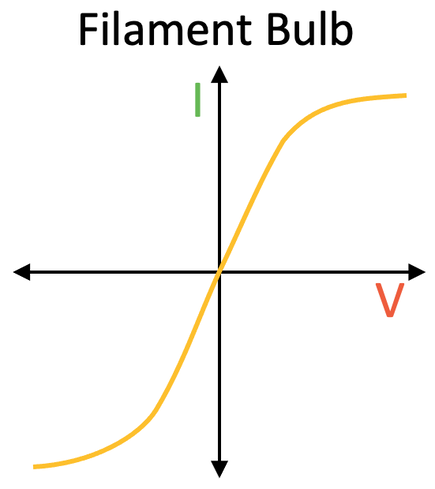
It is not constant, it changes with the current as the temperature changes.
What does the graph look like showing the relationship between current and potential difference across a filament lamp?
What is different with current in a diode?
The current only flows in one direction
What is the resistance like in the reverse direction of a diode?
Very high
What’s the relationship between resistance and temperature in a thermistor?
The resistance of a thermistor decreases as the temperature increases
What’s the relationship between resistance and light intensity in an LDR?
The resistance of an LDR decreases as light intensity increases.
What is used to measure potential difference?
A voltmeter
What is used to measure current?
Ammeter
What is an IV Characteristic?
The relationship between current and voltage, presented as an iv curve on a graph
What is current like in series circuits?
There is the same current through each component
What is potential difference like in series?
The total potential difference of the power supply (circuit) is shared between components
What is resistance like in series?
The total resistance of two components is the sum of the resistance of each component.
What is potential difference like in parallel?
It’s the same across each component
What is current like in parallel?
The total current through the whole circuit is the sum of the currents through separate components. (basically just normal addition)
What is resistance like in parallel?
The total resistance of two resistors is less than the resistance of the smallest individual resistor.
Why is the total resistance smaller in parallel circuits?
You have provided extra pathways for current to go, so more total charge can flow around the circuit.
What happens to the current at a junction in parallel circuits?
In a parallel circuit, the current splits at a junction.
What is resistance?
A measure of how much material opposed the current.
What is the relationship between current and resistance?
They are inversely proportional, if one decreases the other increases.
What is the mains electricity?
An ac supply, specific type of electrical power supplied to homes in the national grid.
What is the frequency and potential difference of the mains?
50 Hz
230 V
What is direct potential difference?
A constant, one directional voltage produced by sources like batteries, causing the current to only flow in one direction
What is alternating potential difference?
A voltage that regularly reverses its direction and changes magnitude, causing the current to alternate
What connects appliances and the mains?
Three core cable.
What colour is the live wire?
Brown
What colour is the neutral wire?
Blue
What colour is the earth wire?
Green and yellow stripes
What does the live wire do?
Carries the alternating current (ac) from the supply to an electrical appliance.
What does the neutral wire do?
Completes the circuit by providing a safe path for the current to come back to the power supply.
What does the earth wire do?
It’s a safety wire to stop the appliance becoming live, it’s a low resistance path for electric current to flow into the ground if a fault occurs.
What’s the potential difference between the live wire and earth?
230V
What does it mean if a circuit becomes live?
The component has come in contact with the live wire and carries a high risk of electrical shock.
Why might the live wire be dangerous?
It carries a high voltage, it can easily turn metal appliances live and cds dried electricity on a path from the body to the ground
What is power measured in?
Watts
The amount of energy an appliance transfers depends on…
how long the appliance is switched on for and the power of the appliance
What is the difference between Ac and Dc mains?
Ac carries electrical power to homes and businesses via wall sockets. Dc carries electrical power for efficient long transmission
What is energy measured in?
Joules
What three things effect the power of a circuit device?
The potential difference across it
The current through it
The energy transferred over a given time
What is the national grid?
A system of cables and transformers linking power stations to consumers
What are step up transformers?
They are used to increase the potential difference from the power station to trandmission cables
What are transmission cables?
Specialised conductors that move high voltage electricity over long distances, overhead lines or underground cables
What are step down transformers?
They decrease to potential difference to a much lower value for domestic use
Why is the national grid efficient?
It uses step up and step down transformers to reduce heating losses and prevent energy waste through current changes
What is a fuse?
Connected to the live wire, if the current gets too high, the fuse melts and breaks the circuit