Animal Architecture and Embryology
 Call Kai
 Learn
Learn Practice Test
 Spaced Repetition
 Match
Match Flashcards
 Knowt Play
1/36

There's no tags or description
Looks like no tags are added yet.
Name | Mastery | Learn | Test | Matching | Spaced | Call with Kai |
|---|
No analytics yet
Send a link to your students to track their progress
37 Terms
5 levels of organization
Cytoplasmic
Cellular
Cell-Tissue
Tissue-Organ
Organ-System
Organization: Cytoplasmic level
unicellular organisms
single celled so all life functions occur within the single cell
Conducted by cell organelles
Example: Ameoba, paramecium, Stentor
Organization: Cellular level
Multicellular or colonial
Multicellular organisms have cells that have differentiated to serve different purposes
Colonies have undifferentiated cells
Cells communicate with other cells
Example: Sponges
Aggregations of cells
Organization: Cell-Tissue
Cells with similar purposes are grouped together to form highly coordinated units like ctenophores and cnidarians
Distinct layers of cells
Have ECM
Example: Sea jellies (Cnidarians)
Aggregations of cells that form tissues
Organization: Tissue-Organ
Different types of tissues grouped together based on similar functions, to form an organ
Parenchyma - functional tissue
Stroma - supporting tissues
Example: Platyhelminthes
Aggregations of tissues that form organs
Organization: Organ-System
Multiple organs with different functions work together to achieve bodily functions
Humans, frogs, arthropods, Nemertean worms, etc.
Aggregations of organs that form systems
Body Size and Complexity
Complex organization needed in large animals because of increased need for oxygen
Large animals: Low SA vs High body volume
Increased need of oxygen, nutrient transport, removal of waste becomes difficult
To combat this: circulatory system and alteration to body shape
Increased folds and flattened shape
Animal Symmetry Definition and Types
Consistency in shape and size of body on the opposite sides of a median plan
Asymmetry
Spherical symmetry
Radial symmetry
Bilateral symmetry
Asymmetry
No median plane to divide the animal into two identical halves
Example: Sponges, snails, wrybill
Spherical symmetry
Any plane passing through the center of the body divides the body into two identical halves
Example: Volvox
Radial symmetry
Any plane, 2 or more, passing through longitudinal axis divides the body evenly
Example: Cnidarians
Bilateral symmetry
Division through the sagittal plane of the animals would result in right and left halves
Example: Cephalization
Animal development steps
Fertilization of ovum by sperm → zygote
Zygote → cleavage -? divide into blastomeres
Fate of a cell
Cytoplasmic specification: factors excreted into the cytoplasm of the cell during cleavage
Conditional specification: Interaction with other cells
Inducers vs responders
Syncytial specification: morphogen
Example: sonic hedgehog, retinoic acid
Radial Cleavage
Produces layers of cell son top of one another in the early embryonic stages
Blastomeres separated from others and can still form a complete embryo - regulative development
Example: Echinoderms: sea urchins, sea cucumber, starfish
Spiral Cleavage
Cells tightly packed in furrows b/w cells
Cells cannot be separated from each other to form complete embryo - mosaic development
Example: Molluscs, annelids, etc.
Germ layers: Ectoderm
forms nervous system and epidermis
Germ layers: Endoderm
forms primitive git, epithelial lining of gastrointestinal tract
Forms openings - mouth and anus
Germ layers: Mesoderm
organs NOT formed by ectoderm and endoderm
Example: kidneys, vessels, skeletal muscles, bones
Gut: Internal body cavity
Has at least one opening for the nutrients to enter/waste removal
Most animals have 2 openings where nutrients enter through one and leaves through another
In some animals, gut is surrounded by a coelom (hollow fluid filled cavity)
Coelom facilitates movement and space for organs and provides flexibility
Peristalsis, locomotion in some animals
Coelom
In some animals, gut is surrounded by a coelom (hollow fluid filled cavity)
Coelom facilitates movement and space for organs and provides flexibility
Peristalsis, locomotion in some animals
Coelomates
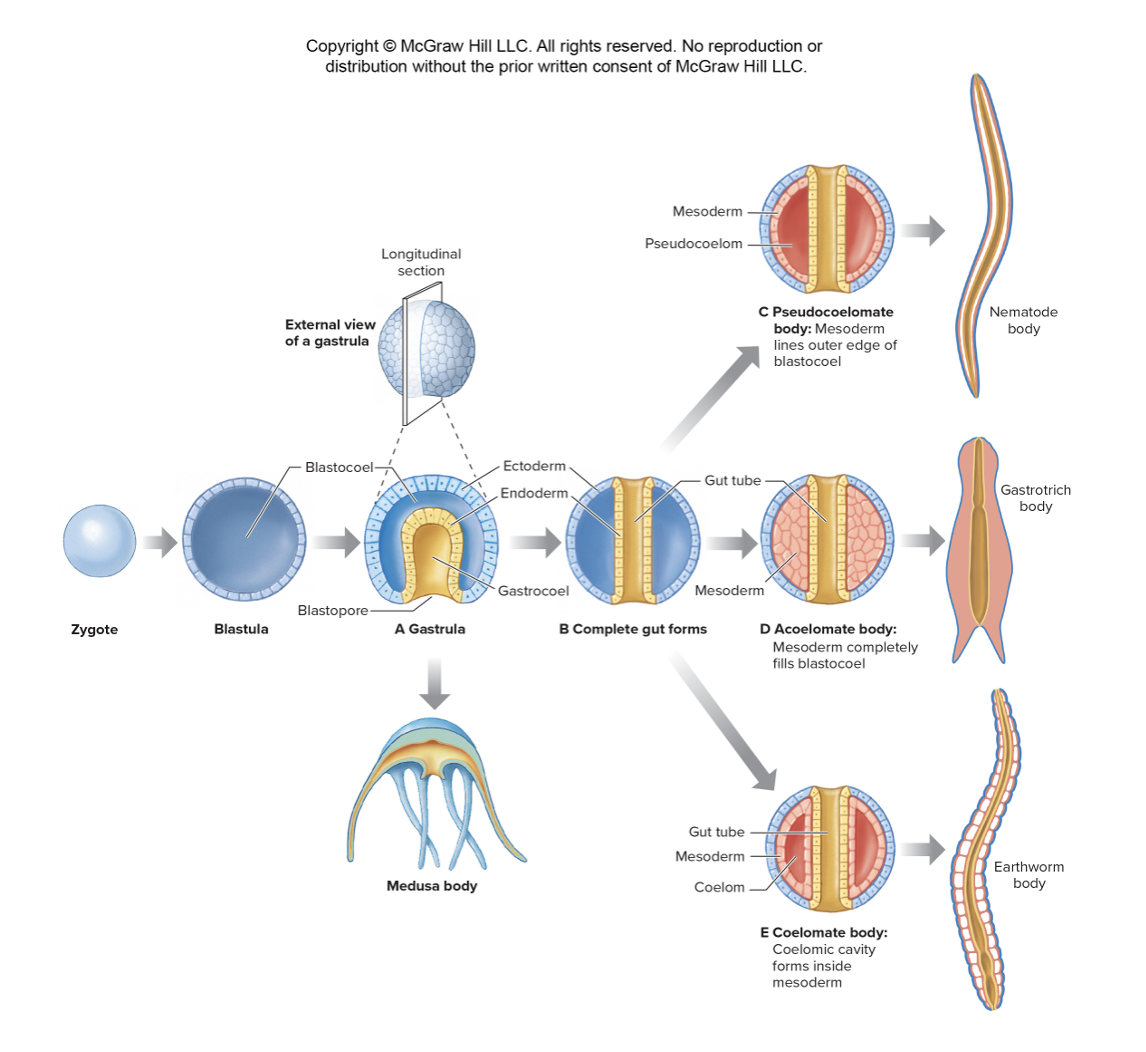
Animals that have a coelom with complete body lining - peritoneum
Peritoneum
Derived from mesoderm
Covers inner and outer edges of cavity
Most bilaterally symmetrical animals and coelomates
Acoelomates
Lack fluid filled cavity between body wall and digestive tract
Mesoderm completely fills area b/w endoderm and ectoderm
Pseudocoelomates
Mesoderm lines ectoderm but not the endoderm - so body cavity is not derived from mesoderm
No peritoneum
“False coelomates“
Development of zygote to form coelomates, acoelomates, and pseudocoelomates
Triploblastic Bilateria
Most animal phyla are bilaterally symmetrical and develop from 3 germ layers
Deuterostomes
Development starts with radial regulative cleavage
Blastopore becomes anus
Second opening becomes the mouth
Has coelom
Includes 3 phyla: Echinodermata, Hemichordata, and Chordata
Protostomes
Development begins with spiral mosaic cleavage
Blastopore forms the mouth
Anus forms secondarily
Includes acoelomates, pseudocoelomates, or even coelomates (depending on the group or species)
Example: Flatworms, earthworms, insects, etc.
Epithelial Tissue
Covers the internal and external surface of organs, body cavities, ducts and other passages through which material passes, more often a mucus lining
Functions: Separates one body region from another
Supported by a basement membrane, mostly made up of collagen - ECM
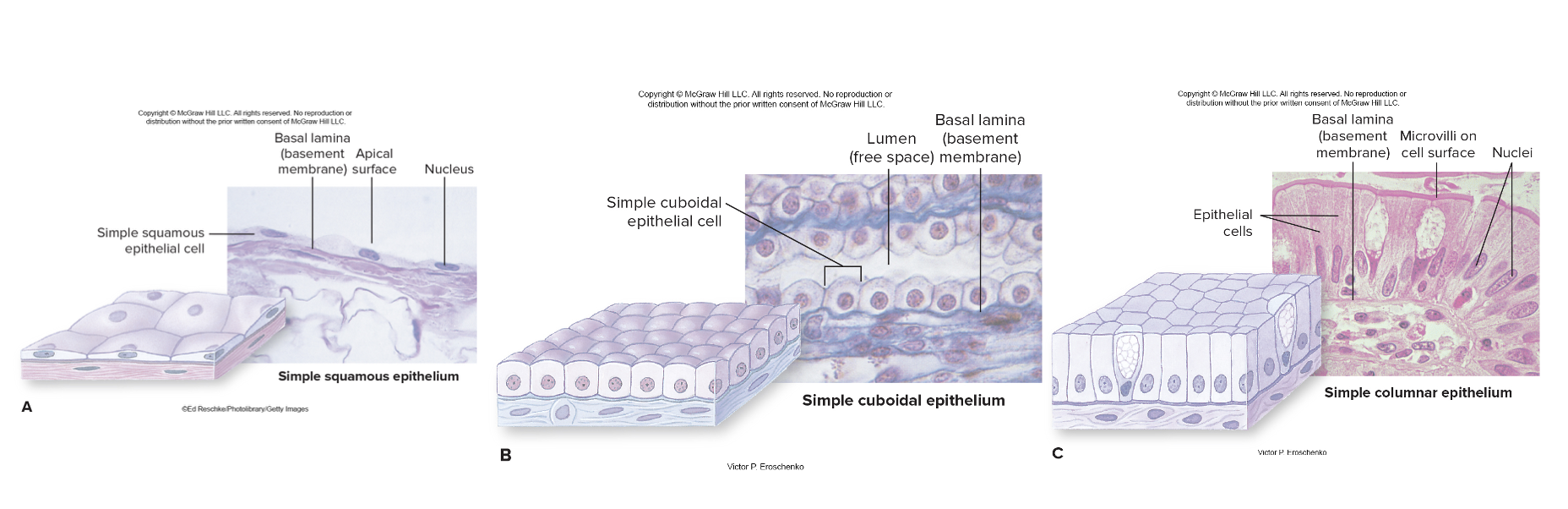
Types of epithelial tissue
Single squamous epthelium
Simple cuboidal epithelium
Single columnar epithelium
Connective tissue
Supportive tissues spread in different types throughout the body to support, protect, aid in transport, storage amongst other functions
Has few cells but many extracurricular fibers (collagen) and ground substance
Types:
Connective tissue proper: loose areolar connective tissue vs. dense connective tissue
Cartilage
Bone
Blood
Muscle
Made up of muscle fibers for contraction
Facilitates movement
Smooth muscle
Involuntary movement like digestive system
Striated muscle
Voluntary movement like in skeletal muscle and involuntary like cardiac muscle
Nervous
Regulation and control of various bodily functions: impulses sent from one part of teh body to another
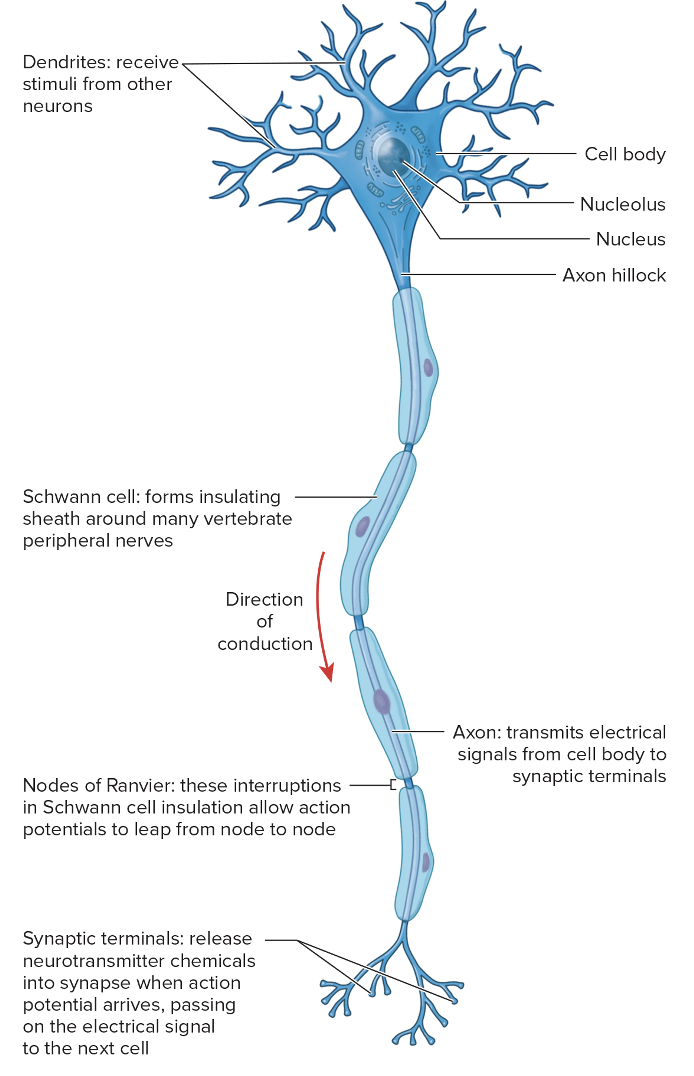
Neuron
transmits electrical signals
Can perceive and respond to various stimuli
Neuroglia
Supportive cell for neurons for nourishment and protection