Chapter 21 - Organic chemistry
 Call Kai
 Learn
Learn Practice Test
 Spaced Repetition
 Match
Match Flashcards
 Knowt Play
1/93

There's no tags or description
Looks like no tags are added yet.
Name | Mastery | Learn | Test | Matching | Spaced | Call with Kai |
|---|
No analytics yet
Send a link to your students to track their progress
94 Terms
Organic chemistry
the study of compounds of carbon
Hydrocarbons
are defined as compounds containing only carbon and hydrogen.
3 types of hydrocarbons
alkanes, alkenes, alkynes
saturated compound
A saturated compound is one in which there are only single bonds between the atoms in the molecule.
unsaturated
An unsaturated compound is one that contains one or more double or triple bonds between the atoms in the molecule.
Alkanes
CnH2n+2 i.e if n = 5 or then C5H(2)(5) + 2 = C5H12 or pentane
List of Alkanes
methane, ethane, propane, butane, pentane, hexane, heptane, octane, nonane, decane
Need to knwo alkanes
Methand, ethane Propane, Butane Hexane
Alkanes
Consist of only single carbon-carbon bonds.
Compounds with only single carbon-carbon bonds are referred to as saturated.
All carbons are tetrahedral.
Boiling points: Low due to (Van Der Waals) but increase with molecular size.
The Alkane family have many similar properties, so we call them a homologous series.
Application - Fuel (methane)
Homologous series
- A series of compounds of similar chemical properties
- SHowing gradation in physical properties
- Having general formula for its memebers
- Each member having a similar formula
_ each member having a similar method of preperation
Structural isomers
Compounds with the same molecular formula but different structural formula
What is used to help name alkanes
Side - chains grouos of atoms attatched to the main carbon chain
Alkyle group - an alkane atom from which a hydrogen atom has been removed
1. Methyl - CH3
2. ethyl group - C2H5
3.Propyl group - C3H7
What happens when the same alkyle group is present more than once
- Present twice - di
- Present thrice - tri
How to name an alkane
- Check how manycarbons in the main chaine
- Check for alkyl groups - is it Ch3 or C2H5 or C3h7
- Check what group of carbons the side chain is attatched to
How to number alkane chains
Identify the side which is closer to the side chain and then number it from there
How to name alkane chain with two different substients
First state at what carbon the first substient is at (3) and then (0f ot occurs more than one time state di or tri) then state the substients name
- For different substients individually do it
Draw the full structural formula and give the systematic name of the following?
CH3CH(CH3)CH3
The bracket is where ths ide chain is
Alkenes
Hydrocarbons with one or more carbon-carbon double bonds
how to name alkenes
- With alkenes change the ending to ene
- And the formula fpr the H in ch is CnH2n so C4 = C4h8
alkenes list (Note: On this course you need to only be concerned on how to draw the first three alkenes when giving molecular formula).
Ethene - C2H4, Propene - C3H6, Butene - C4H8, Pentene - C5H10 etc. Methane cannot be an alkene
alkene properties
Consist of one double carbon-carbon bond. Classified as unsaturated.
Boiling points: Low due to (Van Der Waals) but increase with molecular size.
The C=C bond is planar.
Application: Ethene is used to ripen bananas.
How to name alkenes
Identify longest chain (must contain double bond) & identify prefix based on no of carbons.
Add -ene.
Insert number before -ene to indicate which carbon the double bond belongs to (choose smallest number).
Name & state location of any branches (same rules as for alkanes).
1. State where the branch chane is and identify the tyoe or whether there is on two or three
2. Idemtify the longest chain and then state how many cabrons i.e 6 = hexene
3. Identify where the bonding occurs or where it starts if at C4 then its hex 4 ene
start numbering based on the side which has the bond
Alkynes properties
Consist of a triple bond.
Highly unsaturated due to triple bond
Ethyne (C2H2) is the only alkyne you need to study.
Application: Welding and cutting (Ethyne "acetylene torches").
Prepare ethane and examine its properties
- Using aluminum oxide this acts a dehydrating agent and is a catalyst for the reaction it acts as a dehydrating agent and also a catalyst for a reaction
Prepare ethane and examine its properties - Key steos
- Ethanol is poured into a boiling tube
- Glass wool is placed in this tube and
- The glass wool soaks up the ethanol and holds its in place at the end of the horizontal tube
- A small heap of aliminium oxide is placed in the middle of the tube half way along
- It is gently burned using the bunses burner
Prepare ethane and examine its properties - Observations
- Bubbles are formed in the test tube because ethano,changes into vapour as the aliminium oxide is heated. The ethanol changes into vapour and passes over the aliminium oxide
Prepare ethane and examine its properties - After experiment
5 test tubes of this gas are collected and a stopper is placed on each test tube
- The retots stand is loosened and raises up the apparatus
Suckback
-Occurs when delivery tube is still in water and removed Cold water is sucked along a delivery tube into the glass reaction vessel causing it to crack. This
happens if the source of heat is removed when the delivery tube is still in the water. A partial
vacuum occurs in the reaction vessel due to cooling of the gases in the closed tube,
What does the first tube contain
The first tube usually contains air displaced by the apparatus
Tests on ethene - Physical properties
- Ethene is a colourless gas with a sweet smell
- It is insoluble in water but soluble in chlorolm
Tests on ethene - Combustion
- Stopper removed from one of the test tubes using a lighted wax taper a light is applied to the mouth of the tube
- When gas has stopped burning some limewater is added to the test tube
- The gas burns with a yellow luminous flame - the flame can be described as slightly smokey
Tests on ethene - Adding Bromine
- Bromine is added to ethene
- Then the bromibe red water turns colourless it test the unsaturation of ethenses as ethenes and alkenes have a double bond
Test on ethene - Permangenate
Permangenate is added to the test tube and it turns from purple to colourless this is because it shows that ethane is a unsaturated compound
Alkynes
Change the ane to yne
- And is written in the formula as CnH2n-2
Need to know alkyne
ethyne (colourless and sweet smell)
To prepare ethayne andd examine its properties
Prepared using calcium dicarbide
To prepare ethayne - safety
Since ethyne is a hughly flammable gas no flame should be placed near the gas
To prepare ethayne - Procedure
- Calcium carbude is placed using a spatula in the buchner flask with a water dropper funnel on top
- a delivery tube is connected to a breaker containing acified copper sulfate to remove impurities such as hydrogen sulfide
To prepare ethyne observation
- Calcium dicarbride is a black grey solid
- When the water is ddropped into the reaaction flask ut starts tunring a milky white colour because calcium hydroxide is forming
- Bubbles of gas collect in the glass jar
To prepare bromine - what was observed when a few drops of dilute bromine was added to to the solution
A colour chnage from brown to colourless
What was observed when a few drops of acidified dilute potassium mangenate
Turns from purple tp colourless
Describe a est u could carry out to show that ethyne is an unsaturated compound
Adding acidified pottasium permangenate
Describe how to confirm that ethyne gas is flammable
Insert the lightenning tape into the tube it shiwcases that ethane is flammabke
- A luminous smoky flam is conceived and black soot is formed
What gas burns with a cleaner flame
Ethene because it does not have soot
Large scale use of ethyne
# wielding and cutting
.Structural Isomers
Structural isomers are compounds with the same molecular formula but different structural formulas.
Structural Isomers - how to draw
Alkanes - Remove a CH3 (methyl group) from end of a molecule and place in the middle.
Alkenes - Place the double bond on a different carbon.
- Remove a CH3 (methyl group) from end and place in the middle i.e. C4H8
Crude oil
(petroleum) is a fossil fuel that has been obtained from under the sea and hasn't been treated yet. Crude oil needs to be processed to be used efficiently as a fuel.
Fractional Distillation
Is used to separate crude oil into a number of useful parts. This process involves heating the crude oil and separating the various parts based on their boiling point.
Smaller hydrocarbons:
Low boiling points - separate at the top fractions.
Larger hydrocarbons:
High boiling points - separate at the bottom fractions.
Refinery gases:
methane, ethane, propane and butane.
Mercaptans
(sulphur compound) are added for safety to provide a smell so that leaks can be detected.
LPG
Liquefied Petroleum Gas (LPG): Propane and Butane.
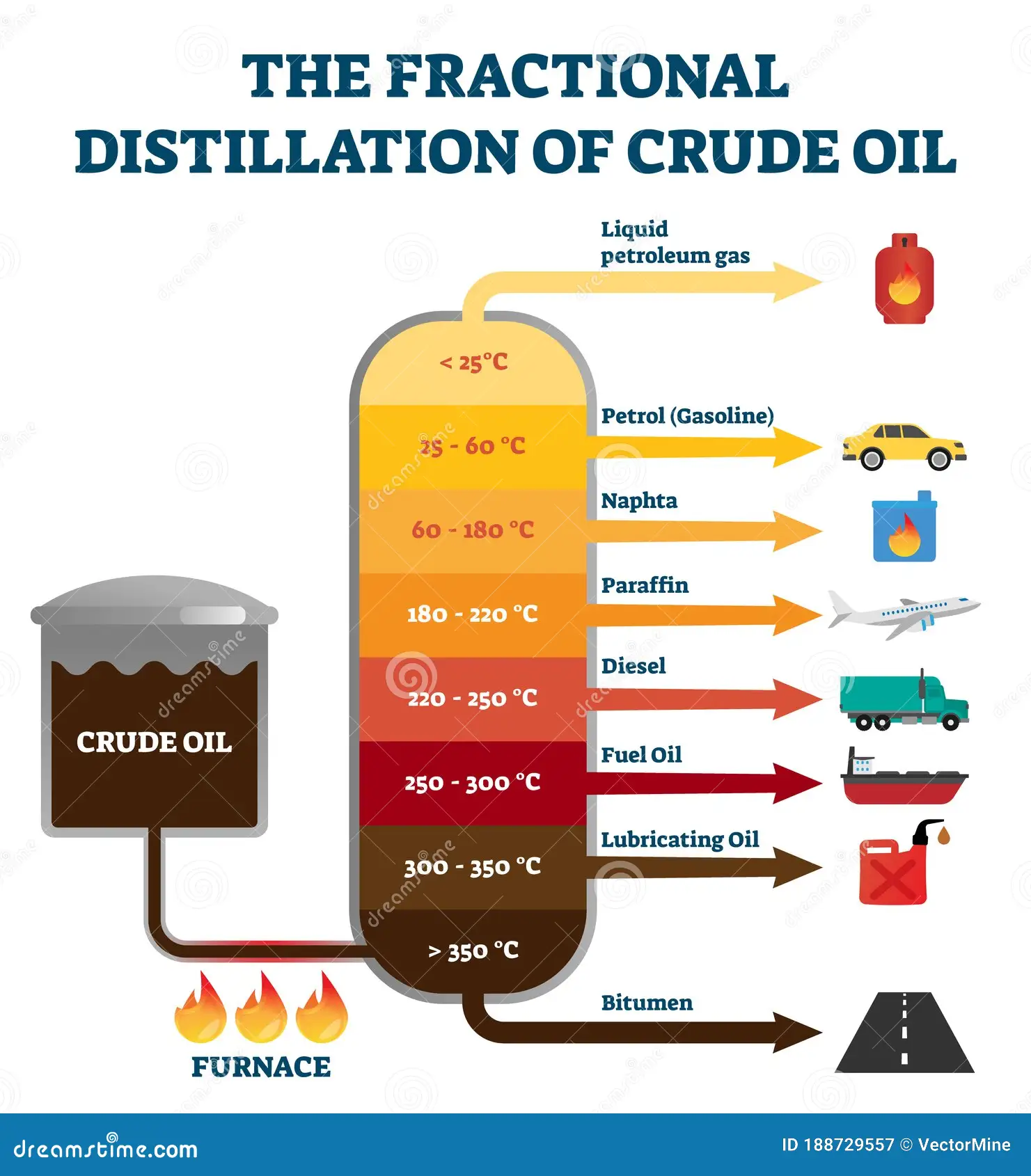
Fractional distillation diagram and how it works
1, Hot vaporised crude oil enters the bottom of the column.
The column has a high temperature at the bottom and a low temperature at the top.
Larger molecules have higher boiling points than smaller molecules.
Larger molecules condense and are collected near the bottom of the column.
Smaller molecules condense and are collected further up the column where it is cooler.
Background how petrol powers a car
Petrol is pumped into engine, vaporised and mixed with air.
Mixture is compressed by a piston and ignited by the spark plug.
On combustion the gases produced expand and cause the piston to move (kinetic energy produced).
When a petrol engine uses a fuel with a low octane number the fuel can auto-ignite which can cause.
Damage to car
Loss of power to the car.
How octane number of fuel measured
The octane number of a fuel is a measure of the tendency of the fuel to resist knocking.
Auto-ignition
Auto-ignition is premature ignition (explosion) of the petrol-air mixture before spark is produced.(knocking)
Higher octane number
The higher the octane number the better the fuel.
Two reference hydrocarbons in relation to octane number.
2,2,4-trimethylpentane (iso-octane) : 100 (83:17 reference mixture)
Heptane: 0
Factors affecting Octane number
Length of chaine
degree of branching the more branching a hydrocarbon has the higher its octane number
straight chain or cyclic nature
lead (no longer used as it is a cata,lyctic converter pouson)
increasing the octane number.
Isomerisation - The changing of long straight chained alkane into its isomers - more branched.
2. Catalytic cracking - Splitting long chained hydrocarbons into short chain molecules using a catalyst. Note: An alkene is always produced.
Catalyctic cracking
- catalytic cracking involves heating the hydrocarbon molecules to around 600 - 700°C to vaporise them
- the vapours then pass over a hot powdered catalyst of aluminium oxide or silica
- this process breaks covalent bonds in the molecules as they come into contact with the surface of the catalyst, causing thermal decomposition reactions
- the long-chain alkane molecules are broken up in a random way which produces a mixture of smaller alkanes and alkenes
Increasing the octane number.
3. Dehydrocyclisation: Forming of ring compounds, hydrogen gas is always given off.
4. Adding oxygenates - Adding methanol, MTBE (Methyl Tertiary Butyl Ether) and ethanol are added to petrol.
Note: Adding oxygenates has an advantage of less pollution.
Two methods to produce hydrogen.
Steam reforming of natural gas
Electrolysis of water.
Steam reforming of natural gas.
Methane + Steam = Hydrogen + carbon monoxide
CH4 + H20 —> 3H2 + COMethane + Steam = Hydrogen + carbon monoxide
CH4 + H20 —> 3H2 + CO
2. Electrolysis of water
Water + Electricity = Hydrogen +Oxygen
H2O —> H2 + ½ O2
Advantages of hydrogen
- Produces a lot of energy
- burns cleaner than hydrocarbons
disadvantage
Explosive very little green hydrogen left
Uses of hydrogen
use to produce ammonia
Use to hydrogenate vegetable oils to produce margarine
Burned as a fuel because it is environmentally friendly it only waste product is water
Exothermic
An exothermic reaction is one that releases heat energy energy exists the system it feels hot
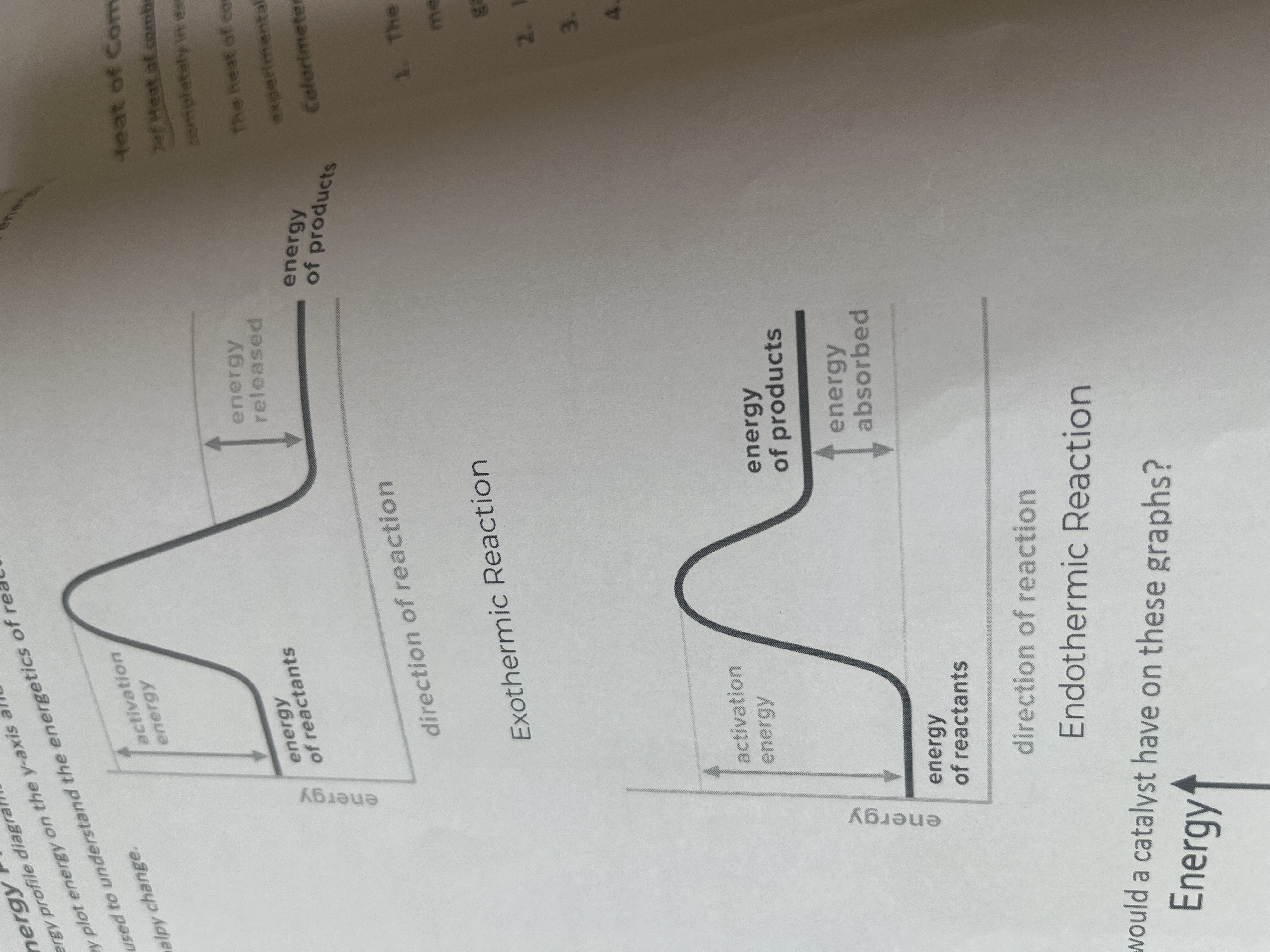
Endothermic
Reaction is one that absorbs heat and energy
Hear of reaction
is the heat change when the number of moles of the reactants indicated in the balanced chemical equation for the reaction to react completely
If H value is negative
If the h value is negative the reaction is exothermic and it gets hotter
If the h value is positive
If the h value is positive the reaction is endothermic and gets cooler
Energy profile diagrams
Energy profile diagrams offer us a way of visualising the changes in energy during a reaction
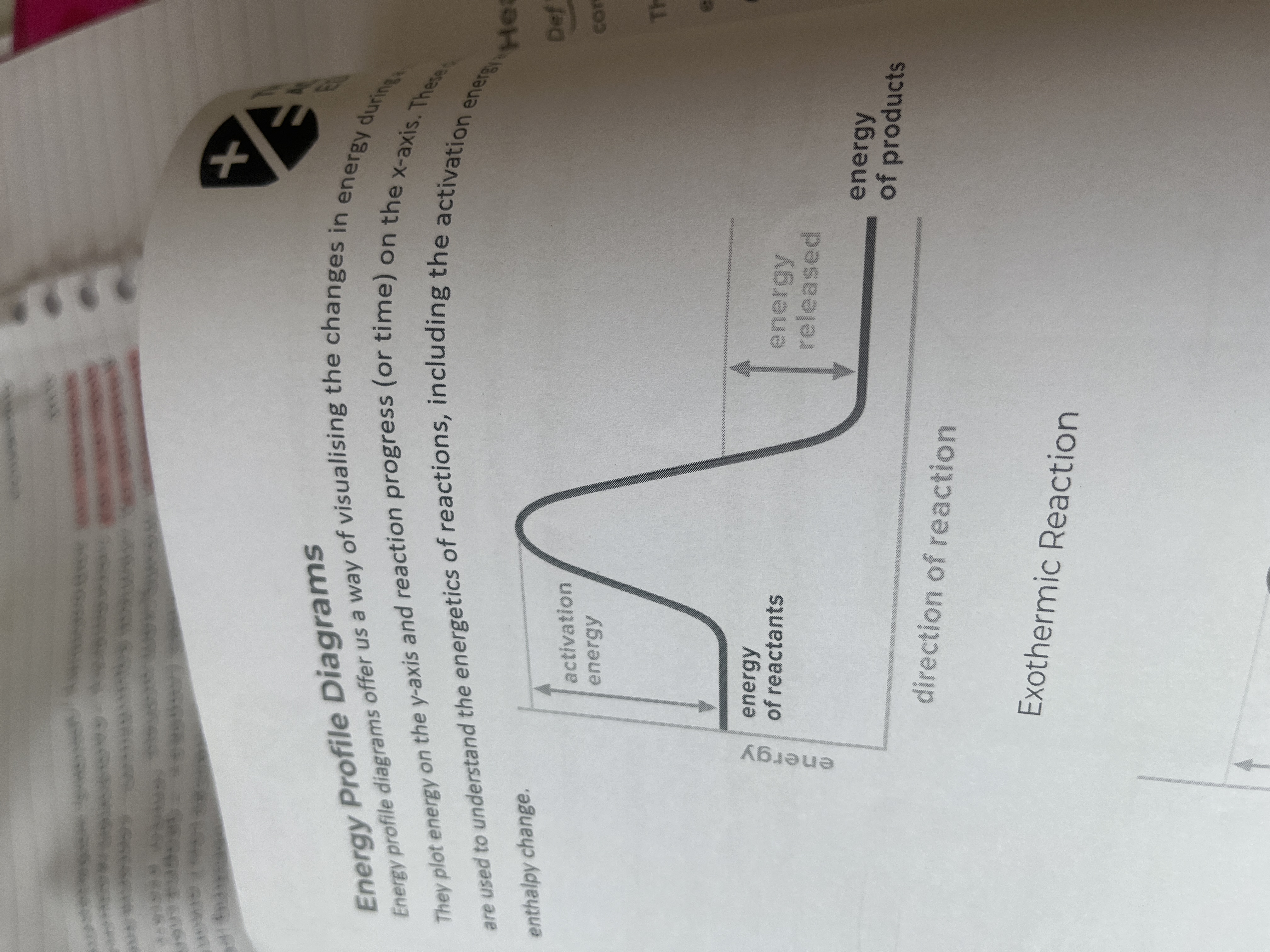
Exothermic reaction
Endothermic reaction
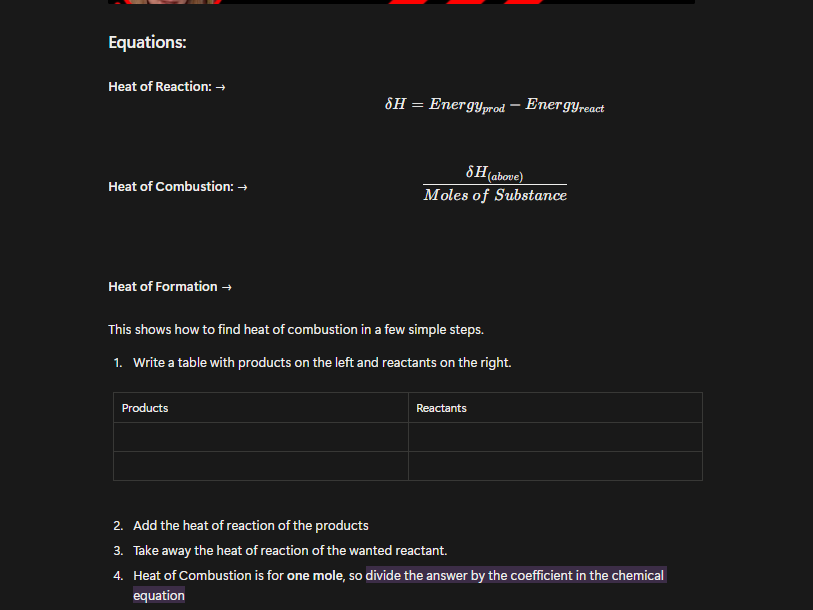
Heat combustion
The heat change when one mole of a substance is burned in completely in excess oxygen
How can the heat of combustion of a substance can be experimentally measured b
The heat of combustion of a substance can be experimentally measured using a Bomb Calorimeter
The steps of using Bomb Calorimeter
the sample to be tested is placed into a metal bomb along with pressurised oxygen gas
Ignition wires ignite the sample
The burning sample heats the water up
The stirrer ensures the heat is evenly spread
Then the thermometer reads the increase in the water temperature
The heat of combustion formula
Q = mc (t)
Q = heat energy
M = mass is f water (g)
C = specific heat capacity
Triangle + t = temperature change
Kilogram calorific value
The kilogram calorific value of a fuel is the heat energy produced when 1 kg of the fuel is burned completely
Writing balanced equations for heat of combustions
All hydrocarbons need oxygen to clmvusbahd the products formed will always be carbon dioxides and water
Writing balanced equations for heat and combustions
Fuel + O2 = Co2 + H2O
Balanced equation for propane
C3H8 + O2 - Co2 + H2O
How to balance equstions
Balance the c then the h then the o
Bond energy - where does h come from
H comes from the fact that in a reaction covalent bonds are broken and new ones are formed breaking bonds required energy making bonds releases energy
By calculating how much energy is needed to bank the bonds and how much energy is given off by making the new bonds we can calculate h
Bond energy
The average energy required to break one moles of a particular covalent bond and to separate the neutral atoms completely from eachother
Heat of neutralisation
The heat change when one moles of H + ions from an acid reacts with one mole of OH ions from a base
The heat of formation
The best of
Hess Law
tates that regardless of the multiple stages or steps of a reaction, the total enthalpy change for the reaction is the sum of all changes. (Enthalpy is the heat energy of a whole system
how to do the calculations
hf