Veterinary accreditation- why should I care
 Call Kai
 Learn
Learn Practice Test
 Spaced Repetition
 Match
Match Flashcards
 Knowt Play
1/15

There's no tags or description
Looks like no tags are added yet.
Name | Mastery | Learn | Test | Matching | Spaced | Call with Kai |
|---|
No analytics yet
Send a link to your students to track their progress
16 Terms
Licensed veterinarian vs accredited veterinarian
State: Licensed veterinarian" means a person licensed by the
board to practice veterinary medicine.
Federal: Accredited veterinarian” means a veterinarian approved by the deputy administrator of veterinary services, Animal and Plant Health Inspection Service (APHIS), United States Department of Agriculture (USDA), and the state veterinarian…
What do other countries use mostly to examin animals
Most other countries use government veterinarians (however defined) to examine animals and issue Health Certificates
What are the accreditation requirements
• Graduate with a DVM or equivalent degree
• Attend/achieve Initial Accreditation Training (IAT)
• Attend core orientation
• Submit application for Vet. Accred. VS form 1-36A
• Be licensed in the state of accreditation
• Attend Supplemental Orientation as needed
Accreditation is voluntary but what 3 things can only be done through a accreditation
• Issuing health certificates (health papers)
• Any fair with out-of-state animals, import/export requirements
• Submit diagnostic samples for certain (common)
diseases
• Administering rabies immunizations
• And signing an official Rabies Certificate
Why is accreditation important for both theveterinary profession and our national interests?
• First line of national defense against threats to US agriculture
• Private DVMs act as legal agents of the Federal Government
• As opposed to creating another layer of redundant competition
• Force-multiplier against foreign animal disease incursions
• Expands our network of surveillance, detection and response
• Perform Examinations, Tests, Certifications for local, regulated diseases
• Ensures uniformity of national disease control programs
• Provides material resources and on-going continuing education to
practitioners
Foreign animal disease FAD
• An important transmissible livestock or poultry disease believed to be absent from the United States and its territories that has a potential significant health or economic impact
Impact of animal disease on animal health
Death, illness, loss of production
Impact of animal disease Economics
• Loss or disruption of trade
• Loss of consumer confidence
• Movement restrictions
Impact of Animal disease Human heath
• Zoonoses
• Mental health
What is the general role of the accredited veterinarian
Keep diagnostic skills sharp
Know which disease are reportable
Likely based on clincal signs and history… not diagnosis
Maintain biosecurity
Report suspect to:
USDA Area Veterinarian in charge (AVIC)
DO NOT
pursue definitive diagnosis
Submit samples for testing
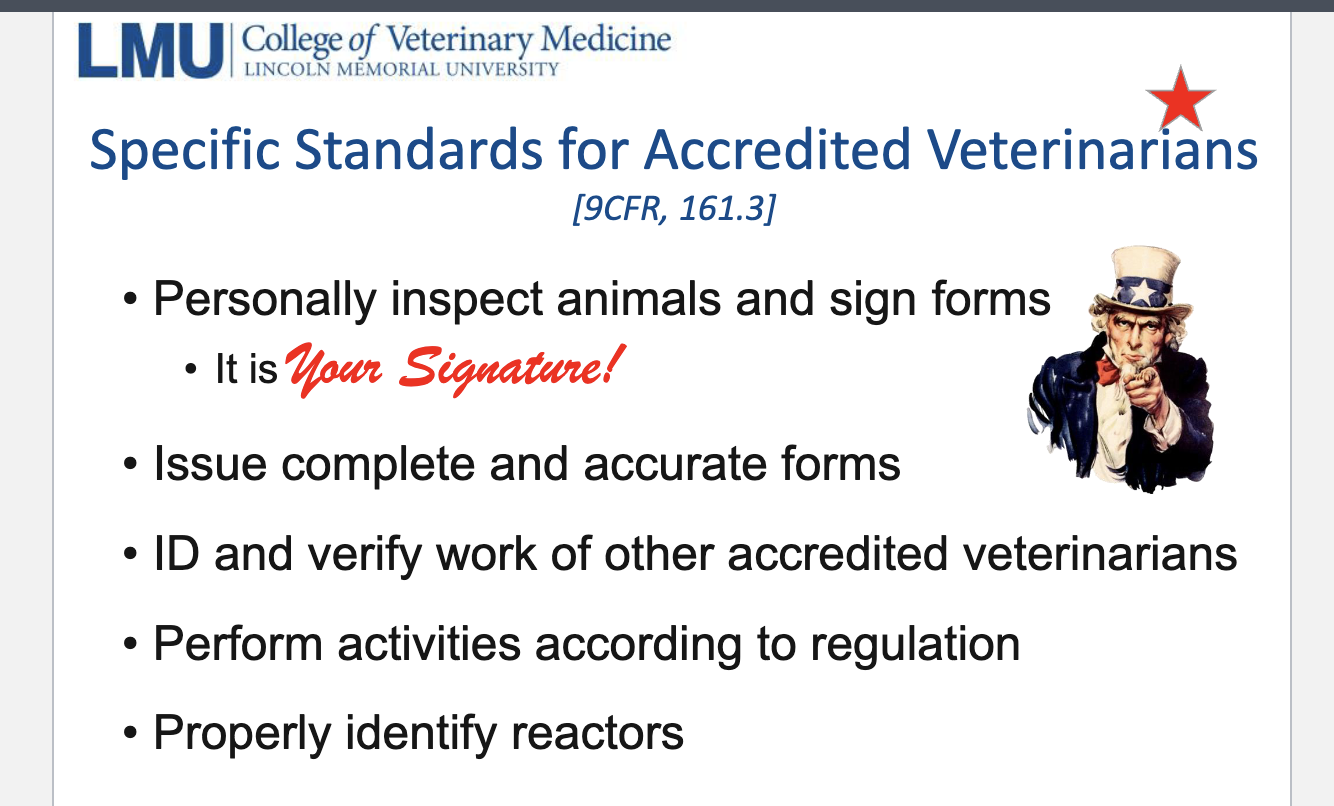
standards for accredited vets
Personally inspect animals and sign forms
• It is Your Signature!
• Issue complete and accurate forms
• ID and verify work of other accredited veterinarians
• Perform activities according to regulation
• Properly identify reactors
Specific standards for accredited veterinarians
• Assist with interstate and international
movement of animals and animal products
• Assess and document animal health through
• Physical examinations
• Diagnostic testing (e.g. TB tests)
• Diagnostic sample submission
• Documentation
What do accredited practitioners get in return?
• Diagnostic and laboratory support to your practice
• Animal movement facilitation
• Exhibition/Fair facilitation
• Current info on diseases of significance/vulnerability
• Tailored presentations to veterinary audiences
• Continuing education (required for license renewal)
• ‘Get out of jail free’ card in case of an FAD incursion
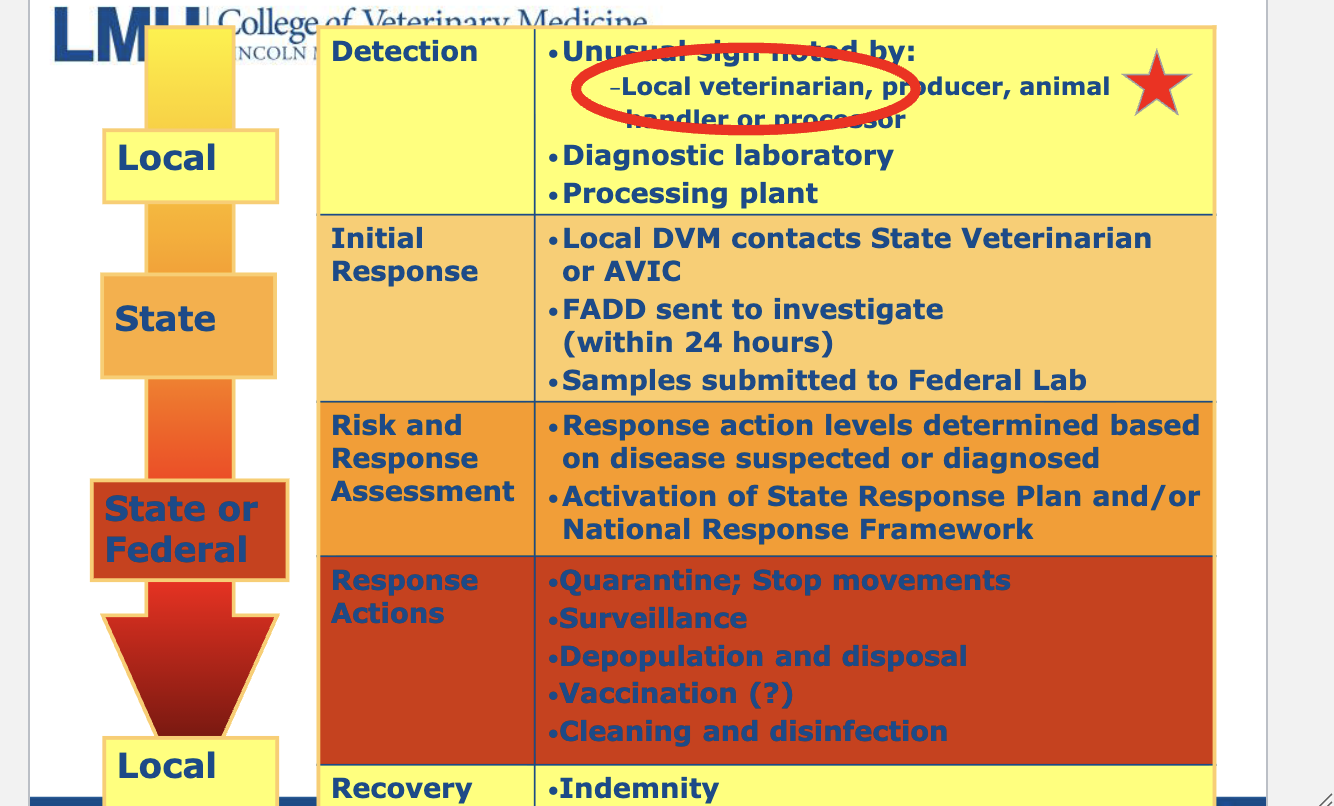
World Organisation for Animal Health (OIE)
• Early Warning System
• Disease reported within 24 hours
• Informs countries at risk
Trade shut down
until further notice
FADD Investigation
Foreign Animal Disease Diagnostician
• Visits premise within 24 hours
• Inspects animals
• Consults with State Veterinarian & AVIC re actions
• Sample collection, handling, submission
• Control measures: movement restrictions & quarantine