Final General Bio II Review
 Call Kai
 Learn
Learn Practice Test
 Spaced Repetition
 Match
Match Flashcards
 Knowt Play
1/51

There's no tags or description
Looks like no tags are added yet.
Name | Mastery | Learn | Test | Matching | Spaced | Call with Kai |
|---|
No analytics yet
Send a link to your students to track their progress
52 Terms
What is alternation of generations?
The reproductive life cycle where organisms alternate between a diploid (2n) asexual phase (sporophyte) and a haploid (1n) sexual phase (gametophyte).
In alternation of generations, what happens when meiosis occurs?
The sporophyte produces/ releases haploid spores.
In alternation of generations, what happens when fertilization occurs?
The gametes fuse to form a zygote.
In gymnosperms and angiosperms, what are the male and female gametophytes?
Male gametophytes = pollen grain (produces sperm)
Female gametophytes = Ovule tissue (gymnosperms) OR Embryo sac (angiosperms) [produce eggs]
Are spores haploid or diploid?
Haploid
Are zygotes haploid or diploid?
Diploid
What is gametangium?
A specialized organ or cell in which gametes are produced.
What are the two gametangia?
Antheridium (sperm producing structure)
Archegonium (egg producing structure)
What is heterospory?
The production of microspores → male gametophytes
AND
The production of megaspores → female gametophytes
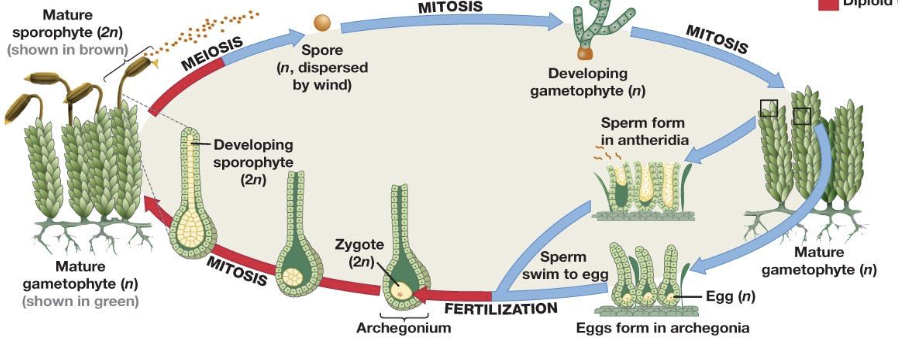
What plant type does this lifecycle belong to?
Nonvascular plants (Bryophytes)
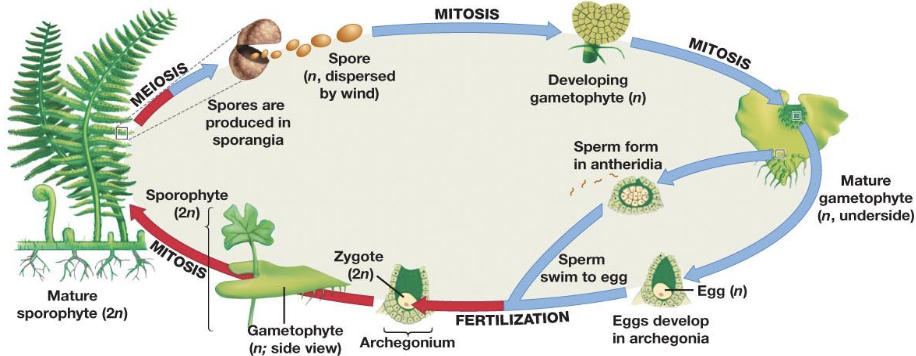
What plant type does this lifecycle belong to?
Seedless vascular plants (Ferns)
How to identify a monocot?
Has a single cotyledon
Veins are parallel
Scattered vascular bundles (the holes in the stems)
How to identify a dicot (eudicot)?
Has two cotyledon
Veins are net-like
Vascular bundles are shaped like a ring (the holes in the stems)
What are the three primary meristems?
Protoderm → Dermal Tissue
Ground meristem → Ground Tissue
Procambium → Vascular Tissue
What are components of the dermal tissue and their functions?
Cuticles → Prevention of water loss
Stomata → Gas exchange
Trichomes → Protection
What are components of the ground tissue and their functions?
Parenchyma → Photosynthesis occurs in shoot system and it stores starch in root system
Collenchyma → Provides plant support during growth
Sclerenchyma → Provides plant support when they cease to grow
What are components of the vascular tissue and their functions?
Xylem → Transports water
Phloem → Transports sugar
What is primary growth?
The growth at apical meristems that leads to longer roots and shoots.
What is secondary growth?
The growth at lateral meristems that leads to a thicker, woodier plant.
Apical meristems
They are actively dividing undifferentiated stem cells located at the tips of plant roots and shoots, responsible for primary growth.
Lateral meristems
They are actively dividing undifferentiated stem cells located along the sides of stems and roots, responsible for secondary growth.
What are hypae?
The individual threat filaments that make up fungi.
What is mycelium?
A large network of hypae.
What is chitin?
Chitin forms the outer layer of fungal cell wall and provides strength and stability.
What phases do fungi go through during asexual reproduction?
Mitosis → spores
Germination → Mycelium
What phases do fungi go through during sexual reproduction?
Meiosis → Spores
Germination → Mycelium
Plasmogamy → Heterokaryotic cell
Karyogamy → Zygote
What does heterokaryotic mean?
When hyphae contain several haploid nuclei from different parents.
What are diploblasts?
Animals whose embryos have two types of tissues.
The ectoderm (outside skin)
The endoderm (inside skin)
What are triploblasts?
Animals whose embryos have three types of tissues.
The ectoderm (outside skin)
The endoderm (inside skin)
The mesoderm (middle skin)
What is the function of the ectoderm in triploblasts?
It gives rise to skin and the nervous system.
What is the function of the endoderm in triploblasts?
It gives rise to the lining of the digestive tract.
What is the function of the mesoderm in triploblasts?
It gives rise to the circulatory system, muscle, and internal structures such a bones and most organs.
What type of organisms are diploblastic?
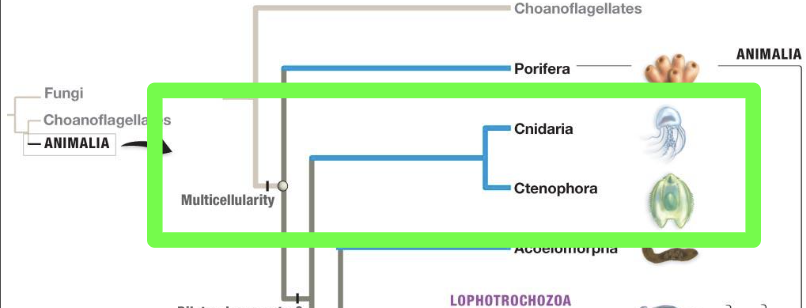
Cnidarians and ctenophores (which are like jellyfish, coral, sea anemones, comb jellies, etc.)
Why was the evolution of the mesoderm important?
Because it gave rise to the first complex muscle tissue used in movement.
What are the nervous systems for diploblasts vs. for triploblasts?
Diploblasts have nerve nets
Triploblasts have a centralized nervous system (CNS)
Which type of organisms have radial symmetry and which have bilateral symmetry?
Diploblasts have radial symmetry
Triploblasts have bilateral symmetry
What is ganglia?
Clustered neurons in the CNS
What is cephalization?
The development of a head region where structure for feeding, sensing the environment, and processing information are concentrated.
What is another word for cerebral ganglion?
The brain
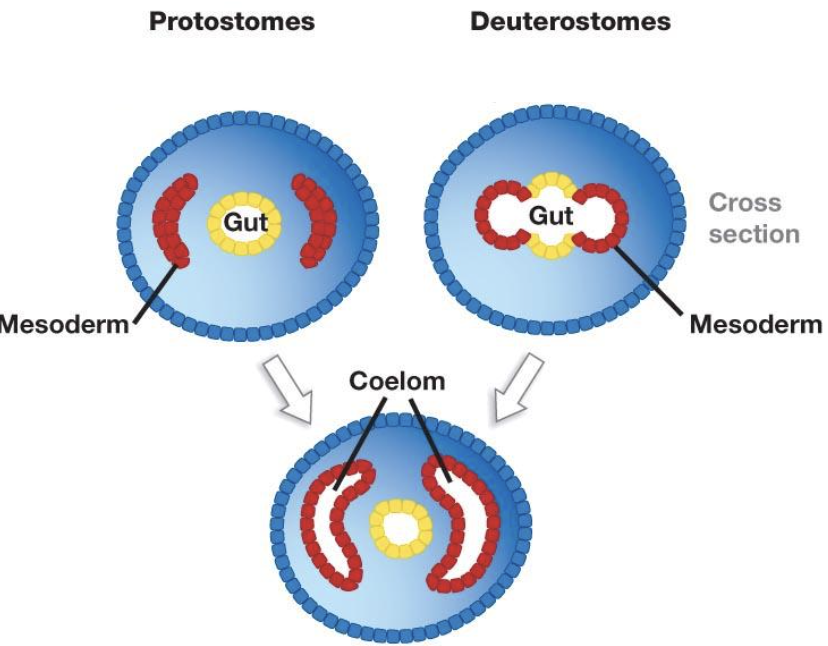
What is the difference between acoelomates, coelomates, and pseudocoelomates?
Acoelomates have no fluid filled enclosed body cavity
Coelomates have a fluid filled enclosed body cavity completely lines with mesoderm
Pseudocoelomates are only partially lined mesodermally so its just one fluid filled body cavity
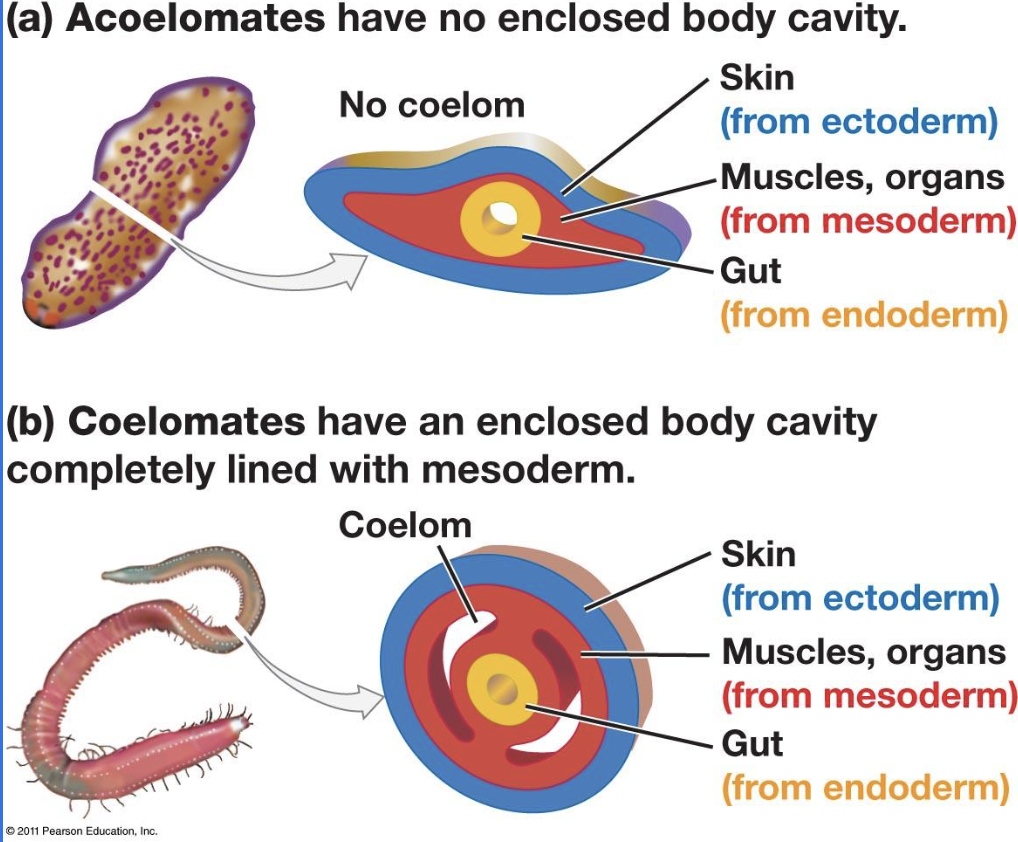
How do coelum and a hydrostatic skeleton work together and for what purpose?
The coelom creates a container for circulation of oxygen and nutrients
The hydrostatic skeleton allows soft-bodied animals to move without fins or limbs
They allow bilaterally symmetric organisms the ability to move more efficiently in search of food
What is gastrulation and how does that process differ between the protostomes and deuterostomes?
Gastrulation is the formation of gut and embryonic tissue layers
Protostomes develop their gut from mouth to anus
Deuterostomes develop their gut from their anus to mouth
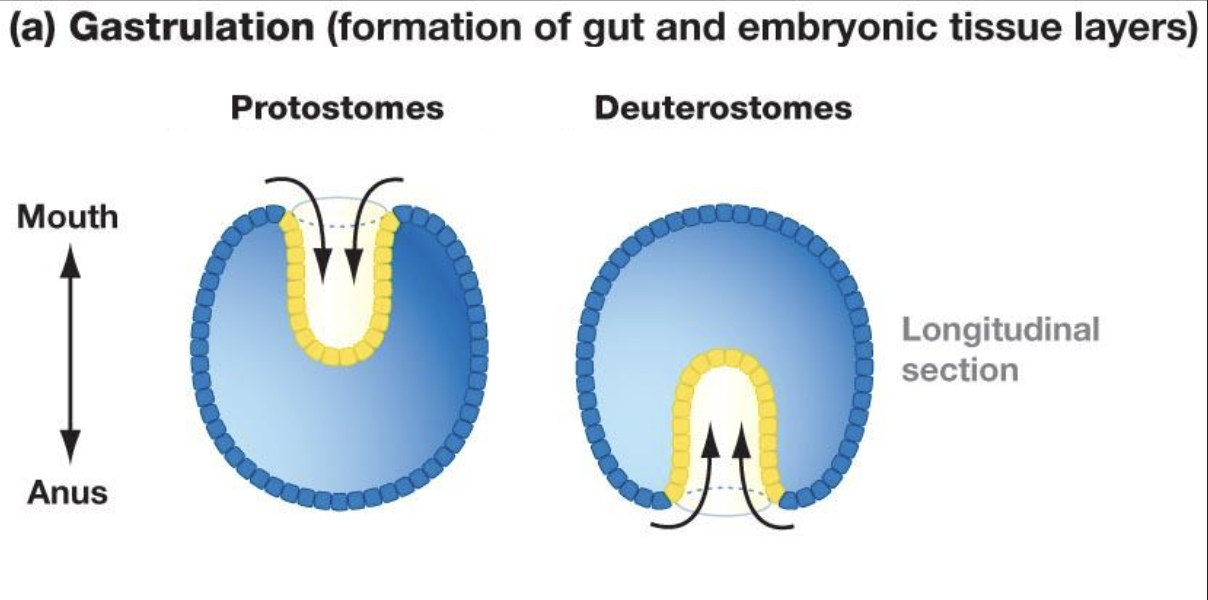
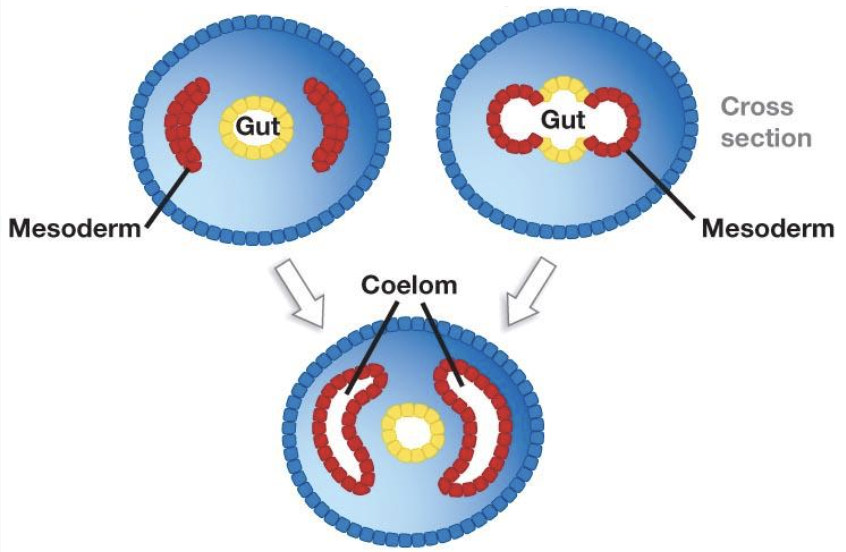
Which one is a protostome and which is a deuterostome?
Left one is a protostome and the right is a deuterostome
What are the four different types of feeders
Suspension/filter feeders (captures and filters food in the air)
Deposit feeders (digests organic matter from soil)
Fluid feeders (sucks liquids like nectar, sap, blood, or juice)
Mass feeders (takes chunks of food into their mouths)
What are the functions of movement in adult animals?
finding food
finding mates
escaping from predators
What are the two types of limbs?
Unjointed and jointed
What are the types of animal life stages?
Larve
Juveniles
Adults
What is tube-within-a-tube describing?
The basic body plan design of like an inner tube within an outer tube
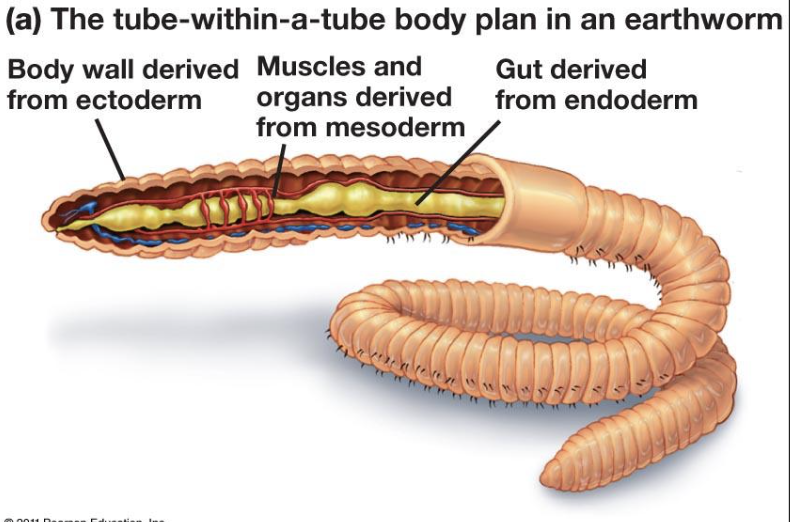
What is the closest living relatives to animals?
The group of protists calls choanoflagellates
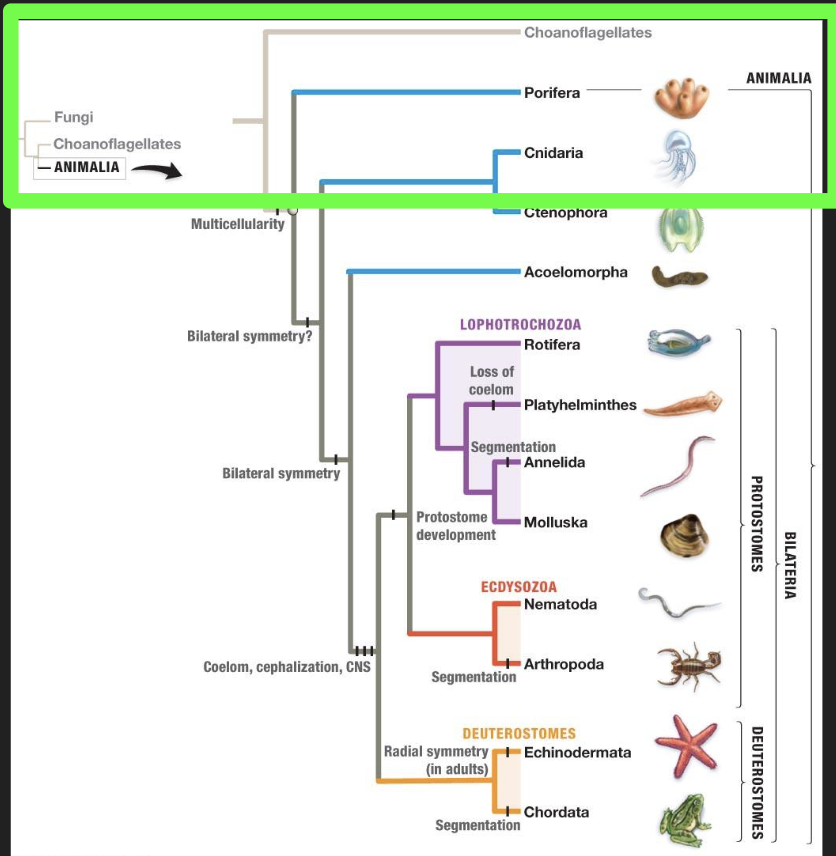
Which group is the sister group to all other animals?
Sponges
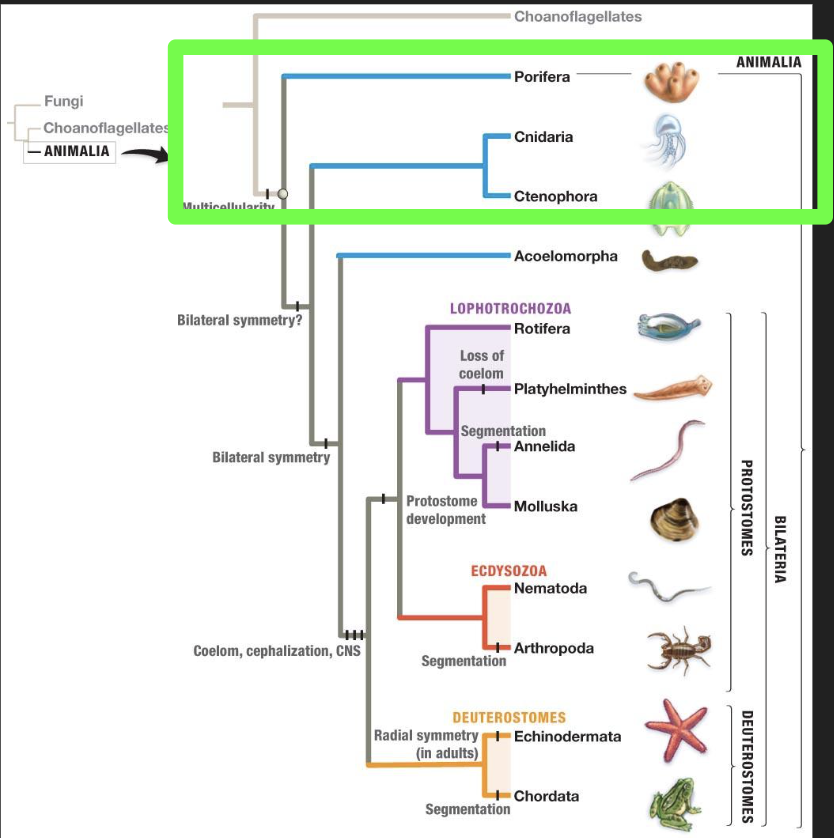
What type of phyletic grouping are Ctenophora and cnidaria?
monophyletic