BSC2010 Unit 3 Lecture 7
 Call Kai
 Learn
Learn Practice Test
 Spaced Repetition
 Match
Match Flashcards
 Knowt Play
1/24

There's no tags or description
Looks like no tags are added yet.
Name | Mastery | Learn | Test | Matching | Spaced | Call with Kai |
|---|
No analytics yet
Send a link to your students to track their progress
25 Terms
Phylogeny
Evolutionary history of a group
2 ways to classify taxa
Phylogenetics
Taxonomy
Taxonomy
Hierarchical way of categorizing species started by Carolus Linnaeus
Binomial nomenclature
Two parts - genus and species name
Principle of parsimony
Simplest path uses the fewest evolutionary changes
Branch points represent ___.
speciation events
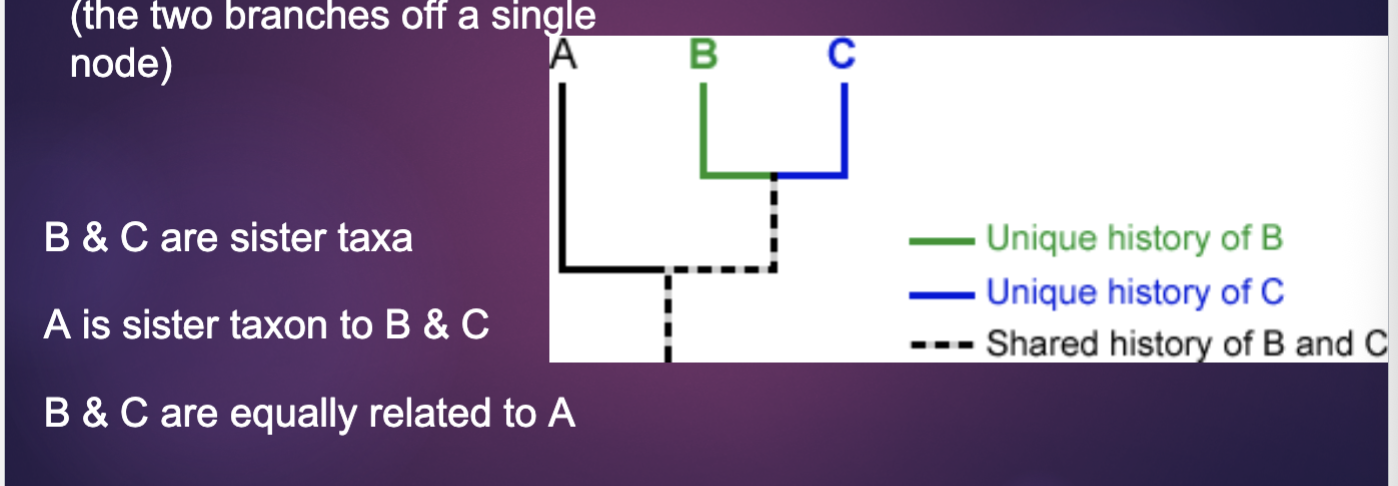
Sister taxa
Two taxa that are each other’s closest relatives (the two branches off a single node)
Sister species
Two species that are each other’s closest relatives
Sister clades
Any two clades that are each other’s closest relatives
Why can phylogenies rotate?
Only the branching relationships matter; the information if the same.
A clade is ___.
Monophyletic
Monophyletic
Includes the most recent common ancestor and all its descendents
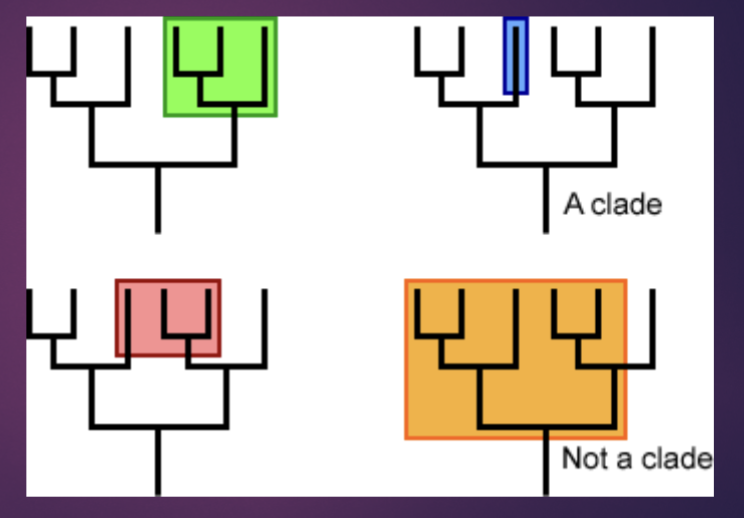
How to recognize a monophyletic group/clade?
Can be cut from the tree with one snip
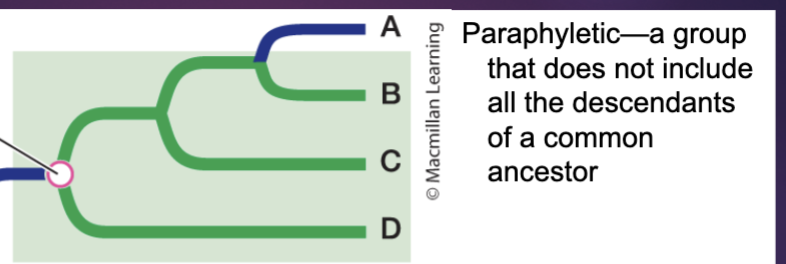
Paraphyletic
Group does not include all descendents of common ancestor
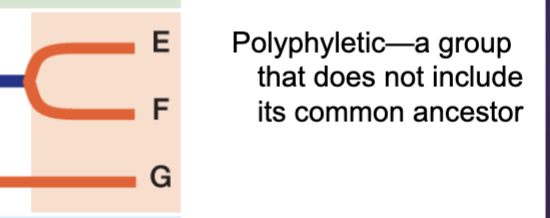
Polyphyletic
Group does not include common ancestor
How are evolutionary relationships reconstructed?
Shared characters → parsimony
Homologous trait
A similarity between two or more features that is due to inheritance from a common ancestor
Analogous trait
Biological features in different species that serve similar functions but evolved independently, not from a common ancestor
Synapomorphies
Shared, derived traits → evidence for common ancestry
Outgroup
Reference group that is closely related to group but lacks synapomorphies that unite the ingroup
Convergent evolution
Independent changes to the same trait in two or more groups of organisms
Example of analogous trait
Bat vs. bird wings
Evolutionary reversal
A character reverts from a derived state back ot an ancestral state
Homoplasies
Traits that are not inherited from a common ancestor; can be from convergent evolution and evolutionary reversal
Name two ways homoplasies can evolve
Convergent evolution and evolutionary reversal