Business HL year 1 finance
 Call Kai
 Learn
Learn Practice Test
 Spaced Repetition
 Match
Match Flashcards
 Knowt Play
1/28

There's no tags or description
Looks like no tags are added yet.
Name | Mastery | Learn | Test | Matching | Spaced | Call with Kai |
|---|
No analytics yet
Send a link to your students to track their progress
29 Terms
Contribution per Unit Formula
selling price - variable costs
Variable costs
If production increases, variable costs increase.
Total Contribution
Contribution x sales volume
Fixed costs
costs that remain the same regardless of the level of production or sales (They must be paid even if no products are sold) ex: Software subscriptions with fixed monthly fees, property rent, equipment depreciation
Unit contribution
selling price - variable costs per piece
Units of production depreciation per unit
cost - salvage value/ total estimated units
salvage value
It is the amount of money a company expects to sell the asset for (or get for its parts) after they are completely done using it
Net book value
the current value of an asset as recorded in a business's accounting books.
total current assets
the sum of all liquid resources a business owns that are expected to be converted into cash, consumed, or sold within 12 months. (debtors, cash, stock/inventory, prepaid expenses)
Cash
Cash is readily available money for immediate payments (current asset)
debtors
debtors are customers who owe the business money for goods or services bought on credit (current asset)
Income Statement
calculates profit
balance sheet
which lists assets and debts
gross profit margin
percentage of revenue a business keeps after paying the direct costs of producing its goods or services (revenue- COGs/ revenue) x 100

current ratio
current assets/ current liabilities
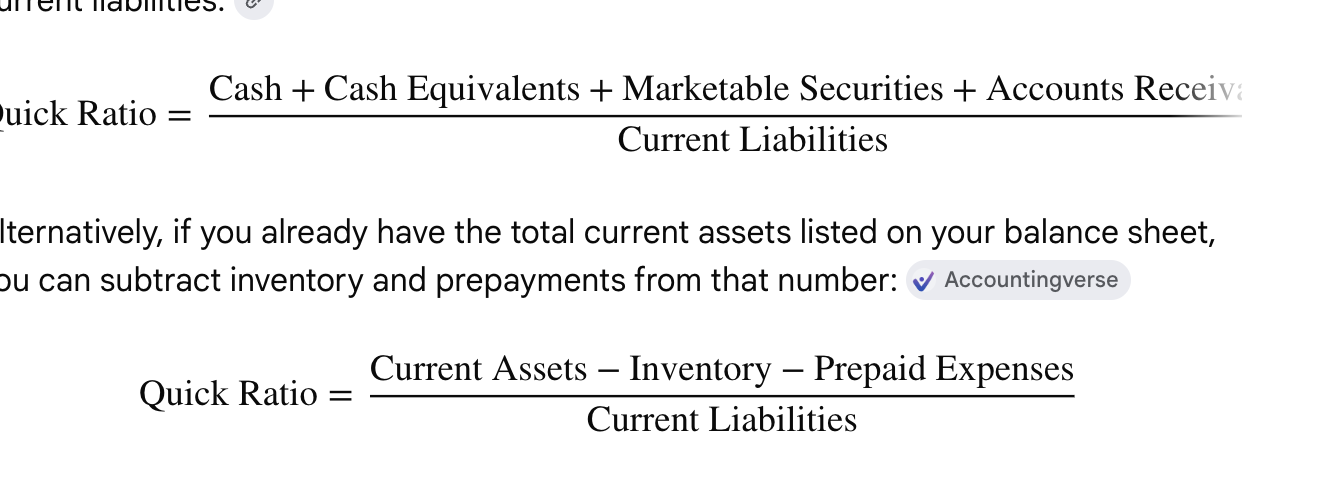
acid test (quick) ratio
current assets - inventory/ current liabilities
Measures a businesses short term liquidity. The ratio strictly limits assets to those that can be turned into cash within 90 days
cost of sales
the total direct cost of producing and delivering the goods or services a business sells during a specific period. It only includes expenses directly tied to production, such as raw materials, direct labor, and shipping, excluding general overhead like rent or marketing
gross profit
company's total revenue minus the direct costs of producing and selling its goods or services (total revenue - cost of goods)
profit margin
percentage of revenue a business keeps as profit after deducting all expenses.
net profit margin
net profit/ revenue x 100
net income
the total amount of money remaining after all expenses, taxes, and deductions are subtracted from total revenue or gross income (total revenue - total expenses)
expenses
the everyday costs required to operate a company, generate revenue, and maintain daily activities.
net fixed assets
the current book value of a company’s long-term, tangible assets
total assets
net fixed assets + current assets
retained earnings/ profit
the portion of a company's net income that is kept and reinvested in the business, rather than being distributed to shareholders as dividends. It accumulates over time and represents a crucial internal source of funding for long-term stability and growth
Return on Capital Employed (ROCE)
profit before interest and tax/ capital employed x 100
capital employed
Capital Employed= Total Assets}- Current Liabilities
(Alternatively: Share Capital + Retained Earnings + Non-Current Liabilities)\
capital invested in a business to generate profits.