Behavioral Neuroscience Exam 3
 Call Kai
 Learn
Learn Practice Test
 Spaced Repetition
 Match
Match Flashcards
 Knowt Play
1/234

There's no tags or description
Looks like no tags are added yet.
Name | Mastery | Learn | Test | Matching | Spaced | Call with Kai |
|---|
No analytics yet
Send a link to your students to track their progress
235 Terms
Cognitive Control
The ability to regulate cognitive processes to achieve goals, involving functions like attention, working memory, and decision-making. - Controlled by the Prefrontal Cortex
Core Executive Function
Inhibitory Control
Working Memory
Cognitive Flexibility
Higher order (built from above)
Organization of Frontal Cortex
Believed to be hierarchically organized from anterior to posterior
Anterior of frontal cortex
abstract goals
Posterior parts of Prefrontal Cortex
Concrete goals and direct actions
Dorsal organization of Prefrontal cortex
Where (how pathways)
Ventral Pathways of Prefrontal Cortex
What pathways
Medial Pathways of Prefrontal Cortex
Hot or value related processes
Lateral prefrontal cortex organization
Cold or cognitive processes
How Does the prefrontal Cortex implement cognitive control
-integrates information from sensory, motor, and other cortical areas
-Subcortical areas in learning and reward
-Guides information flow through the brain through top-down processing and selecting specific action plans
Phonological Working Memory
-able to hold information and generate auditory info for about 2 seconds when rehearsed
-speech/acoustic store and subvocal articulatory rehersal process
Functions of Phonological Working Memory
Facilitating language Acquisition
Control behavior through self-instruction
Visuo-spatial working memory (Sketchpad)
-Holds limited amount of visual info. while you attend to it
-survives eye movements, blinks, and other visual interruptions
Functions of Visuo-Spatial Working Mem.
Maintaining continuity across eye movements
creating and maintaining images when imaging and describing an object or scene
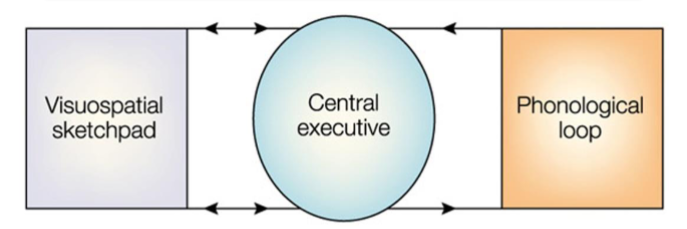
Model for working memory
The central executive functioning area works by both providing information and gaining information from the phonological loop and visuospatial sketchpad
Networks in Visuo-Spatial Memory
Prefrontal Cortex
Posterior Parietal Cortex
Visual cortex and inferior temporal cortex
Prefrontal Cortex in Visuospatial Memory
-May not be directly representative of visual content
-top-down influence over representations in visual cortex
-control what visual info is represented in the working memory
Posterior Parietal Cortex in Visuo-Spatial Memory
-May provide top-down signals
-may represent depending on info withint he working memory
Visual Cort4ex and Inferior Temporal Cortex in Visuo-Spatial Memory
represents and stores visual content
Brain Networks of Phonological Memory
-Left hemisphere Bias
Lateral prefrontal cortex (Brodmann area 44)
Premotor motor cortex
Temporo-Parietal junction (Brodmann area 40)
possible auditory cortex
Delayed Response task for working memory on monkeys
monkey is shown and empty and food dish. Slide is then closed and food is covered and then the monkey needs to reach to grab correct dish for food
During this time a sustained AP is fired after seeing food
Shows how brain remembers information of period of time
How does the brain generate Sustained activity for Working memory
Info goes through inputs, hidden layer and delay periods, and then the output
info flows in a loop through feedback connections
Recurrent neural networks (where neurons send feedback signals to each other)
How does the prefrontal cortex respond during delay periods
Different cells respond at varying times depending on their level of response to the stimulus (Ex: some respond to a subset of signals, some are sustained other first after a delay, etc.)
what specific brain area supports the prefrontal cortex in memory and cognitive control?
Mediodorsal thalamus- Allows an excitatory signal to enter which allows an array of delayed responses from neurons which allows sustained activity. This keeps a signal alive through the whole task
Why do we have rules?
rules govern why we have specific actions and guide our behavior
have both exogenous and endogenous cues depending on the context
Some rules are specific and others are more abstract
What happens when our brain is unable to follow rules
lesions in PFC can cause a difficulty to follow rules and these deficits can lead to schizophrenia
Where are abstract rules held in the PFC
anterior part of PFC
Where are concrete rules held in the PFC
posterior PFC
Task Set
Configuration of Cognitive Processes Necessary to Perform a task
Ex: encoding a set of instructions from a researcher through rehersal
What is Set-Shifting
process of selecting between two competing task sets
Task-Cueing Paradigm
cue is shown for a period until target, then pause, then new cue, then all is repeated
Intermittent Cueing Paradigm
No pauses and simply one target is shown until the switch and then a new target is shown
How does the dorsolateral PFC react to task sets
reacts best to spatial forward and spatial backward
How does hte Parietal lobe react to task sets
reacts best to spatial forward and spatial backward will some activity in verbal forward and backward
How does the Ventrolateral PFC react to task sets
most reaction in verbal forward and backward
How does the Temporal Lobe react to task sets
most reaction in verbal forward and backward
How does anterior PFC react to Task sets
general activity in spatial forward and backward along with verbal forward and backward
How does the Anterior Prefrontal Cortex react to specific task sets for the DLPFC (dorsalateral PFC)
Spatial tasks
How does the Anterior Prefrontal Cortex react to specific task sets for the VLPFC (Ventrolateral PFC)
verbal tasks
How are decisions made
accumulate sensory evidence
Transform sensory evidence into a decision variable
Apply decision rule based on criteria
How do neurons decide while way to fire for a moving stimulu
one example: neurons have either right or left preference and a decision variable is caculated by subtracting left from right. Then this gives changes in neural activity on a scale
Behavioral Inhibition
Cancellation of planned or early stage of action
Cognitive Inhibition
overriding of mental process, wholly or partly
What happens when inhibition is unsuccessful
impulse or compulsion
ADHD, drug addictions, schizophrenia- impulsive
OCD and drug addictions- Compulsions
What brain structure is key in the stop-signaling in the brain
Right Inferior Frontal Cortex
When damaged, people become impulsive and unable to stop impulses
What is happening when a healthy brain is trying to inhibit an action
Gamma activity goes wayyyyyy up
Happens quickly to inhibit actions quickly
What is the hyper direct pathway
The cerbral cortex sends an excitatory message to the subthalamic nucleus which sends an excitatory signal to the GP internal segment which sends an inhibatory signal to the thalamus
How does the hyperdirect pathway work in inhibition
reduces activity in thalamus to directly inhibit actions
general intellligence
general ability common to cognitive tasks
Crystallized intellligence (gC)
acquired knowledge about nature of hte world and learned operations
Fluid Intelligence (gF)
ability to solve novel problems independent of acquired knowledge
Where is fluid intellligence located
inferior frontal sulcus, interaparietal sulcus, anterior insula, anterior cingulate cortex
What happens when the fronto-parietal network is damaged
fluid intelligence goes down
Damage outside this network has no affect on fluid intelligence
Why do we need attention
too much info to process at the same time so attention helps us focus on important information
Stimulus Salience
item that significantly differs from neighboring items
Stimulus-driven, “bottom-up” or “exogenous” process
Behavioral goals
specific tasks we need to solve
“top down” or “Endogenous” process
How do goals and salience guide attention
top down factors can override bottom-up factors
can be hard to ignore new items and their sudden appearance
Spatial attention
attention to a particular location
Feature-based attention
attention to a particular stimulus feature
Object-based attention
attention to a particular object
Can spread from cued to uncued locations
Temporal attention
attention over time
Overt attention
attention on what you are fixating on
attention guides your gaze to important info
Covert attention
where you are looking differs from where you are attending
attention directed away from your gaze
Posner cueing task
valid target if it appears at cued location
invalid target if it appears away from cued location
neutral target is there is not prior cue
How does attention improves target detection and reaction time
in valid conditions- highest response rate and fastest reaction time compared to invalid conditions
How does attention affect sensitivty of neurons
as attention increases, sensitivity increases
contrast is not as necessary when higher attention is applied
How does attention modulate the response of sensory neurons to stimuli
responses increases when attention is on the preferred stimuli
decreases when attention on ineffective stimuli
brain networks in frontal and parietal cortex for attention
pronto-parietal network including frontal eye field, supplementary eye field, and posterior parietal cortex
provide feedback for sensory info and what is beh. relevant
What does the posterior parietal cortex do for attention
signals attention priorities
neurons respond best when stimuli are beh. relevant
vice versa for beh. irrelevance
How does feedback from the parietal cortex affect the sensory cortex
parietal cortex increases the response to the sensory cortex
this is done through increases AP sent from the parietal to the sensory cortex
when there are few AP from the posterior parietal cortex leads to reduced activity of sensory neurons
How does the frontal eye field affect the visual cortex
feedback from the frontal eye field increases responses in the visual cortex
When stimulation is appleid to the frontal eye field more V4 cells respond in the visual cortex
What does the pulvinar do
routes information across the cerebral cortex
either directly connected or will be indirectly connected for the cortical areas
How does attention affect pulvinar neurons
Attention increases activity for the pulvinar neurons
What happens with spatial neglect
severe condition where patients are not aware of one side of space
often occurs in right hemi.
commonly due to damage of posterior parietal cortex
Reference frames that can be affected by neglect
egocentric and allocentric
Attention and Eye movement networks overlap in brain
Same fronto-parietal and subcortical areas contribute to attention and eye movement
can be used to direct attention and eye movements
Lateral interaparietal area, Supplementary eye field, frontal eye field
What is Consciousness?
awake state in which we have experiences, we are able to report
mirror self-recognition test
mark placed on forhead and observed if they wipe off mark on own
Sleep
non-REM sleep (stages 1-3)
REM sleep
General anesthesia
caused by drugs with diff. molecular mechanisms of actions
Disorders of consciousness
brainstem death, coma, unresponsive wakefulness syndrome, minimally conscious state
Awake characteristics
low voltage, fast EEG
Vivid, externally generated sensations
logical and progressive thought
Continuous and voluntary movement
often eye movement
Non-REM Sleep
high voltage, slow EEG
Dull or absent sensations
logical and repative thought
occasional involuntary movement
eye movement rare
REM sleep
low voltage, fast EEG
vividing internally grenerated sensations
vivid, illogical, bizarre thoughts. Muscle paralysis, movement commanded but not carried out mov.
Often, rapid eye movement
What are the two components of Consciousness
arousal and awareness
Arousal
alertness or vigilance
Awareness
refers to conscious perception of the richness of conscious experience
Awareness of environment
conscious perception of environment using our senses
Awareness of Self
inner process that does not require our senses or external stimuli; includes knowledge of our own socio-cultural history
Levels of awareness and arousal
different levels of awareness and wakefulness depending on the state
Ex: high in both for conscious wake compared to super low in both for a coma
Neural Correlates for consciousness
minimal neural mechanisms jointly sufficient for consciousness
How is the neural correlates of consciousness connected
large scale intergration across brain areas
frontal cortex; parietal cortex and posterior cingulate, temporal cortex, intralaminar nuclei of thalamus extensively connected with above cortical areas
How are integration happening for the NCC
through neural synchronizationW
What areas do not contribute to the NCC
cerebellum-the lack of integration within this system makes it appear that this brain area is not involved
What areas are important for arousal
brainstem and thalamic areas such as the Mesencephalic reticular formation, Basal nucleus of Meynert, hypothalamus, medial septal nucleus, and THalamic reticular nucleus
Cortical and thalamic areas involved in awareness
Thalamus, occipital cortex, parietal cortex, frontal cortex, and temporal cortex
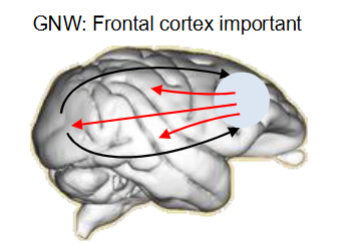
Global neuronal workspace theory
consciousness depends on an “ignition” process through which info becomes globally available
front down processing is required from the frontal lobe to specialized processing in the posterior cortex
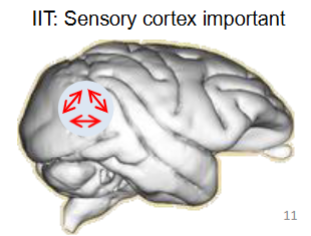
Integrated information Theory
Consciousness depends on integrated information
integration is supported through interactions between neurons in cortical and thalamo-cortical circuits
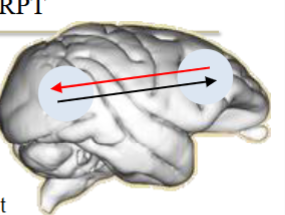
Predictive Coding (frontal cortex is important)
modeling of consciousness through top down processing
moves from frontal lobe to sensory cortex
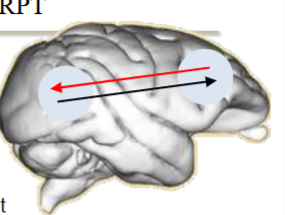
Higher order theories (frontal cortex important)
consciousness depends on the frontal cortex, which supports higher-order thoughts about sensory experiences
sensory representations within the posterior cortex alone is insufficient