Transition metals
 Call Kai
 Learn
Learn Practice Test
 Spaced Repetition
 Match
Match Flashcards
 Knowt Play
1/37

There's no tags or description
Looks like no tags are added yet.
Name | Mastery | Learn | Test | Matching | Spaced | Call with Kai |
|---|
No analytics yet
Send a link to your students to track their progress
38 Terms
What is a d-block element?
An element where it’s highest energy electron is in the d sub-shell
What two elements have a different electron configuration?
Cu and Cr
3s sub-shells are more stable when all sub-shells are fully or singly occupied
So the 4s sub-shell is singly occupied
What is a transition element?
-A d-block element that forms at least one stable ion with a partially filled d sub-shell.
What two elements are are d-block elements but not transition elements?
Sc and Zn as there don’t form ions with a partially filled d-sub-shell.
In Sc3+ the d sub-shell is empty.
In Zn2+ the d sub-shell is full.
Properties of transition elements
Variable oxidation states → 4s and 3d sub-shells are close in energy so it’s easy to lose electrons from either sub-level.
Form coloured ions
- Catalytic behaviour → act as an intermediate in exchange of reacting species.
- Provides surface are for reactions to occur → metal forms weak bonds with reacting species + holds then in place → Adsorption → Bonds rearranged → Products diffuse/desorb.
TM catalysts reduce energy usage BUT can be toxic.
What are complex ions?
Transition metals bonded to one or more ligands by coordinate bonds/dative covalent bonds.
e.g. [Co(H2O)6]2+
Draw the complex ion [Co(H2O)6]2+

What is a dative/covalent bond?
A strong electrostatic attraction between a shared pair of electrons and the nuclei of the bonded atoms, with the bonded pair of electrons donated from one atom only.
What is a ligand?
A molecule/ion that can donate a lone pair of electrons to the transition metal ion to form a coordinate bond.
Types of ligands
Monodentate ligands → donates one pair of electrons and forms one coordinate bond.
Bidentate ligands → donates 2 pairs of electrons to the TM to form 2 coordinate bonds.
Multidentate ligands → contains more that 2 atoms that donate pairs of electrons to form coordinate bonds.
Complex shapes:
Octahedral
6 coordinate bonds
Bond angle = 90*
e.g. [Co(H2O)6]2+
![<ul><li><p>6 coordinate bonds</p></li><li><p>Bond angle = 90*</p></li><li><p>e.g. [Co(H2O)6]2+</p></li></ul><p></p>](https://assets.knowt.com/user-attachments/09c4438f-1e2c-4123-95fa-3ca1a569ec90.heic)
Complex shapes:
Tetrahedral
4 coordinate bonds
Bond angle = 109.5*
Occurs when ligands are large
[CuCl4]2-
![<ul><li><p>4 coordinate bonds</p></li></ul><ul><li><p>Bond angle = 109.5*</p></li><li><p>Occurs when ligands are large</p></li><li><p>[CuCl4]2-</p></li></ul><p></p>](https://assets.knowt.com/user-attachments/3ec2c5de-4d53-4b67-9512-3848d73f82ab.jpg)
Complex shapes:
Square planar
4 coordinate bonds
Bond angle = 90* in cis isomers and 180* in trans isomers
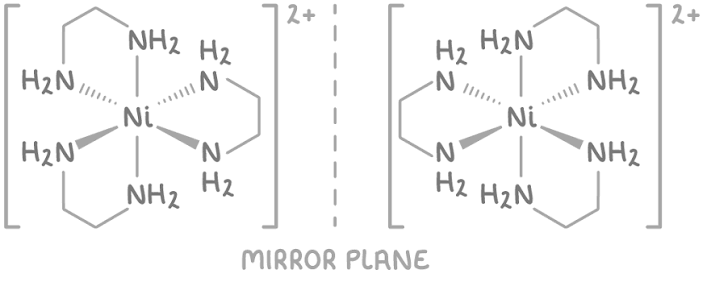
What is optical isomerism?
Give an example.
Complexes are optical isomers when they are non-superimposable mirror images.
Optical isomerism found in octahedral complexes with bidentate ligands.
What is cis-trans isomerism?
Give an example.
Cis isomers have identical ligands on the same/adjacent side and trans isomers have identical ligands on opposite sides.
Found in octahedral and square planar complexes.
e.g. [Co(H2O)4Cl2] or cis/trans platin
![<ul><li><p>Cis isomers have identical ligands on the same/adjacent side and trans isomers have identical ligands on opposite sides.</p></li><li><p>Found in octahedral and square planar complexes.</p></li><li><p>e.g. [Co(H2O)4Cl2] or cis/trans platin</p></li></ul><p></p>](https://assets.knowt.com/user-attachments/8da537c1-8cff-4da3-b5ed-de287b79256a.png)
What is cis platin?
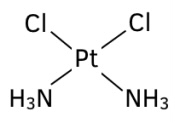
Square planar complex with 4 coordinate bonds.
Cis platin has a bond angle of 90* and trans platin has a bond angle or 180*
Cis platin is an anticancer drug which binds to DNA in cancer cells (Cl- bonds to N in DNA) → prevents cell division and the cell dies.
Cis platin also prevents healthy cells from producing leading to side effects:
Kidney damage
Nausea/vomiting
Suppressed immune system
Hair loss
trans platin doesn’t work.
What are ligand substitution reactions?
When one or more ligands are replaced with another ligand.
Ligand substitution reaction of [Cu(H2O)6]2+ with NH3
[Cu(H2O)6]2+ (aq) + 4NH3 (aq)
→ [Cu(NH3)4(H2O)2]2+ (aq) + 4H2O (l)
Pale blue solution → Dark blue solution
![<ul><li><p>[Cu(H2O)6]2+ (aq) + 4NH3 (aq) </p><p>→ [Cu(NH3)4(H2O)2]2+ (aq) + 4H2O (l)</p></li><li><p>Pale blue solution → Dark blue solution</p></li></ul><p></p>](https://assets.knowt.com/user-attachments/34876fbf-4c61-42ba-9a81-792a8b7c1cb5.jpg)
Ligand substitution reaction of [Cu(H2O)6]2+ with Cl-
[Cu(H2O)6]2+ (aq) + 4Cl- (aq) → [CuCl4]2- (aq) + 6H2O (l)
Pale blue solution → yellow solution (green if it is at equilibrium)
![<ul><li><p>[Cu(H2O)6]2+ (aq) + 4Cl- (aq) → [CuCl4]2- (aq) + 6H2O (l)</p></li></ul><p>Pale blue solution → yellow solution (green if it is at equilibrium)</p><p></p><p></p>](https://assets.knowt.com/user-attachments/b046fcdf-0e51-488d-afb7-62b06f7eaea6.jpg)
Ligand substitution reaction of [Co(H2O)6]2+ with Cl-
[Co(H2O)6]2+ (aq) + 4Cl- (aq) → [CoCl4]2- (aq) + 6H2O (l)
Pink solution → blue solution
![<ul><li><p>[Co(H2O)6]2+ (aq) + 4Cl- (aq) → [CoCl4]2- (aq) + 6H2O (l)</p></li><li><p>Pink solution → blue solution</p></li></ul><p></p><p></p>](https://assets.knowt.com/user-attachments/917772cd-e574-4141-b700-9b16c4fc3f7c.jpg)
Ligand substitution of [Cr(H2O)6]3+ with NH3
[Cr(H2O)6]3+ (aq) + 6NH3 (aq) → [Cr(NH3)6]3+ (aq) + 6H2O (l)
Pale purple solution (can be green to start with due to impurities) → purple solution
→ turns green when heated.
![<ul><li><p>[Cr(H2O)6]3+ (aq) + 6NH3 (aq) → [Cr(NH3)6]3+ (aq) + 6H2O (l)</p></li><li><p>Pale purple solution (can be green to start with due to impurities) → purple solution</p></li><li><p>→ turns green when heated.</p></li></ul><p></p>](https://assets.knowt.com/user-attachments/77e60b98-a365-4f43-a674-18a42351252b.jpg)
How does haemoglobin work?
Causes blood to appear red
Carries oxygen from the lungs to cells in the body
Contains and Fe2+ ion which binds to oxygen and carries it around the body to muscles
Oxygen binds reversibly and forms a coordinate bond
O2 and CO2 exchange via ligand substitution
CO forms stronger coordinate bonds than O2 and bind irreversibly
Precipitation reactions; NaOH reactions
Reaction with Cu2+
Cu2+ (aq) + 2OH- (aq) → Cu(OH)2 (s)
Pale blue solution → pale blue ppt
Insoluble in excess NaOH
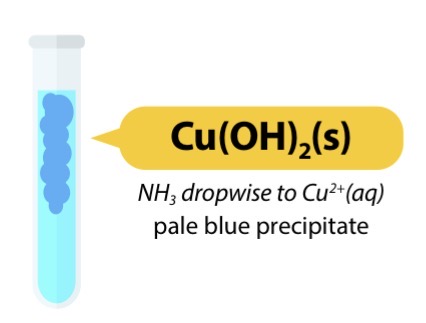
Precipitation reactions: NaOH reactions
Reaction with Cr3+
Cr3+ (aq) + 3OH- (aq) → Cr(OH)3 (s)
Pale purple solution → Dark green ppt
Is soluble in excess NaOH:
Cr(OH)3 (s) + 3OH- → [Cr(OH)6]3- (aq) → produces a dark green solution
![<ul><li><p>Cr3+ (aq) + 3OH- (aq) → Cr(OH)3 (s)</p></li><li><p>Pale purple solution → Dark green ppt</p></li><li><p>Is soluble in excess NaOH:</p></li><li><p>Cr(OH)3 (s) + 3OH- → [Cr(OH)6]3- (aq) → produces a dark green solution</p></li></ul><p></p>](https://assets.knowt.com/user-attachments/3f361a79-263b-4053-b7eb-0d11a0ef5cf8.jpg)
Precipitation reactions: Reactions with NaOH
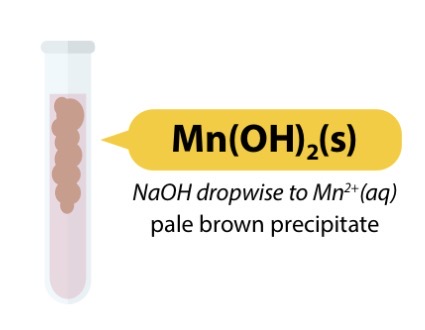
Reaction with Mn2+
Mn2+ (aq) + 2OH- (aq) → Mn(OH)2 (s)
Pale pink solution → Pale brown ppt (can darken on standing due to oxidation)
Insoluble in excess NaOH
Precipitation reactions: Reactions with NaOH
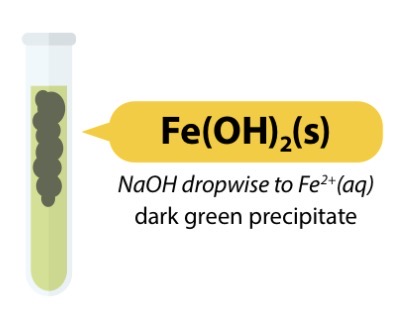
Reaction with Fe2+
Fe2+ (aq) + 2OH- → Fe(OH)2 (s)
Pale green solution → Dark green ppt (can darken on standing due to oxidation from Fe2+ to Fe3+)
Insoluble in excess NaOH
Precipitation reactions: Reactions with NaOH
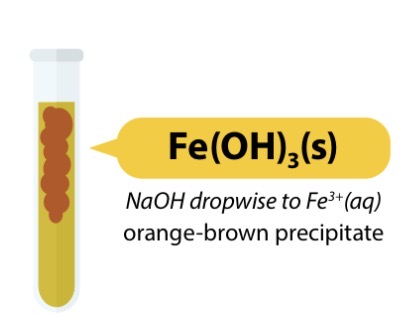
Reaction with Fe3+
Fe3+ (aq) + 3OH- (aq) → Fe(OH)3 (s)
Pale yellow solution → orange/brown precipitate
Insoluble in excess NaOH
Precipitation reactions: Reactions with NH3
Reaction with [Cu(H2O)6]2+
(REPEAT)
[Cu(H2O)6]2+ (aq) + 2NH3 (aq) → [Cu(OH)2(H2O)4] (s) + 2NH4+
(NH3 is added drop wise)
Pale blue solution → Pale blue ppt
Soluble in excess NH3 (aq):
[Cu(OH)2(H2O)4] (s) + 4NH3 (aq) → [Cu(NH3)4(H2O)2]2+ (aq) + 2H2O (l) + 2OH- (dark blue solution)
>Ligand substitution
Precipitation reactions: Reactions with NH3
Reaction with [Cr(H2O)6]3+
[Cr(H2O)6]3+ (aq) + 3NH3 (aq) (dropwise) → [Cr(OH)3(H3O)3] (s) + 3NH4+ (aq)
Pale purple solution → Dark green solution
Soluble in excess HN3 (aq):
[Cr(OH)3(H20)3] (s) + 6NH3 (aq) —> [Cr(NH3)6]3+ (aq) + 3H2O (l) + 3OH- (aq) (purple solution)
![<ul><li><p>[Cr(H2O)6]3+ (aq) + 3NH3 (aq) (dropwise) → [Cr(OH)3(H3O)3] (s) + 3NH4+ (aq)</p></li><li><p>Pale purple solution → Dark green solution</p></li><li><p>Soluble in excess HN3 (aq):</p></li><li><p>[Cr(OH)3(H20)3] (s) + 6NH3 (aq) —> [Cr(NH3)6]3+ (aq) + 3H2O (l) + 3OH- (aq) (purple solution)</p></li></ul><p></p>](https://assets.knowt.com/user-attachments/40dd7670-12af-4ca9-807e-22449c3344e9.jpg)
Precipitation reactions: Reactions with NH3
Reaction with [Mn(H2O)6]2+
[Mn(H2O)6]2+ (aq) + 2NH3 (aq) → [Mn(OH)2(H20)4] (s) + NH4+ (aq)
Pale pink solution → Brown ppt
Insoluble in excess NH3 (aq)
![<ul><li><p>[Mn(H2O)6]2+ (aq) + 2NH3 (aq) → [Mn(OH)2(H20)4] (s) + NH4+ (aq)</p></li><li><p>Pale pink solution → Brown ppt</p></li><li><p>Insoluble in excess NH3 (aq)</p></li></ul><p></p>](https://assets.knowt.com/user-attachments/d2aa2e97-4777-4236-a994-39c14ade100d.jpg)
Precipitation reactions: Reactions with NH3
Reaction with [Fe(H2O)6]2+
[Fe(H2O)6]2+ (aq) + 2NH3 (aq) →
[Fe(OH)2(H2O)4] (s) + 2NH3+ (aq)
Pale green solution → Dark green precipitate
Insoluble in excess NH3 (aq)
![<ul><li><p>[Fe(H2O)6]2+ (aq) + 2NH3 (aq) → </p><p>[Fe(OH)2(H2O)4] (s) + 2NH3+ (aq)</p></li><li><p>Pale green solution → Dark green precipitate</p></li><li><p>Insoluble in excess NH3 (aq)</p></li></ul><p></p>](https://assets.knowt.com/user-attachments/2cce9701-85c6-4442-940f-c1685ec28d04.jpg)
Precipitation reactions: Reactions with NH3
[Fe(H20)6]3+ (aq)
[Fe(H2O)6]3+ (aq) + 3NH3 (aq) → [Fe(OH)3(H2O)] (s) + 3NH4+ (aq)
Pale yellow solution → orange/brown ppt
Insoluble in excess NH3 (aq)
![<ul><li><p>[Fe(H2O)6]3+ (aq) + 3NH3 (aq) → [Fe(OH)3(H2O)] (s) + 3NH4+ (aq)</p></li><li><p>Pale yellow solution → orange/brown ppt</p></li><li><p>Insoluble in excess NH3 (aq)</p></li></ul><p></p>](https://assets.knowt.com/user-attachments/640900db-ad4e-4534-aea5-cf25c605f82c.jpg)
Redox reactions:
Oxidation of Fe2+ → Fe3+
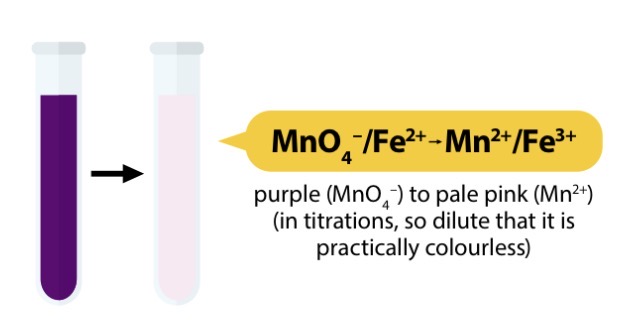
Fe2+ can be oxidised with H+/MnO4-
MnO4- (aq) + 8H+ (aq) + 5Fe2+ (aq) → Mn2+ (aq) + 5Fe3+ (aq) + 4H2O(l)
Purple solution → Pale pink solution
Mn is reduced since the oxidation number reduces from +7 in MnO4- to +2 in Mn2+ (Oxidising agent)
Fe is oxidised since the oxidation number increases from +2 in Fe2+ to +3 in Fe3+
Redox reactions:
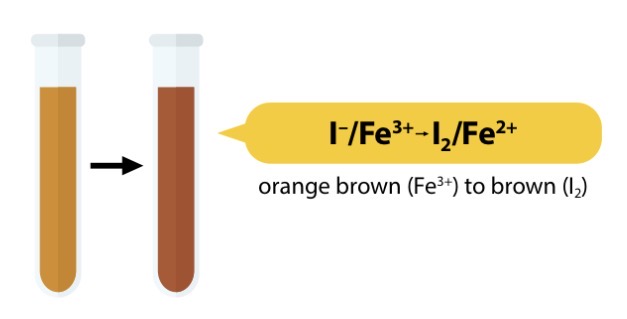
Reduction of Fe3+ → Fe2+
2Fe3+ (aq) + 2I- (aq) → 2Fe2+ (aq) + I2 (aq/s)
Orange/brown solution → green solution + dark brown solution (dominates)
In the presence of I-, Fe3+ can reduces to Fe2+
The overriding colour change is rusty brown → dark brown
Redox reactions:
Oxidation of Cr3+
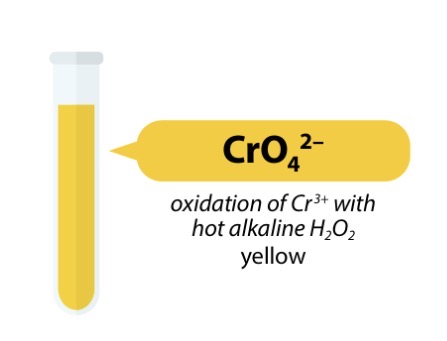
Cr3+ can be oxidised with H2O2/OH-
Step 1: 2Cr3+ (aq) + 3H2O (l) +10OH- (aq) → 2CrO42- (aq) +8H2O (l)
Green solution → Yellow solution
Use hot alkaline H2O2
Step 2: 2CrO42- +2H+ → Cr2O72- +H2O
Yellow → Orange
Redox reactions:
Reduction of Cr2O72- to Cr3+
Treat Cr2O72- with zinc (reducing agent)and either HCl or H2SO4
Cr2O72- (aq) +14H+ (aq) + 3Zn (s) → 2Cr3+ (aq) + 3Zn2+ (aq) + 7H20 (l)
Orange → Green (2Cr3+)
Redox reactions:
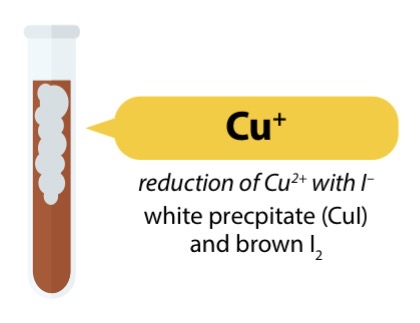
Reduction of copper (II)
2CU2+ (aq) + 4I- → 2CuI (s) + I2 (aq)
Blue solution → white ppt + brown solution (offwhite)
Redox reactions:
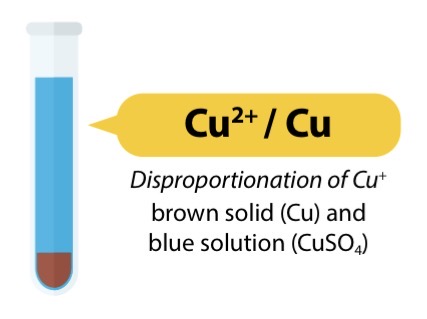
Disproportion of Cu+
Disproportion occurs readily in solution
2Cu+ (aq) → Cu (s) + Cu2+ (aq)
Colourless solution → brown ppt + blue solution