Chapter 32
 Call Kai
 Learn
Learn Practice Test
 Spaced Repetition
 Match
Match Flashcards
 Knowt Play
1/41

There's no tags or description
Looks like no tags are added yet.
Name | Mastery | Learn | Test | Matching | Spaced | Call with Kai |
|---|
No analytics yet
Send a link to your students to track their progress
42 Terms
Characteristics used to define an animal
Nutritional Mode
Cell Structure & Specialization
Reproduction & Development
Nutritional Mode:
Animals are chemoheterotrophs that acquire their nutrition by ingestion, where preformed organic molecules are taken into the body & broken down by either intracellular or extracellular digestion (which usually takes place in a specialized cavity).
Cell Structure & Specialization:
Animals are multicellular eukaryotes whose cells lack supportive cell walls; their bodies are held together by extracellular proteins (like collagen) & several types of intercellular junctions. 2 tissue types, nervous & muscle, are unique to animals.
Reproduction & Development:
Most animals reproduce sexually with a dominant diploid stage. After a sperm fertilizes an egg, the zygote undergoes cleavage, leading to the formation of a blastula, which then undergoes gastrulation (part of the embryo folding inward) to form a gastrula; the blastopore forms there as the opening of the archenteron; this develops into the digestive tract, the blastopore becomes the mouth or the anus, and the gastrula produces 2 tissue layers, an inner endoderm & outer ectoderm, from which all other tissues & organs form. Many animals have distinct larval stages where the larva eventually undergo metamorphosis. Most animals (& only animals) have Hox genes regulating the development of body form.
cleavage
A succession of mitotic cell divisions that the zygote undergoes with little to no growth, leading to the formation of a blastula.
blastula
A multicellular, hollow ball of cells, formed by cleavage before undergoing gastrulation.
archenteron
The first stage in the development of the digestive system in gastrulation; a blind sac lined by endoderm that develops into the animal’s digestive tract.
blastopore
Connects the archenteron to the exterior of the gastrula; the opening of the archenteron that develops into the mouth in protostomes and the anus in deuterostomes.
gastrula
A blind pouch, formed by gastrulation, that produces the endoderm & ectoderm that form all other tissues & organs.
larva
A stage in some animals’ life cycle that’s sexually immature, has a different morphology from the adult, usually eats different foods, and sometimes lives in a different habitat
metamorphosis
The process by which a larva transforms into an adult.
Hox genes
Homeotic genes present in some animals (and only animals) that regulate the expression of other genes and the development of body form; they contain homeoboxes (common “modules” of DNA sequences). The complexity of an animal’s body is correlated with the number of Hox genes.
Summarize the main stages of animal development. What family of control genes plays a major role?
In the haploid stage, sperm and egg cells are produced directly by meiotic division.
Also in the haploid stage, most animal species have a small flagellated sperm fertilize a larger non-motile egg, forming a diploid zygote.
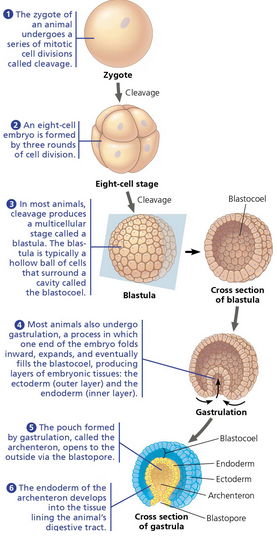
The single-celled diploid zygote of an animal undergoes a series of mitotic cell divisions called cleavage.
An 8-cell embryo is formed by 3 rounds of cell division.
Cleavage leads to the formation of a multicellular embryonic stage called a blastula, which in most animals takes the form of a hollow ball surrounding a cavity called the blastocoel.
Gastrulation occurs, the process by which one end of the embryo fold inward an expands until it fills the blastocoel; this produces layers of embryonic tissues: the outer layer is the ectoderm, the inner layer is the endoderm. The resulting developmental stage is the gastrula. Hox genes start to play a major role here.
The pouch formed by gastrulation is the archenteron, which opens to the outside via the blastopore.
The endoderm of the archenteron develops into the tissue lining the animal’s digestive tract.
ancestral group to Kingdom Animalia & its features
The common ancestor may have lived 770-710 MYA; it could have resembled modern choanoflagellates: tiny, stalked aquatic protists that are the closest living relatives to animals. They closely resemble the choanocyte cells in sponges, unlike other protists, plants, or fungi; DNA sequence data indicate that choanoflagellates and animals are sister groups; and genes for certain proteins previously known only from animals have been discovered in choanoflagellates.
animal body plans
Zoologists sometimes categorize animals according to a body plan, a set of morphological & developmental traits. It’s a convenient way of referring to similarities of development & structure; species sharing a body plan aren’t always sister taxa. Likewise, closely related species may have different body plans.
asymmetry vs radial symmetry vs bilateral symmetry
An asymmetrical animal can’t be divided along any plane of its body to produce mirror images; animals with radial symmetry can be divided into mirror images along numerous planes, as long as it passes through the center of the body along the long axis; & in animals with bilateral symmetry, only a single plane can produce mirror images.
traits of bilaterally symmetrical animals
A right & left side.
A dorsal (top) & ventral (bottom) side.
Anterior (head) & posterior (tail) ends.
Cephalization, the development of a head. This concentration of sensory, nervous, & feeding structures at the anterior end is critical for directional movement, allowing organisms to detect and process environmental stimuli efficiently; this enhances survival & fosters complex behaviors. Bilaterally symmetrical animals move forward, so having the head at the anterior end allows these animals to sense danger before coming into contact with it.
the 3 germ layers that form in the early embryo
Tissues are collections of specialized cells isolated from other tissues by membranous layers; during development, 2-3 germ layers give rise to the tissues & organs of the animal embryo.
Ectoderm covers the embryo’s surface.
Endoderm is the innermost germ layer & lines the developing digestive tube, called the archenteron.
Mesoderm is the layer between the endo- & ecto-derm layers, found in the more common bilaterally symmetrical triploblastic animals.
body cavity
A fluid- or air-filled space between the endoderm and ectoderm, found in nearly all animals. Functions in:
Its fluid cushions the internal organs, helping to prevent internal injury.
The non-compressible fluid of the body cavity can function as a hydrostatic skeleton against which muscles can work.
The presence of the cavity enables the internal organs to grow & move independently of the outer body wall.
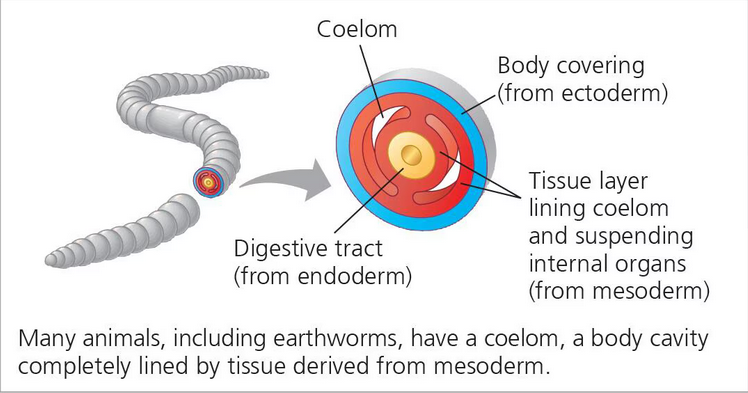
coelom
A true body cavity lined entirely with mesoderm. The inner & outer layers of mesoderm surrounding the cavity connect & form structures that suspend the internal organs; a coelom’s fluid prevents internal injury by cushioning the suspended organs. In soft-bodied animals like earthworms, the coelom’s fluid acts as a skeleton against which muscles can work; a coelom also enables the internal organs to grow & move independently of the ectoderm.
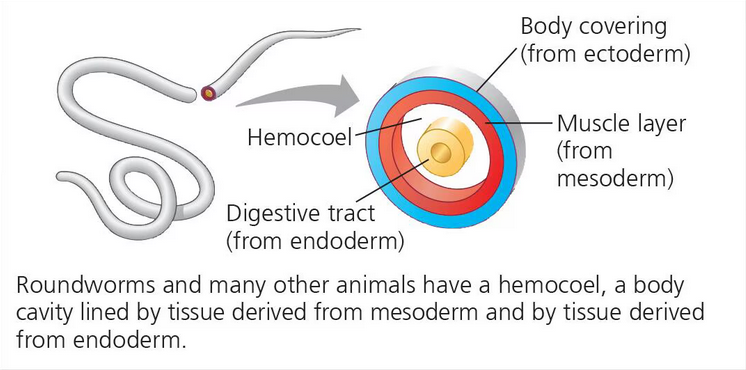
hemocoel
A body cavity lined with both mesoderm & endoderm. A hemocoel contains hemolymph, a mixture of blood & other internal fluids; in functions in the internal transport of nutrients & waste.
diploblastic vs triploblastic
Diploblastic animals are less common and have ectoderm & endoderm; triploblastic animals are more common and have an additional mesoderm layer between the ectoderm & endoderm.
coelomates
Triploblastic animals possessing a true coelom; many animals including earthworms.
hemocoelomates
Triploblastic animals possessing a hemocoel; roundworms and many other animals.
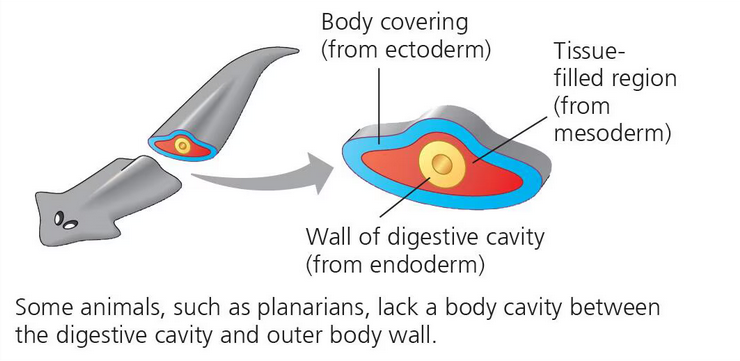
acoelomates
Triploblastic animals lacking a body cavity; planarians and some other animals.
protostomes vs deuterostomes
Many animals can be categorized as having protostome or deuterostome development based on early development. These mainly differ in the:
Type of cleavage: in protostomes, it is spiral & determinate; in deuterostomes, it is radial & indeterminate.
Pattern of coelom formation: protostomes have schizocoelous development; deuterostomes have enterocoelous development.
Fate of the blastopore: in protostome development, the blastopore becomes the mouth & the other hole formed becomes the anus; in deuterostome development, the blastopore becomes the anus & the other hole formed becomes the mouth.
protostomes
Cleavage
Spiral, where the planes of cell division are diagonal to the vertical axis of the embryo. Determinate, where the fate of each embryonic cell is determined early in development; if cells are separated from the embryo, the cell will lack all the structures that would have developed from those cells.
Coelom formation
Schizocoelous development occurs, where solid masses of mesoderm split to form the coelom.
Fate of the blastopore
The blastopore becomes the mouth and the other hole that forms becomes the anus.
Animal groups
Arthropods, molluscs, annelids, & nematodes.
deuterostomes
Cleavage
Radial, where the cleavage planes are parallel or perpendicular to the vertical egg axis. Indeterminate, where each cell in the early embryo has the ability to develop into a complete embryo; this makes possible identical twins and embryonic stem cells, because if cells get separated from the embryo they can develop into embryos themselves.
Coelom formation
Enterocoelous development occurs, where the mesoderm buds from the wall of the archenteron to form the coelom.
Fate of the blastopore
The blastopore becomes the anus and the other hole that forms becomes the mouth.
Animal groups
Chordates (vertebrates), echinodermatates, & hemichordatates.
the major branching points of animal phylogeny
About 3 dozen animal phyla; Metazoa’s 1st branch point splits the Parazoa from the Eumetazoa. The eumetazoans are divided into the Radiata & the Bilateria. The Bilateria includes 3 major clades: Deuterostomia, Lophotrochozoa, & Ecdysozoa.
Metazoa
Monophyletic clade of all animals, which share a common ancestor; splits into the Parazoa & the Eumetazoa.
Parazoa
Branches from Metazoa; lacks true tissues.
Eumetazoa
Branches from Metazoa; has true tissues. splits into Radiata & Bilateria.
Radiata
Branches from Eumetazoa; is diploblastic & has radial symmetry.
Bilateria
Branches from Eumetazoa; is triploblastic & has bilateral symmetry. Splits into Deuterostomia, Lophotrochozoa, & Ecdysozoa.
Deuterostomia
Branches from Bilateria; most of the animals with deuterostome development.
Lophotrochozoa
Branches from Bilateria; either has a feeding structure called a lophophore, goes through a distinct developmental stage called the trochophore larva, or both.
Ecdysozoa
Branches from Bilateria; shed exoskeletons through a process called ecdysis.
lophophore
A crown of ciliated tentacles that surround the mouth & function in feeding, found in some lophotrochozoan animals including brachiopods.
trochophore larva
A distinct larval stage observed in some lophotrochozoan animals, including some annelids & molluscs.
ecdysis
The process by which nematodes, arthropods, and some other ecdysozoans shed their old exoskeletons as they grow.
key ways that animals differ from plants & fungi:
Animals are heterotrophs that ingest their food; plants are autotrophs & fungi absorb their food.
Animals lack cell walls, which are found in both plants & fungi.
Animals have muscle & nerve tissue, which are absent in both plants and fungi.
Animal sperm & egg cells are produced by meiotic division, while the reproductive cells of plants & fungi undergo mitotic division.
Animals regulate the development of body form with Hox genes, which are absent in both plants & fungi.
what may have caused the Cambrian explosion:
New predator-prey relationships
An increase in atmospheric oxygen
An increase in developmental flexibility provided by the origin of Hox genes & other genetic changes.