Bio 351 - Exam 3 (phloem & respiration)
 Call Kai
 Learn
Learn Practice Test
 Spaced Repetition
 Match
Match Flashcards
 Knowt Play
1/48

There's no tags or description
Looks like no tags are added yet.
Name | Mastery | Learn | Test | Matching | Spaced | Call with Kai |
|---|
No analytics yet
Send a link to your students to track their progress
49 Terms
Flow of photoassimilates
Through phloem from sources to sinks
source
Mature leaves or storage organs that produce more photoassimilates than they use
sink
Roots, stems, and fruits that consume photoassimilates for metabolism
Why aren’t mature leaves sinks?
They have a slow growth rate with little metabolic demands
phloem
Living STEs that are consistently regenerated for long-distance transport, bidirectional (different sieve tubes within the same bundle)
vascular bundle makeup
inner xylem with outer phloem surrounded by a bundle sheath
vascular cambium
produces xylem inward and phloem outward
sieve tube elements (STEs)
elongated conducting cells connected end to end by sieve plates that lack a nucleus and rely on companion cells
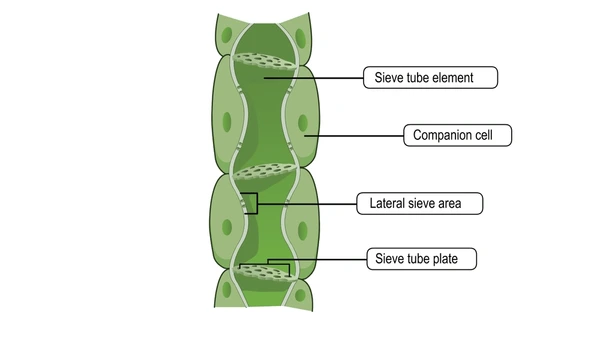
sieve tube elements
How are damaged sieve plates sealed?
P-proteins plug plates to prevent pressure release that could affect phloem sap, protein crystals from ruptured plastids seal tubes
companion cells
Have nuclei, mitochondria, chloroplasts. Reduced cytoplasmic contents and smooth ER minimize resistance to sap flow
transfer cells
Parenchyma cells associated with phloem that transfer photoassimilates b/t mesophyll cells
Where does G3P go after exiting the chloroplast?
To the cytosol for starch storage or sucrose synthesis
C allocation refers to what?
Whether G3P is devoted to starch or sugars
How is C mainly transported?
As sucrose because its soluble, osmotically effective, and non-reducing
reducing sugars
not translocated because ketone group is reactive
non-reducing sugars
disaccharides that don’t have reactive groups and if they do it forms sugar alcohol
pressure flow model for phloem transport
Mass flow due to pressure gradient (+ hydrostatic pressure from source to sink), linked with transpirational water flow from the xylem, passive
phloem loading (pressure-flow model)
At source, photoassimilates are transported into STEs. Decreases solute potential so water diffuses in from the xylem and pressure gradient drives solutes towards sink tissues
phloem unloading (pressure-flow model)
At sink tissues, change in water potential causes water to exit towards the xylem
symplastic phloem loading
Assimilates travel from mesophyll cells to sieve elements via plasmodesmata (passive), rely on conversion of sucrose to larger sugars to get trapped within the phloem (polymer trap model)
RFO’s in polymer trap model
After plasmodesmata diffusion, glucose enters intermediary cells, changes to large non-reducing sugars that cannot diffuse back into mesophyll cells. Creates concentration gradient
apoplastic phloem loading
sugars move symplastically through plasmodesmata to bundle sheath, are released into cell wall space (apoplast), and actively transported across PM of companion cells via sugar transport proteins
What does apoplastic phloem loading do?
Lowers solute potential increasing water entry into phloem so that sugars accumulate in STEs
How do sugars get into the cell wall and then the cytosol in active phloem transport?
H+-ATPase (in companion cell PM) uses ATP to pump protons into apoplast creating high H+ in the apoplast and low H+ in the cytosol = electrochemical gradient
Sucrose-H+ symporters use gradient to transport sucrose into companion cell, sucrose uptake occurs against its own conc. gradient by moving with H+
Where does respiration occur?
plastids, cytosol, mitochondria
“metabolic currency” forms
hexose-P and triose-P (G3P) link photosynthesis, glycolysis, and biosynthesis
Purpose of respiration in plants
Supplies ATP and NADH/NADPH reducing power. Designed to manage C allocation rather than only ATP, C retained in biomass
How does resp. differ in plant organs?
Buds have high rates whereas older tissues are lower
Respiration biosynthetic roles
C skeletons (AAs, nucleotides, organic acids, secondary metabolites), shared intermediated with N-assimilation, plant growth
Cytosol role in respiration
Where C arrives from photosynthesis, storage, and phloem. Hexose-P pools are C-decision hubs where some is reconverted to sucrose
Plastids role in respiration
Where photosynthesis produces G3P, pentose phosphate pathway generates NADPH for biosynthesis
Mitochondria role in respiration
Organic acids from cytosol enter to fuel TCA cycle (releases CO2, NADH, FADH2), oxidative phosphorylation (uses these to make ATP). Primary metabolites accumulate (malate, citrate, 2-oxoglutarate)
Characteristics of mitochondria
Continuously change to match metabolic demand (high demand in growing regions), close to plastids for metabolite exchange, function within other organelles
mitochondria electrochemical gradients
Due to metabolite transport across cristae that forms a proton motive force, ATP export/ADP import, and organic acid movement
roles of metabolites in mitochondria
C storage, pH buffering, ion balance, transport C b/t tissues
Malate roles
Major transport C form b/t plastids, mito., and cytosol. Redox shuttle b/t compartments, osmoregulation in guard cells
2-oxoglutarate roles
Connects resp. to N assimilation to support AA biosynthesis
How is energy released from stored photoassimilates?
glycolysis, citric acid cycle, respiratory e- transport chain
glycolysis
Creates pyruvate from carbohydrates, begins with sucrose, flexible and branched, many rxns are reversible (ex. too much sugar=convert back to starch)
tricarboxylic acid cycle (TCA or Krebs cycle)
Convert pyruvate to acetyl-CoA and e-, which is passed to electron carriers NADH and FADH2. Intermediates are citrate, 2-oxoglutarate, malate
respiratory (mitochondria) e- transport chain
Electron transport used as energy to create ATP, O is terminal e- acceptor. Need membrane, H+ gradient, ATP synthesis
Hexose-P fates
Glycolysis for energy and organic acids
OPPP pathway for NADPH
Sucrose (transport)
Starch (storage)
Cell wall synthesis or other paths
Fermentation in plants vs animals
Animals→ occurs because O2 is low, more urgent
Plants→ When soils are flooded and O2 is low but not required since plants can recycle NADH from pyruvate reduction
Oxidative pentose phosphate pathway (OPPP)
Produces NADPH since plants cannot only rely on chloroplasts. In cytosol and plastids to allow NADPH formation in dark roots and non-photosynthetic tissue, suppressed in light
TCA intermediates in plants vs animals
Animals→ Intermediates cycled quickly
Plants→ Cycle strategically, biosynthesis and metabolism first, energy second
malic enzyme
Allows mitochondria to oxidize malate directly to pyruvate, NADH generation without glycolytic input
PEP carboxylase
Links resp to N-assimilation, converts PEP to oxaloacetate without C loss (essential for ammonium assimilation)
Alternative oxidase (AOX)
When plant is receives more light than it can process, e- bypass processing complexes to prevent over-reduction of ETC and ROS. Limits ATP production and generates heat
Role in thermogenesis in emerging skunk cabbage