Federalism
 Call Kai
 Learn
Learn Practice Test
 Spaced Repetition
 Match
Match Flashcards
 Knowt Play
1/29

There's no tags or description
Looks like no tags are added yet.
Name | Mastery | Learn | Test | Matching | Spaced | Call with Kai |
|---|
No analytics yet
Send a link to your students to track their progress
30 Terms
What is federalism?
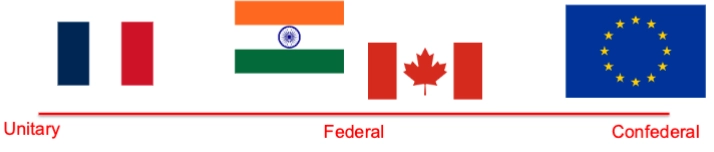
a system with multiple levels of constitutional authority and a division of powers between them, such that neither is subordinate to the other
Why do we use federalism?
practical reasons (size+diversity, recognition of subnational identities) and normative reasons (benefit of larger union, local rule, “check” against government power)
Why did Canada form a union in 1867?
economic interests and territorial expansion (ie. trade)
threat from the US
access to resources, manpower and political power found through solid government
Why did Canada choose a federalist system?
Quebec and Maritimes sough local control and wouldn’t have agreed otherwise
What are some examples of Federal power (s.91)?
Examples include defense, trade, immigration, criminal law, banking, aboriginal policy and residual power.
What are some examples of Provincial power (s.92)?
direct taxes, property + civil rights, health care, education, local work, natural resources.
What are the shared powers? (s.95)
agriculture and immigration.
How is federalism designed to favour the national government?
nation building powers (great subjects of legislation), superior revenue sources, and powers of reservation and disallowance.
What are powers of reservation and disallowance?
Reservation is the authority granted to the federal government to disallow provincial legislation that it deems inconsistent with national interests, while disallowance is the ability to veto such laws within one year of their enactment.
What does veto mean?
A formal rejection of a proposed law by a governing authority, preventing it from becoming effective.
What is high decentralisation?
The Canadian federal system evolved towards strong decentralisation, provinces are more powerful (control a larger share of what governments do and tax)
What is fiscal federalism?
financial arrangements between the federal and provincial levels of government, primarily through transfers from the federal government to provinces.
What is vertical fiscal imbalance?
gap between federal resources and spending demands and provincial and spending demands (federal vs provinces)
What is horizontal fiscal imbalance?
Differences among provinces in resources (province vs province)
What is federal spending power?
it allows the federal government to spend money in areas of provincial jurisdiction by transferring funds to provinces (sometimes with conditions attached)
What is the Canada Health Transfer?
funding for health care service provision, largest transfer of 54.7 billion. Most to Ontario and least to Nunavut in equal per capita, so biggest population receives the most.
What is the Canada Social Transfer?
funding for social services and education of 17.4 billion. Most to Ontario and least to Nunavut in equal per capita, so biggest population receives the most.
How is vertical imbalance addressed?
Through federal transfers and federal spending power to provinces, however, they treat all provinces equally which means there is no equity. Therefore horizontal fiscal imbalance is addressed.
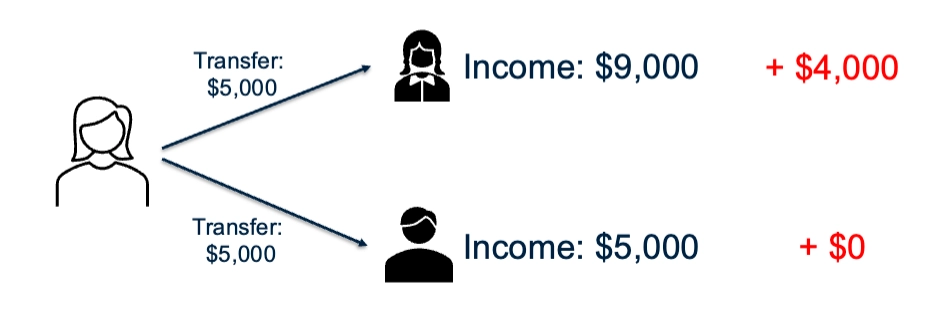
How is horizontal fiscal imbalance addressed?
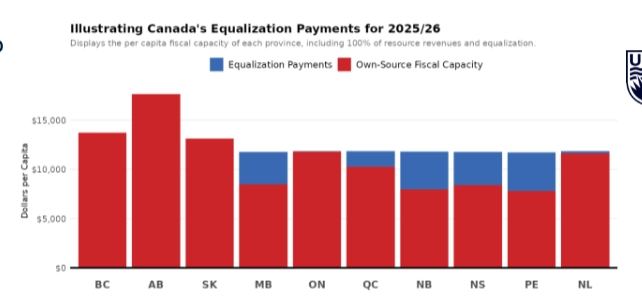
equalization payments to some provinces of 26.2 billion whose fiscal capacity is below the national average to ensure reasonably comparable level of public services at reasonable levels of taxation (Constitution Act, 1982 (s.36))
What is classical federalism?
A political system where power is divided between a central government and regional governments, each with specified areas of authority, ensuring a balance of powers.
What is emergency federalism?
A situation where the central government enhances its powers during crises, often leading to increased authority over regional governments to address urgent national issues.
What is cooperative federalism?
A model of federalism where federal and state governments work together to achieve common goals, often leading to shared responsibilities and collaborative policy-making.
What is executive federalism?
A model of federalism where federal–provincial decision-making led mainly by the executive branches, leading to feeling less democratic as legislatures have less input.
What is quasi-federalism?
A system where power is divided between central and regional governments, but with a greater emphasis on central authority and control.
What is bicameralism?
A system of government where the legislature is divided into two separate chambers or houses, typically an upper and a lower house, which work together to create and pass laws.
What is the council of the federation?
A meeting of Canada's provincial and territorial leaders aimed at promoting collaborative decision-making and addressing common issues.
What is the first ministers’ conference?
A gathering of Canada's provincial and territorial premiers, along with the Prime Minister, to discuss issues of national importance and coordinate policies among different levels of government.
What is asymmetrical federalism?
A form of federalism where different levels of government have varying powers and responsibilities, often resulting in unequal relations among constituent units.
What is the Social Union Framework Agreement?
An agreement among Canada's federal, provincial, and territorial governments to enhance cooperation on social policy initiatives and improve social services.