Probability Basics and Examples: Tree Diagrams, Independence, and Conditional Probability
 Call Kai
 Learn
Learn Practice Test
 Spaced Repetition
 Match
Match Flashcards
 Knowt Play
1/18

There's no tags or description
Looks like no tags are added yet.
Name | Mastery | Learn | Test | Matching | Spaced | Call with Kai |
|---|
No analytics yet
Send a link to your students to track their progress
19 Terms
What is the General Multiplication Rule for any two events A and B?
P(A ∩ B) = P(A) * P(B|A)
When do you use the General Multiplication Rule?
To find the probability that two events A and B both occur, especially when the events are dependent.
What does a tree diagram represent in a chance process?
The sample space of a process involving multiple stages, where branches after the first stage represent conditional probabilities.
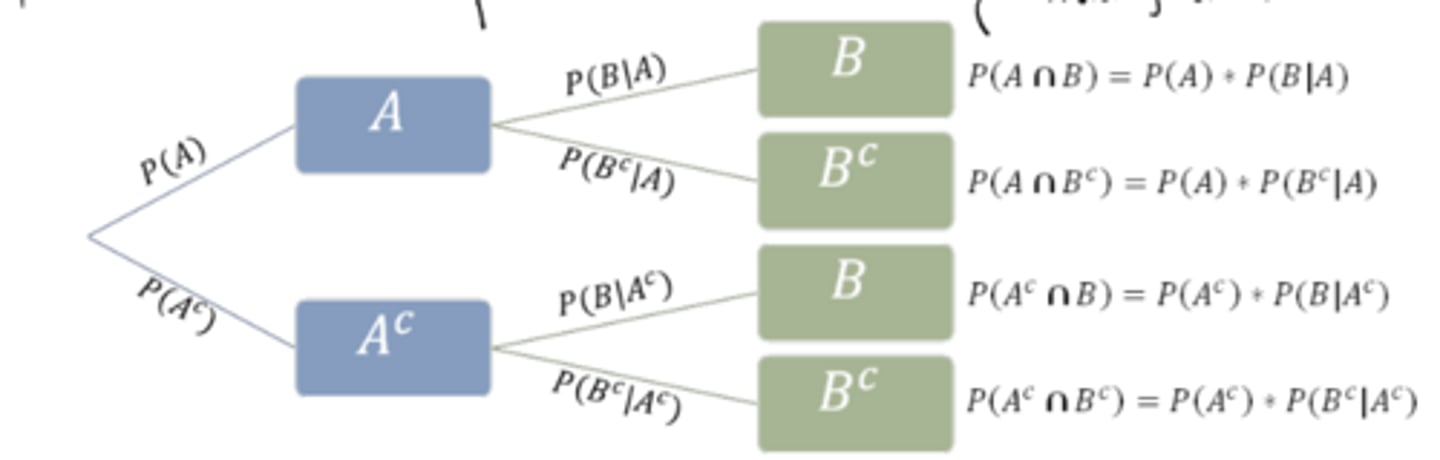
What is the sum of probabilities for each set of branches in a tree diagram?
100% or 1.0
How is the end result of a specific outcome calculated in a tree diagram?
By multiplying the probabilities along the branches leading to that outcome.
What is the definition of independent events?
Two events are independent if the occurrence of one does not change the probability that the other occurs.
If events A and B are independent, what is the value of P(B|A)?
P(B)
What is the Multiplication Rule for two independent events A and B?
P(A ∩ B) = P(A) * P(B)
How does sampling with replacement affect the independence of events?
It makes the events independent because the first result does not change the probabilities for the second pick.
How does sampling without replacement affect the independence of events?
It makes the events dependent.
What is conditional probability?
The probability of an event occurring given that another event has already occurred.
If P(A|B) = P(A), what can you conclude about events A and B?
They are independent.
When calculating the probability of a union of disjoint outcomes in a tree diagram, what operation is used?
Addition (summing the probabilities of the individual paths).
How do you determine if two events are independent using a contingency table?
Check if P(A|B) = P(A) or if P(A ∩ B) = P(A) * P(B).
What is the primary purpose of a tree diagram?
To visualize the sample space and calculate probabilities for multi-stage chance processes.
What happens to the denominator when sampling without replacement?
It decreases by 1 for the second event.
What does the 'Total' column in a contingency table represent?
The sum of frequencies for a specific category across all other variables.
What is the difference between independent and dependent events?
Independent events do not influence each other's probabilities, while dependent events do.
Why is it important to distinguish between sampling with and without replacement?
Because it determines whether the events are independent or dependent, which changes the calculation method.