AMAZON RAINFOREST CASE STUDY (2a)
 Call Kai
 Learn
Learn Practice Test
 Spaced Repetition
 Match
Match Flashcards
 Knowt Play
1/9

There's no tags or description
Looks like no tags are added yet.
Name | Mastery | Learn | Test | Matching | Spaced | Call with Kai |
|---|
No analytics yet
Send a link to your students to track their progress
10 Terms
Amazon rainforest overview
- The Amazon Rainforest occupies an area of more than 6 million km squared.
- 60% of the rainforest is in Brazil.
- It has high average annual temperatures between 25 and 30°C.
- It has small seasonal temperature changes and a high average rainfall (>2000mm) with no dry season.
- There is convectional rainfall all year round.
- 55% of rainfall is recycled by evapotranspiration.
- Water loss from the Amazon basin from river flow and export of atmospheric vapour to other areas.
- Water gain in the basin is from moisture from the Atlantic ocean.
Flows and stores in the Amazon water cycle
- Evapotranspiration: high rates of evaporation due to high temperatures, abundant moisture, and dense vegetation. Precipitation feedback loops allow for high rainfall totals, 55% of all rainfall is returned to the atmosphere by evapotranspiration. Most evaporation is from intercepted rainfall from leaves.
- Vegetation/biomass: trees are crucial to the water cycle, they absorb, store, and release water.
Flows and stores in the Amazon water cycle cont.
- Soil/groundwater: Abundant rainfall and deep tropical soil = high water storage in soil and aquifers.
- Atmosphere: the atmosphere stores high amounts of moisture (absolute humidity) due to high temperatures - high relative humidity.
- Runoff: rapid runoff due to high rainfall, intense storms, and well-drained soils. River discharge peaks in 1 or 2 months depending on seasonal rainfall.
Physical factors affecting the water cycle
- Geology: Impermeable crystalline rocks in the Amazon basin have minimal water storage capacity; this results in rapid runoff. Limestone and sandstone are permeable/porous so store lots of rainwater and results in slower runoff.
- Relief: Most of the Amazon basin is made up of lowlands. Here, water moves across the surface (overland flow) or horizontally through the soil (throughflow). In the west of the Amazon, steep catchments of the Andes create rapid runoff. The Pantanal floodplain is inundated annually, storing water and slowly moving it into rivers.
- Temperature: High temperatures mean high rates of evapotranspiration, strong conventions lead to high atmospheric humidity.
Human factors affecting the water cycle
DEFORESTATION
- Since 1970, 1/5 of the Amazon has been destroyed.
- 2014: flooding of the Madeira River killed 60 people. This was a result of human activity which has modified stores and flows within the water cycle.
- Deforestation has reduced water storage in trees/soil/permeable rocks/atmosphere.
- Fewer trees mean less evapotranspiration and less precipitation. Total runoff and runoff speeds have increased.
- Deforestation changes climate locally (increase runoff by turning forests into grasslands as there is less interception so less rainfall, also destabilises albedo and ground temperature), and globally (regional rainfall predicted to decline by 20%).
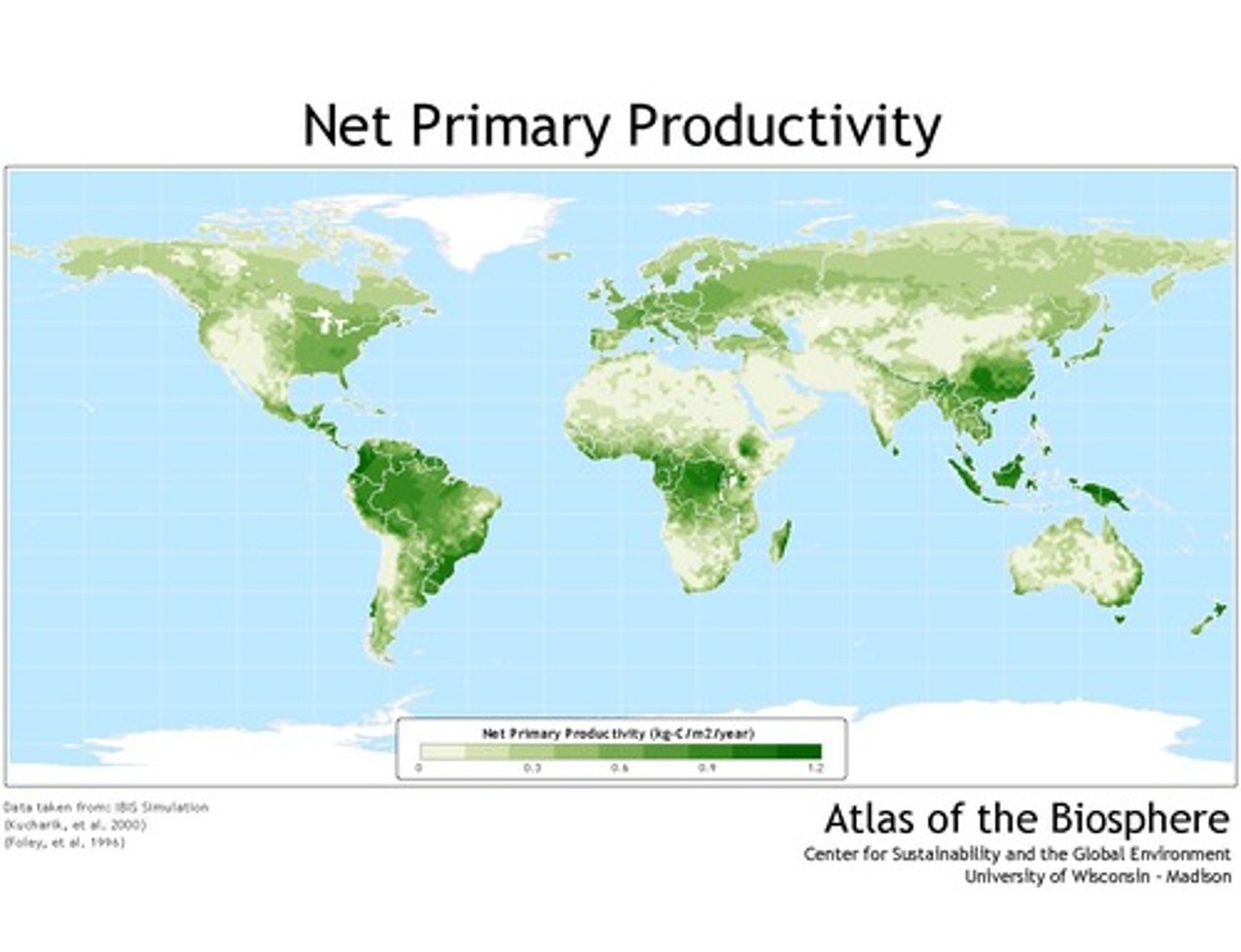
NPP (net primary productivity)
- The humid, tropical climate creates ideal conditions for plant growth, NPP is high.
- Biomass is high (400-700 tonnes/ha). Large trees store 180 tonnes of carbon/ha above ground and 40 tonnes/ha in roots.
- Soil stores 90-200 tonnes/ha of carbon. The Amazon is a major global carbon store (2.4bn tonnes absorbed per year).
- Humid, tropical climate cause rapid decomposition and quick release of carbon dioxide, carbon fixation through photosynthesis is also high.
- Leached and acidic soils contain limited carbon and nutrients. Rapid decomposition/recycling of organic matter is the reason why there is such a high NPP and biomass in a place with poor soil quality.
Factors effecting flows and stores of carbon
- VEGETATION: trees are the principle carbon store (100 billion stores), 60% stored in above-ground biomass.
- Photosynthesis connects the rainforest to the atmospheric carbon stores.
- NPP is stimulated by high temperature/rainfall/sunlight. 15-35% of all NPP is in terrestrial ecosystems.
- Leaf litters gathers in soil and decompose rapidly (high humidity).
- Nutrients then released into soil, taken up by tree roots, emitting carbon dioxide which is then released back into the atmosphere - constant cycle.
- GEOLOGY: dominated by igneous and metamorphic rock.
- Carbonates are largely absent from mineral composition.
- Some parts of the Andes are made up of limestone, which is a carbon store in the slow carbon cycle.
Factors effecting flows and stores of carbon cont.
- DEFORESTATION: in primary forest (unaffected by humans) biomass of trees represent 60% of all rainforest ecosystem's carbon (180 tonnes/ha).
- Deforestation exhausts carbon biomass store e.g. land use for soya cultivation only stores 2.7 tonnes/ha of carbon.
- Deforestation reduces inputs of organic matter to soils, depletes them of carbon and exposes them to sunlight.
- This means there are fewer decomposers and the flow of carbon from soil to atmosphere is reduced.
Strategies to manage rainforests and positive effects on the carbon cycle and the water cycle
LEGISLATION OF PRIMARY FOREST
- Amazon Regional Protected Areas (government led since 1998) covers an area 20x the size of Belgium.
- 2015: 44% of the Brazilian Amazon is a national park.
- Reforestation projects (NGOs and businesses), but this is slow progress.
- Fast growing seedlings planted on smallholdings and financial assistance provided (monoculture but it is sustainable).
IMPROVED AGRICULTURAL TECHNIQUES
- Farming is the main cause of deforestation.
- Diversification projects, like rotational coppicing and combining livestock and arable operations allow 5 fold increase in productivity and reduces deforestation.
Strategies to manage rainforests and positive effects on the carbon cycle and the water cycle cont.
PROJECTS TO REFOREST AREAS
- REDD scheme: Surui people joined the UN led scheme in 2009.
- Tribe is paid for protecting the rainforest and abandoning deforestation using carbon credits.
- 2013, Natura purchased 120,000 tonnes of carbon credits from the Surui, this is the first ever carbon credit sale by indigenous people.