Meiosis and Mitosis: Key Differences and Processes in Human Biology
 Call Kai
 Learn
Learn Practice Test
 Spaced Repetition
 Match
Match Flashcards
 Knowt Play
1/25

There's no tags or description
Looks like no tags are added yet.
Name | Mastery | Learn | Test | Matching | Spaced | Call with Kai |
|---|
No analytics yet
Send a link to your students to track their progress
26 Terms
What is meiosis?
Meiosis is the basis for sexual reproduction, where two gametes fuse during fertilization to form a new organism.
What type of cells are produced by meiosis?
Gametes, which are haploid (n) and contain half the number of chromosomes as each diploid (2n) parent.
What is the ploidy of gametes?
Gametes are haploid (n), containing 23 chromosomes in humans.
What is the ploidy of somatic cells?
Somatic cells are diploid (2n), containing 23 pairs of chromosomes in humans.
What are the two main phases of meiosis?
Meiosis I and Meiosis II.
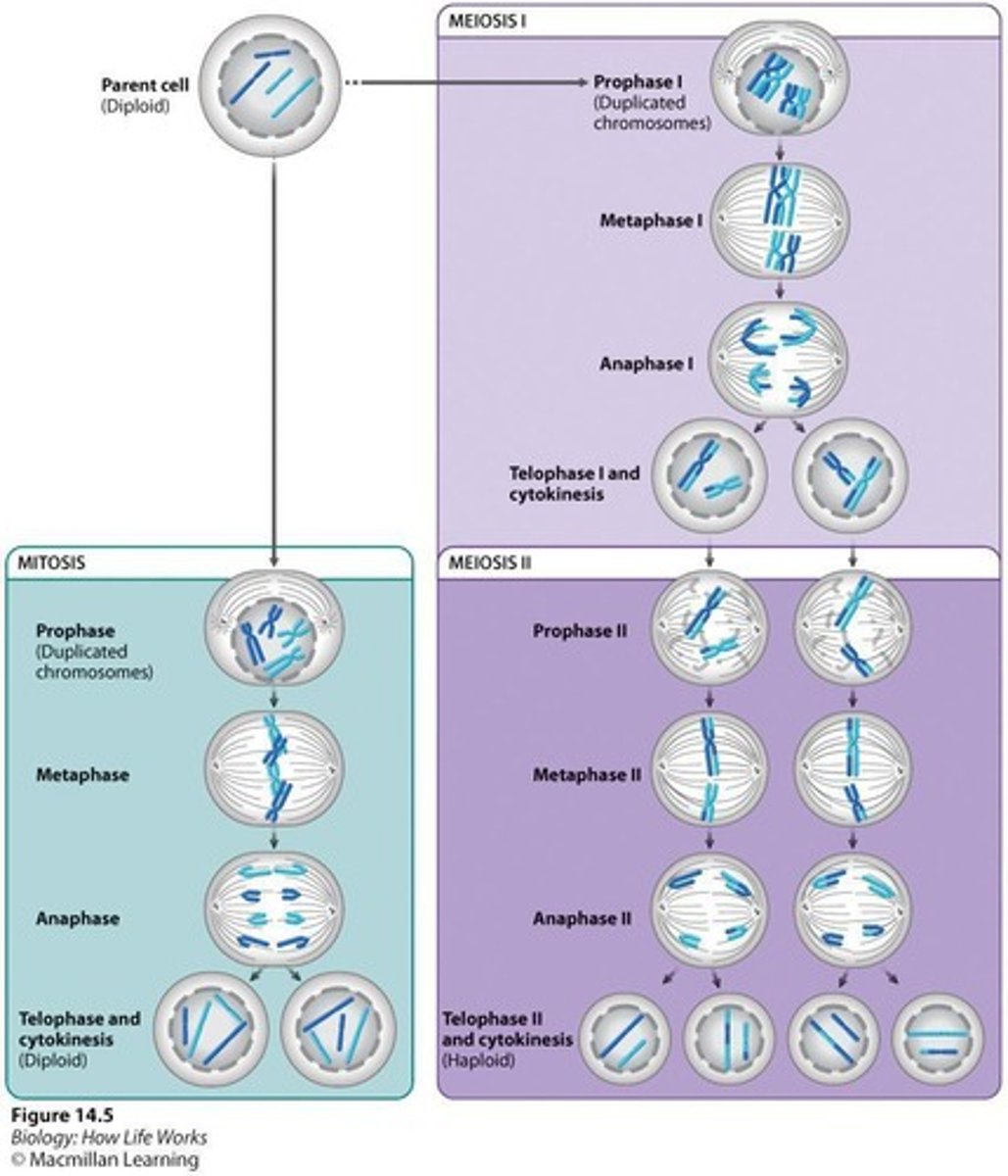
What happens during Meiosis I?
Homologous chromosomes separate from one another, reducing the number of chromosomes by half.
What occurs during Meiosis II?
Sister chromatids separate, similar to mitosis.
How many daughter cells are produced at the end of meiosis?
Four daughter cells, each genetically unique and haploid.
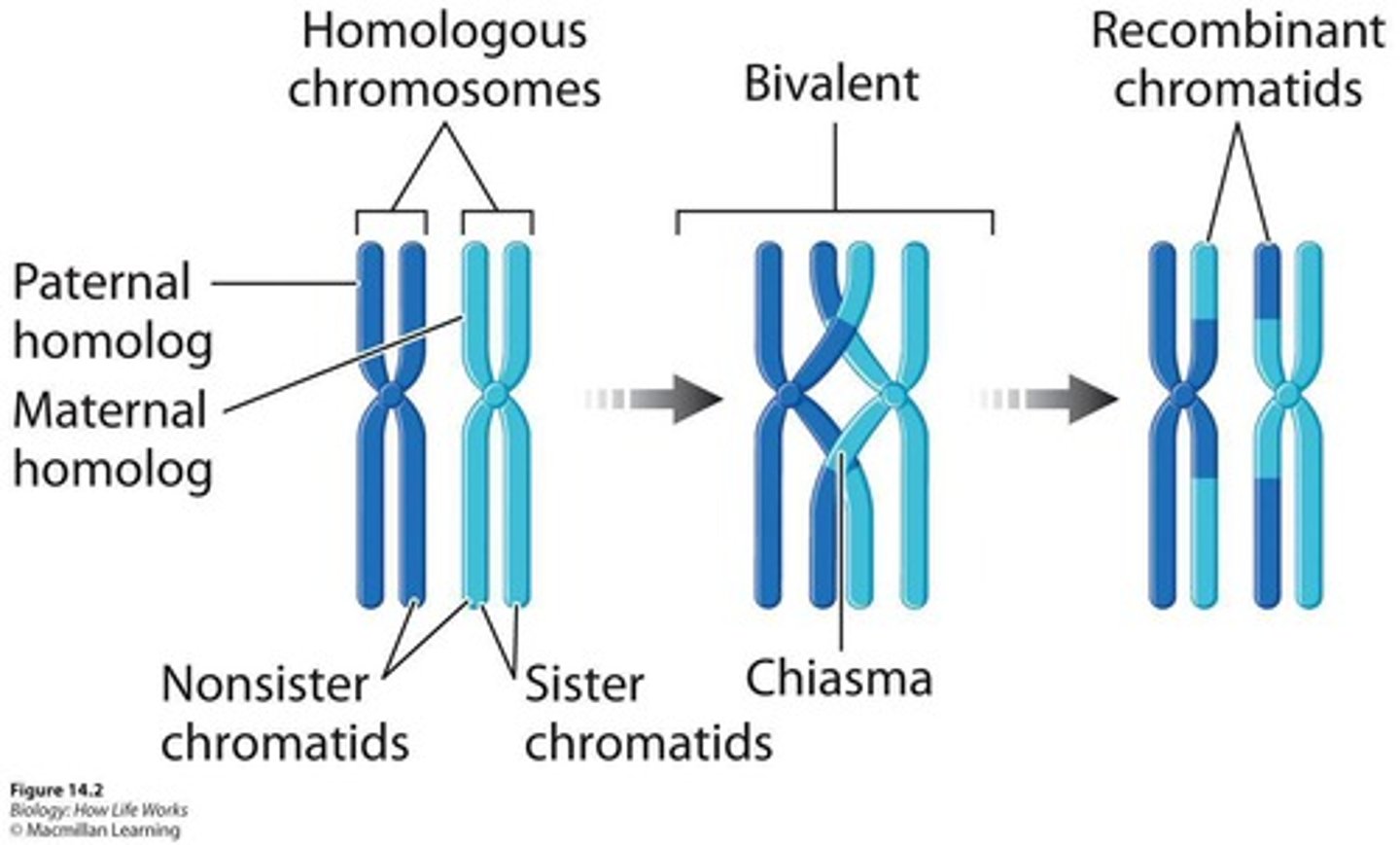
What is crossing over?
The exchange of genetic material between non-sister chromatids during Prophase I, increasing genetic variation.
What is the significance of the S phase in meiosis?
DNA synthesis occurs, preparing the cell for division.
What is the difference between mitosis and meiosis in terms of daughter cells?
Mitosis produces two identical diploid daughter cells, while meiosis produces four genetically unique haploid daughter cells.
What is the outcome of cytokinesis after Meiosis I?
The ploidy changes from diploid (2n) to haploid (n) as homologous chromosomes have separated.
What happens during Metaphase I of meiosis?
Bivalents align at the center plane of the cell, with random orientation.
What is the role of the meiotic spindle during meiosis?
The meiotic spindle attaches to kinetochores on chromosomes to facilitate separation during cell division.
How does meiosis contribute to genetic diversity?
Through crossing over and the random assortment of chromosomes during gamete formation.
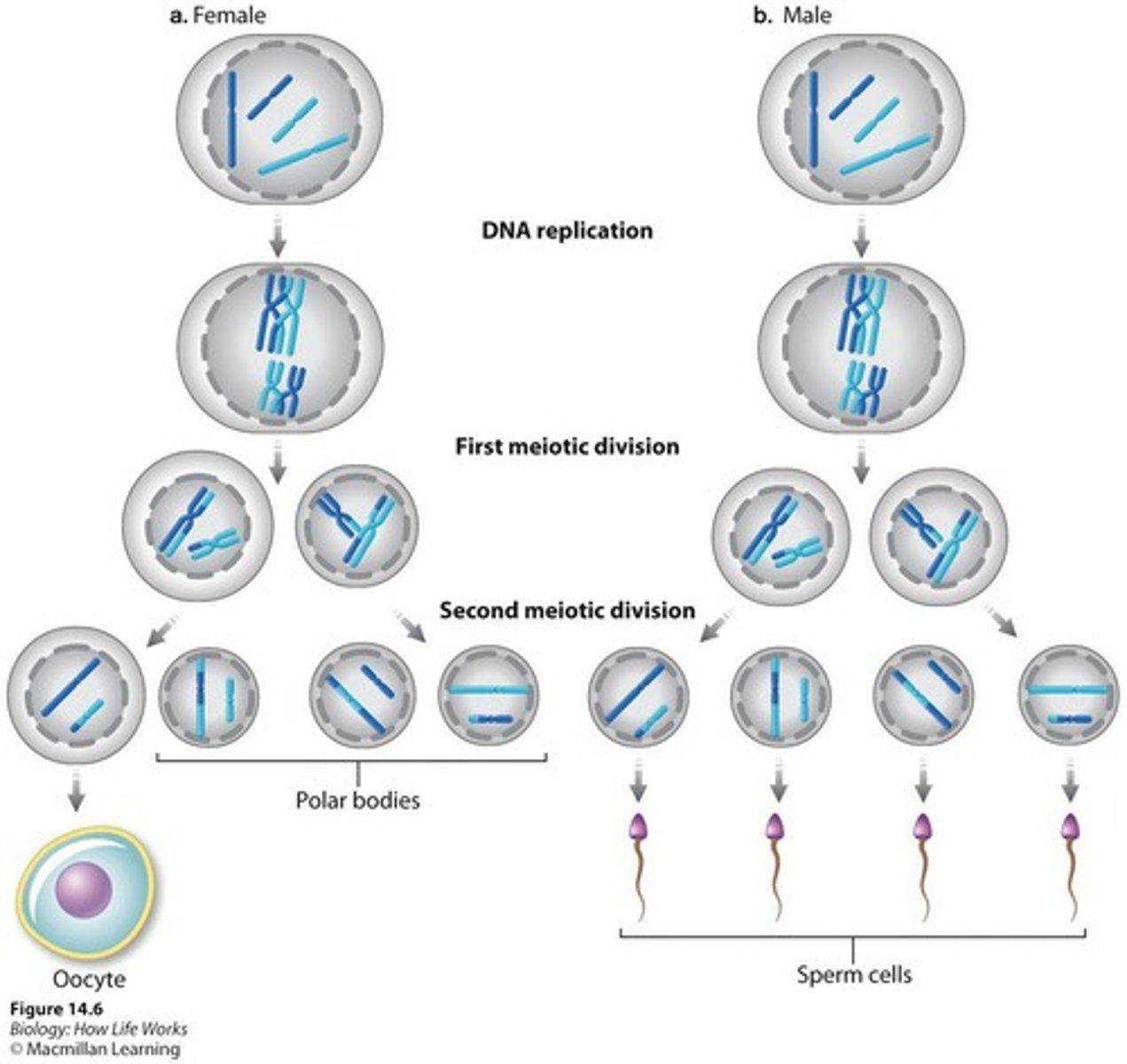
What is the difference in cytoplasmic division between males and females during meiosis?
In females, one oocyte and three polar bodies are formed; in males, cytoplasmic division is equal.
What is the primary function of meiosis?
To produce gametes or spores for sexual reproduction.
How many rounds of DNA synthesis occur in meiosis?
One round of DNA synthesis occurs before meiosis begins.
What is the difference in chromosome separation between mitosis and meiosis?
In mitosis, sister chromatids separate; in meiosis I, homologous chromosomes separate, and in meiosis II, sister chromatids separate.
What are the two types of cells involved in meiosis?
Germ (sex) cells and somatic cells.
What is the result of recombination during meiosis?
It leads to novel combinations of alleles not seen in parental chromosomes.
What is the terminal event in meiosis?
Meiosis is a terminal event, meaning it leads to the formation of gametes that cannot continue dividing.
What is the significance of the G0 phase in cell division?
It is a decision point for cells that are not actively dividing.
What is the difference in pairing of homologous chromosomes between mitosis and meiosis?
Homologous chromosomes pair during meiosis I but do not pair during mitosis.
What is the outcome of meiosis in terms of genetic identity?
Each daughter cell is genetically unique, unlike the identical daughter cells produced in mitosis.
What happens to the number of chromosomes during meiosis?
The number of chromosomes is halved from diploid to haploid.