PSC 140 Midterm 2
 Call Kai
 Learn
Learn Practice Test
 Spaced Repetition
 Match
Match Flashcards
 Knowt Play
1/140

There's no tags or description
Looks like no tags are added yet.
Name | Mastery | Learn | Test | Matching | Spaced | Call with Kai |
|---|
No analytics yet
Send a link to your students to track their progress
141 Terms
theories of cognitive & social development: a sociocultural approach (topic)
why do we care about theories of cognitive & social development?
theory is a critical part of the scientific method
organizes our thinking
offers a shared language
can be new or established
examining developmental theories:
gives us some perspective on how the field itself has developed
help us to better understand children
theories of cognitive & social development
historic theories
cognitive development
piaget
vygotsky
social development
ethology
learning
contemporary theories
sociocultural
Bronfrenbrenner biocological model (chap 9)
Vygotsky (chap 9)
Rogoff (assigned article)
information processing
piaget +learning + dodge social problem solving
core knowledge
piaget + ethology
theories of cognitive and social development
a sociocultural approach
bronfrenbrenner’s bioecological model
vygotsky
rogoff
Sociocultural theories of cognitive development
Cognitive development occurs in interpersonal contact
Guided participation (is important) in which knowledgeable individuals guide child learning (an important sociocultural process)
Bioecolgical model
A child environment is gonna be composed of nested structures
Each structure represents a different level of influence on the child development
Vygotskian principles of cognitive development
Children are social beings shaped by their cultural contexts
Children are both learners and teachers
Children are products of their culture
Cognitive change orinates in social interaction
How does cognitive change occur?
Social referencing: children look to social partners for guidance about how to respond to unfamiliar events
Social scaffolding: more competent people provide temporary frame works that lead children to higher-order thinking
Ex. ways teacher can scaffold children learning: providing hints, offer range of possible answers (when childrens are having a hard time), can help give the kids additional resources
Can be used to help childrens learn new skills and knowledge
Autobiographical memory: memories of one’s own experiences, including one’s thoughts and emtiions
Vygosky and cognitive change
Zone of proximal development
The range b/w what children can do unsupported vs what they can do with optimal social support
Ex. addition: if they had a more expert partner, then they can pratice doing addition with 2 digits number as compared to doing addition with single digits
How much flexibility we see in the child’s ability will be based on the experience that their social partners have
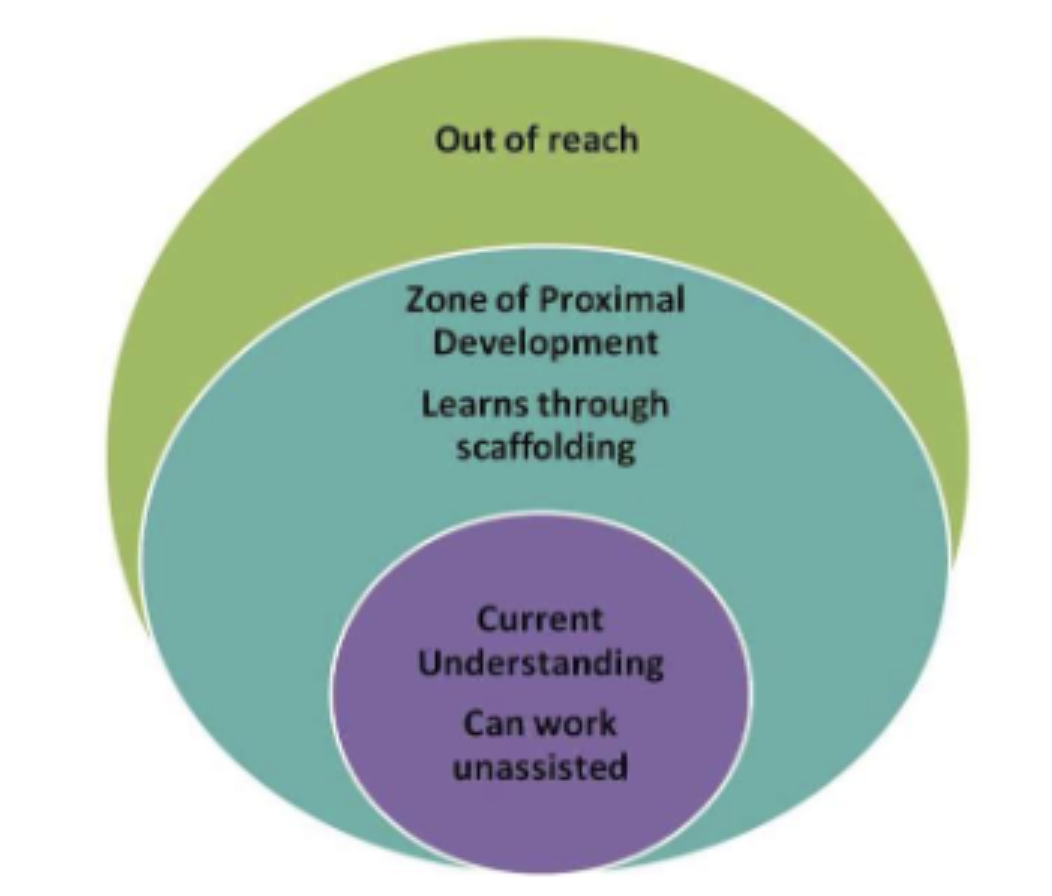
what is zone of proximal development?
not static, it changes with childs abilities, knowledge, support, etc
recognizes that children have a range of possible learning outcomes
children do not passively absorb information, they actively construct it during interactions with others
Contemporary social cultural theory
Rogoff
Cultural differences in parenting, expectations, etc, creating learning differences
Third party attention:attening to events not directly addressed to oneself can provide important information
Piaget theory
Piaget observed and described children at different ages
His theory is very broad
Piaget theory focuses on nature-nuture interaction and continuities and discontinuities
Goes through birth through adulthood
Includes moral reasoning and all of cognitive development
Described this changes as stages (stage theory), development is done in stages
Principle of stage theory are consistent, fixed way of thinking
Piaget says there are 4 stages of cognitive development
Stage theory is considered discontinuity development
Piaget assumption about children
Children construct their own knowledge in response to their experiences
Structures (schemas): an organized group of interrelated memories, thoughts, and strategies that the child uses in trying to understand a situation
Children are intrinsically motivated to learn and do not need rewards from adults to motivate learning
They live to learn, they love to learn
Central themes in Piaget's theory
Nature and nurture interact to produce cognitive development
Organization: Children use observations to build a body of coherent knowledge
adaptation: children respond to the demands of the environment in ways that meet their own goals
2 processes work together from birth to help children organize knowledge
Assimilation: (relying on information you already have), people translate incoming information into a form they can understand
Sees cat and he says ‘dog’
Accommodation: (cognitive change is happening, change in knowledge structure ), people adapt current knowledge structures in response to new experiences
Sees cat and says ‘dog’ but then they correct and tell him its not a dog it a cat (he is accommodating). There's a change in knowledge structure
There are distinct stages of cognitive development, with the following properties:
Qualitative change (different kids are different ages, perform/think differently)
Broad applicability (in the stage the child it is in it is going to influence any domains that its in) (stage theory explains the cognitive development in all of the kids in the age)
Brief translations
Invariant sequence (everyone passes through the stages in the exact same order, no skipping or going backwards)
Piaget said most ppl dont get to the last stage
piaget stages of cognitive development (image)
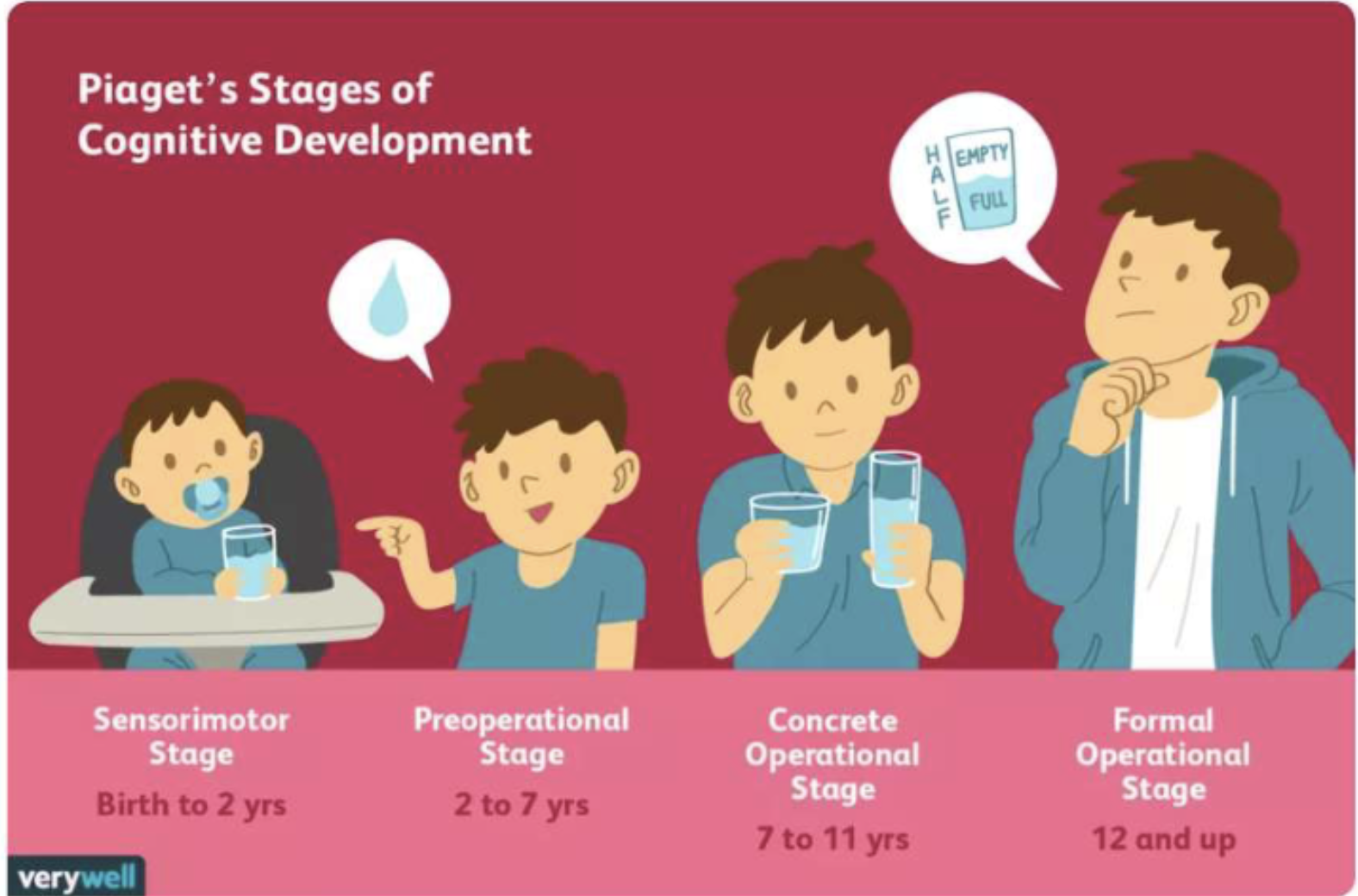
Sensimotor stage
Birth to 2 years
Knowledge develops through sensory and motor abilities
Object permanence: the knowledge that things continue to exist when out of sight
A not B error
Deferred imitation: the repetition of other people behavior after a delay (happens at the end of the stage)
Preoperational stage
2-7 years
Symbolic representations: the use of one object to stand for another
Egocentrism: looking at the world only from one’s point of view
Concrete operational stage
Concrete operational stage (7 to 11-12 yrs)
Children can reason logically about concrete objects and events
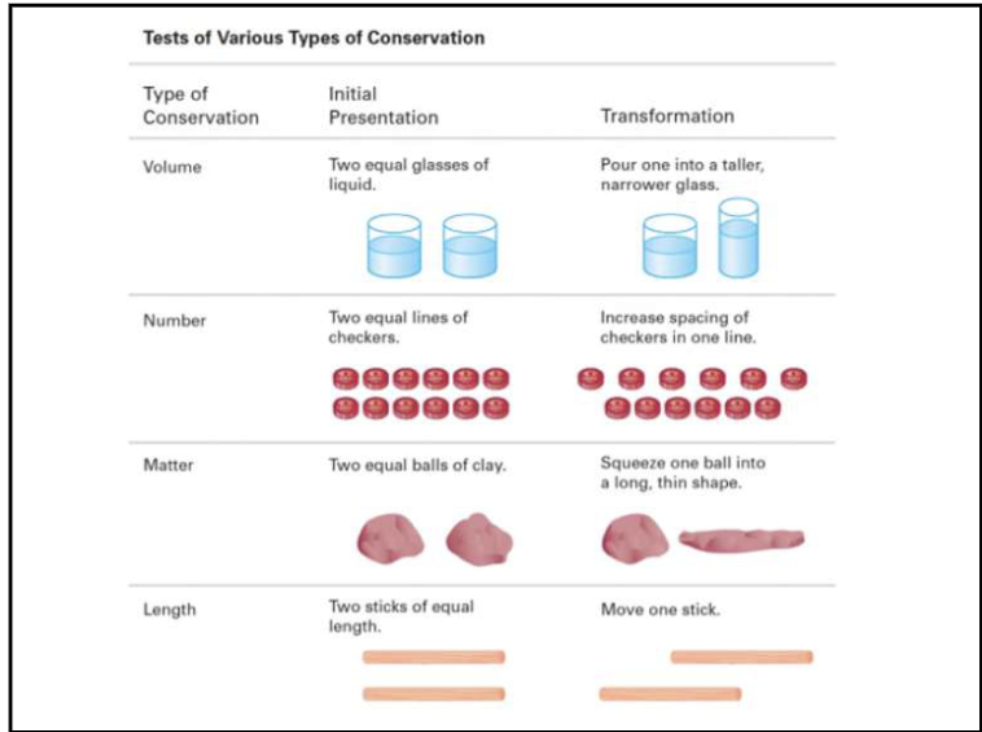
Exemplified by the development of the conversation concept (more than one dimension at a time)
Children understand the conversation concept when they realize that changing the appearance or arrangement of objects does not necessarily change other key properties (e.g., understand that the volume of water in one big cup is the same in the small cup)
Conservation is what Piaget believes is the most important in this stage believe is a huge cognitive milestone
conservation
Formal operational stage
Ability to think abstractly and reason hypothetically
Ability to engage in scientific thinking
Hypothetical deductive reasoning: hitting a glass with a feather vs a hammer, what happens to the glass?
Types of reasoning (huge milestone)
Deductive reasoning:
General information -> specific instances
We have general information, and we apply it to specific instances
It's not until adolescence that deductive reasoning emerges
It's in the scientific method
Inductive reasoning:
Specific instances -> general information
Are our personal love experiences, and we extract rules of how the world works
Kids are very good at inductive reading
See it throughout the life cycle
It's in the scientific method
Strengths of piaget theory
Children actively seek and construct knowledge
Development follows an invariant sequence (Development processes through stages)
Errors are informative and may provide important information about the development of children's thinking
Cognitive development in the first two years does not depend on language
Weakness of piaget theory
Children's thinking is not as consistent as the stages suggest
Infants and young children are more competent than Piaget recognized
Piaget understands the social components of cognitive development
Piaget was better at describing processes than explaining how they operate
Information processing theories
Computer as a model
Hardware
Software
more about the mechanism, when referring to learning applies to both cognitive and social domains
Children are active problem solvers
View children as undergoing continuous cognitive change
Examine how nature and nurture work together
Describe how cognitive change occurs
Are concerned with the development of learning, memory, and problem-solving skills
Development of learning and memory
Working memory: system that involves actively attending to, gathering, maintaining, storing, and processing information
Long-term memory: consists of the knowledge that people accumulate over a lifetime
Executive functioning: involves the control of cognition
Basic memory process
Associating events with one another
Recognizing objects as familiar
Generalizing from one instance to another
Encoding (representing features of objects and events in memory)
The speed with which children execute basic processes increases greatly over the course of childhood
Myleination
Development of strategy
Learning and memory emerge at 5 and 8 yrs of age
Because of the acquisition of strategies (learning different strategies)
Social learning theory
Observation and imitation are the primary mechanisms of development
Banduras bobo doll study
Does vicarious reinforcement, observing someone else receive a reward or punishment, affect behavior?
Information processing theory of social problem solving
Emphasizes the role of cognitive processes in social behavior
Research focuses on the use of aggression as a problem-solving strategy
Hostile attribution bias: the tendency to assume that other people’s ambiguous actions stem from hostile intent
Core knowledge theories of cognitive development
Principles of core knowledge theories
Focus on areas (such as understanding people) that have been important throughout human history
Children are much more advanced in their thinking than Piaget suggested
Children have innate cognitive capabilities that are the product of human evolutionary processes
Ethological theories
Ethology: the study of behavior within an evolutionary context
Ethologists argue that a variety of innate behavior patterns in animals, including imprinting, were shaped by evolution
Conclusion: **** mention for which conclusion this is
These theories have contradictory features
It is not possible to create a unified grand theory
We incorporate insights from all of the theories to help us understand children in different ways and in different settings
Conceptual development (topic)
Development of folk knowledge
Children develop theories about the natural world, test them out and refine their mental maps
They have theories about actions, objects, spacve people, and number
Understanding people
Three psychological constructs are at the center of naive psychology the ideas that people commonly use to understand human behavior
desires
beliefs
actions
piagetian, nativist, and empiricists/socialcultural theorists have different explanations for how children develop common sense ideas about people
piaget (recap)
Development processes through stages
Childrens thinking changes qualitavelty as they progress through the stages
Egocentrism
Shift from preoperational to concrete operational thought
Understanding minds of others a product of cognitive development
nativist /core knowledge theories (recap)
Have innate knowledge relevant to areas that have beenn important throughout human evolution
Knowledge is domain specific
Origins of abilities seen in infancy
Understanding people emereges infancy
Theory of mind (what is it?)
b/w ages 2 and 5 yrs children form a theory of mind
‘Theory of mind’ is a basic understanding of how the mind works and influences behavior
A child's theory or mind includes knowledge of perceptions, psychological states, and actions
Theory of mind: false beliefs problems
3 yr old children have some understanding of how beliefs and desires affect behaviors
Knowing what other people are thinking , and incorporating their perspective is necessary in theory of mind tasks
Where does theory of mind come from?
Theory of mind module - a brain mechanism devoted to understanding other human beings
What is the evidence?
Brain areas specialized for this reasoning
Invariance in the timing of development
Deficit in children with autism spectrum disorder (only one view)
Attentive parents
Joint attention
Imitation
Social experiences
Talking about mental stages
Sensitivity to feelings of others
Pretend play
empiricist/social cultural theories
Devlopment results from everyfay interactions with others
Children are products of their culture/experience/environment
Experince interacting with others is important for development of theory of mind
Children with older siblings do better on false belief tasks
Performance on false beliefs tasks is a function of other cognitive abilities
what is number understanding?
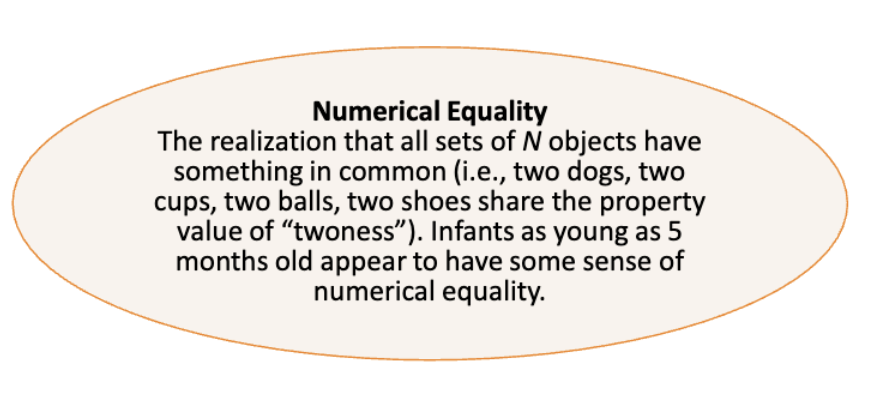
Numerical equality
The relization that all sets of N objects have something (ie. two dogs, two cups..)
Infants as young as 5 month old appear to have some sense of numerical quality
How does number understanding develop?(piaget view)
Number abilities undergo qualitative change through the stages he described
Operational thought is especially important, why?
Operational thinking support
How does number understanding develop?(nativist/core knowledge view)
Innate core concept of number
Special mechjanims for representing and earning about numbers
Specialized brain areas
Number abilities should be early emerging
Newborns has non sykmbolic numerical equality
According to this presecrive, infants can add and subtract
How does number understanding develop?(empiricist / socialcultural view)
General cognitive abilities
Cultural differences in numerical understanding
Sociocultural differences in culture
Children from china learn to count faster than US
Could be of how numbers are represented in
Ramani & siegler
Low income children are often at the disadvantage with respect to number knowledge
Ramani & siegler hypothesized that these children differ in their number sense
Ramani & siegler gave them the opportunity to play these games what differences do you see b/w the boards ?
inteligence (topic)
what is inteligence?
The ability to
Use knowledge to reason
Make decisions
Solve problems
Understand complex ideas
Learn quickly
Make sense of events
Adapt to environmental challenges
Hard to define which makes it difficult to measure
Intelligence as a single trait
Charles setrum came with the idea that everyone holds a certain amount of g (general intelligence). He came through this concept through backdoor analysis (a statistical method that uses observations to make an estimate of a quality factor)
Intelligence as a few basic abilities
Two types of intelligence
Crystallized intelligence: factual knowledge about the world, word meanings, arithmetic, etc (semantic knowledge)
Fluid intelligence: ability to think on the spot by drawing inferences and understanding relations b/w conceptys not previously encountered
Crystalized intelligence is something that continues to grow over the life span, fluid intelligence peaks at around 30’s and gradually declines from there
Thurstone's seven primary mental abilities
He thought 2 wasn’t enough so he believed we needed 7 categories
Word fluency, verbal meaning, reasoning, spatial visualization, numbering, rote memory, and perceptual speed
Thurstone vs cattel
The 7 mental abilties is more precise and give us more details compared to just 2 types
Resolving the competing perspectives
John Carroll proposed the three-stratum theory of inteligencee which is a hierarchical integration that includes
g
eight generalized abilities
many specific processes
what is Emotional intelligence?
Emotional intelligence: its meaning varies across cultures, social intelligence that emphasizes the ability to manage, recognize, and understand emotions and use emotions to guide appropriate thought and action
resilience/grit: an individual's ability to properly adapt to stress and adversity
The complexity of intelligence
The development of intelligence is embedded in contexts
Measuring intelligence: intelligence tests
Bayley scale of infant development
Wechsler Intelligence Test for Children (WISC)
(WIDC) is divided into 2 main sections
Verbal: general knowledge and language skills (crystalized intelligence)
Performance: spatial and perceptual abilities ( fluid intelligence)
Stanford binet
Intelligence quotient IQ: the overall quantitative measure of a child's intelligence relative to that of other children of the same age
IQ = MA /CA * 100
MA = mental age, which the test estimates, ca = chronological age (how may day old you are) that how we get an IQ score
Stability of IQ scores
Scores are stable from the age of 5 onward
Children IQ at 5 have high correlation with their IQ at age 15
The scores however, do show an average change up or down a few points
IQ as a predictor
Is intelligence testing valid?
IQ is the best single predictor pf school performance and educational attainment
Predicts work performance, income, and performance in jobs requiring complex skills
But other factors matter too
Individual motivation
Background
Biases in IQ testing
Normative scoring – who makes up the ‘average’ group
Cultural bias – based on knowing the langauge and culture of a mainstream
May reflect education and schooling, not intelligence
Influences of schooling
School attendance improves IQ scores
Average IQ scores rise during the school year and drop during the school
Intelligence and schooling
Tale of 2 schools
Westernized schooling
Brazilian street math
kids in brazil who sell fruits are able to make good math calculations on the spot, but when they are told to do problems on paper or write it out they dont do well
Race, ethnicity and intelligence
It is in fact that IQ scores differ among groups
These data refer only to statistical averages, not individual scores
Millions of ethnic minorities have higher IQ’s than that of the average Euro-American
There are differences in ethnic performance on subtests
Race is not an explanatory factor - score differential is indicative of the environment within which children are raised
Poverty and intelligence
Poverty affects intelligence in several ways
Malnutrition and teratogens can disrupt brain development
Reduced access to health services, poor parenting, insufficient stimulation, and emotional support can impair intellectual growth
In all countries studied, children from wealthier homes scored higher on IQ tests than children from poorer homes
In countries with the most income inequality, the difference in IQ is the greatest
Risk factors and IQ
Risk factors that are related to IQ scores
Head of the household is unemployed or working in low status occupation
Mother did not complete high school
At least four children in the family
No father or stepfather in the home
African American family
A large number of stressful life events in the past few years
Rigidity of parents' beliefs about child development
Maternal anxiety
Maternal mental health
Negative mother-child interactions
Intervention programs
Programs that work:
Home-based programs: focus on improving parenting skills
Center-based program: childcare with emphasis on teaching reading and arithmetic skills, reinforcement of learning, and providing a stimulating environment
Carolina abecefarian project – box 8.2
Head Start program
Effectiveness of programs
Gains in IQ scores from participation in early programs are not lasting, but there are other long-term effects
Fewer children needed special education classes
Fewer children were held back in school
More program participants graduated from high school
Less likely to turn to criminal activity
Principles of successful intervention programs
Timing
Intensity
Direct provision of learning experiences
Breadth
Recognition of individual differences
Environmental maintenance of development
Cultural appropriateness and relevance of intervention strategies
Conclusions of inteligence
Intelligence and success in life involve a broader range of capabilities than those measured by traditional intelligence traits
There is no single correct theory of intelligence
A variety of theories and assessments reveal the different ways in which people are intelligent
Early intervention programs can dramatically affect both intelligence and academic achievement
emotional (topic)
What are emotions?
Emotions are feelings or affect that involve:
subjective evaluation
Physiological process - heart rate…
Cognitive appraisals
Emotions are short-lived
Emotion motivates people towards an action
Discrete emotions theory
Innate, evolved, and universal
Suggests emotional experiences are innate, evolved, and universal
We have 5+ emotions that are seen as default/universal
Anger
Fear
Sadness
Disgust
Happiness
Surprise
Emotions have unique physiological reactions
Functionalist perspective on emotion
The basic function of emotion is to promote action
What do emotions do?
Emotions are central, adaptive forces in all aspects of human activity
Promote action toward achieving a goal
Emotions determine
Cognitive processing
Social processing
When do basic emotions emerge?
Carool anaylzye facial expression of infants
Children need to be able to discriminate between each emotion
Newborn infants will habituate towards the difference of 2 emotions
Basic emotions in infancy
Newborns experience only pleasure and distress
By 6 months, infants have all basic emotions
Stranger warriness
Emerges around 6 months
Infants begin to realize that all people are not the same, the relationship they have with their primary caregivers is special
Separation anxiety, which is distress due to separation from the parent who is the child’s primary caregiver
Complex emotions in toddlerhood
Self-conscious emotions
Embarrassment, pride, guilt, and shame
Involve feelings of success when one’s standards or expectations are met and failure when they are not
Require a sense of self
Emotional development in later childhood
Children overall become less intense and less emotionally negative with age in the preschool and early school years
Cognitive development changes the causes of emotions
Fears are generally related to real-life important issues rather than imaginary creatures
Perceptions of others' motives and intentions are important in determining whether or not a child will be angered
Understand regret and relief
Emotional development in adolescence
Emotional intensity during adolescence
Why?
Hormonal changes
Frontal regions of the brain develop
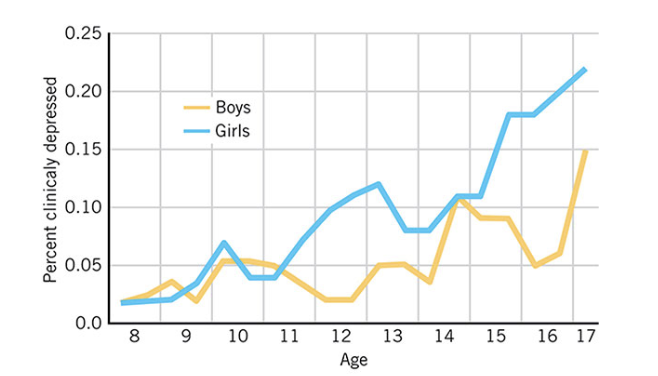
Adolescent depression
depression increases in boys and girls as the grow but more for older girls
Cultural experiences in emotional expression
Children’s and parents' experience, expression, and understanding of emotion are embedded in the physical and social structures within which they live, and the beliefs, values, and practices of the culture
There are cultural differences in children’s expression of emotions
Japanese toddlers show more distress than European toddlers
Why?
Collectivism vs individualism
Children's place in the family
Value of emotional experience and expression
Children also learn to understand the difference b/w real and false emotions
Display rules: a social group’s informal norms about when, where and how much one should show emotions and when and where displays of emotions should be suppressed or masked by displays of other emotions
Display rules in lab
Regulation of emotions
Emotional self-regulation: a complex process that involves initiating, inhibiting, or modulating
Internal feeling states (subjective emotional experience)
Emotion-related physiological processes (ex. Heart rate)
Emotion-regulated cognitions (thoughts about desires or about how to interpret situations)
Emotion-related behavior (ex. Facial expressions of feelings or aggression due to anger)
The development of emotional regulation
Parents help infants regulate their emotions by controlling exposure to stimuli, removing the source of frustration or fear
By 6 months, infants begin to ‘self soothe’, distracting themselves through shifting their gaze or stroking objects or clothing
With language development, children use talk to regulate the expression of emotions
Adults teach children how to express emotions in social acceptable ways
Social referencing
Cognitive strategies
Using cognitive strategies to control negative emotions
Young children use behavioral strategies to regulate emotions
Older children use cognitive strategies to distract themselves by thinking about goals and focusing on positive aspects of a situation
Children learn to select appropriate regulatory strategies through problem-solving skills, the recognition of things they cannot control, and by adapting to the situation
delay of gratification
the ability to delay gratification predicts social, emotional, and academic competence years later
temperament
temperament:
biologically based individual differences in behavioral tendencies
consistent across situations
relatively stable over time
New York Longitudinal Study
easy
difficult
slow to warm up
stability of temperament
Traits remain stable over time
behavioral inhibition
the tendency to be fearful and restrained when dealing with novel or stressful situations
Goodness of fit matters:
goodness of fit - how well an individual’s temperament matches their environment
attachment (topic)
what is attachment?
its the close and enduring bond b/w children and their parents or other primary caregivers
early research on attachment was done with children seperated from their parents early in life
harry harlow
harry harlow conducted experimental work with monkeys
he found that monkeys raised without their mothers or other monkeys were maladjusted socially throughout their lives
cloth vs wire mother
once monkey woudl go to wire mother to be fed but once done it would go to the cloth mother suggesting it tactile that forms the bond not feeding
the caregiver as a secure base
john bowly was also influenced by Freud’s theory of how infants early relationships with mothers shape later development
he replaced the psychoanalytic with the concept of the secure base
secure base = they look at caregiver for hints, a starting point
this concept was influenced by the ethological theory of konrad lorenz
bowlby’s attachment phase (4 phases)
preattachment (birth to 6 weeks) : infants signals people to them (by crying)
attachment in the making (6 weeks to 6-8 months): preference for familiar people is shown
clear-cut attachment (6-8 months to 1 ½ - 2 years): infants actively seek contact with the caregiver
reciprocal relationships (1 - ½ years on): infants make organized efforts to be near their parents
outcome of the phase:
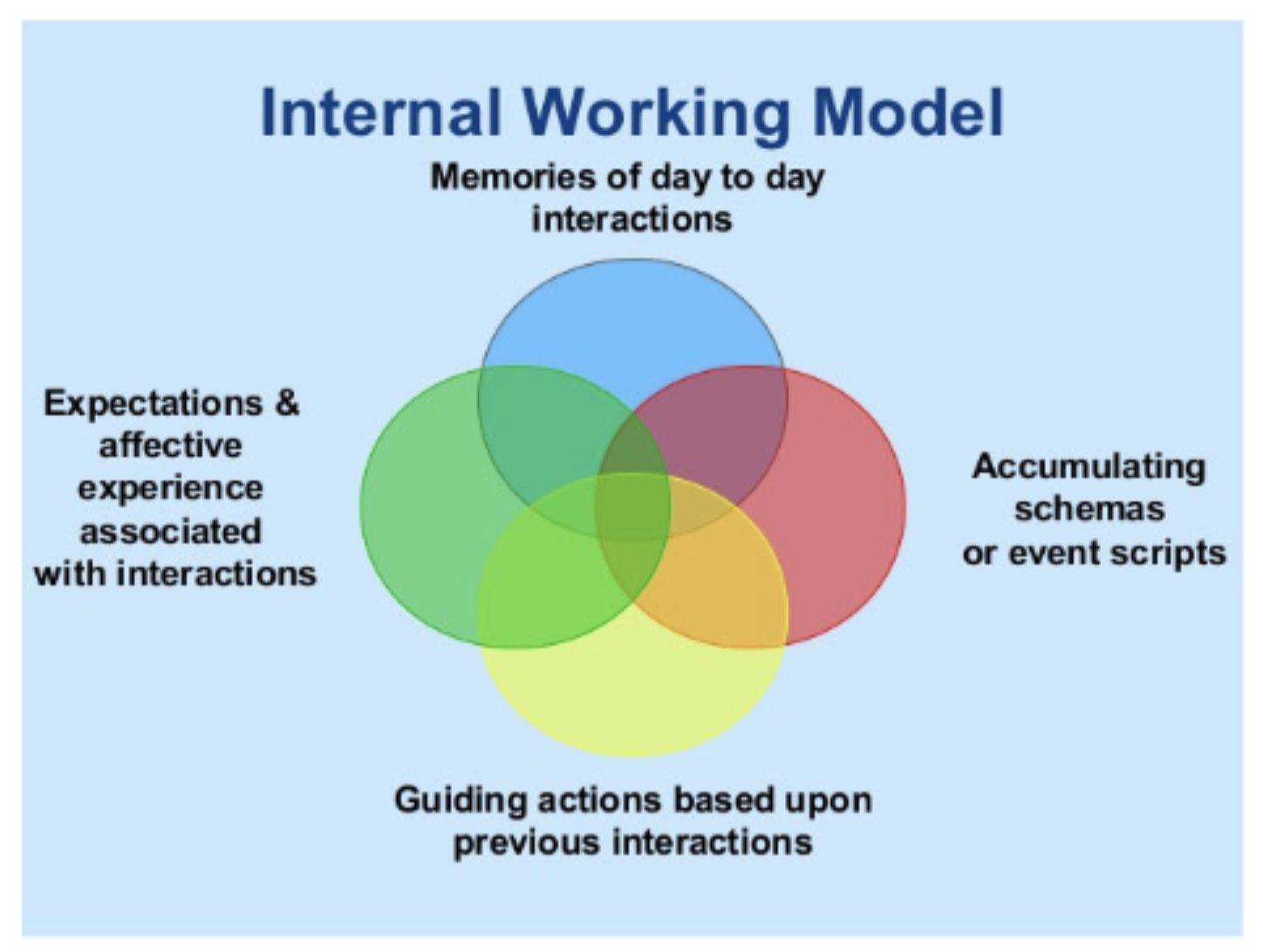
internal working model of attachment: mental representations of the self in relationships with others
mary ainsworths research
she conducted naturalistic observation of parents and children in Uganda (1954) and balitmore, maryland
strange situation test
bell and anisworth (1972): maternal responsiveness and crying
aniworths strange situation
steps in strange situations:
observer shows the experimenter room to mother and infant, then leaves the room
infant is allowed to explore the playroom for 3 minutes; mother watches but doesnt participate
a stranger enters the room and remains silent for 1 minute, then talks to the baby for a minute; and then approaches the baby, and the mother leaves quietly
the stranger does not play with the baby but attempts to comfort it if necessary
after 3 minutes the mother returns, greets, and consoles the baby
when the baby has returned to play, the mother leaves again, this time she says goodbye when she leaves
stranger attempts to calm and play with the baby
after 3 minutes, the mother returns and the stranger leaves
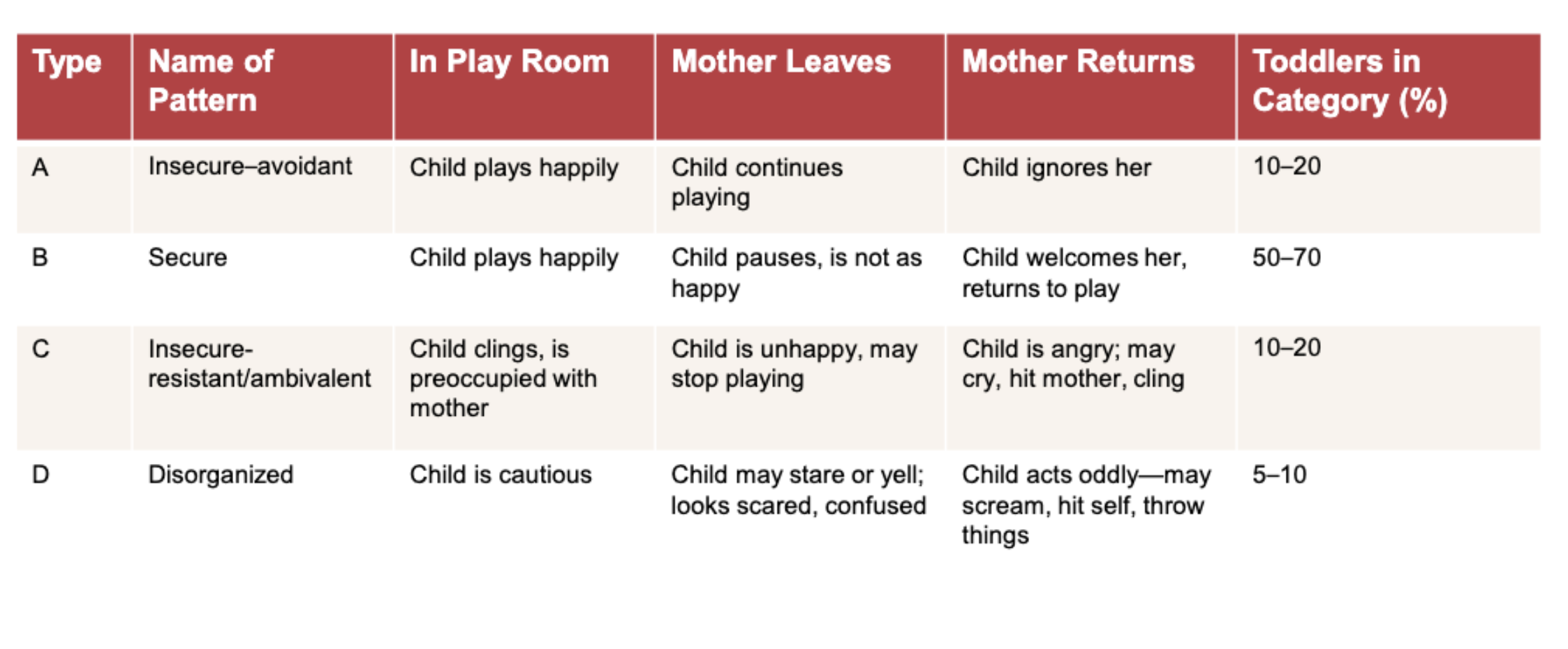
what are the patterns of infant attachment? ( 4 types)
3 types of insecure
insecurely resistant or ambivalent
insecure avoidant
disorganized/disoriented
1 type of secure
anisworth secure attachment
securely attached
use the mother as a secure base but leave her side to explore the room
happy to see the mother return
cultural variations in attachment
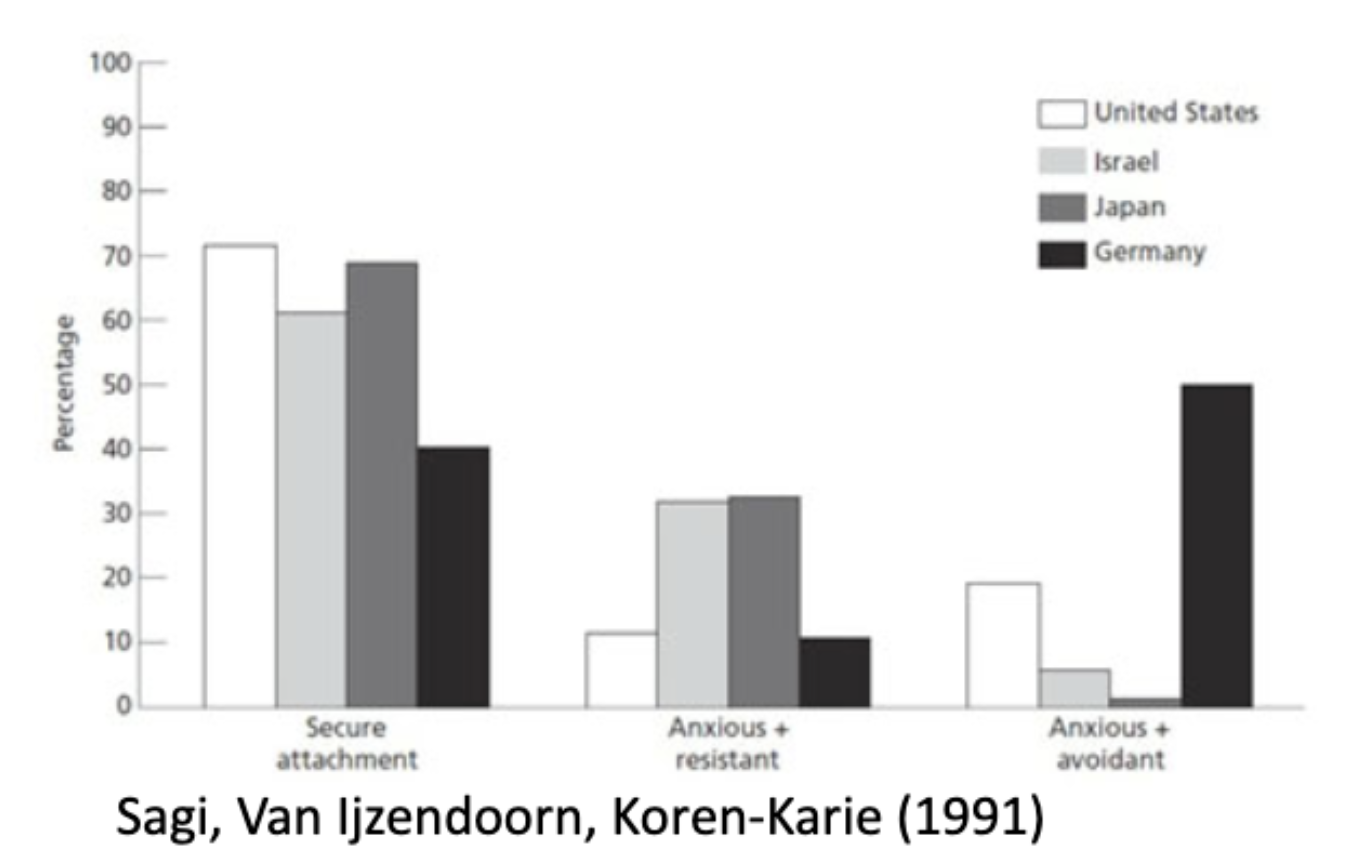
similarities in secure attachment are seen cross culturally, but not in the other patterns oof attachment
japanese infants behave differently from U.S infants in the strange situations
factors associated with security attachment
parental sensitivity in child rearing
characteristics of the child
parental sensitivity
its a caregiving behavior that involves the expression of warmth and contingent responsiveness to children
it can be exhibited in a variety of ways, including responsive caregiving when an infant is distressed or upset and engaging in coordinated play with the infant
mothers of securely attached infants generally respond warmly to their offspring and are sensitive to their needs
parental sensitivity and patterns of attachment
mothers of securely attached infants respond readily to their children’s signal
mothers of anxious/resistant infants are inconsistent in caregiving
mothers of anxious/avoidant infants tend to be indifferent and emotionally unavailable
mothers of disorganized/distressed infants are intrusive, emotionally unavailable; may dissociate or be in a trance-like state; confuses or frightens the child; may be harsh or abusive
child characteristics - temperament
the child’s temperament influences the parent’s behavior and the security of the child’s attachment
parents may be frustrated by difficult children
children who elicit negative responses from parents are more likely to be insecurely attached than other children
why does it matter what kind of attachment children have?
this first social relationship may provide the basis for all of the individual’s later social relationships
securely attached children
show better social adjustment
have better social skills
use good/appropriate emotional expression and communication
Insecure/avoidant children:
show inhibitive emotional responsiveness
do not seek comfort from other people
behavior patterns carry on to older years, unless drastic environmental changes occur
long term effects of attachment patterns
(zimmerman 2004)
43 adolescents asked about their childhood attachment and their current friendships
secure attachments as children predicted closer friendships as adolescents
(simpson et al 2007)
78 individuals tested in strange situations at 1 year and followed to ages 20 - 23
securely attached infants had better friendships as teens and better romantic relationships in 20s
research on long-term effects is correlational