10. Aggression
 Call Kai
 Learn
Learn Practice Test
 Spaced Repetition
 Match
Match Flashcards
 Knowt Play
1/38

There's no tags or description
Looks like no tags are added yet.
Name | Mastery | Learn | Test | Matching | Spaced | Call with Kai |
|---|
No analytics yet
Send a link to your students to track their progress
39 Terms
Aggression
___________: Behaviour intentionally directed towards another to cause physical or psychological pain or harm
Types of Aggression based on motive
Hostile Aggression
Instrumental Aggression
Hostile Aggression
___________:Driven by anger, the goal is to hurt someone, no other purpose
Ex. Reacting in rage (e.g., revenge-type situations like John Wick)
Instrumental Aggression
___________:Aggression is a means to an end, the goal is something else, harm is just part of it. There is a goal
Ex. “Moving Zen” story → punching someone to get a cab to the hospital in Japan
When is something aggressive? (Arnold Bus)
Task specific? Done to complete a task not to harm
Not a blatant rule violation? No rule about hitting a chair
Not intended to do harm? Didn’t intend to harm the chair
Not aggression
Explanations for Aggression
Freud—Instinct Theory
Physiological Explanations
Gender Explanation
Frustration Aggression (Social Psychology)
Social Learning (Bandura)
Freud—Instinct Theory
___________:Aggression is innate (we are born with it) and universal (everyone has it)
We have a death instinct, drive towards destruction (others or self)
Solution is catharsis, release aggressive energy in safer ways
Evidence: weak support, recent research suggests yelling/expressing anger has some benefit but doesn’t strongly support
Physiological Explanations
___________: Aggression linked to genetics, brain structure, chemistry, seen across species as animals (wolves and pups) show aggression differently
3. Gender Explanation
___________:Males tend to be more aggressive, linked to higher social dominance
Frustration Aggression (Social Psychology)
___________: Frustration: Anything that thwarts us from getting what we want, leading to aggression
Evidence Harris
Limitations
When does it lead to aggression?
Cue-based
Real-world
Significance
Evidence (Harris 1974)
Frustration Aggression
___________: Movie theatres and grocery stores, more aggression occurs when someone cuts in front of the line vs. the back of the line.
Greater frustration from more strongly blocked goal
Limitations of Frustration Theory
___________:Frustration does not always lead to aggression
Ex. Sometimes people do nothing, the situation can matter.
Bus out of service (less anger)
Bus drives past you (more anger)
Cut off by bad driver vs. cut off by ambulance
When does frustration lead to aggression?
Cue-based Aggression
Real-World Test
Significance Theory
Cue-Based Aggression (Berkowitz and Lepage)
___________:Participants shocked by confederate (1-7 shocks) Later allowed to shock back
In the room there was a neutral object (sports equipment) or a rifle (aggression cue) which they are told to ignore
More aggression when rifle is present, environmental cues trigger aggression
“The finger pulls the trigger, but the trigger may also pull the finger”—Berkowitz
Orne said it could be due to demand characteristics; participants act how they think they should. Berkowitz rejected this explanation
Real-World Test (Turner et al. 1975)
___________:Supports the idea that situational cues increase aggression and rules out demand characteristics as an explanation as no one knew they were in the study
Pickup truck stops at a green light, measure honking as aggression. Honking was greatest when
Driver was hidden by a curtain (deindividuation)
Bumper sticker “Vengeance vs Friend”
Rifle in the back of a truck
Significance Theory (Kruglanksi)
___________:Frustration leads to aggression when SIGNIFIGANCE is threatened. People need to feel they matter, frustration arises when you feel ignored, disrespected, unimportant
Examples: people gossiping about you → feel unimportant
If its verbal, you could respond back and nonverbal ignore or something else
Interestingly aggression is more likely when there’s a chance to restore significance
There’s a “sweet spot” for significance
Social Learning (Bandura)
___________:Aggression in learned, not just instinctive, became big when TV was invented
You can learn from associations, stimulus response, or just by watching
We watch other people be aggressive (parents, tv)
Bobo Doll Study
TV Violence
Bushman & Anderson'
Video Games & Violence
Bobo Doll Study
___________: Children watched adults behave aggressively, children imitated aggression.
Limitation: The doll is designed to be hit, there’s nothing else to do with it
TV Violence (Eron 1960)
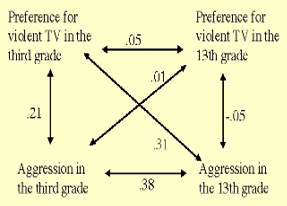
___________:A longitudinal study measuring violent TV preference (Grade 3 boys) and aggression (reports from teachers, peers, self)
Results: Small correlation at the same (.21)
10 Years Later in Grade 13: Weak relationship between current TV and aggression BUT TV watched in Grade 3 predicted aggression later (.31)
Follow up (Age 30) Measured criminal convictions, TV watched in childhood predicted number of criminal convictions
Bushman & Anderson (1990)
___________: Argue TV violence causes aggression.
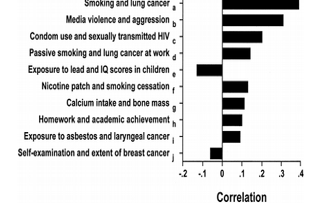
In real life ~0.2% of crimes are murder but on TV its ~50%, showing a distorted reality, if we lived in this world we would have 30 days to live
Networks say TV doesn’t influence behaviour, but he says if ads influence behaviour why wouldn’t TV content?
People downplay the link between TV violence and aggression
Even though the effect size is similar to other accepted psychological effects
Video Games and violence (Anderson)
Video games increase….
Aggressive behaviour
Aggressive thoughts
Aggressive emotions
Blood pressure and heart rate
Prosocial Behaviour(Chris Ferguson)
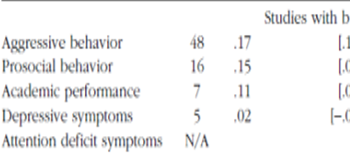
___________:Looked at existing research on children, videogames, and aggression. A Meta-analysis (combining many studies)
Aggressive behaviour: 48 (correlational) studies looking at the relationship ≈ .17 (small to medium)
__________ behaviour: 16 studies the relationship is ≈.15 (almost the same size)
If video games “cause aggression” then logically they should also “cause __________ behaviour” but researchers don’t usually make this claim. Suggests the relationship may not be causal, could be misinterpreted
Video Games Third Variable
___________:Ferguson suggests researchers rarely consider the ___________. Once you account for both of these the relationship decreases
Effects of the peer group: Aggressive kids may have aggressive friends
Levels of family violence: Growing up in a violent home increases aggression
We know homicides and income inequality are related, why don’t researchers include these broader variables? When we look at all of these the relationship is inconsequential (very weak)
APA Task Force Conclusion
___________: Suggests
Video games may cause violence
Video game violence leads to delinquent and criminal behaviour
Gender Based Violence
___________:Shift in research: Earlier focus on violence between strangers, changed in the 70s to violence within families, relationships, and friends.
Check & Malamuth Study
“When Men Batter Women” (Neil Jacobson)
Donald Dutton Domestic Violence Work
Check & Malamuth Study
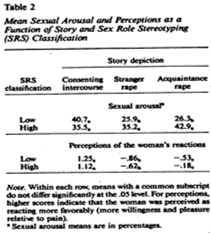
___________:Examined the link between pornography causing violence and the role of sex role stereotypes (SRS) Only 1 example of a study
Participants: Male & female undergraduates read 1 of 3 stories of the same length and style:
Consensual intercourse
Stranger rape
Acquaintance rape
Questions
How arousing they found the story (higher=more)
Low SRS: highest arousal for consensual sex, lower for rape scenarios
High SRS: found all 3 arousing and equally arousing
Perceptions of woman’s reaction (higher=more positive)
Low SRS: Consensual=positive, stranger=very negative, acquaintance=somewhat negative
High SRS: Consensual=positive, stranger=negative, acquaintance=kind of negative (closer to neutral)
Important result: They did not find a difference between men and women responses
Sex Role Stereotype Scale (SRS)
___________: Used instead of directly asking about rape myths (less obvious) Divided participants into
High SRS (traditional views):“Only men should be doctors” More likely to endorse rape myths (a woman dresses a certain way, etc.)
Low SRS: Believe women and men are equal
“When Men Batter Women” (Neil Jacobson)
___________:Studied men with history of domestic violence, Measured physiological responses (heart rate, etc.)
Setup: Partner was present, discussed money (couples often argue about) to trigger a reaction
Two Types of Male Abusers (previously thought to be of one sort)
1. Cobras
2. Pitbulls
1. Cobras:
___________: Appear calm, show no physiological arousal (same heart rate) and suddenly become violent “strike like a cobra”
2. Pitbulls
___________:Become visibly angry, show high physiological arousal (increased heart rate, sweating), more emotionally reactive, and are likely more common
Donald Dutton Domestic Violence Work
___________:Worked with Vancouver Police going to domestics’ cases. Asked to help, set up a program: Men choose treatment or jail, they were expected to provide data
Tried predicting who the treatment would work for, was never able to get these right
Discovered
Cobras: similar to psychopaths
Pitbulls: Similar to borderline personality disorder, “approach-avoidance” pattern, difficulty regulating emotions
Psychopathy (Bob Hare)
___________: Dutton’s colleague. See tragedy -> feel nothing -> try to replicate others
Why do Victims Stay (Dutton)
___________: The earlier explanation was they were masochistic, something psychologically wrong. Modern= traumatic bonding, a normal reaction. Attachment forms through cycles of abuse and reconciliation
Mutual Violence (Dutton)
___________: Got him in some trouble
Traditional feminist view: male → female violence (one-sided)
His argument: Also, mutual (common couple violence), big surveys find both
They looked at different databases
Shelter data from feminists: saw one-sided violence
Larger Surveys and data: mutual violence
Dutton Updated View (2019)
Social learning plays some role in so far as children exposed to violence 3x as likely to perpetuate domestic violence as adults
Attachment bond (BPD) is a more powerful predictor of domestic violence than social learning
Small percentage of people who engage in domestic violence and few people regard domestic violence to be acceptable
Domestic violence cannot be ascribed to societal norms and must be ascribed to individual factors (e.g., attachment)
Reducing Aggression
Punishment
Catharsis
Communication, Problem Solving, Apologizing
Punishment
___________: To work in reducing aggression, it must be these, and almost all the time punishment is rarely either
Prompt and uncertain, and
Unavoidable
Catharsis
___________:Freudian idea; Little evidence to support, some value to expressing yourself rather than holding it in
Rocky movie; watching violence,
Releasing aggressive energy → reduces future aggression
Communication, Problem Solving, Apologizing
___________:The answer to reducing aggression, probably true but also very hard
“Raise your words not your voice. It is rain that grows flowers, not thunder”