ORAL EXAM STUDY 3
 Call Kai
 Learn
Learn Practice Test
 Spaced Repetition
 Match
Match Flashcards
 Knowt Play
1/29

There's no tags or description
Looks like no tags are added yet.
Name | Mastery | Learn | Test | Matching | Spaced | Call with Kai |
|---|
No analytics yet
Send a link to your students to track their progress
30 Terms
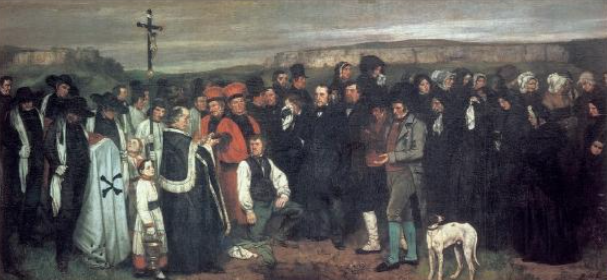
Gustave Courtbet, A Burial at Ornans, 1849-1850
Shows funeral in France, normal villagers at a regular burial (people were surprised because it was hug like a history painting, but the subject of the painting was everyday life)
Realism —> showing life exactly as is, not dramatic or exaggerated
Industrial Revolution —> when factories and cities grew and everyday workers became more visible (this painting shows regular people as important subjects)
Monumental Scale —> using a huge canvas usually meant for kings/religion (instead, its just a simple funeral on a huge scale)
Anti-Idealization (Realism) —> people look plain, tired, and realistic (not perfect or heroic)
Naturalism —> copying real life closely, everyone looks individually real, not stylized
Class Structure/Social Commentary —> art suggests something about the society (makes connection that regular people are just as important as powerful figures)
Hierarchy of Genres —> history painting were “most important”, the artist is making a normal event feel just as important as historical ones
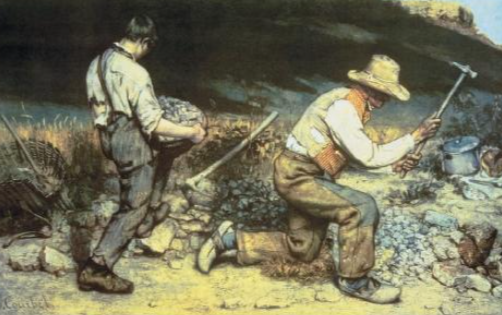
Gustave Courtbet, The Stone Breakers, 1849
Two poor workers (one older, one younger) breaking rocks on the side of the road, they are doing exhausting labor with no emotion of beauty added (faces aren’t shown so they are less than individuals and more seen like people in the working class only)
Realism —> showing real life without changing it (tired workers going hard physical labor)
Industrial Revolution —> rise of factories/heavy labor systems (reflects poor working conditions for laborers)
Social Realism —> art showing struggles of working-class (plus poverty/work)
Class Structure/Consciousness —> awareness of social class differences (highlights lower-class workers with no escape from labor)
Repetition/Labor Cycle —> the idea that work is continuous and never-ending
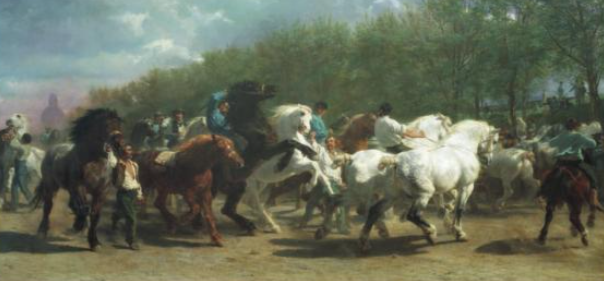
Rosa Bonheur, The Horse Fair, 1853 (MMA)
A horse market in Paris, where they are being shown, moved, and traded
Realism —> showing real subjects accurately (horses are painted while in motion)
Animal Study/Naturalism —> carefully observing animals to understand their anatomy (horses look scientifically correct/detailed)
Industrial Revolution —> animals were important for transportation/work (horses were key to everyday life/economy)
Movement —> showing action/motion in a still image (they are actively moving in the scene), the horses are trying to resist control
Power and Energy —> emphasis on strength, force, and physical dominance (horses fill the scene with intensity)
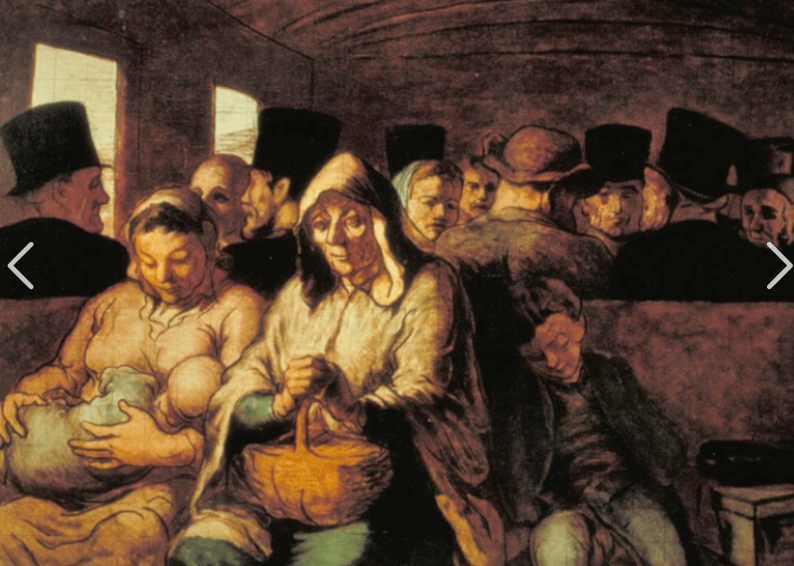
Honoré Daumier, The Third-Class Carriage, 1862 (version is at MMA)
Poor passengers sitting in a packed train in France, they look tired and worn out, showing how uncomfortable life was for lower-class people during modern travel, no one is really interacting with each other (disengaged)
Realism —> showing real people/situations (ordinary people on public transport)
Industrial Revolution —> period of railroads, factories, and mass transport (train shows new industrial society)
Social Commentary —> art that highlights social problems (shows inequality between rich v. poor travelers)
Urbanization —> growth of cities and crowded living (crowded train = city life pressure)
Class Structure —> division between different social/economic classes (third-class = lowest economically)
Isolation —> feeling of emotional/social separation even among others (passengers sit physically close but aren’t interacting)
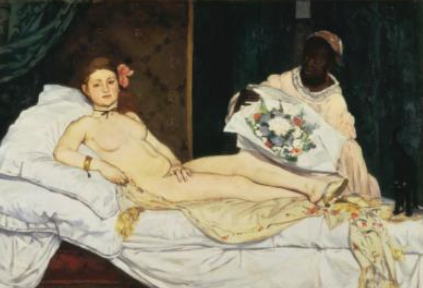
Édouard Manet, Olympia, 1863
Nud3 woman laying on a bed in Paris, staring at the viewer, she isn’t a goddess, a black maid is bringing her flowers from a client (shocking because she looks confident and confrontational, maybe she is a prostitute)
Realism —> showing real modern life (Parisian woman is real, not mythology)
Modern Life —> focused on present-day society (contemporary Paris) with real social roles
Gaze —> how she is looking/engaging with the viewer (staring right at us confidently, showing confrontation and awareness)
Anti-Idealization/Rejection of Ideal Beauty —> body isn’t perfect or mythological (real and unidealized)
Shock Value —> art meant to provoke strong reaction/controversy, as the viewers are shocked (shock value) by the direct stare and prostitution theme
Male Gaze —> representation of women as objects for male viewing pleasure, the painting challenges it by making her aware and in control of her gaze
Racial Hierarchy/Class Structure —> social ranking based on race (social inequality), higher v. lower status
Symbolism —> black cat = sexuality/independence, flowers = client/payment system
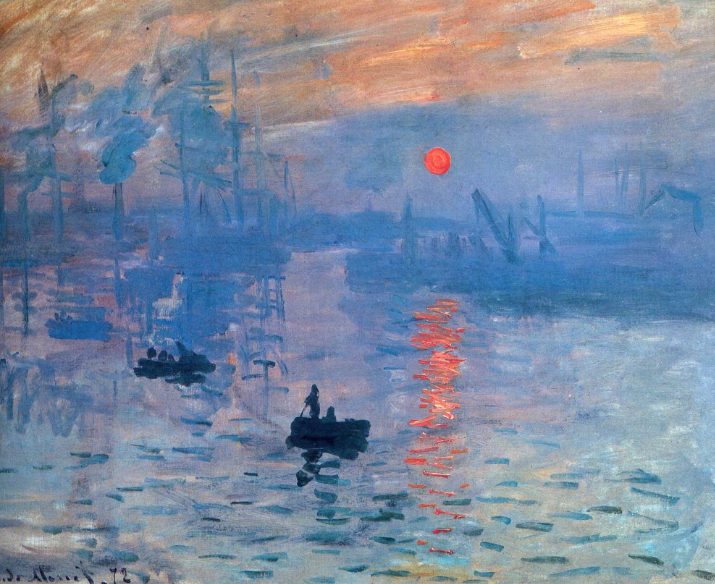
Clade Monet, Impression - Sunrise, 1872
Foggy harbor at sunrise in Le Havre, it highlights a fleeting moment rather than a detailed scene
brushstrokes —> quick, visible, and soft (details are not sharp and the forms dissolve into light and color)
Effects of light on color and form —> it focuses on how light changes the appearance of objects, the sunlight reflects on water, which makes the objects blurry/shift
Scenes of modern life —> everyday contemporary subjects instead of historical/mythological (real harbor during industrial-era France)
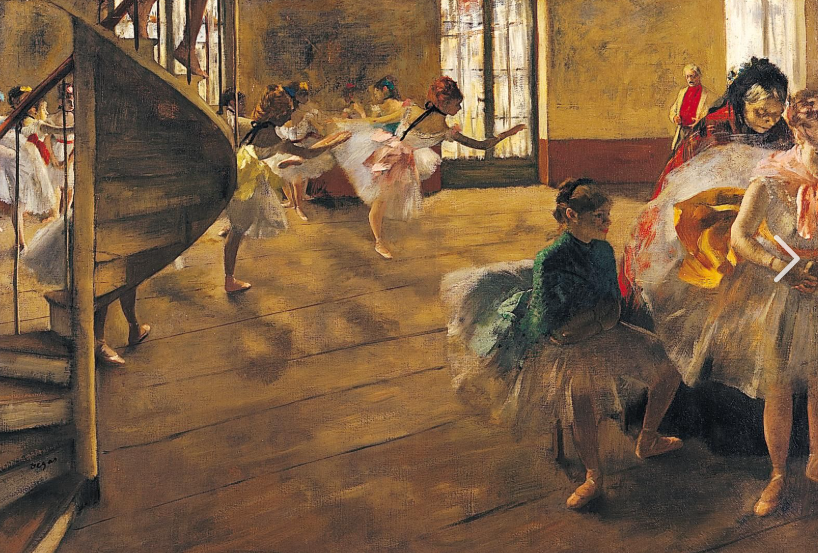
Edgar Degas, Ballet Rehearsal, 1874
Ballet dancers practicing in a studio where the instructor is observing/correcting their movements, some dancers are stretching, resting, or adjusting their positions, the figures of off-center
Effects of light and color and form —> light changes how forms/colors are perceived, as the soft indoor lighting shapes dancers’ bodies and movement
Scenes of modern life —> focus on everyday contemporary activity which shows rehearsal rather than performance stage glamour
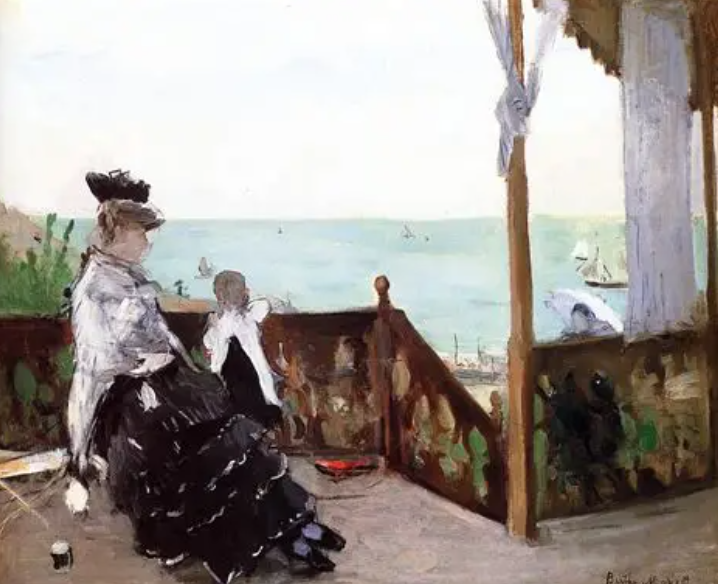
Berthe Morisot, Villa at the Seaside, 1874
A woman is next to a seaside, the brushwork is loose and has soft light with a calm atmosphere, focusing on private life rather than public scene
Effects of light on color and form —> changing light affects perception of color/shape where the sunlight creates soft, shifting tones across the scene
Leisure class —> upper class with time to leisure rather than labor, where it shows relaxed but privileged lifestyle
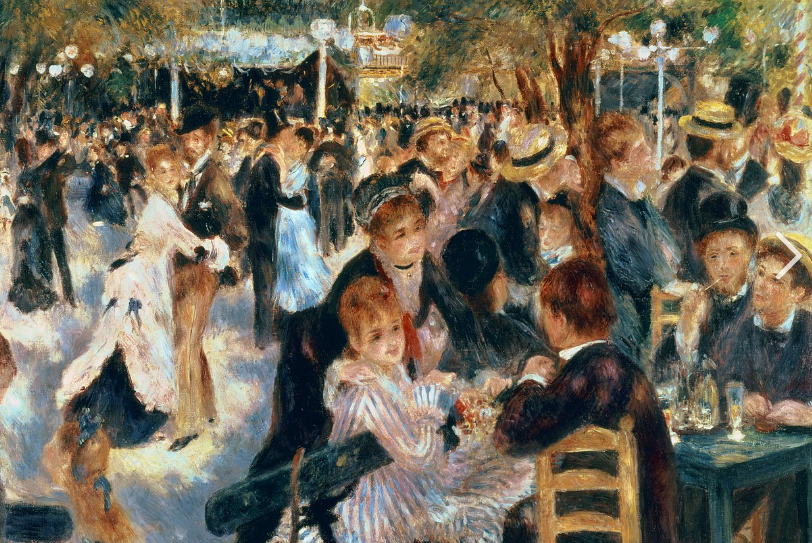
Pierre Auguste Renoir, Moulin de la Galette, 1876
An outdoor dance garden in Paris where people are socializing, talking, and dancing, as there is sunlight filtering through the trees with a vibrant, lively atmosphere with loose, color brushwork
Effects of light on color and form —> light alters how we see color/shape where sunlight breaks into patches across figures and ground
Scenes of modern life —> depiction of contemporary social activities where it shows real Parisian weekend leisure culture
Leisure class —> social group with time and money for entertainment where these people are relaxing and not working
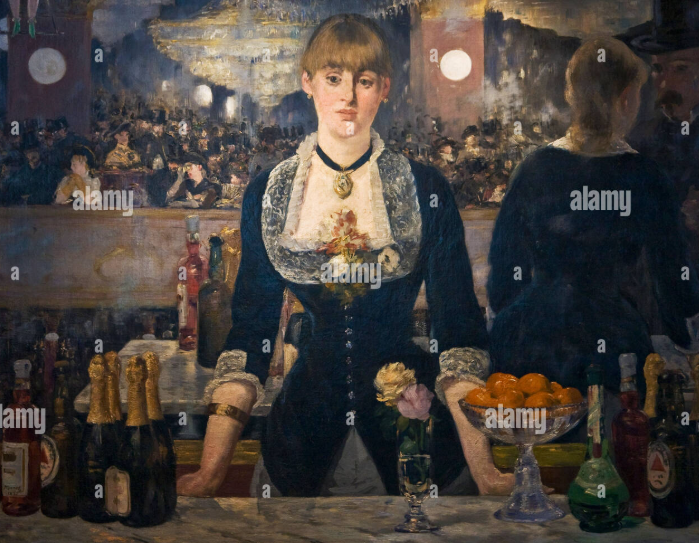
Manet, A Bar at the Folies-Bergère, 1881-1882
Barmaid is standing behind a counter in a venue where there are bottles, fruit, and champagne on the counter; behind here is a mirror reflecting the crowd and her interaction with a man, she looks very detached, we are right in front of the bar, engaging directly with the scene
Effects of light on color and form —> lighting changes appearance of objects and space where the bottles and reflective surfaces shirt with light
Scenes of modern life —> focus on contemporary urban society where it depicts Paris nightlife and entertainment culture
Leisure class —> people who spend time in entertainment and social venues, where this cafe-concern crowd represents urban leisure society
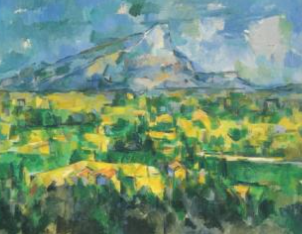
Paul Cezanne, Mont Sainte-Victoire, 1904-1906
Landscape painting of mountains near Cezanne’s house with repeated geometric brushstrokes, simple trees, fields, and sky with a focus on structure not realism, with multiple viewpoints in one image
Pointillism (related) —> building image from structured marks/units of color (artist influenced later abstraction)
Impasto —> thick application of paint creating texture where you can see the visible paint layers that emphasize structure and surface
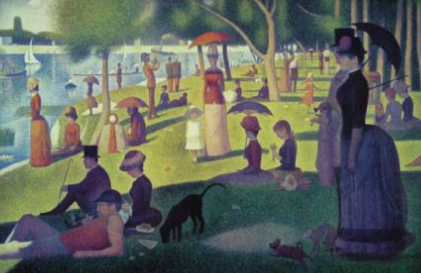
Georges Seurat, A Sunday Afternoon on the Island of La Grande Jatte, 1884-1886
People are relaxing in a park by a river where figures are stiff, stylized, and highlight controlled with small dots of color to create the full image
Pointillism —> technique using small dots of pure color to form images where the entire painting is built from them which blends in the viewer’s eye
Leisure class —> upper social group with time for recreation where the park visitors are middle/upper-class with their leisure society
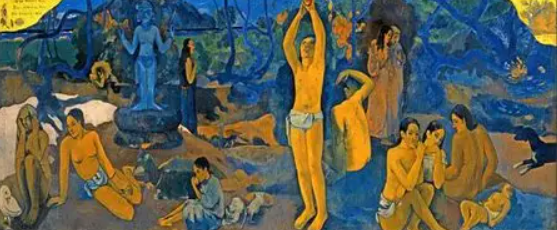
Pail Gauguin, Where do we come from, What are we, Where are we going?, 1897
Figures represent different stages of life (baby-adult-old age) where the large symbolic figures are in Tahiti, the atmosphere is exotic and spiritual, dreamlike with non-realistic colors in the palette with a flat spatial arrangement
Symbolism —> using imagery to represent ideas rather than realism where the figures represent life stages and existential questions
Impasto —> thick paint application of texture where the expressive paint adds emotional intensity
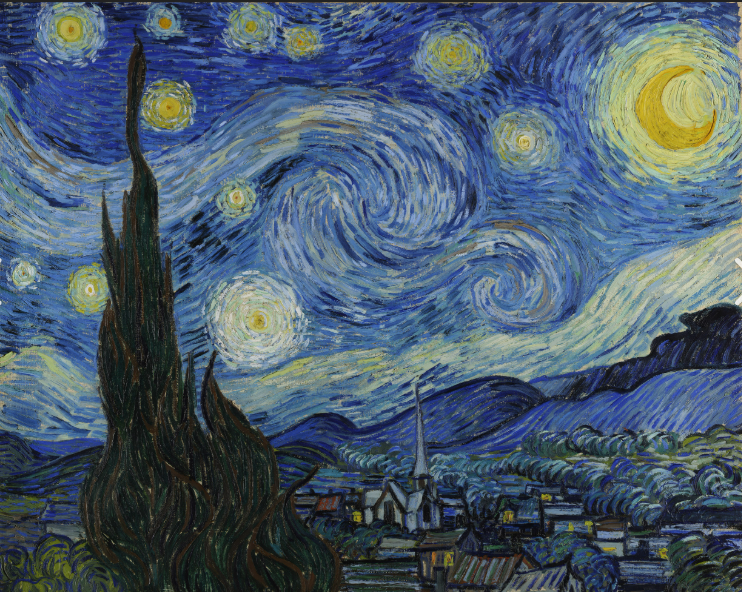
Vincent Van Gogh, The Starry Night, 1889 (MoMA)
Night sky filled with swirling stars and motion with a large glowing moon and energetic brushstrokes, where a small village is below and calm with a cypress tree is rising
Impasto —> thick, textured application of paint where the visible brushstrokes create movement and intensity
Post-Impressionism —> art that moves beyond Impressionism toward emotion and structure where it focuses on emotional expression instead of optical realism
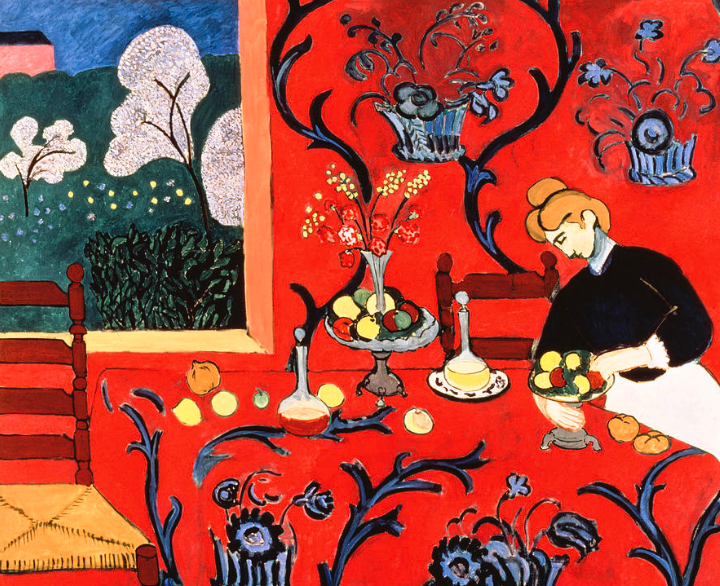
Henri Matisse, Harmony in Red (Red Room), 1908-09 - Fauvism
A room full of red patters where the table, wall, and background are blended together in a flattened perspective with bold colors; decorative/almost abstract space
Fauvism —> art movement using bold, non-naturalistic color where the intense red overwhelms realistic depiction
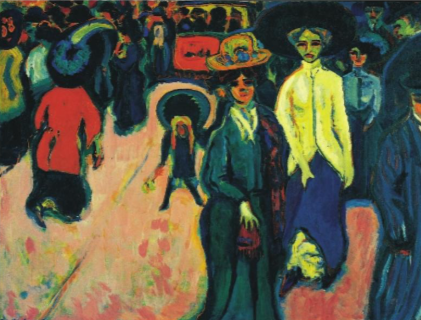
Ernst Ludwig Kirchner, Street, Dresden, 1908 - Expressionism, The Bridge
A crowded urban street with elongated figures where women in fashionable clothes are walking towards the viewer; has distorted perspective and sharp angles, giving off a dark and uneasy atmosphere
Expressionism —> art focused on emotional distortion of reality where the figures are exaggerated to express urban tension
Die Brucke (The Bridge) —> German expressionist group seeking emotional intensity in art where Kirchner was a part of this movement that rejected realism
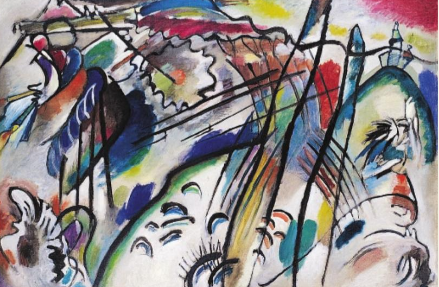
Vassily Kandinsky, Improvisation No. 28, 1912 - Expressionism, The Blue Rider
Abstract shapes, lines, and colors with no clear objects or figures that show dynamic movement across the canvas, giving off a strong emotional and spiritual energy
Expressionism —> art expressing emotional experience rather than physical reality where the shapes and colors represent feelings, not objects
Der Blaue Reiter (The Blue Rider) —> expressionist group that focused on spirituality and abstraction where Kandinsky used color and form to express inner emotions
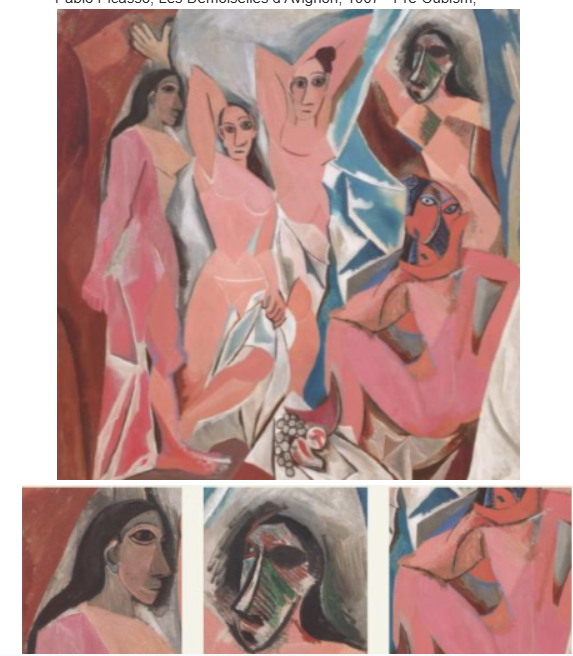
Pablo Picasso, Les Demoiselles d’Avignon, 1907 - Pre-Cubism
5 nud3 female figures in a fragmented space with sharp, angular bodies and distorted face (African masks on 2 of the figures), there is no traditional perspective or depth and the poses seem confrontational, breaking the traditional representation of the human body
Pre-Cubism —> early stage leading to Cubism with fragmented forms where figures are broken into angular shapes, rejecting realism
African Art influence —> there was an influence of African masks and sculpture on modern European art
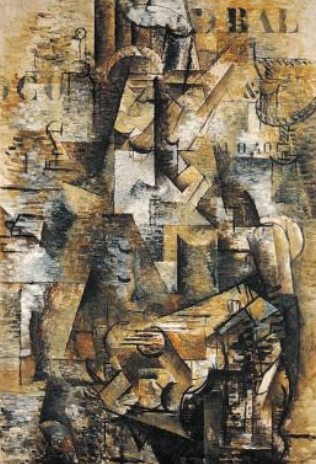
Georges Braque, The Portuguese, 1911 - Analytic Cubism
Fragmented male figure with a guitar with multiple overlapping viewpoints, showing muted browns and grays, making it hard to distinguish the body parts clearly as the object is broken into geometric fragments
Analytic Cubism —> breaking objects into geometric parts and analyzing multiple viewpoints where the figure is fragmented into abstract shapes
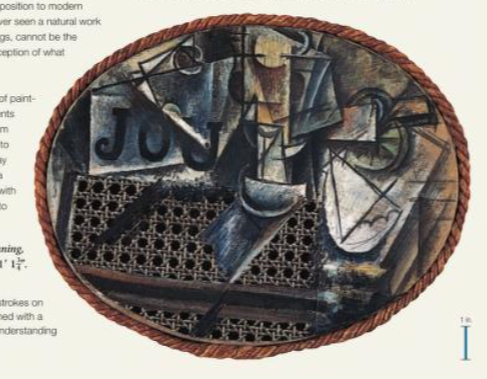
Picasso, Still Life with Chair Caning, 1911-12 - Collage Cubism
Still life with rope, printed chair patter, and painted elements where it combines real materials and a painted surface on an oval canvas shape including letters and textures (combining real objects with painting)
Collage cubism —> combining real materials with painted elements (rope/printed chair in artwork)
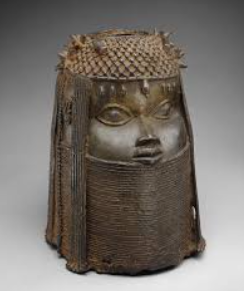
Benin (13th - 18th centuries) Head of an oba, 1700-1897 (late period), brass, erms: oba, ashe (power)
Brass sculpture of a royal head with highly detailed facial features and crown elements; symmetrical and idealized representation that is used in royal court rituals symbolizing divine kingship/authority
Oba —> king/ruler in Benin culture
Ashe (power) —> spiritual force or power in Yoruba/Benin belief culture where the artwork symbolizes divine power
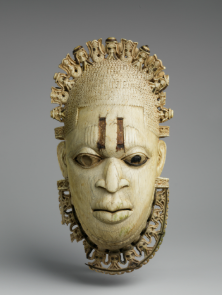
Ivory belt mask of a Queen Mother (iyoba), from Benin, Nigeria, mid-16th c. ivory, Term: Iyoba
Ivory carved mask worn by royal women as a highly detailed face and has decorative elements; symbol of authority and status
Iyoba —> Queen Mother in Benin culture, where the mask represents her political and spiritual importance
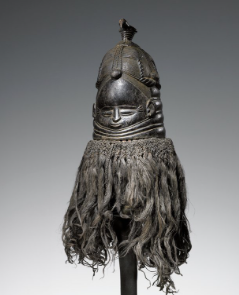
Female mask, from Mende culture, Sande Society, 20th c, wood, Terms: Nowo, kpanguima (special pleace where Mende women go for initiation), bonya (rings around the neck literally translated “a little extra”)
Smooth wooden mask used in initiation rituals which stylized female features on a polished surface and had a symmetrical design, worn during ceremonies (represented idealized female identity and transformation)
Nowo —> spirit associated with female masks in Mende culture where the mask embodies the spiritual presence during the rituals
Kpanguima —> sacred initiation space for Mende women where this mask was used during those ceremonies in that space
Bonya —> “a little extra” meaning rings/marks of beauty and status where the neck markings would symbolize beauty/social identity
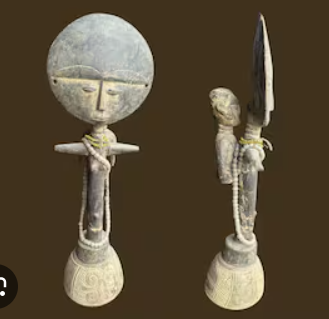
Fertility Figure: Female (Akua Ba), Asante Culture, Ghana, 19th century, Wood, beads, string
Wooden fertility doll with an elongated form with stylized head and body proportions; beads and decorations added and is used by women for fertility rituals (represents fertility, beauty, ideal womanhood)
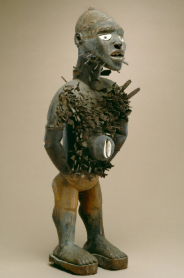
Nail figure, from the Democratic Republic of Congo, Kongo culture, c. 1875-1900
Wooden figure covered in nails and metal objects, where the inserted objects represent agreements or spiritual activation, it has an intense powerful presence (used for healing, justice, or protection)
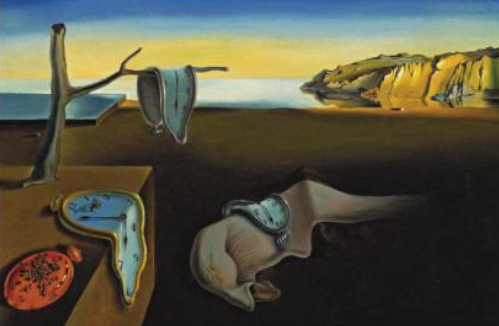
Salvador Dali, The Persistence of Memory, 1931 - Surrealism
Melting clocks over landscape with strange, dreamlike desert setting with distorted organic forms and ant-like creatures with silent, eerie atmosphere (dream logic is replacing reality)
Surrealism —> art that explores dreams, unconscious mind, and irrational imagery where the melting clocks represent distorted perception of time
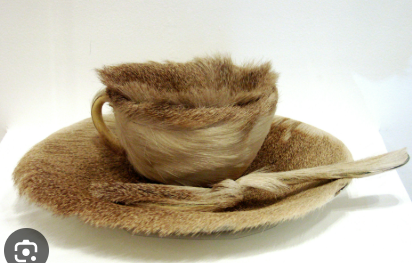
Meret Oppenheim, Object (Luncheon in Fur), 1936 - Surrealism
Teacup, saucer, and spoon covered in fur; everyday object is made to be disturbing and tactile with soft, animal-like surface that contrasts the function of it
Surrealism —> movement focused on unconscious, dreamlike imagery where a familiar object becomes irrational and disturbing
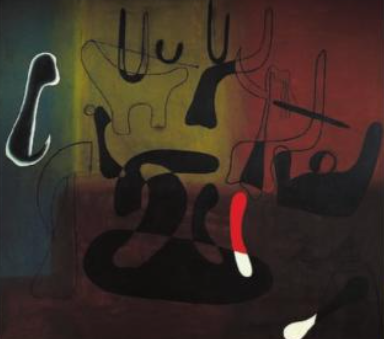
Joan Miro, Painting, 1933 - Surrealism
Abstract shapes, stars, and organic forms with floating symbols and figures with bright colors and playful composition (represents abstract dreamlike symbolic space)
Surrealism —> movement focused on unconscious, dreamlike imagery where a familiar object becomes irrational and disturbing
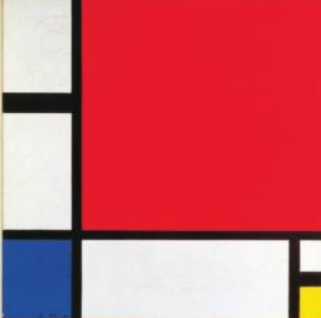
Piet Mondrian, Composition with Red, Blue, and Yellow, 1930 - De Stijl
Grid of black lines with primary colors with strict geometric structure, there are no organic shapes or curves; has balances minimal composition (gives off pure abstraction of order and harmony)
De Stijl —> Dutch movement that focused on simplicity, geometry and primary colors which this painting reduced art to basic structure and color harmony
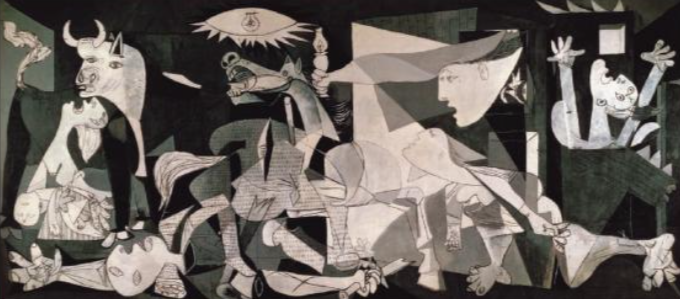
Picasso, Guernica, 1937
Large, chaotic scene of war destruction, where there are screaming figures, broken bodies, and animals; black, white and gray palette with a light bulb symbol above the scene as well as a horse, bull, and civilians in distress (giving a powerful anti-war statement about violence and suffering)
Surrealism —> influenced it; dreamlike, distorted imagery reflecting unconscious emotion where the chaotic fragmentation of bodies and space are shown
Political Art —> art that responds to political events or issues, where this is the response to the bombing of Guernica during the Spanish Civil War