Clinical Applications of Immunology ( PART 2)
 Call Kai
 Learn
Learn Practice Test
 Spaced Repetition
 Match
Match Flashcards
 Knowt Play
1/20

There's no tags or description
Looks like no tags are added yet.
Name | Mastery | Learn | Test | Matching | Spaced | Call with Kai |
|---|
No analytics yet
Send a link to your students to track their progress
21 Terms
Tumor antigens recognized by T cells fall into what four categories?
Mutation (most tumors)
Tumor-specific Expression (many tumors)- Germ cell lines
Tissue-specific expression- melanomas prostate (PSA)
Overexpression (some tumors)- Excessive normal proteins HER2
Overexpression, High or low specificity?
LOW tumor specificity, (some tumors)- Excessive normal proteins HER2
Tissue-specific expression, High or low specificity?
LOW tumor specificity, melanomas prostate (PSA)
Tumor-specific Expression, High or low specificity?
HIGH tumor specificity, (many tumors)- Germ cell lines
Mutation, High or low specificity?
HIGH tumor specificity, Most tumors
Describe the direct evidence that immunity is important in cancer
Immune-deficient mice are more susceptible to spontaneous and carcinogen tumors
Cytokines like Interleukin-2 (IL-2) show anti-tumor activity
Checkpoint protein inhibition with anti-CTLA-4 antibody is active in melanoma
Infusion of T cells has anti-tumor efficacy in melanoma
Describe the indirect evidence that immunity is important in cancer
T cells are actively involved in immune response and surveillance or suppression of tumor cells. EX:
In different histologies, usually primary tumors, T cell infiltrate is a positive prognostic factor: In colon cancer immunoscore
In melanoma, T cell infiltrate and PD-L1 staining in metastases are important predictive factors with immunotherapy
In ovarian cancer, present of T regulatory cells are associated with a poor outcome.
What are the mechanisms of T cell suppression in a tumor microenvironment
Nutrient deprivation
Hypoxia
Metabolic Waste
Immunosuppressive Factors
Describe immune surveillance and the phases
The immune system can reject cancer via the "Immunoediting" process, which consists of three phases:
Elimination (surveillance)
Equilibrium
Escape
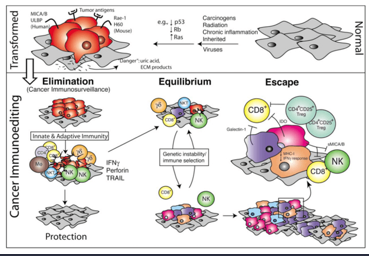
Describe what happens during “elimination” in the Immunoediting process
The Innate and Adaptive immunity destroy the tumor cells before they become clinically apparent
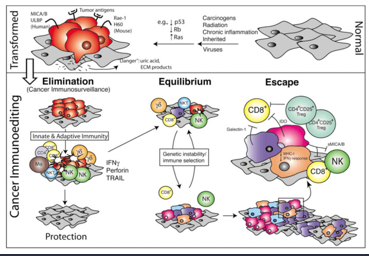
Describe what happens during “equilibrium” in the Immunoediting process
Elimination is not effective, leads to more replication of cancer cells, however the body is able to control it.
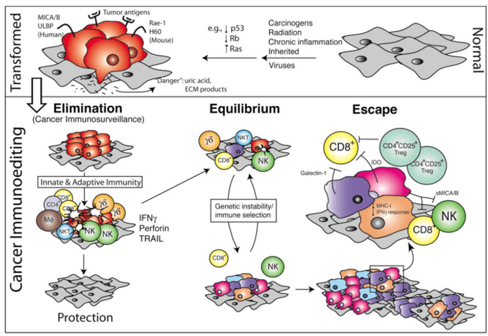
Describe what happens during “Escape” in the Immunoediting process
Tumor cell is successfully bypassed the immune system’s recognition, growing unchecked, leads to clinically detectable cancers
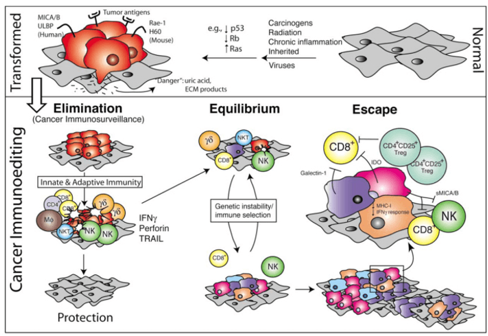
Tumor immunity relies on a delicate biological balance between immune ______ and immune ________
Stimulation
Inhibition
Describe the Etiology of autoimmune diseases
Genetic Predisposition
Human leukocyte antigen (HLA) complex
Family history of autoimmune diseases
Environmental Triggers
Infections: viral, bacteria, fungal
Toxins
Lifestyle
Smoking
Dietary considerations
Hormonal influences
Women are more likely to develop autoimmune diseases
sex hormones (estrogen)
Describe the pathophysiology of autoimmune diseases
Breakdown of immune tolerance
Loss of self-tolerance
Autoantibody production
T cell mediated damage
Immune complex formation
Negative/Positive selection (autoantigens to MHC complex)
Autoreactive T cells
Describe the clinical presentation of autoimmune diseases
Fatigue
Joint pain and swelling
Skin problems
Digestive issues
Systemic symptoms
Describe the treatment principles of autoimmune diseases
Manage symptoms
Reduce inflammation (anti-inflammatory meds)
Suppress the aberrant immune response
Cure is not typically possible
Biological therapies:
Antibody therapy
RNA interference therapy
Hematopoietic stem cell transplant therapy
Autoantigen based therapies
Define immunotherapy
Stimulate or boost the immune system
Provide immune system components
Targeting and modulating immune responses
Discuss the principles of immunotherapy in the treatment of cancer
Immune checkpoint inhibitors
Adoptive cell therapy (CAR T-cell therapy)
Monoclonal antibodies
Cancer vaccines
Discuss the principles of immunotherapy in the treatment of Autoimmune diseases
Focus on suppressing the overactive immune tissue response to minimize symptoms and prevent tissue damage
Discuss the principles of immunotherapy in the treatment of Infectious diseases
Focus on modulating the immune response to pathogens
Enhance the immune response to help clear the infection or ameliorating immunopathology (damage caused by the immune response itself