ArtHistory 300 Ancient Greece Midterm 1
 Call Kai
 Learn
Learn Practice Test
 Spaced Repetition
 Match
Match Flashcards
 Knowt Play
1/59

There's no tags or description
Looks like no tags are added yet.
Name | Mastery | Learn | Test | Matching | Spaced | Call with Kai | Chat |
|---|
No analytics yet
Send a link to your students to track their progress
60 Terms
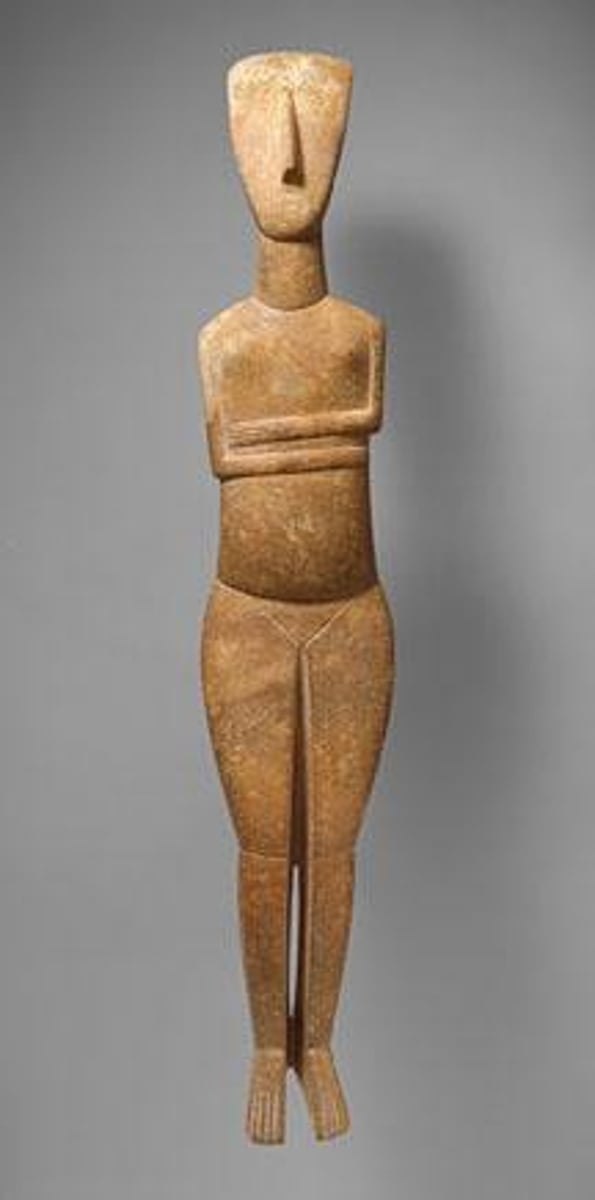
Cycladic Folded Arm Figure
Who: Cycladic people
What: Folded arm figurine depicting a woman made of marble
Where: Found in the Cycladic islands of Greece
When: 2600-2400 BC
Why: One of the earliest found pieces of early Bronze Age art. From the Cycladic islands that could represent a religious figurine. The red 'paint' that was originally on head and neck is a rare material that demonstrates the Cycladic civilizations engaged in trade as it was imported.
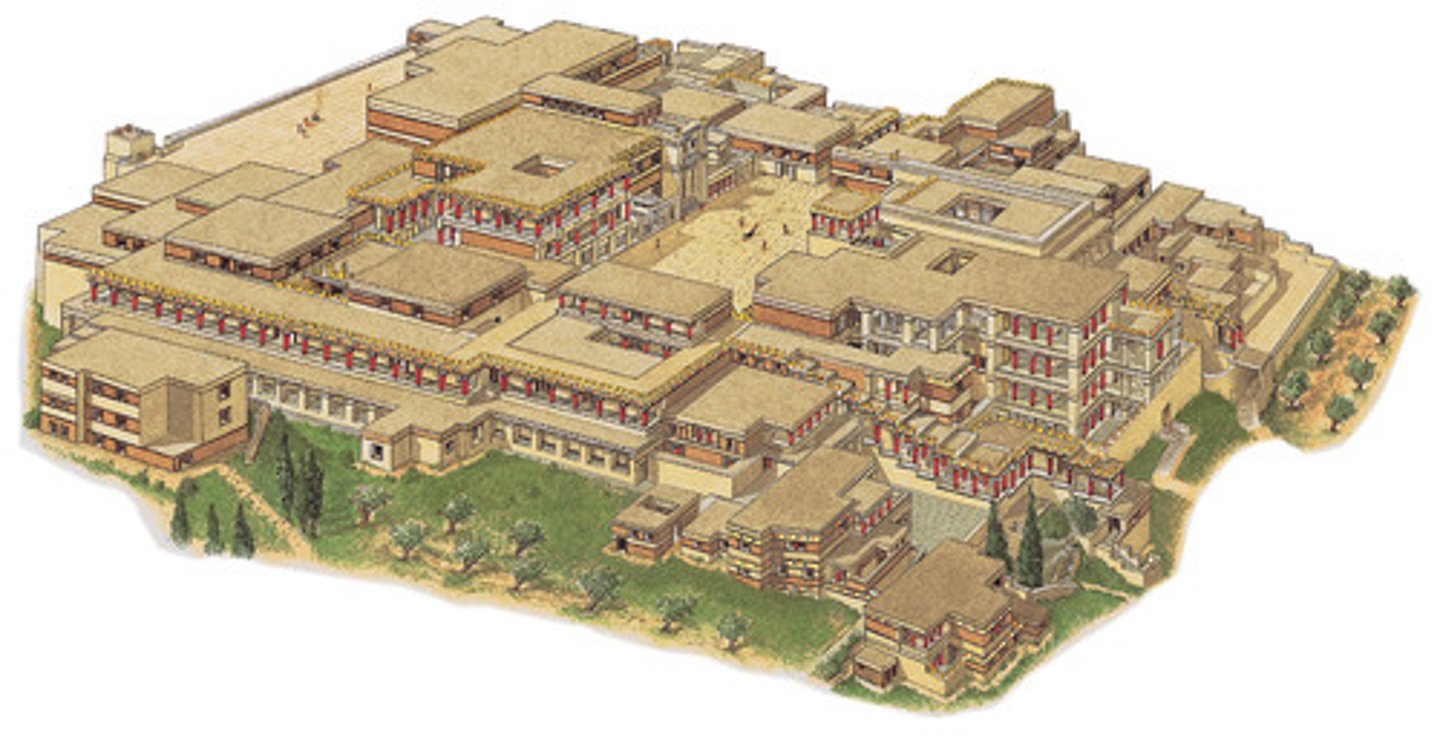
Palace of Knossos
Who: The palace of Knossos
What: This was a great Minoan palace found on the kephala hill of the island of crete
Where: Kephala hill on the island of Crete in the meditteranean sea of the coast of Greece
When: 1700-1400 BC
Why: This palace is important and one of the most famous archeological dig sites. It was a political, cultural, and social center of the Minoans. IT had storefronts, throne room, courts, and living quarters. It is home to many famous mythical frescoes and objects. Had major influence in the development in western Culture.
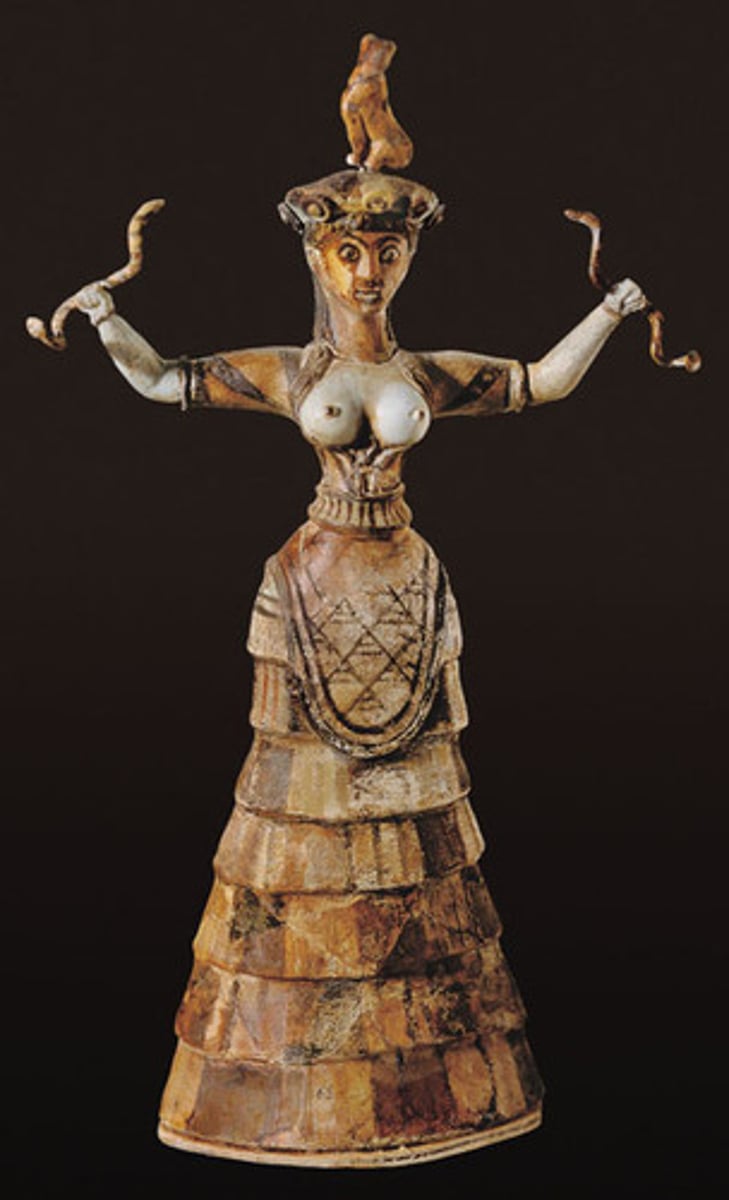
Snake Goddesses/Priestesses from Knossos
Who:
The artist is unknown, but it's attributed to the Minoan civilization123.
What:
These are faience statuettes known as the "Snake Goddesses"3. They depict a woman with bare breasts holding a snake in each of her raised hands1.
Original Findspot:
The statuettes were found at the Palace of Knossos on Crete451.
When:
The statuettes date to ca. 1700-1600 BC451.
Why it's interesting and important:
The Snake Goddesses are iconic symbols of the Minoan civilization and exquisite examples of Minoan miniature sculpture3. They are believed to depict the chthonic Minoan snake goddess3. The image of the Snake Goddess is one of the most frequently reproduced sculptures from antiquity and is a powerful and evocative image45. What she meant to the Minoans who made her, however, is not very well understood45.
While the statuette's true function is somewhat unclear, her exposed and amplified breasts suggest that she is probably some sort of fertility figure.
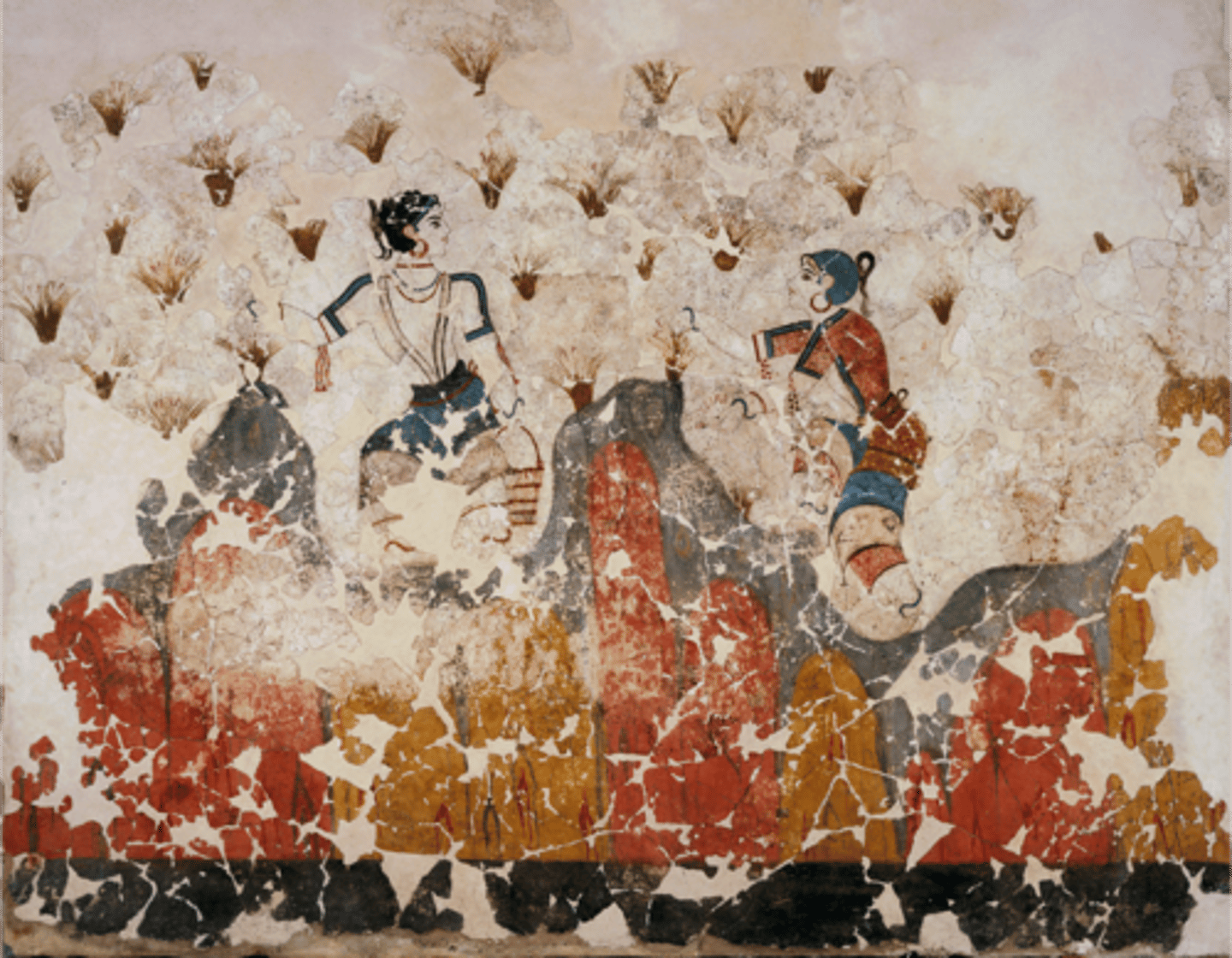
Bull-Leaping Fresco at Knossos, LM I
Who:
The artist is unknown, but it's attributed to the Minoan civilization1.
What:
This is a fresco that shows a bull-leaping scene21. The fresco depicts a large bull and three human figures. Two of the human figures have white skin, while the third human figure has a reddish-brown skin3.
Original Findspot:
The fresco was found in the Palace of Knossos on Crete214.
When:
The fresco dates to around 1500 BC3.
Why it's interesting and important:
The Bull-Leaping Fresco is the most completely restored of several stucco panels originally sited on the upper-story portion of the east wall of the palace at Knossos1. It's an iconic symbol of the Minoan civilization and provides valuable insights into their culture, particularly their sports and religious practices21.
The different skin colors in Minoan frescoes, such as the Bull-Leaping Fresco, are due to a set of rules in Minoan art. Women are always depicted with white skin and men with reddish tan skin1. This convention is more than just an artistic choice; these colors have symbolic significance1. The reddish-brown skin tone of the men is thought to indicate that they spent a significant amount of time engaging in outdoor activities such as hunting, fishing, and athletics2. So, the color differentiation provides interesting information about the gender roles and societal norms of the Minoan civilization
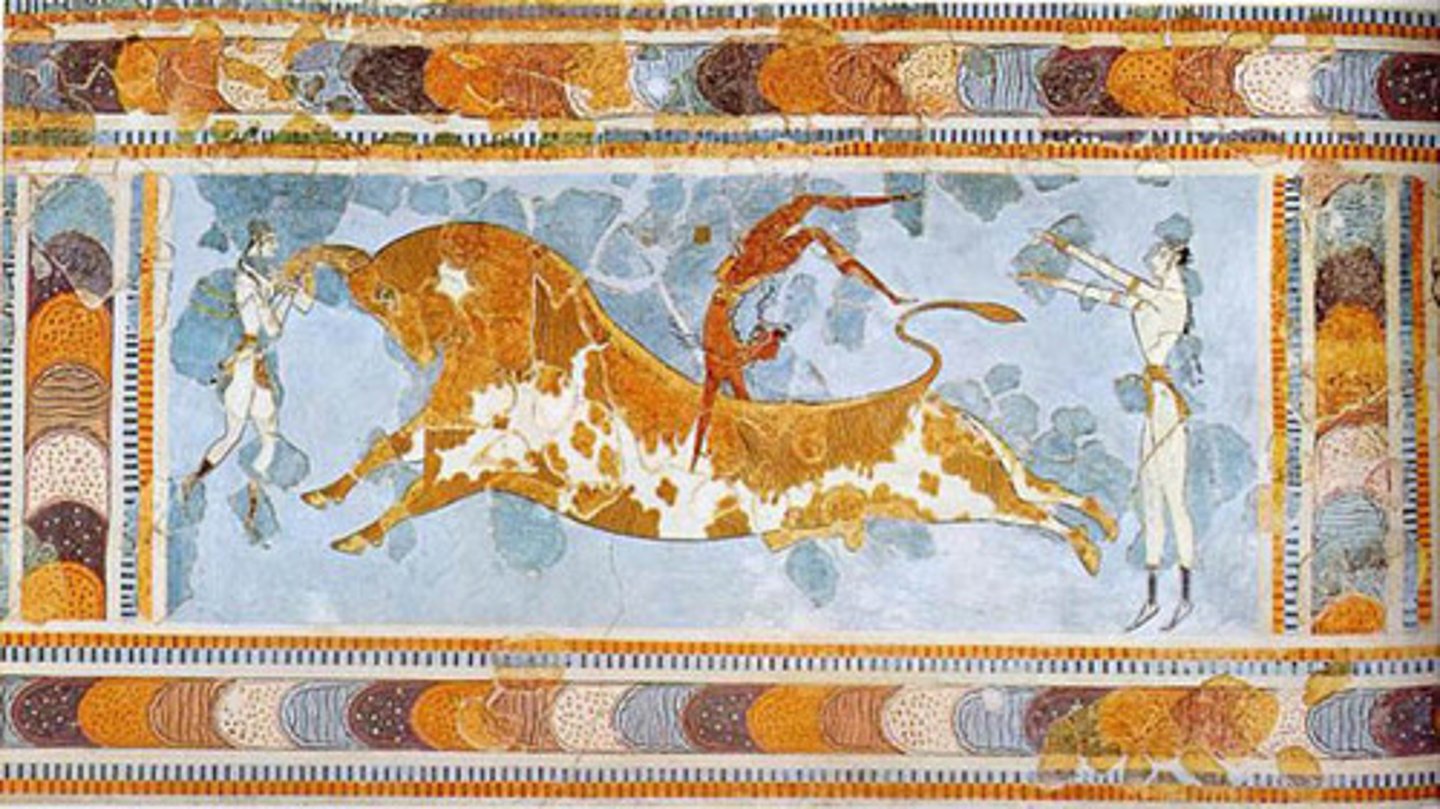
Minoan Marine style jar from Palaikastro (New Palace Period, LM IB)
Who:
The artist is unknown, but it's attributed to the Minoan civilization12.
What:
This is a Marine Style flask1. It is decorated with large octopuses which are depicted frontally but appear to be swimming diagonally, their writhing tentacles covering the whole surface of the flask1. Among the tentacles are themes denoting the seabed, such as sea urchins, tritons and small rocks with seaweed1.
Where:
The flask is currently housed in the Archaeological Museum of Heraklion12.
Original Findspot:
The flask was found in Palaikastro, a wealthy site on the far eastern coast of Crete23.
When:
The flask dates to around 1500-1450 BC12.
Why it's interesting and important:
The flask from Palaikastro is one of the most iconic vases of the Marine Style and a masterpiece of the Minoan potter's art during the New Palace period1. The exceptional naturalistic conception is typical of the vase painter, named the "Marine Style Master"2. The Marine Style is one of the styles that make up the "Special Palatial Tradition", the ceramic production of the New Palaces1. In the case of the Marine Style, the decorative motifs are not just aesthetically pleasing but also carry symbolic meaning1.
The Marine Style decoration on the Minoan jar from Palaikastro carries symbolic meaning. The marine world is emphatically presented as a reference point in both the daily life and religious beliefs of the Minoans1. The octopuses and other sea creatures depicted on the jar are not just aesthetically pleasing but also carry symbolic meaning1. The style is reminiscent of the monumental fresco paintings and gives a clear sense of "horror vacui" or "fear of empty space", meaning that the whole surface is filled with details1. While there is not a specific narrative, it is clear that the overall meaning is a representation of a love for the sea2. This subject matter on vases is called of "Marine Style" pottery2. The marine style is shown in the design of the subject as well as the overall structure of the jar2.
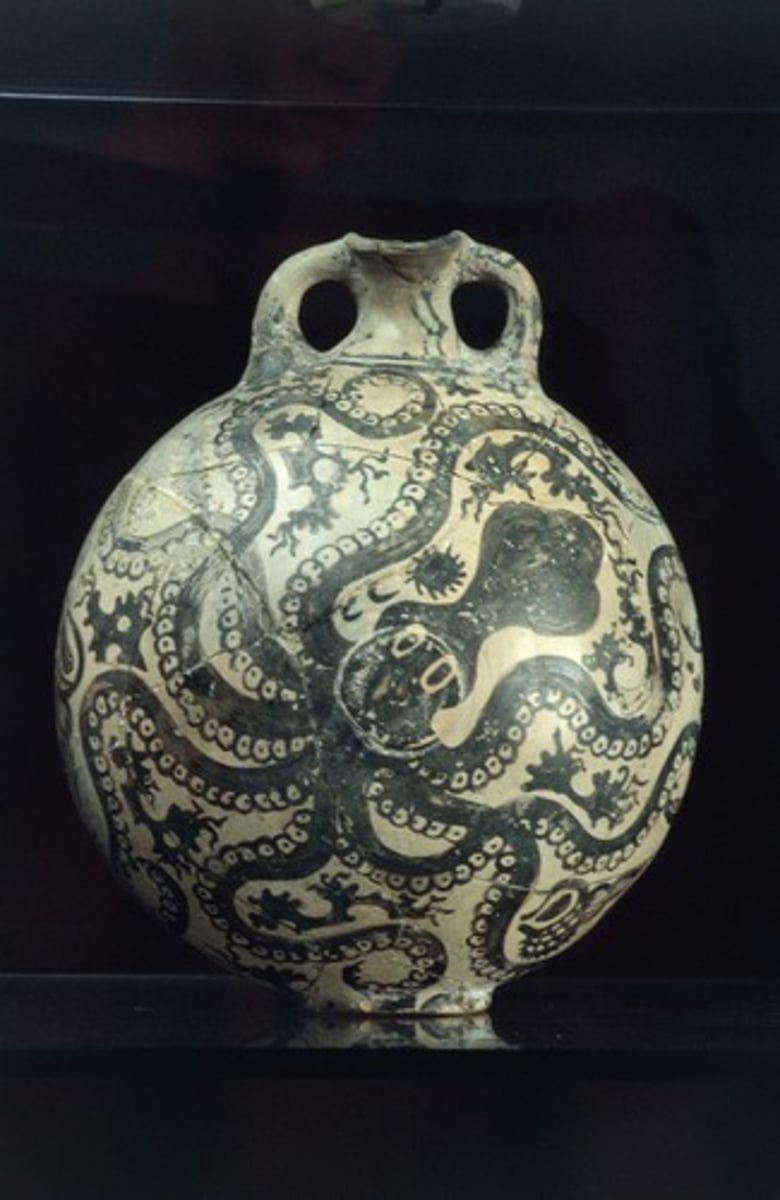
Akrotiri, a Bronze Age town on Thera (Santorini)
Who:
The inhabitants of Akrotiri were part of the Cycladic civilization1.
What:
Akrotiri is an archaeological site and a Cycladic Bronze Age town1. It was a thriving Mediterranean trading center with links to the peoples of Crete, the Cyclades, mainland Greece, and Egypt2.
Where:
Akrotiri is located on the Greek island of Santorini (Thera) near the present-day village of Akrotiri1.
Original Findspot:
The town is located at its original site on Santorini1.
When:
The town was destroyed in the Theran eruption sometime in the 16th century BCE31. Radiocarbon dating places it most probably between 1620 and 1530 BCE1.
Why it's interesting and important:
Akrotiri provides a well-preserved snapshot of Bronze Age life due to its preservation under volcanic ash from the Theran eruption31. The vibrant frescoes on the walls of almost all buildings in the town have been remarkably well preserved2. These frescoes display a clear love of the sea and the natural world with seascapes, animals, fish, and plants being popular subjects
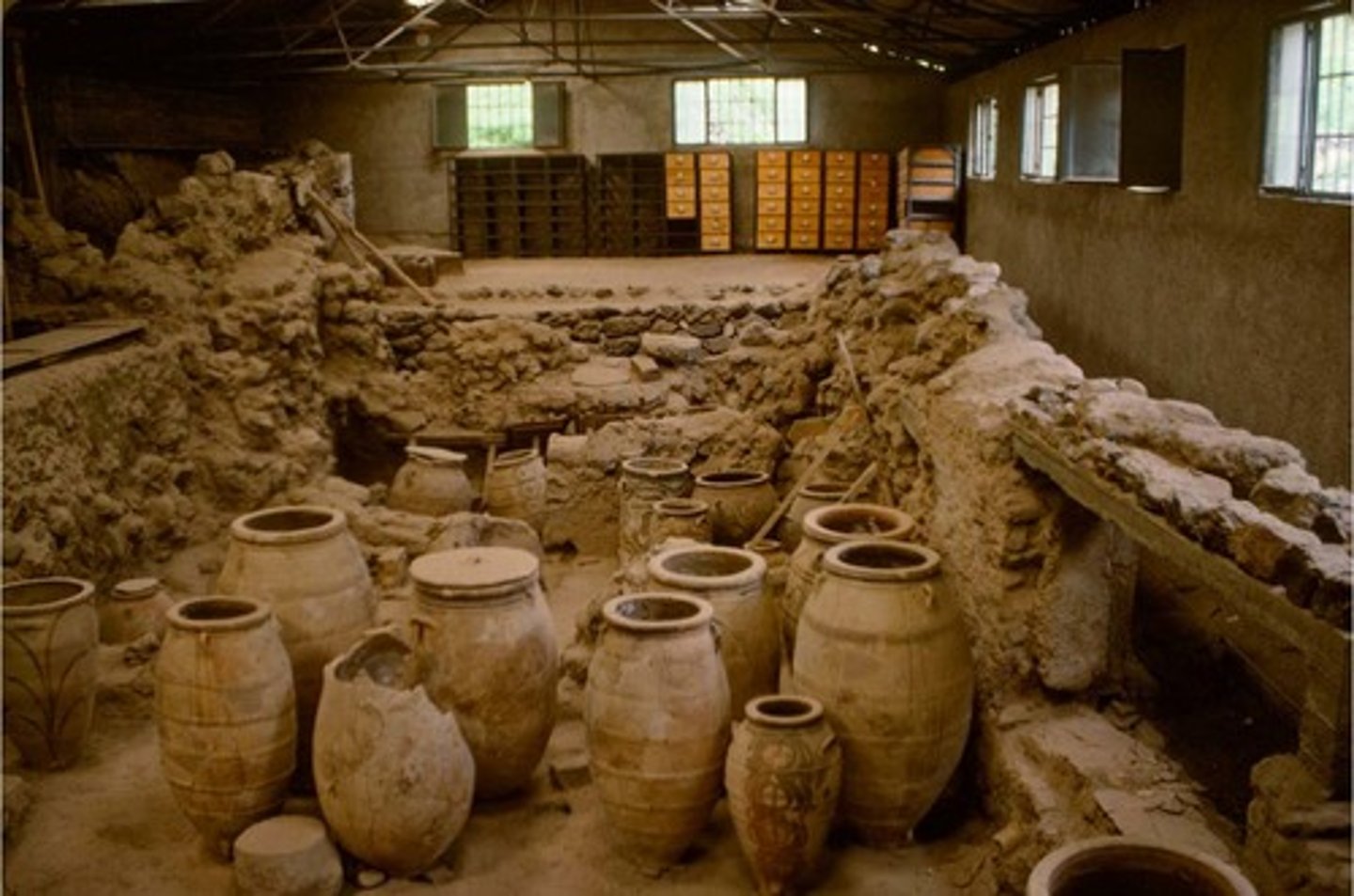
Fresco of "Crocus Gatherers" from Xeste 3 at Akrotiri
Who:
The artist is unknown, but it's attributed to the Minoan civilization1.
What:
This is a wall fresco aptly named 'the Saffron Gatherers'1. It depicts two women handpicking saffron crocuses (Crocus sativus) amongst a rocky landscape1. They are both dressed in rich clothing and are wearing elaborate jewelry1. The older woman on the left is gathering the stamens of flowers and placing them in a basket while observing the movements of the younger girl. The younger woman is gathering stamens of flowers with both hands and is looking back, as if she is seeking the older woman's approval1.
Where:
The fresco is currently housed in the Archaeological Museum of Thera1.
Original Findspot:
The fresco was found on the east wall of room 3a of the Xeste 3 building in the Akrotiri settlement of the Greek island of Thera, now known as Santorini1.
When:
The fresco dates to approximately 1650 BC1.
Why it's interesting and important:
The 'Saffron Gatherers' is part of a large fresco found in the Xeste 3 building, which is likely to have been used as a public building for religious rituals1. These frescoes are excellent representations of Minoan art, which spread to other Aegean islands, such as Thera1. The strong connection between Minoan art and nature is indisputable. Amongst the various depictions of nature in Minoan art, the crocus flower and its stigma (the female organ) are particularly prevalent1.
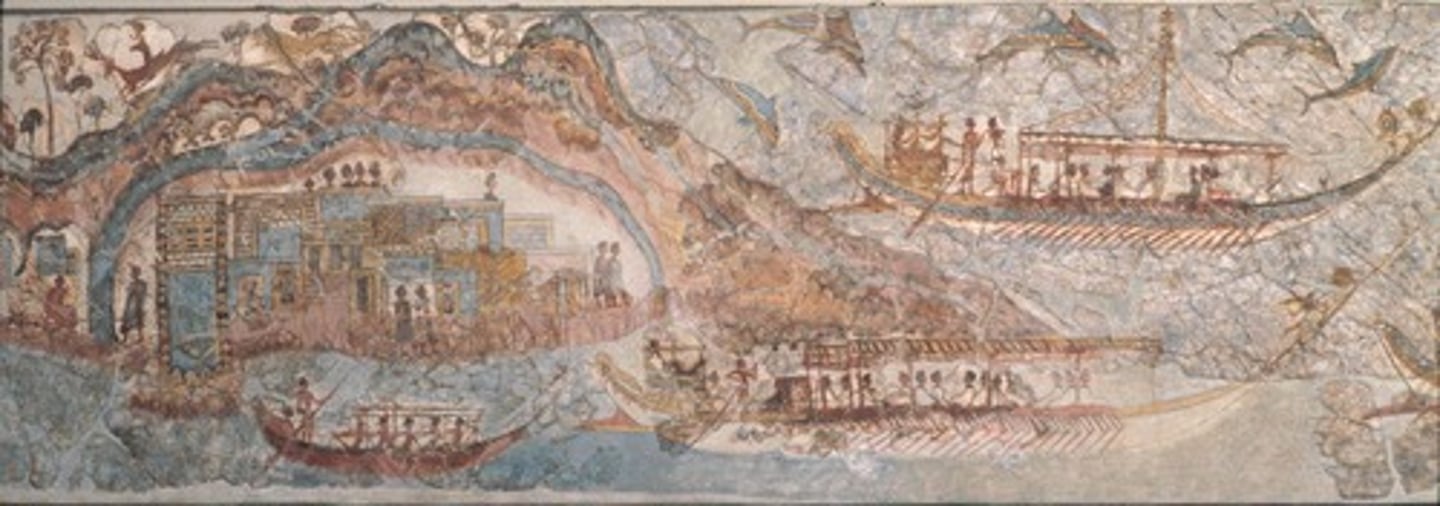
So-called "Miniature Fresco" from the West House at Akrotiri
Who:
The artist is unknown, but it's attributed to the Minoan civilization12.
What:
This is a fresco that was found in room five of the West House of Akrotiri12. It depicts a ship procession between two Minoan coastal cities13.
Where:
The fresco is currently housed in the Archaeological Museum of Thera4.
Original Findspot:
The fresco was found in the West House at Akrotiri, on the island of Thera (now Santorini)12.
When:
The fresco dates to approximately 1500 BC2.
Why it's interesting and important:
The "Miniature Fresco" from the West House at Akrotiri provides valuable insights into the Minoan civilization, particularly their maritime activities and trade relations, in several ways:
Maritime Trade: The Minoans were primarily a mercantile people engaged in overseas trade1. The fresco depicts a ship procession between two Minoan coastal cities23, which suggests that the Minoans had a strong maritime presence and were involved in extensive trade networks4.
Shipbuilding: The fresco also provides evidence of the Minoans' sophisticated shipbuilding techniques5. The Minoans maintained a massive and impressive fleet of ships, which facilitated their trade and exchange4.
Trade Relations: The depiction of the ship procession suggests that the Minoans had regular sea contacts with other regions. Artifacts of Egyptian provenance found in Crete and other Minoan centers, as well as finds from Greece mainland and its islands buried in Egypt, attest to the intense sea trade between the people of the Aegean and Egypt5.
Economic Power: The Minoan economy was based on the maritime trade of agricultural products like wine, olives, and figs in exchange for minerals and other resources like copper and ivory4. The fresco, showing a ship procession, is a testament to this economic power.
Cultural Influence: Evidence of Minoan products and cultural influences have been found across the Mediterranean, indicating that through trade and exchange, the Minoans managed to spread their cultural ideas4.
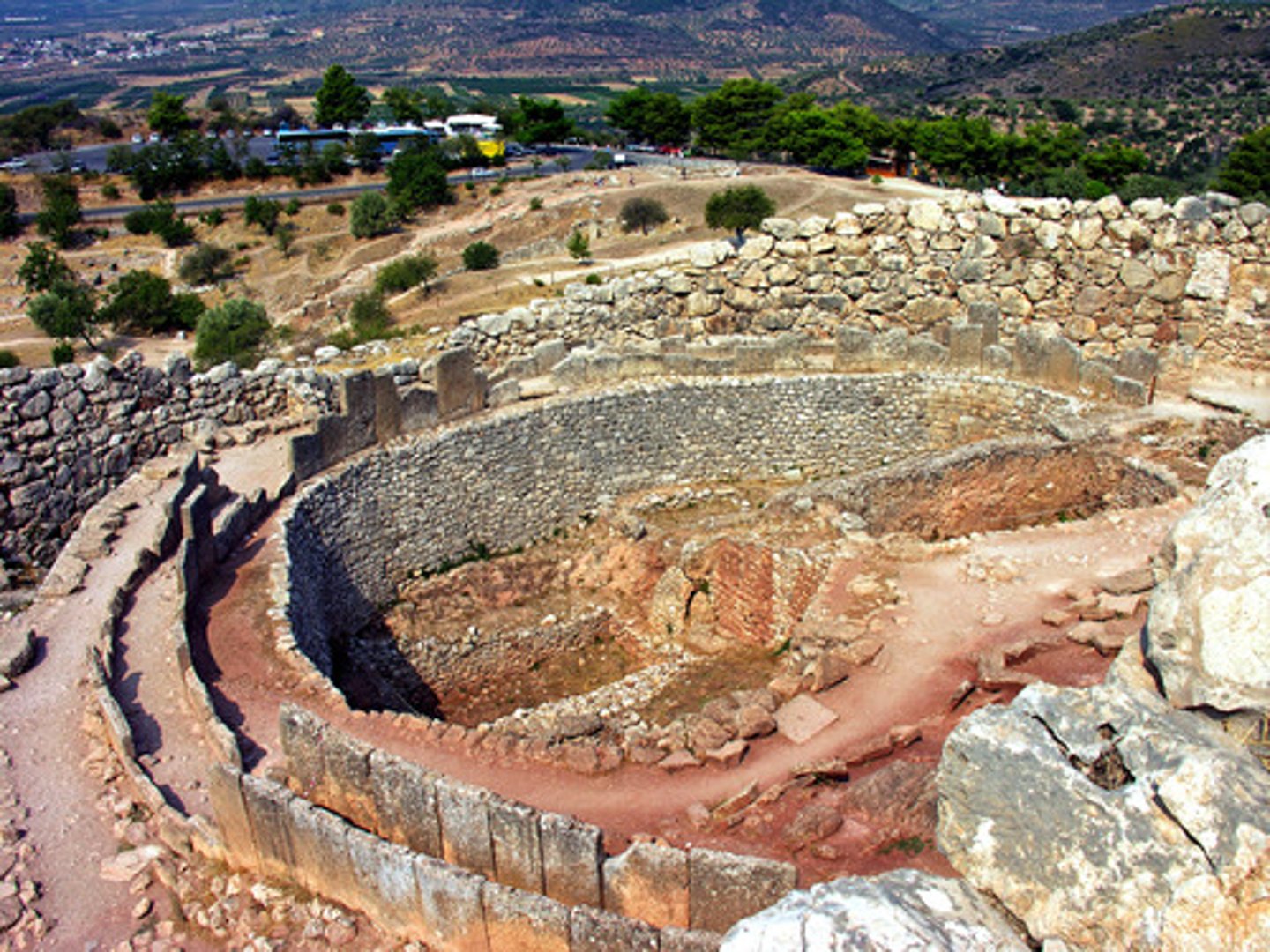
The Shaft Graves, Mycenae
Who:
The graves were those of royal or leading Greek families1.
What:
The Shaft Graves are late Bronze Age (c. 1600-1450 BC) burial sites1. They contain a wealth of objects, including gold masks, weapons, and ornaments2.
Where:
The Shaft Graves are located in the Mycenaean citadel at Mycenae2.
Original Findspot:
The graves are located at their original site in Mycenae2.
When:
The graves date back to the Late Bronze Age (1550-1200 BC)2.
Why it's interesting and important:
The Shaft Graves at Mycenae signify the elevation of a local Greek-speaking royal dynasty whose economic power depended on long-distance sea trade3. (Agamemnon) The graves were unplundered and undisturbed until found by modern archaeologists at Mycenae1. The wealth of objects found in the graves has shed light on the city's culture and customs2.
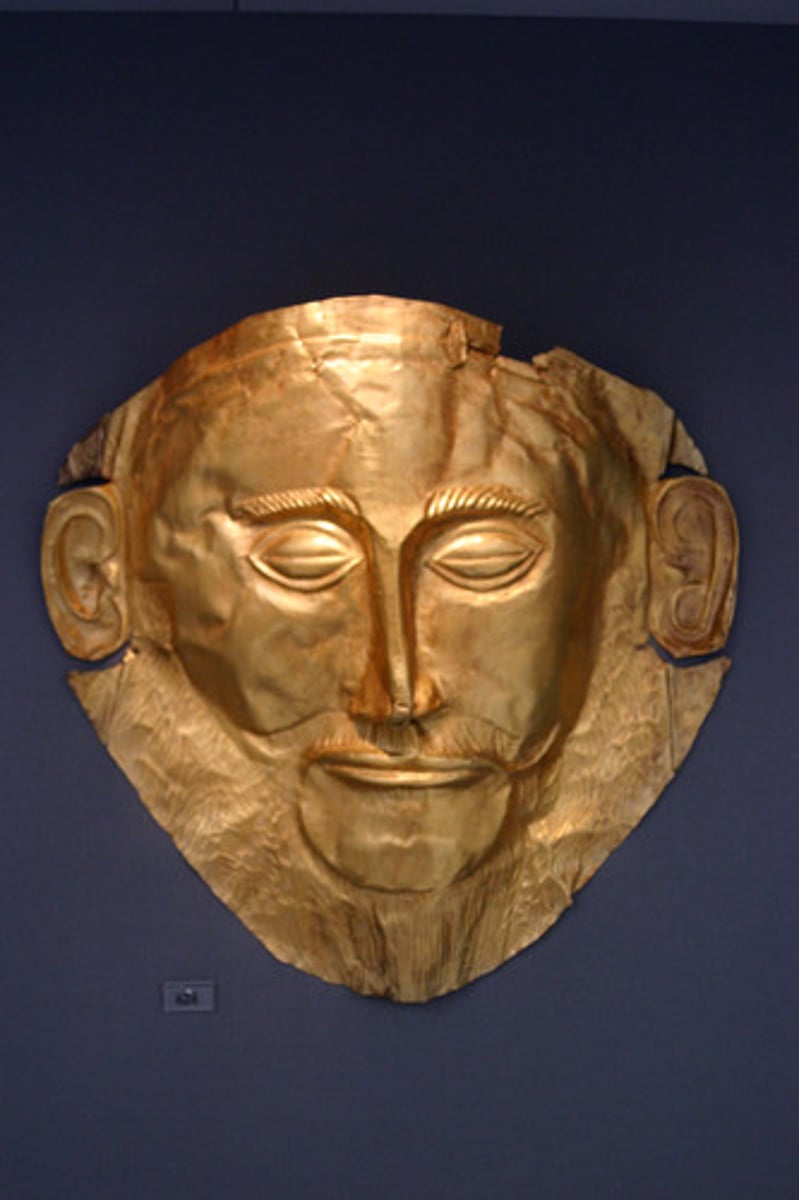
Gold mask, "Mask of Agamemnon" from Grave Circle A, Mycenae, LH I (ca. 1725-1600 BC)
Who:
The mask was discovered by German archaeologist Heinrich Schliemann, who believed that he had found the body of the Mycenaean king Agamemnon1. However, modern archaeological research suggests that the mask predates the period of the legendary Trojan War by 300-400 years1.
What:
The Mask of Agamemnon is a gold funeral mask1. It was created from a single thick gold sheet, heated and hammered against a wooden background with the details chased on later with a sharp tool2.
Original Findspot:
Schliemann found the gold funeral mask in 1876, in a shaft tomb designated Grave V, at the site Grave Circle A, Mycenae1.
When:
The mask dates to about 1550-1500 BC1.
Why it's interesting and important:
The Mask of Agamemnon is one of the most distinctive archaeological objects and has been described as the "Mona Lisa of prehistory"1. It provides valuable insights into Mycenaean funerary practices and beliefs. Despite doubts about its authenticity and its association with Agamemnon, it remains an iconic symbol of Mycenaean culture3.
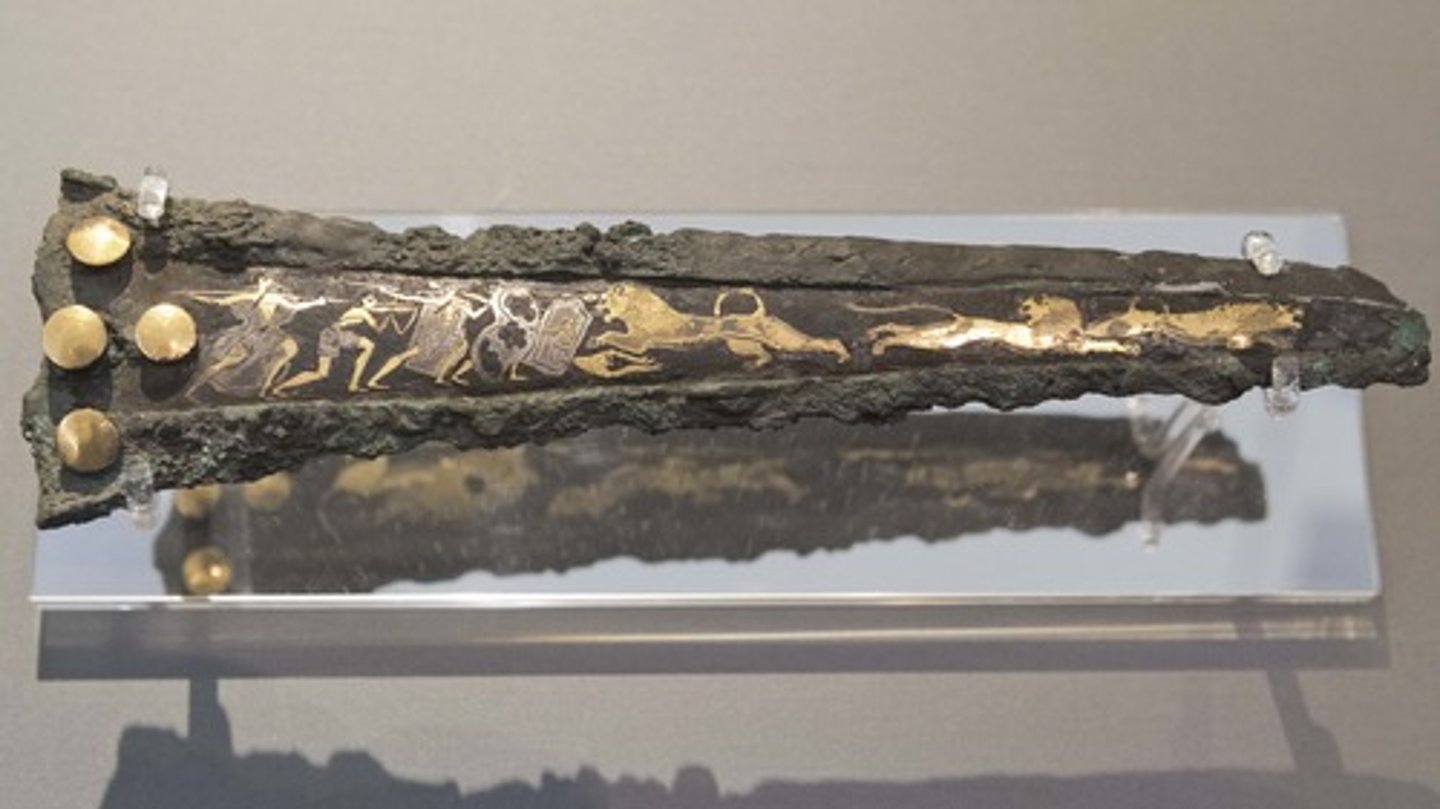
Niello dagger from Shaft Grave IV, LH I (ca. 1725-1600 BC)
Who:
The artist is unknown, but it's attributed to the Mycenaean civilization12.
What:
This is a dagger made of bronze, with gold, silver, and niello inlay1. The scene on the dagger blade shows male hunters carrying large shields, semi-cylindrical or figure-of-eight shaped1.
Where:
The dagger is currently housed in the National Archaeological Museum of Athens3.
Original Findspot:
The dagger was found in Shaft Grave IV in Grave Circle A at Mycenae12.
When:
The dagger dates to around 1725-1600 BC12.
Why it's interesting and important:
The Niello dagger from Shaft Grave IV is one of the most famous artifacts from Mycenae. It provides valuable insights into Mycenaean warfare and their advanced metalworking techniques2. The scene on the dagger blade is a testament to the Mycenaean's martial culture and their use of large shields for protection1.
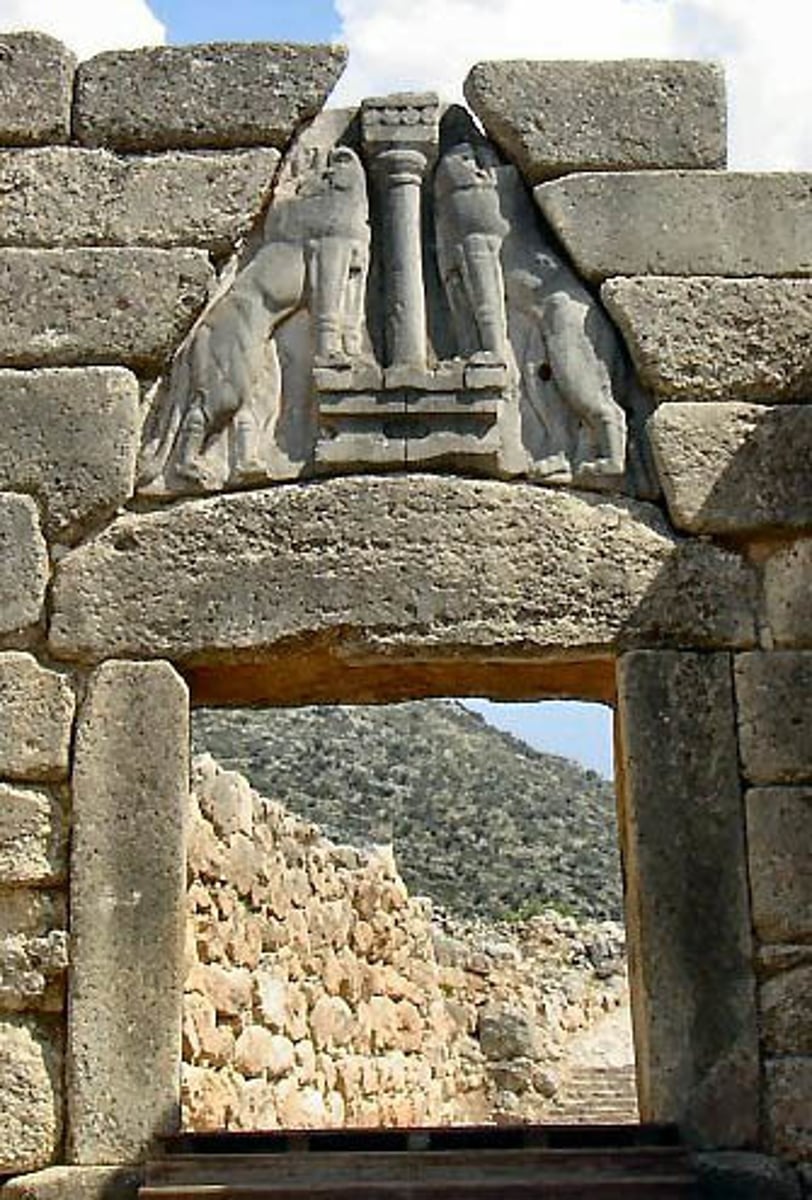
Lion Gate at Mycenae,
Who:
The gate was built by the Mycenaeans, a Bronze Age civilization that flourished on mainland Greece1.
What:
The Lion Gate is the main entrance of the Bronze Age citadel of Mycenae in southern Greece1. It was named after the relief sculpture of two lionesses or lions in a heraldic pose that stands above the entrance1. The gate is the sole surviving monumental piece of Mycenaean sculpture, as well as the largest surviving sculpture in the prehistoric Aegean1.
Where:
The Lion Gate is located at its original site in Mycenae1.
Original Findspot:
The gate is located at its original site in Mycenae1.
When:
The Lion Gate was erected during the thirteenth century BC, around 1250 BC1.
Why it's interesting and important:
The Lion Gate is one of the most iconic symbols of Mycenaean culture. It provides valuable insights into their architectural and artistic capabilities1. It's also significant because it's the only monument of Bronze Age Greece to bear an iconographic motif that survived without being buried underground1.
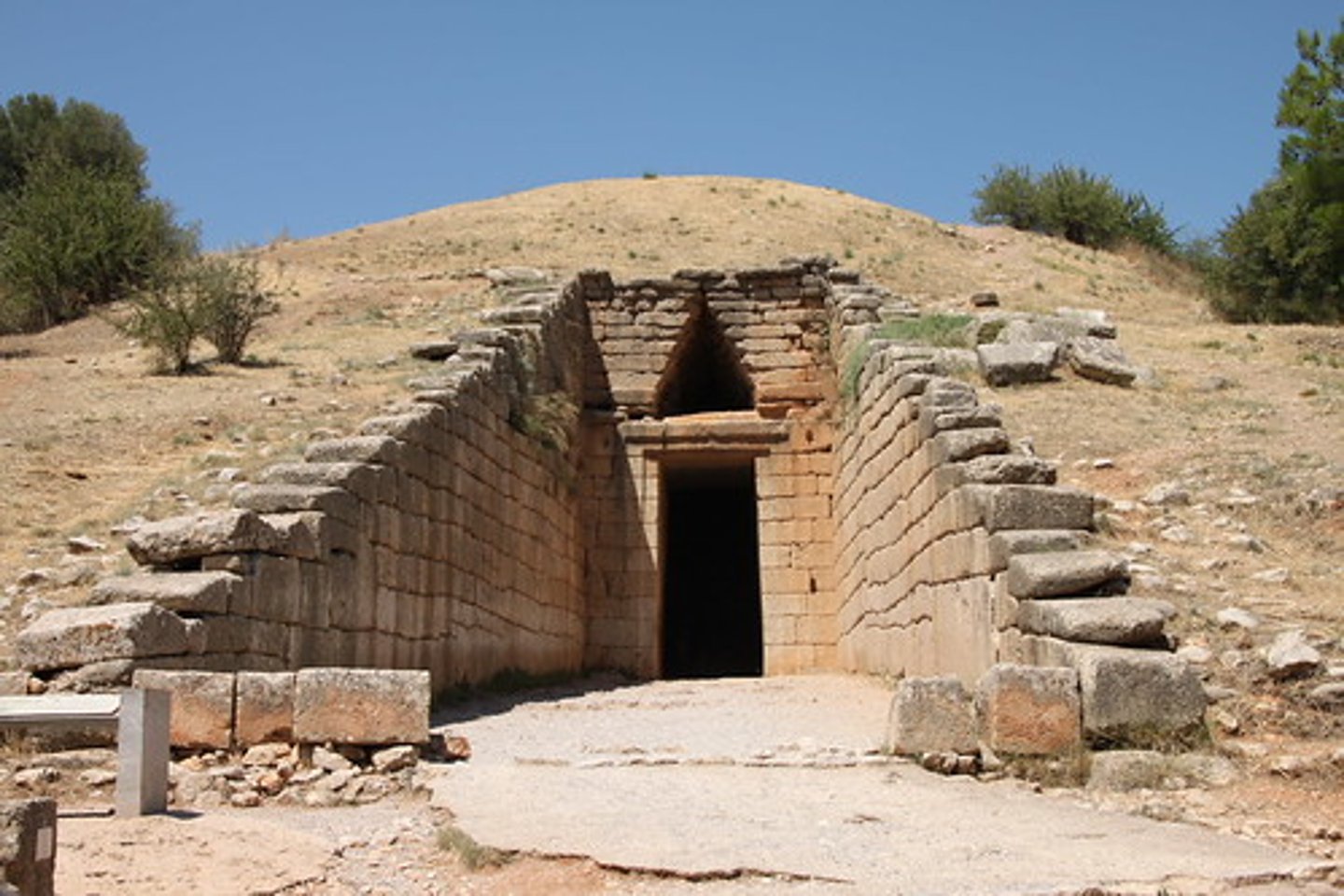
The So-called Treasury of Atreus, a Mycenaean Tholos Tomb
Who:
The tomb was built by the Mycenaeans, a Bronze Age civilization that flourished on mainland Greece1.
What:
The Treasury of Atreus, also known as the Tomb of Agamemnon, is a large tholos or beehive tomb1. It is the largest and most elaborate tholos tomb known to have been constructed in the Aegean Bronze Age1.
Where:
The tomb is located at its original site in Mycenae1.
Original Findspot:
The tomb is located at its original site in Mycenae1.
When:
The tomb was constructed between 1300 and 1250 BCE1.
Why it's interesting and important:
The Treasury of Atreus is one of the most distinctive archaeological objects. It provides valuable insights into Mycenaean funerary practices and beliefs1. Despite doubts about its authenticity and its association with Agamemnon, it remains an iconic symbol of Mycenaean culture1.
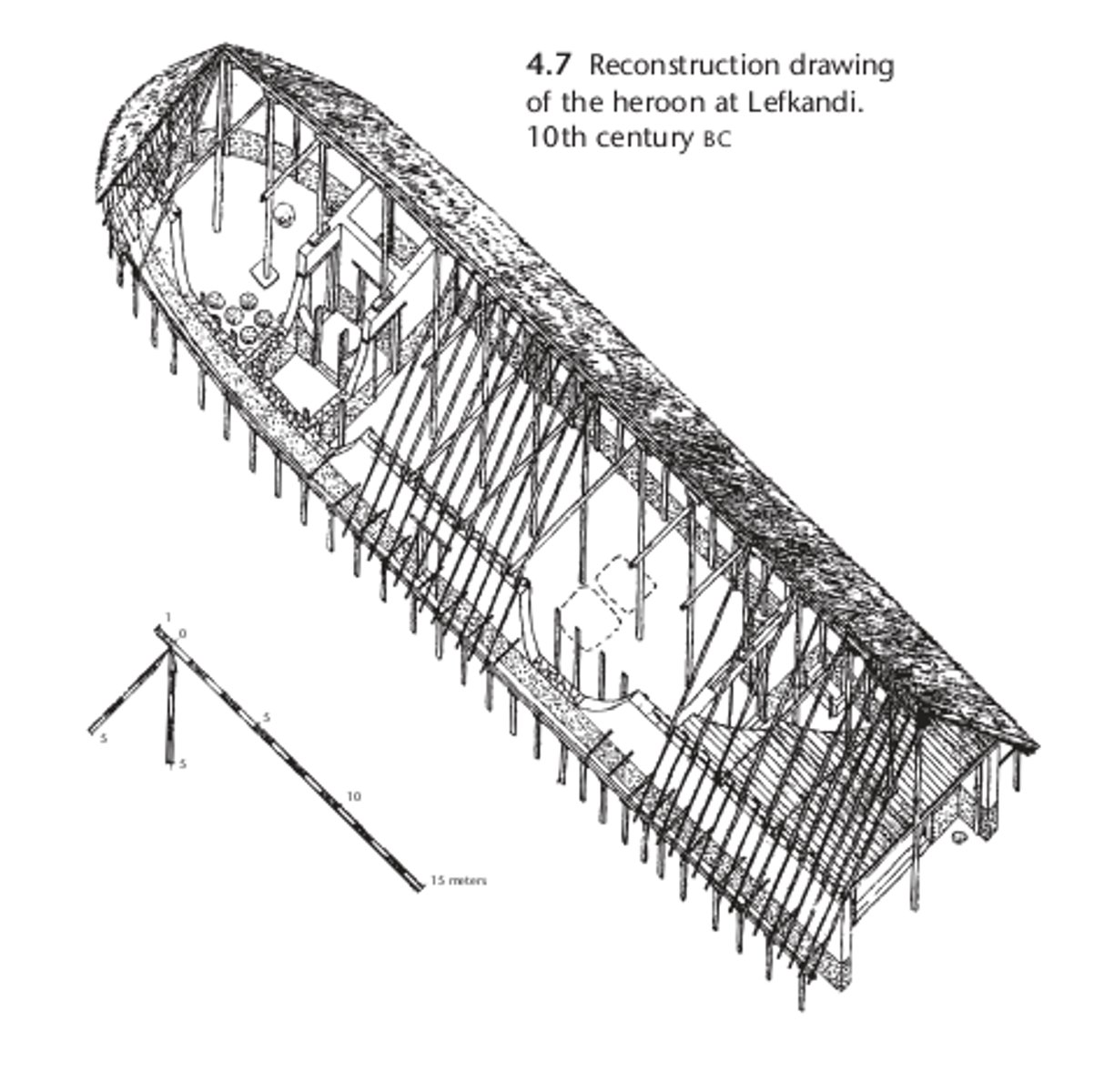
The Heroon at Lefkandi
Monumental structure in timber and mud brick covering the burials of a man, woman, and four horses. Ca. 1000-950 BCE.
Who:
The Heroon at Lefkandi was built by the inhabitants of Lefkandi, a significant settlement during the Early Iron Age12.
What:
The Heroon at Lefkandi is an unusual funerary structure that contained a double human burial alongside a horse burial1. It's considered the earliest monumental building of Iron Age Greece3.
Where:
The Heroon is located at its original site in Lefkandi, Euboea, Greece41.
Original Findspot:
The Heroon is located at its original site in Lefkandi1.
When:
The Heroon dates to around 1000-950 BC1.
Why it's interesting and important:
The Heroon at Lefkandi is significant because it provides valuable insights into the funerary practices and beliefs of the Early Iron Age Greeks5. Its scale and nature have led some scholars to identify it as a heroon1. The structure's planning concept and measurements also provide insights into Greek architecture during this period3.
Planning and Design: The Heroon at Lefkandi appears to be a simple construction, in which the interaxial or bay of 15 ft seems to be the planning unit for the ground plan1. This suggests that even in this early period, Greek architects were using standardized units of measurement in their designs1.
Building Materials: The walls of the Heroon were made of stone and mud brick, and the interior was plastered smooth2. Postholes on the outside of the exterior walls, against the interior of the walls, and in the center indicate that timber was used to support the thatched roof2. This gives us an idea of the materials and construction techniques used during this period2.
Monumental Architecture: The Heroon at Lefkandi is considered the earliest monumental building of Iron Age Greece13. This suggests that the Greeks were constructing large and impressive structures even in this early period13.
Cultural Significance: The Heroon was likely used as a public building for religious rituals1. This indicates that architecture played a significant role in religious and communal activities during this period1.
Influence on Later Architecture: The Heroon at Lefkandi has won a special place in archaeological manuals as a forerunner
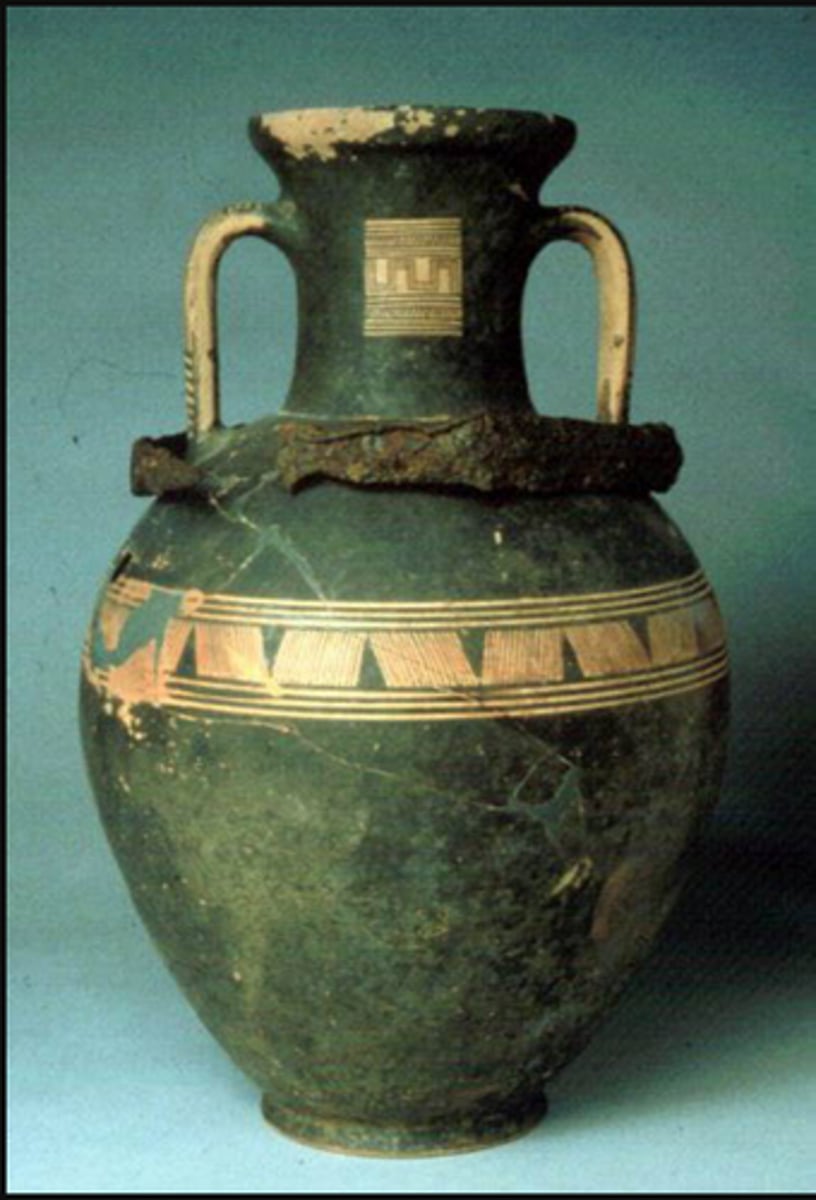
Grave of Warrior (ca. 900-875 BC) and Grave of Rich Woman (ca. 850 BC), Athens
Who: The tombs represent a warrior and a rich woman from the Early Geometric period of Ancient Greece12.
What: These are tombs, specifically the Grave of Warrior (ca. 900-875 BC) and Grave of Rich Woman (ca. 850 BC)12.
Where: The tombs are located near Pylos in the Peloponnesian peninsula in southern Greece13.
Original Findspot: The original findspot is an olive grove in Southern Greece1.
When: The Grave of Warrior dates to approximately 900-875 BC, and the Grave of Rich Woman dates to approximately 850 BC12.
Why it's interesting and important: These tombs provide significant insights into the origins of Greek civilization and the Mycenaean culture12. The well-preserved artifacts found in these tombs, including weapons, gold, jewels, and intricately carved seals, offer valuable information about the trade, culture, and societal structures of ancient Greece12. The discovery of these tombs has been hailed as one of the biggest on mainland Greece in decades2.
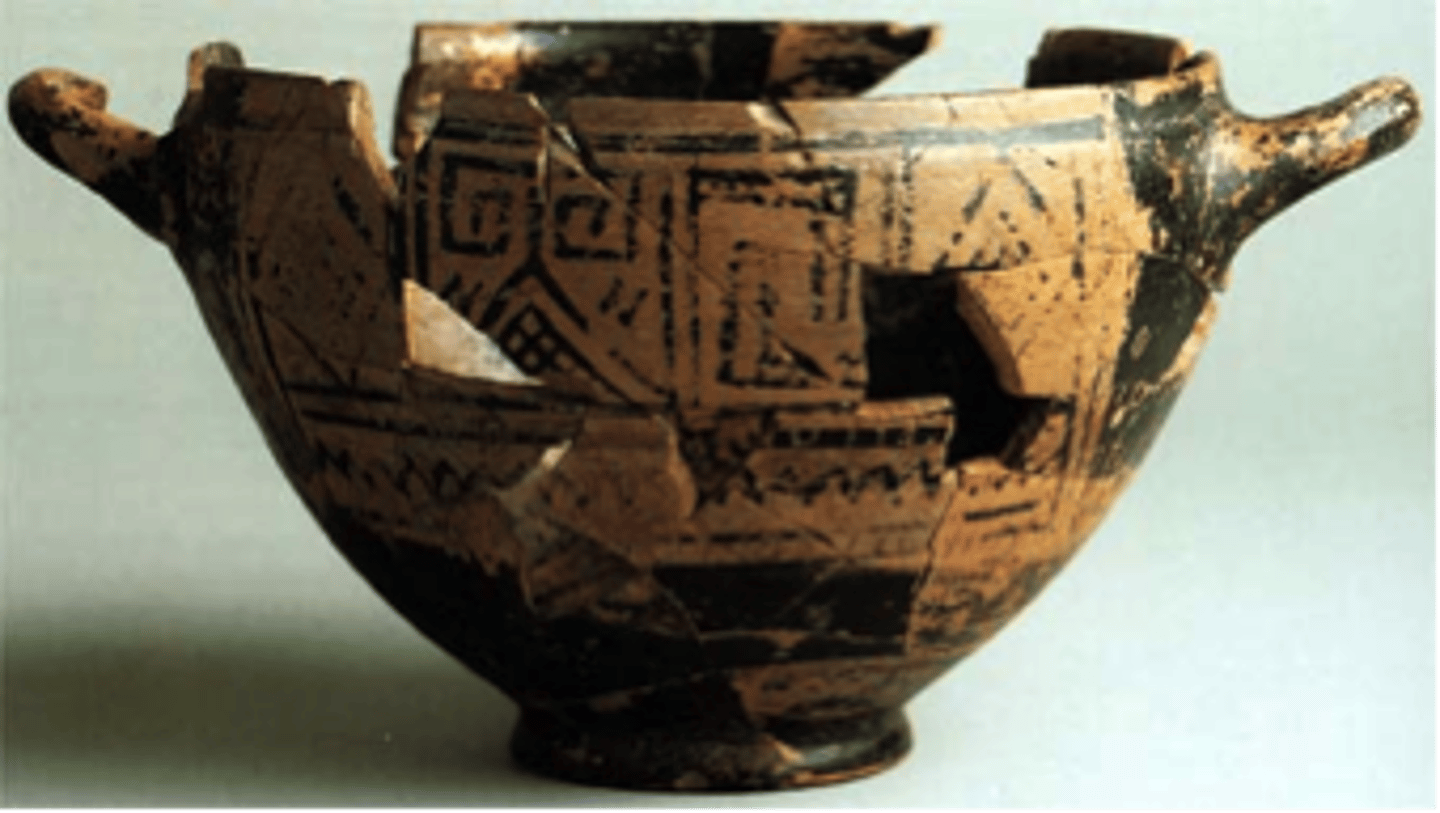
Nestor's Cup, an East Greek cup with verse inscription, ca. 720 BC
Who: The cup is associated with Nestor, a figure from Greek epic poetry12.
Nestor's Cup was made in Rhodes in the eighth century BC1. The cup was decorated in the Geometric style1. The inscription on the cup was added after its manufacture
What: Nestor's Cup is an "orientalized" clay drinking cup, also known as a kotyle31.
Where: The cup was found on the island of Ischia in Italy, in the region known as Magna Graecia31.
Original Findspot: The original findspot is Lacco Ameno, the ancient trading market site of Pithekoussai in Magna Graecia, on Ischia, an island in the Gulf of Naples (Italy)1.
When: The cup dates to the Geometric Period, around 750-700 B.C31.
Why it's interesting and important: Nestor's Cup is significant because it bears a three-line inscription, which is one of the earliest surviving examples of writing in the Greek alphabet12. The inscription appears to make an allusion to Homeric poetry, particularly the Iliad3
Translated, it reads: "I am Nestor's cup, good to drink from. Whoever drinks this cup empty, straightaway Desire for beautiful-crowned Aphrodite will seize him."3 This inscription has led to many interpretations and discussions among scholars3.
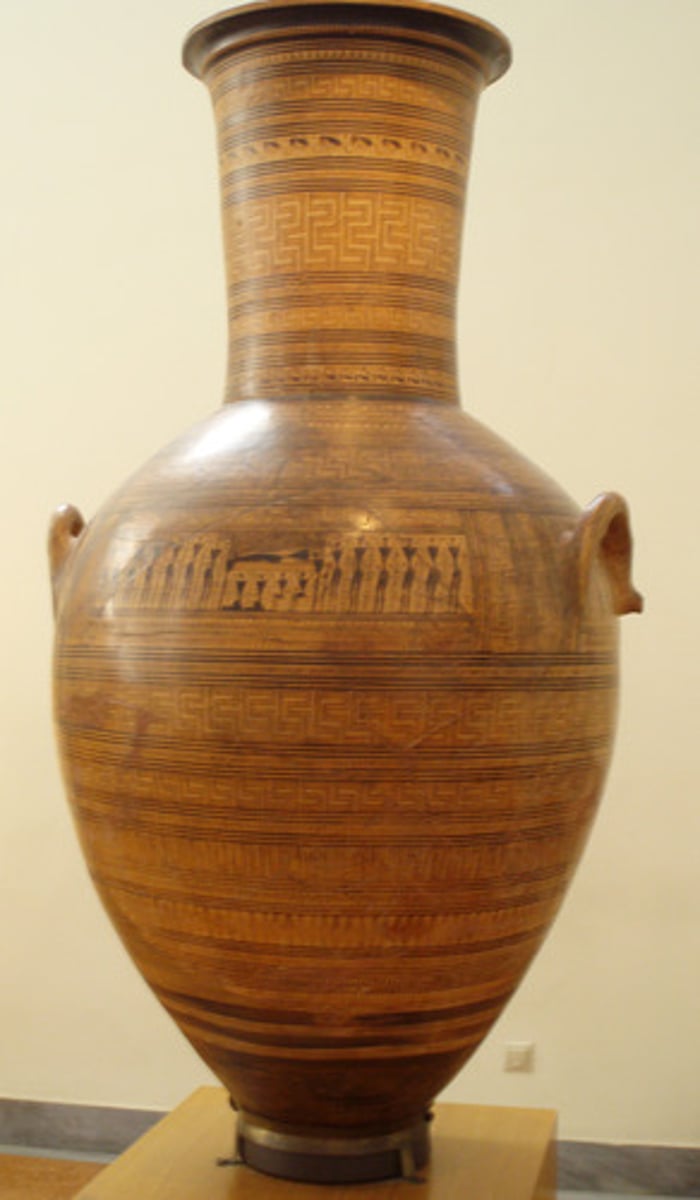
Dipylon Vase
Who: The Dipylon Vase is attributed to an unknown artist known as the Dipylon Master1. This artist is one of the earliest individually identifiable Greek artists1.
What: The Dipylon Vase is a large Ancient Greek painted vase, made around 760-750 BC1. It's an amphora, a type of container used for storage1.
Where: The vase was discovered at the Dipylon cemetery, near the Dipylon Gate, in Kerameikos, the ancient potters' quarter on the northwest side of the ancient city of Athens1. It is now held by the National Archaeological Museum, Athens1.
Original Findspot: The original findspot is the Dipylon cemetery in Athens1.
When: The vase dates to around 760-750 BC1.
Why it's interesting and important: The Dipylon Vase is significant because it's one of the masterpieces of Greek Geometric art2. It's covered entirely in ornamental and geometric patterns, as well as human figures and animal-filled motifs1. The vase signifies the passing of an aristocratic woman, who is illustrated along with the procession of her funeral consisting of mourning family and friends situated along the belly of the vase1. The woman's nobility and status is further emphasized by the plethora of detail and characterized animals, all which remain in bands circling the neck and belly of the amphora1.
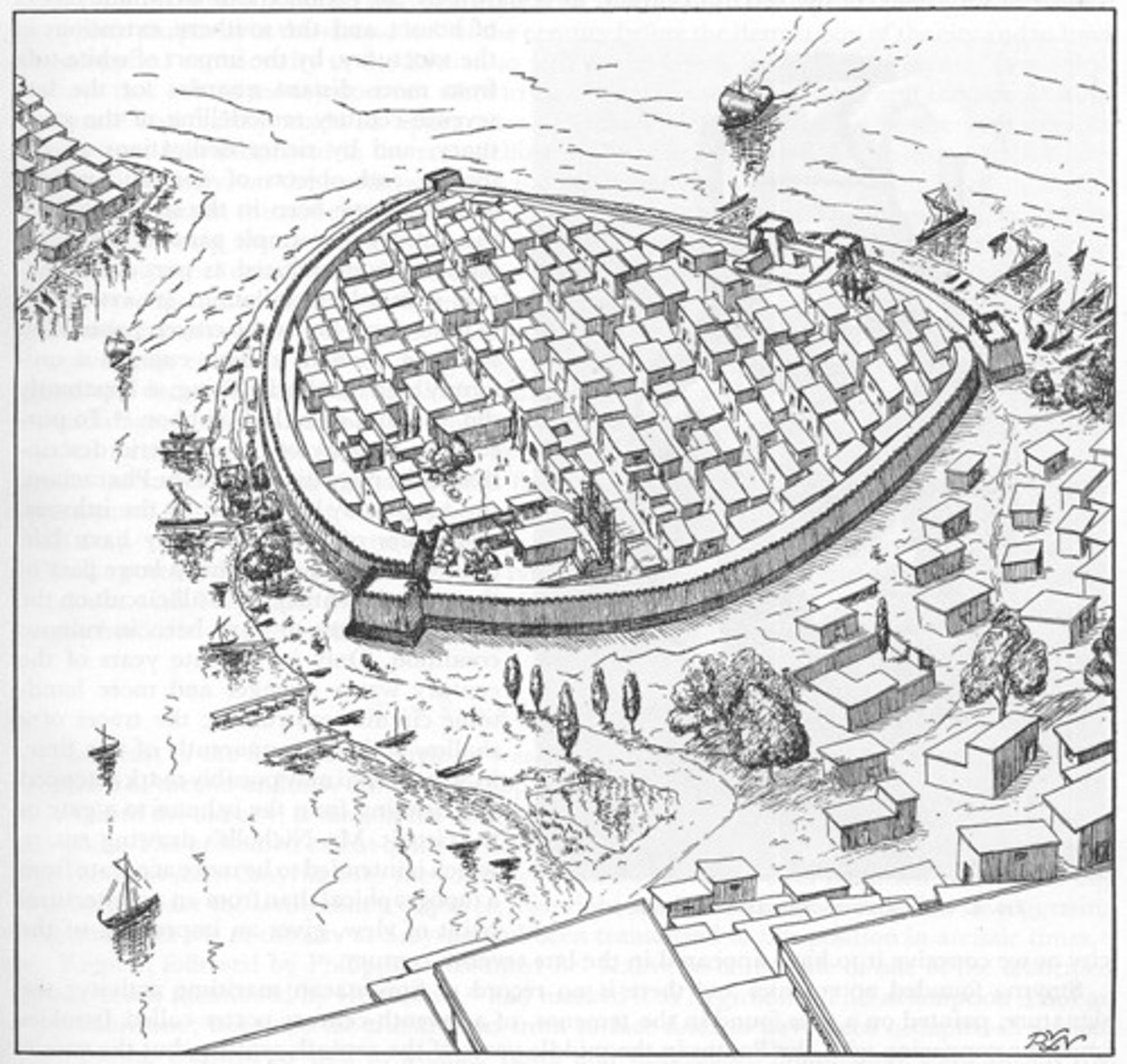
Polis of Smyrna (Old Smyrna, modern Izmir)
Who: The Polis of Smyrna, also known as Old Smyrna, was established by Aeolian Greek settlers around 1000 BC1.
What: Old Smyrna is an ancient Greek city2. It was a large tell rising approximately 21 meters (70 feet) above sea level prior to its excavation3.
Where: The remains of Old Smyrna are located near Bayraklı, which was once a village but is now part of modern Izmir4. The city is situated in Western Anatolia, in what is today Turkey3.
Original Findspot: The original findspot is near Bayraklı in modern Izmir4.
When: The earliest occupation at Old Smyrna was during the 3rd millennium BC. It was occupied fairly continuously from about 1000-330 BC3.
Why it's interesting and important: Old Smyrna is significant because it reflects early versions of the modern-day port city of Izmir3. It lies in a geologically active region at the foot of Yamanlar Dagi, a now-extinct volcano3. The city has been subjected to numerous earthquakes during its long occupation3. Despite these challenges, it thrived due to benefits such as the ancient baths called the Agamemnon hot springs, found near the southern coast of Izmir Bay, and a ready source of building material for architecture3.
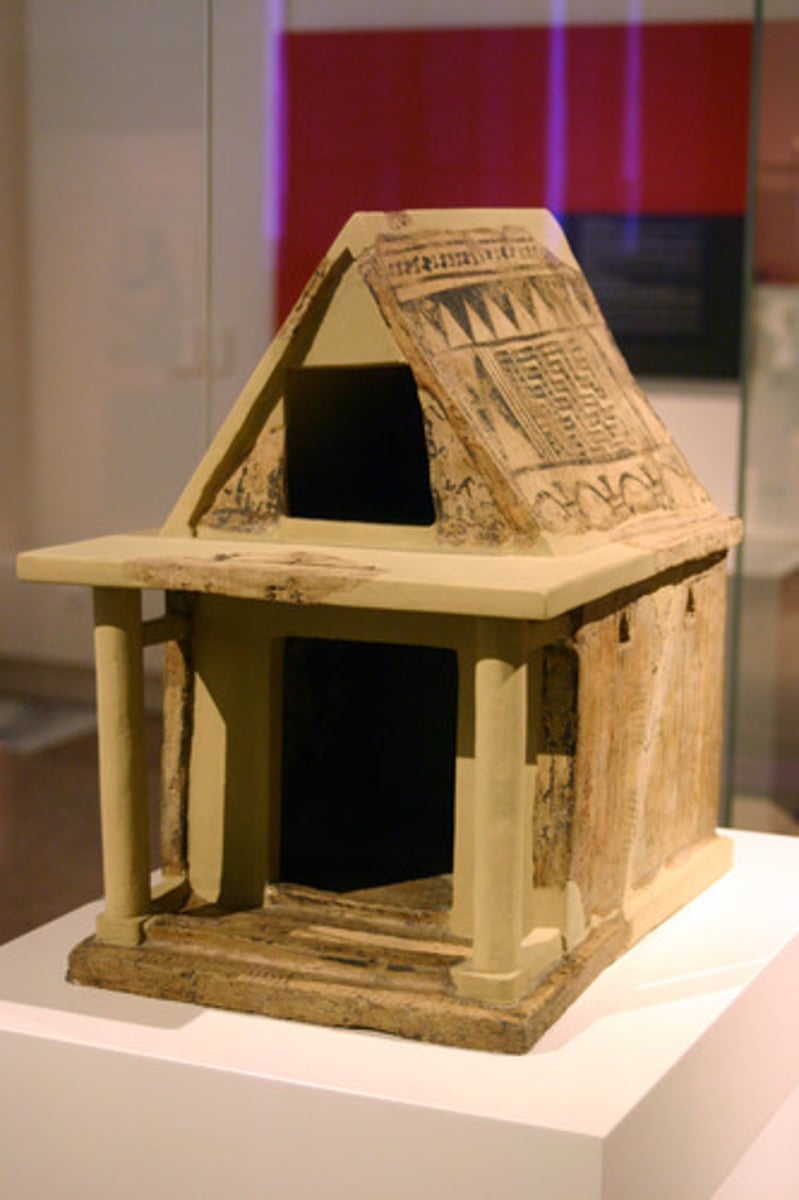
Apsidal building model from Argos
Who: The Apsidal building model from Argos was created by the ancient Greeks1.
What: It's an apsidal building model, a type of structure that is characteristic of rural societies in Greece1. Apsidal and elliptical buildings have a tradition that goes back to the late Neolithic period1.
Where: The original findspot is Argos, a city in the Peloponnese, Greece1.
When: The model dates back to the late 8th century BC1.
Why it's interesting and important: This apsidal building model is significant because it provides insights into the architectural styles and construction techniques of the time1. It also reflects the societal structures and living conditions of ancient Greece1.
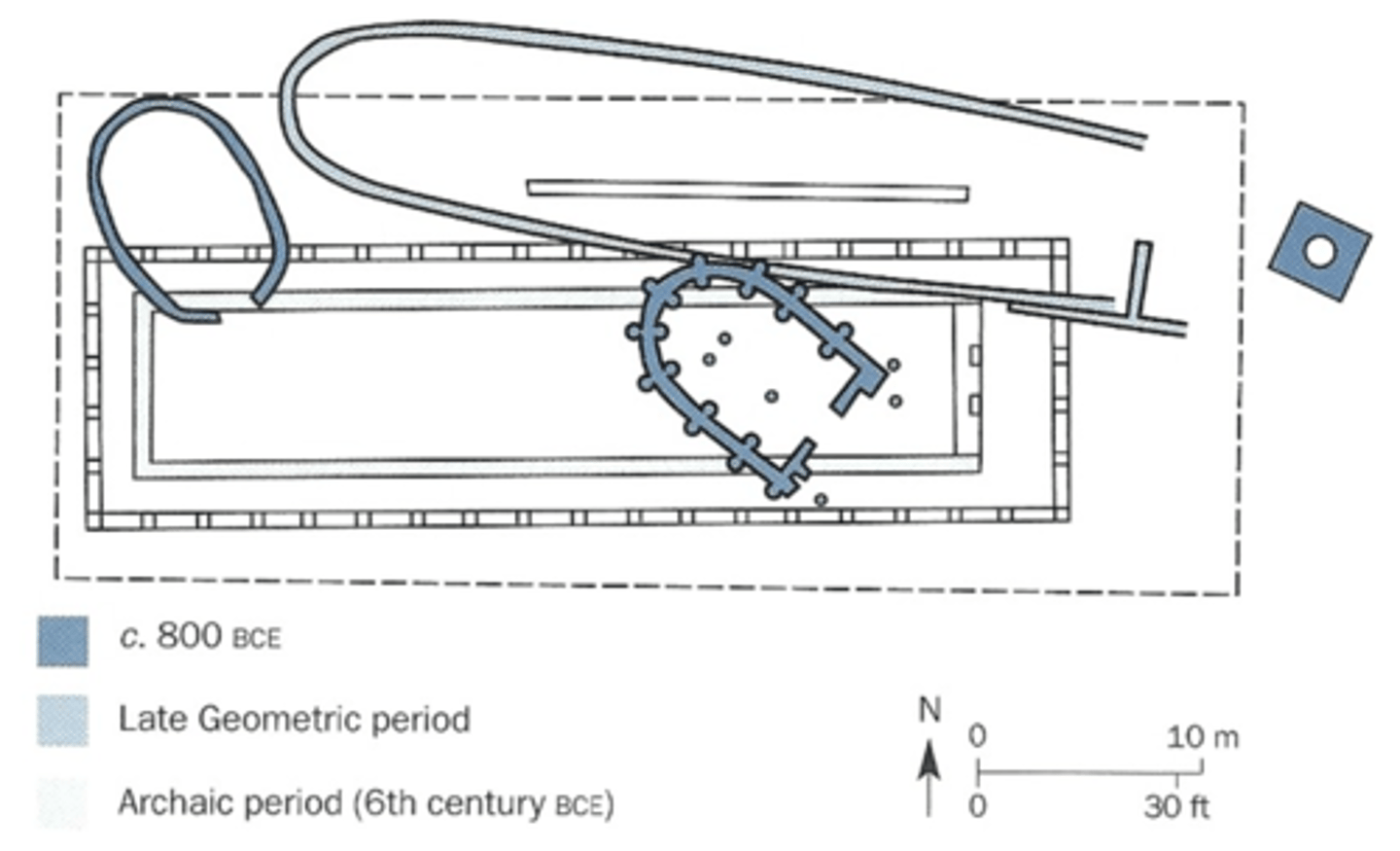
Eretria, Temple of Apollo Daphnephoros
Who: The Temple of Apollo Daphnephoros was a religious center and fundamental place of worship within the core of the ancient city, Eretria1.
What: It is a temple dedicated to Apollo Daphnephoros1. The temple had three principal building phases dating to the eighth, seventh, and sixth centuries2.
Where: The temple is located in Eretria, a city in Euboea, Greece3. It is situated north of the Agora1.
When: The earliest structure at the Apollo sanctuary, an eighth-century Geometric hut, was apsidal in plan. A second structure located just to the east of the first Geometric temple is interpreted as a hekatompedon of the Geometric period. The early archaic temple is reconstructed in plan as an Ionic hekatompedon with a peripteros of 6 x 19 columns surrounding a long, narrow cella without an interior colonnade2.
Why it's interesting and important: The Temple of Apollo Daphnephoros is the most important and widely known monument of Eretria1. It provides valuable insights into the architectural styles and religious practices of ancient Greece. The temple was dedicated to Apollo Daphnephoros, an epithet given to Apollo in reference to a myth which Ovid also wrote of in his Metamorphoses
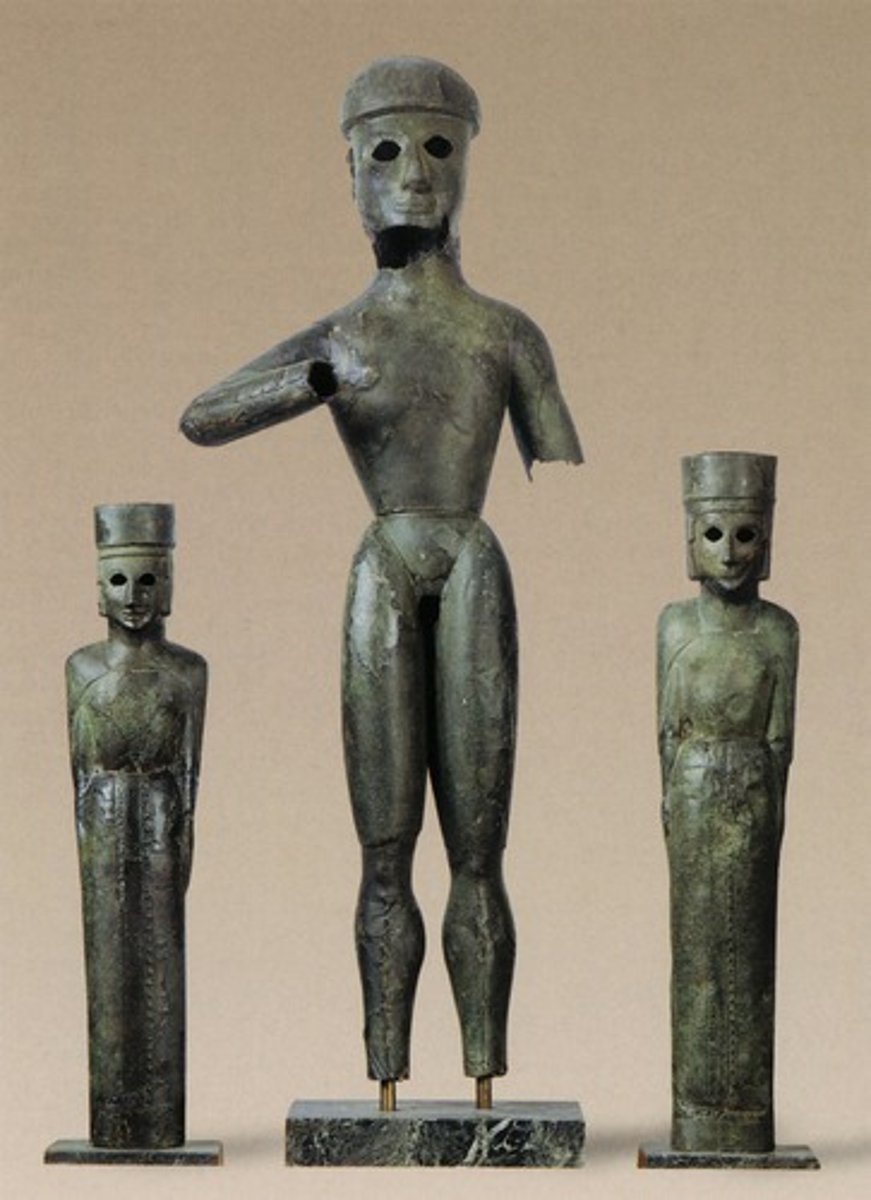
Cult Statues from Dreros, Temple of Apollo, ca. 700 BC
Who: The statues are identified as the god Apollo, the goddess Artemis, and their mother Leto1.
The Cult Statues from Dreros, Temple of Apollo, were made by ancient Greek artisans around 700 BC
What: These are a group of three bronze statuettes, with a larger male figure between two female ones1. They are the earliest known hammered statuettes, made of joined bronze sheets over a wooden core which has not been preserved1.
Where: The statues were found inside the temple of the agora of the ancient city of Dreros1. They are currently housed in the Heraklion Archaeological Museum1.
When: The statues date back to the 8th century BC1.
Why it's interesting and important: These statues are especially important from a technical point of view, as they are the earliest in Greece made by hammering2. They all had a wooden core, onto which the metal plaques were nailed, and inlaid eyes of a different material2. The central figure, a man wearing a loin-cloth, is identified as Apollo the archer2. The figures are rounder and bulkier than earlier bronze statuettes of the early 8th century BC. They show the development of the human form, in Archaic art, in which anatomical details are rendered naturalistically1.
The statues are early examples of hammered statuettes, made of bronze sheets over a wooden core1. This technique was a significant development in Greek art and sculpture1.
Statuette dedicated by Mantiklos, ca. 700 BC.
Who: The statuette was dedicated by Mantiklos to Apollo12.
What: It's a bronze statuette of a youth, known as the Mantiklos Apollo12. The statuette is missing its right arm and lower half of its legs3.
Where: The statuette was discovered in Thebes, Greece1. It is currently housed in the Museum of Fine Arts in Boston12.
When: The statuette dates back to around 700-680 BC12.
Why it's interesting and important: The Mantiklos Apollo is one of the earliest known Greek bronze sculptures1. An incised inscription in Greek, arranged in poetic meter and running up and down the figure's thighs, reads: "Mantiklos dedicated me as a tithe to the Far Shooter, the bearer of the Silver Bow. You, Phoibos [Shining One], give something pleasing in return."2 This inscription provides valuable insights into the religious practices and beliefs of ancient Greece2.
Was a tithe
![<p>Who: The statuette was dedicated by Mantiklos to Apollo12.</p><p>What: It's a bronze statuette of a youth, known as the Mantiklos Apollo12. The statuette is missing its right arm and lower half of its legs3.</p><p>Where: The statuette was discovered in Thebes, Greece1. It is currently housed in the Museum of Fine Arts in Boston12.</p><p>When: The statuette dates back to around 700-680 BC12.</p><p>Why it's interesting and important: The Mantiklos Apollo is one of the earliest known Greek bronze sculptures1. An incised inscription in Greek, arranged in poetic meter and running up and down the figure's thighs, reads: "Mantiklos dedicated me as a tithe to the Far Shooter, the bearer of the Silver Bow. You, Phoibos [Shining One], give something pleasing in return."2 This inscription provides valuable insights into the religious practices and beliefs of ancient Greece2.</p><p>Was a tithe</p>](https://knowt-user-attachments.s3.amazonaws.com/f5ef3ba0-1f6b-40b1-b468-babad375e9d6.jpg)
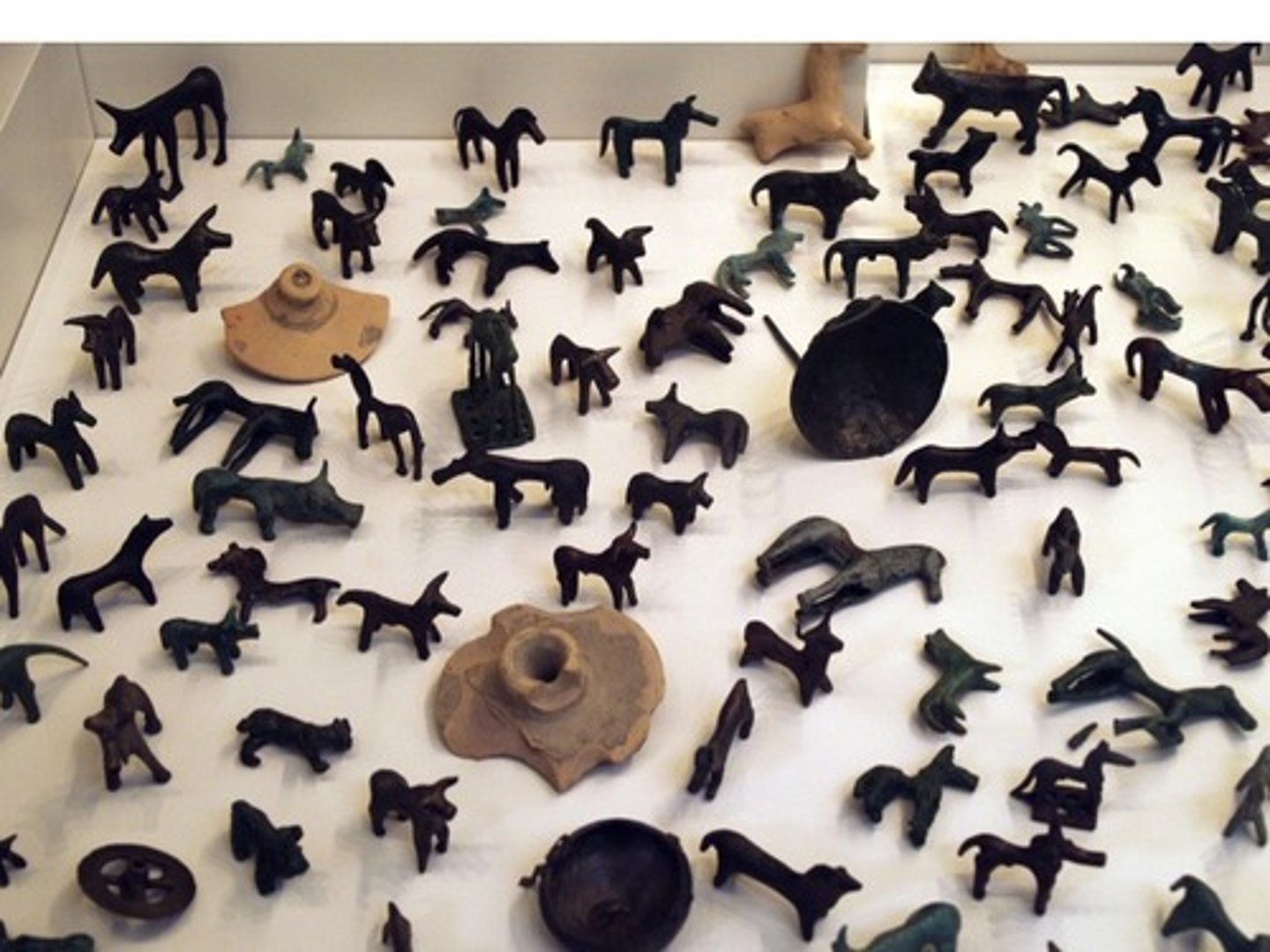
Animal Figurines from Olympia
Who: The animal figurines were created by ancient Greek artisans, possibly by local workshops in Argos, Korinth, Lakonia and on Crete, or by itinerant bronzesmiths coming from different regions of the Peloponnese and working temporarily in the neighborhood of the sanctuary1.
What: These are bronze animal statuettes2. They were votive gifts, dedicated to the gods as a form of worship3.
Where: The figurines were discovered in Olympia, Greece3. They are currently on display in the Archaeological Museum of Olympia32.
When: The figurines date back to the 8th - 7th century BC2.
Why it's interesting and important: These figurines provide valuable insights into the religious practices and beliefs of ancient Greece. They often depict warriors, charioteers and, of course, athletes such as the mid-6th century BC statuette of a discus thrower or the early-5th century statuette of a runner3. More than 14,000 bronze artifacts were preserved buried in the soil of Olympia, by far the largest number ever found in a region of the ancient Hellenic world3.
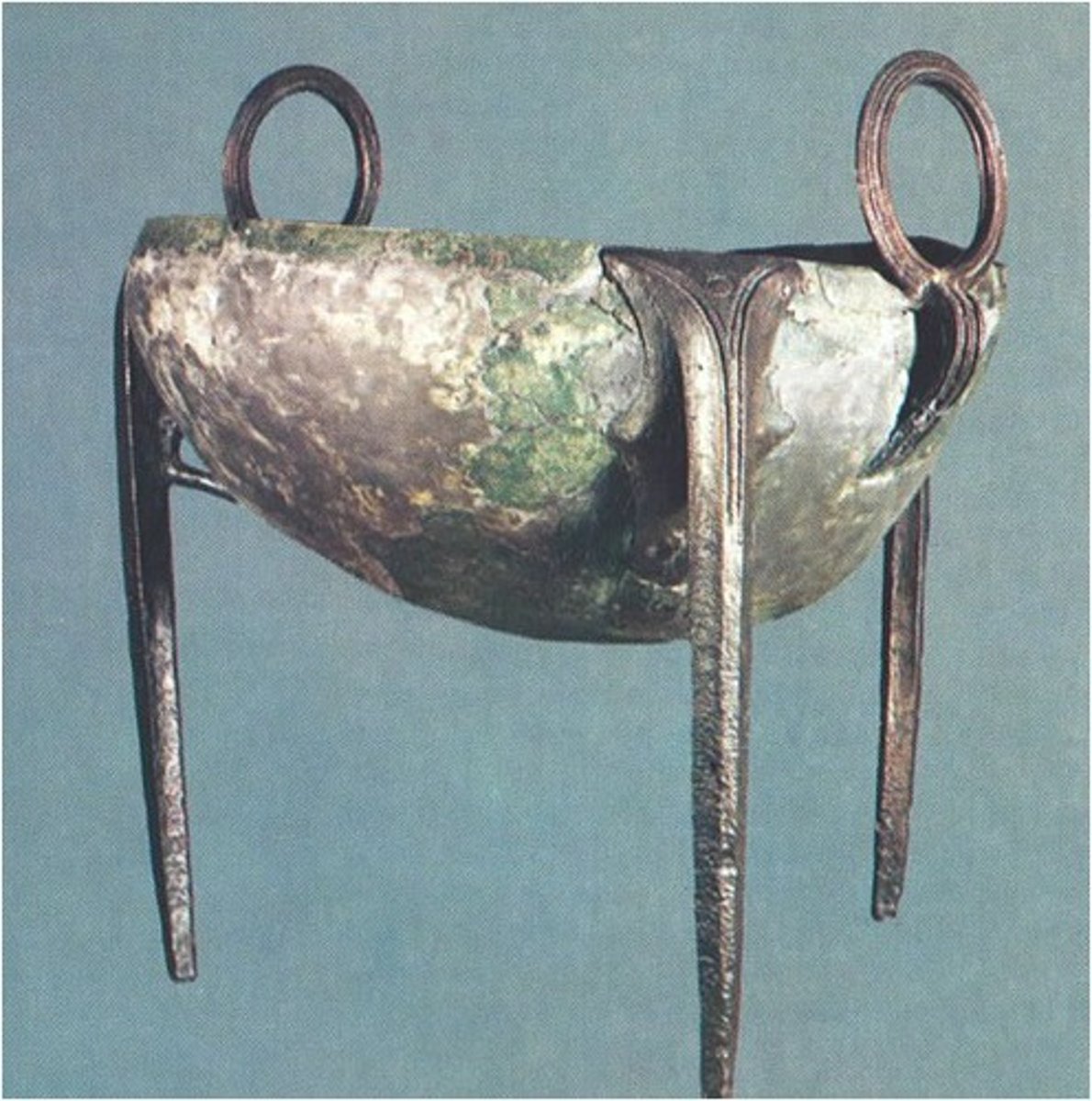
Tripod Cauldron from Olympia
Who: The Tripod Cauldron was created by ancient Greek artisans1.
What: It's a large bronze tripod cauldron21. Tripod cauldrons were often used in ancient Greece for cooking or as votive offerings3.
Where: The cauldron was discovered in Olympia, Greece21. It is currently housed in the Archaeological Museum of Olympia21.
When: The cauldron dates back to around 800 BC1.
Why it's interesting and important: The Tripod Cauldron is significant because it's one of the oldest preserved in Olympia1. These types of cauldrons were often used in religious ceremonies and were considered symbols of wealth and power3. They provide valuable insights into the religious practices, societal structures, and living conditions of ancient Greece3.
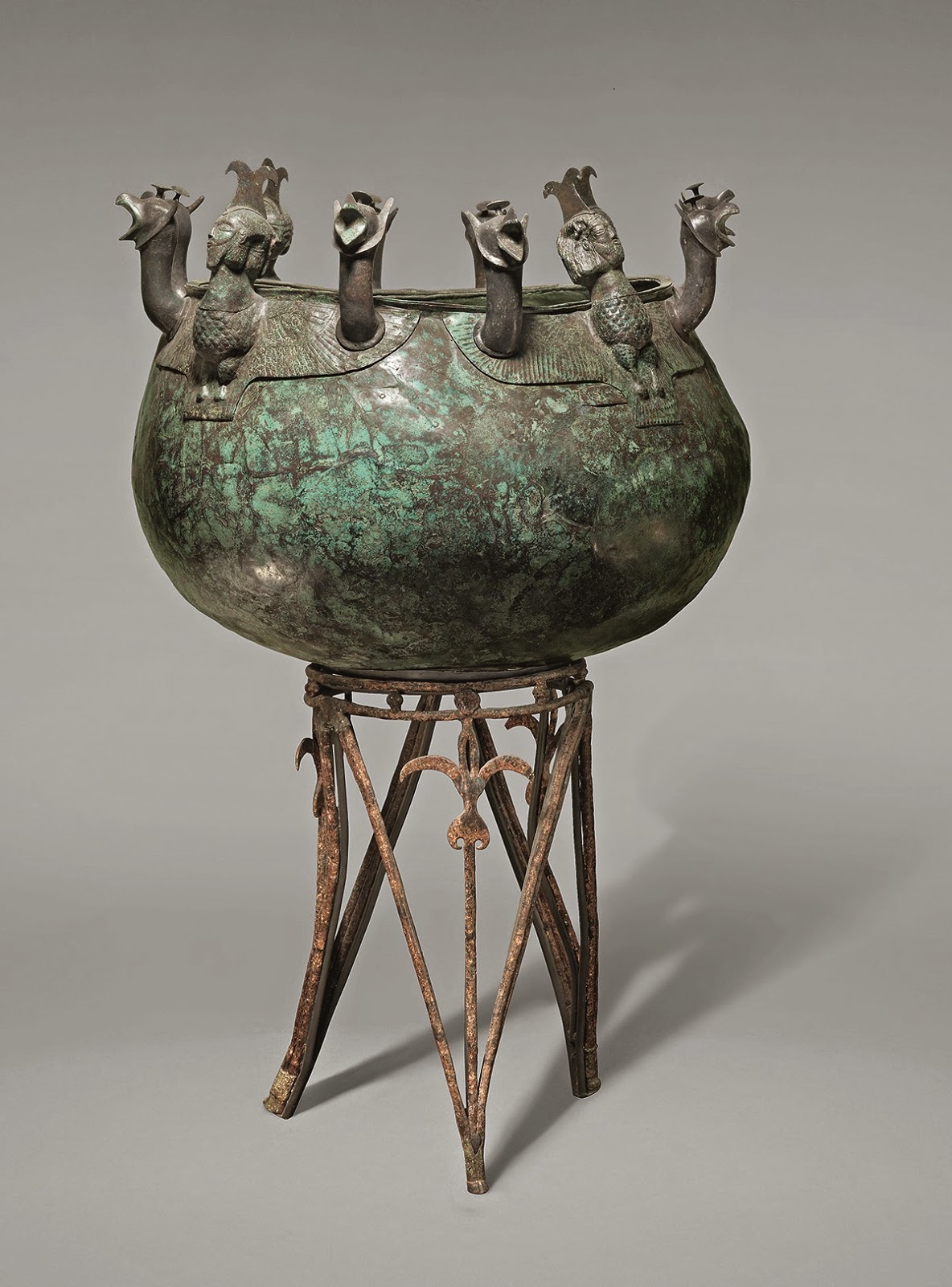
Cauldron from a olympia and samos, late 8th c BC
samos Blown off course to Platea, a Samian ship led by Colaeus aided the stranded Corobius, then was driven by winds through the Pillars of Heracles to Tartessus, where they made immense profits. They dedicated a bronze cauldron to Hera with part of their earnings, marking the start of friendship between the Samians, Cyrenaeans, and Theraeans. Olympia —> sanctuary of zeus
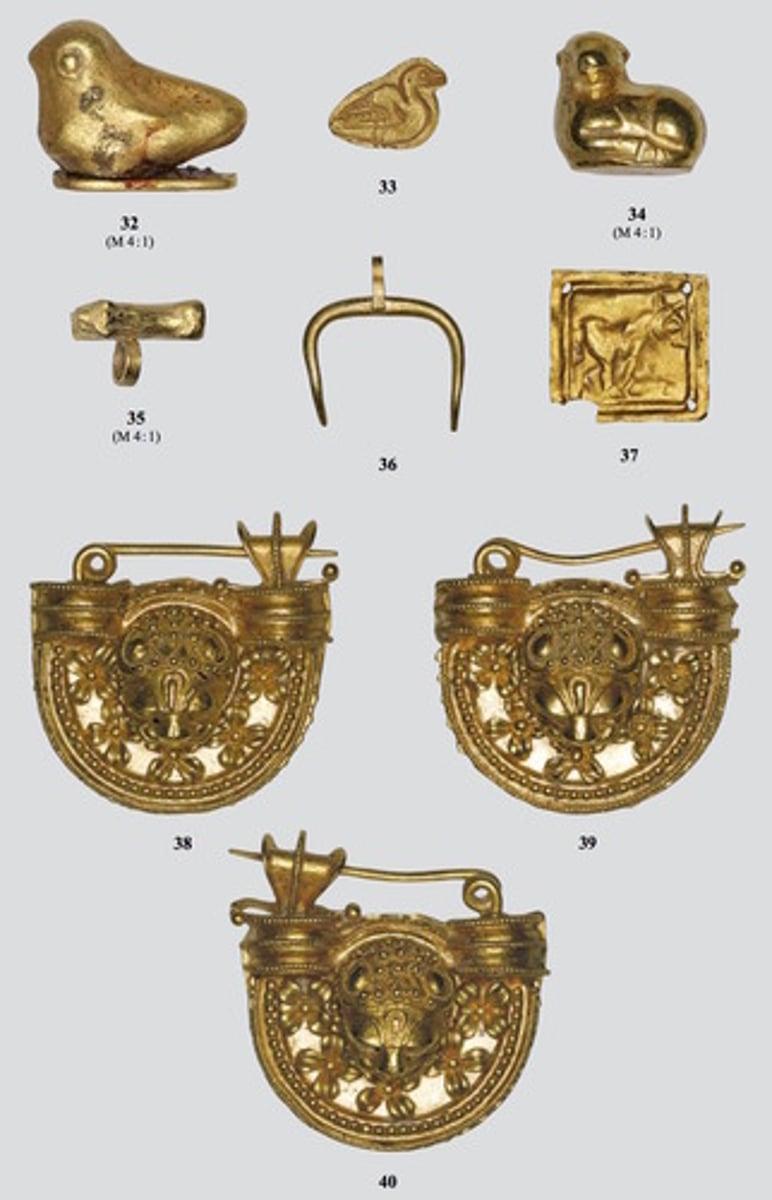
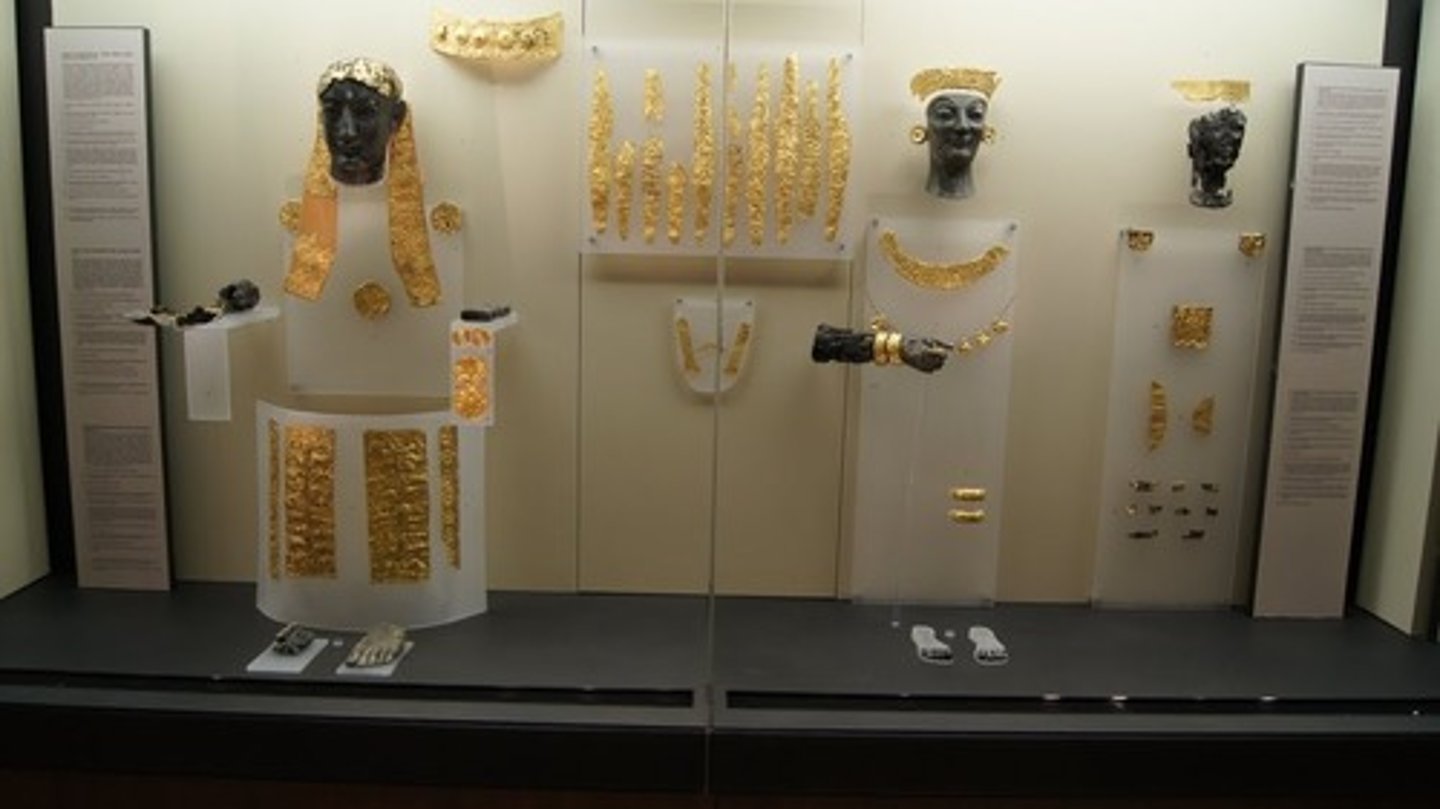
Jewelry from the Temple of Artemis at Ephesus
Who: The jewelry was dedicated to Artemis, the goddess associated with the temple1.
What: The jewelry includes various items, many of which may be made of silver-gold alloy, electrum2. These were often used as offerings to Artemis1.
Where: The Temple of Artemis is located in Ephesus (near the modern town of Selçuk in present-day Turkey)1. The jewelry is likely housed in various museums around the world.
When: The temple and its treasures date back to ancient times, with the earliest version of the temple antedating the Ionic immigration by many years1.
Why it's interesting and important: The jewelry from the Temple of Artemis provides valuable insights into the religious practices and beliefs of ancient Greece. They often depict warriors, charioteers and, of course, athletes such as the mid-6th century BC statuette of a discus thrower or the early-5th century statuette of a runner1.
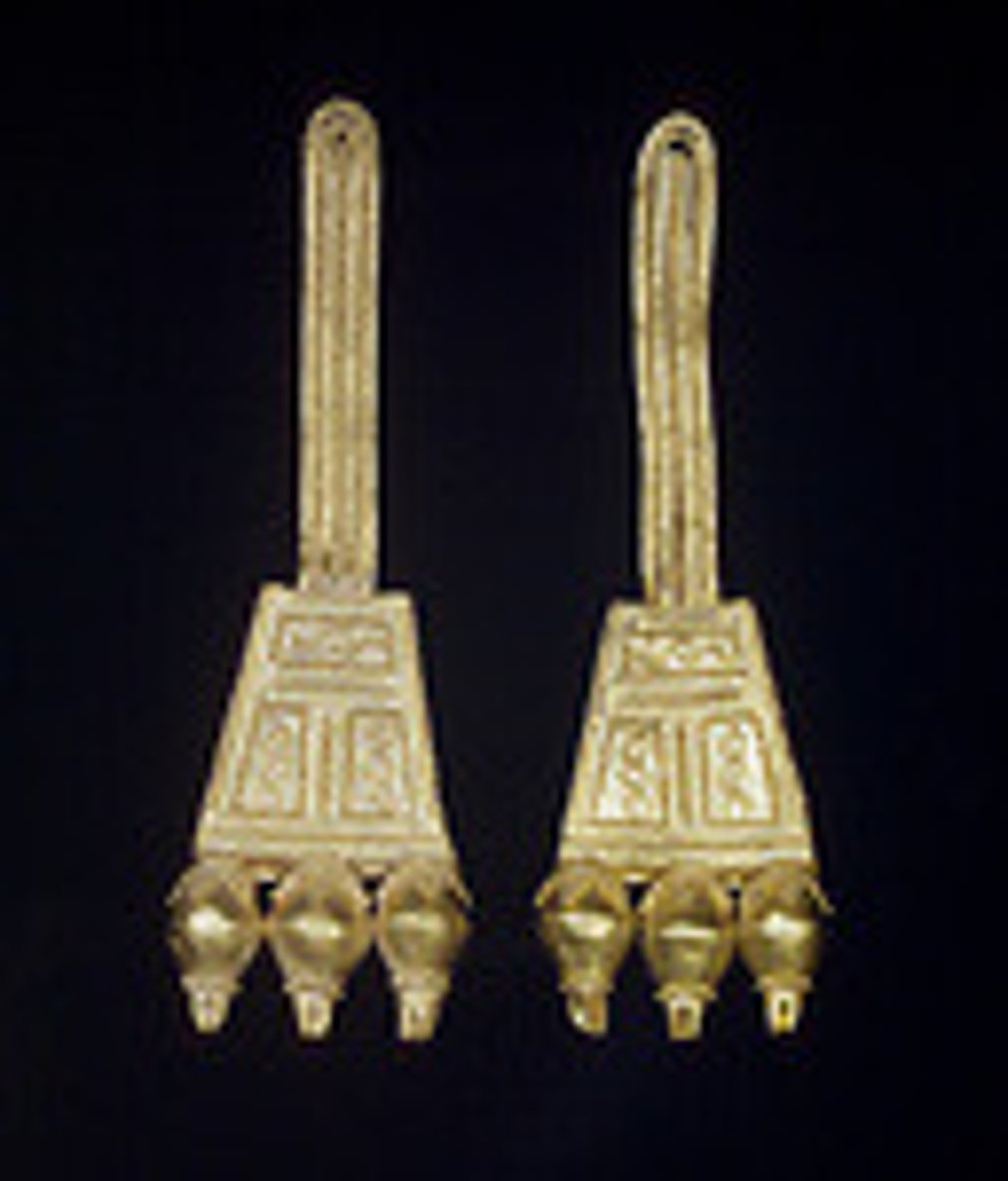
Jewelry from the Temple of Artemis at Kameiros, Rhodes:
Who: The jewelry was created by ancient Greek artisans3.
What: The specific types of jewelry found in Kameiros are not mentioned in the sources. However, ancient Greek jewelry often included necklaces, bracelets, earrings, and rings made from gold, silver, and gemstones.
Where: Kameiros is located on Rhodes, an island in Greece3. The jewelry is likely housed in various museums around the world.
When: Items found in Kameiros date back as far as the 8th century BC3.
Why it's interesting and important: Jewelry from Kameiros provides valuable insights into the craftsmanship and artistic styles of ancient Greece. They also reflect societal structures and living conditions of that time3.
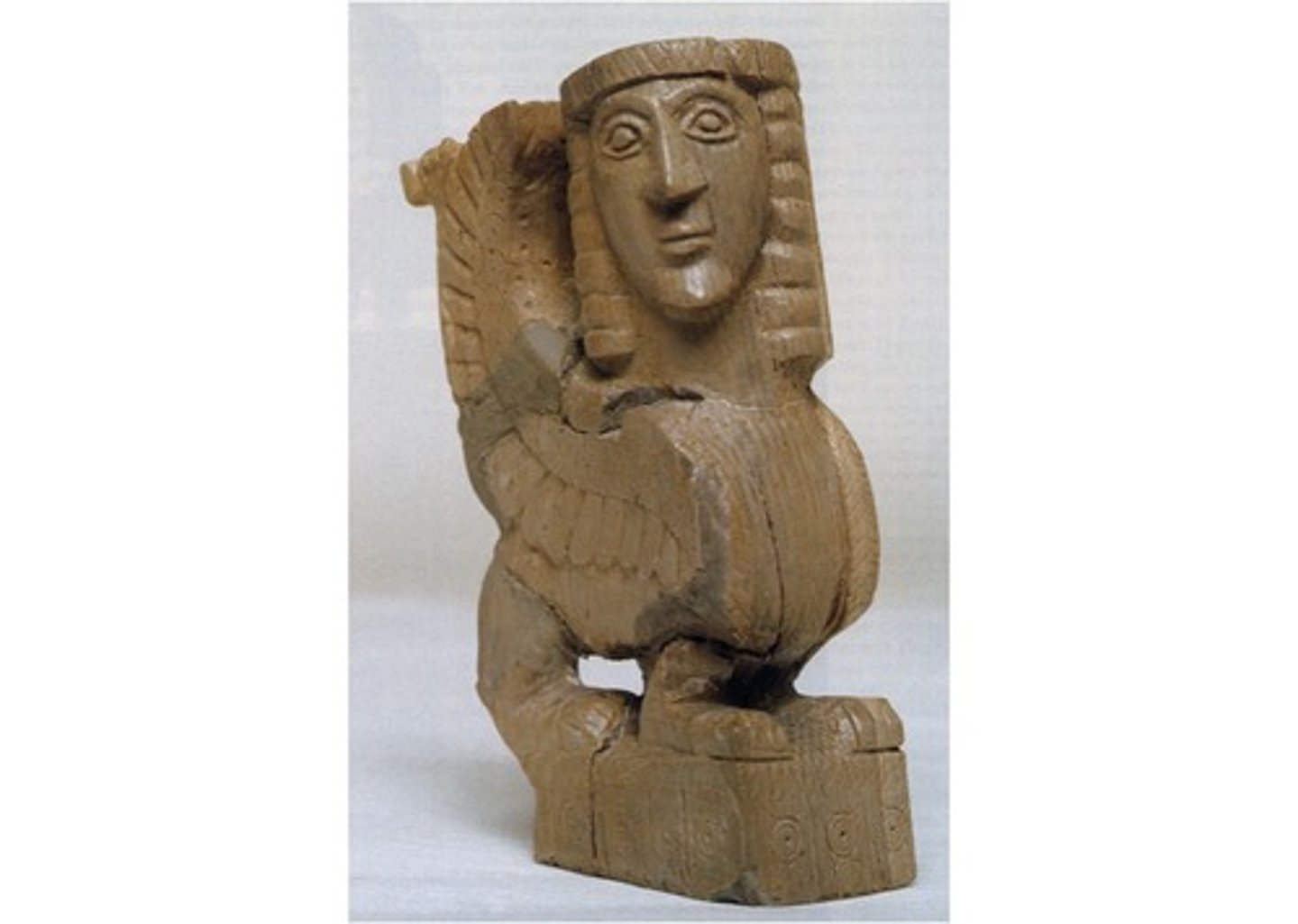
Ivory sphinx from Perachora
Who: The Ivory Sphinx was created by ancient Greek artisans12.
What: It's a delicately carved ivory sphinx1. Sphinxes are mythical creatures with the body of a lion and the head of a human1.
Where: The sphinx was discovered in Perachora, in the territory of Corinth1. It is currently housed in various museums around the world.
When: The sphinx dates back to around 650 BC1.
Why it's interesting and important: The Ivory Sphinx from Perachora is significant because it provides valuable insights into the craftsmanship and artistic styles of ancient Greece. It displays curving wings, a triangular face with large eyes and a prominent nose, and a wig with horizontal banding1. This sphinx likely came to the region by way of the trade routes of Syria and Mesopotamia1.
Material: The use of ivory indicates the availability and trade of luxury materials in ancient Greece. Ivory, being a delicate and expensive material, also suggests that the artisans had advanced skills to work with such a medium.
Technique: The intricate details of the sphinx, such as the curving wings, triangular face, large eyes, prominent nose, and wig with horizontal banding, demonstrate the high level of craftsmanship and attention to detail of the Greek artisans.
Symbolism: The sphinx is a mythical creature with the body of a lion and the head of a human. Its presence in Greek art reflects the cultural and religious beliefs of the time.
Style: The style of the sphinx, with its stylized features and decorative elements, is characteristic of the Orientalizing Period in Greek art (700-600 BC). This period was marked by increased influence from the cultures of the Near East and Egypt.
Trade: The presence of such an artifact in Perachora suggests that there were active trade routes between Greece and other regions like Syria and Mesopotamia.
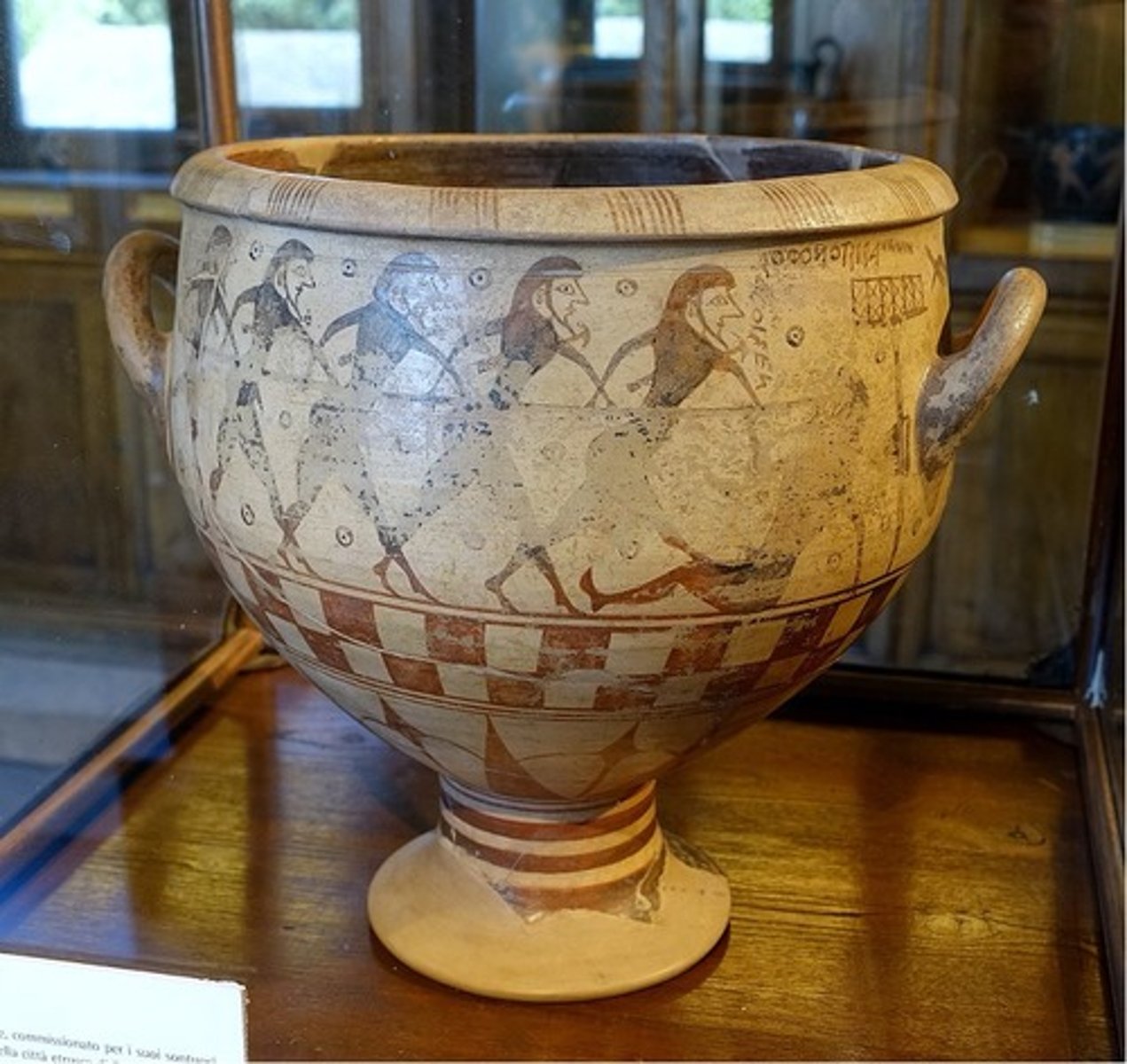
Krater (The Aristonothos Krater), from Cerveteri, signed by Aristonothos
Who: The krater was created by an artist named Aristonothos12.
What: The Aristonothos Krater is a large ceramic vessel used for mixing wine and water2. It is decorated with scenes depicting Ulysses and his companions blinding the giant Polyphemus3.
Where: The krater was discovered in Cerveteri, Italy2. It is currently housed in the Musei Capitolini in Rome, Italy41.
When: The krater dates back to around 650 BC2.
Why it's interesting and important: The Aristonothos Krater is significant for several reasons:
It's one of the few ancient Greek vases that bear the signature of its creator, Aristonothos1.
The scenes depicted on the krater provide valuable insights into the myths and legends of ancient Greece3.
Odysseus blinding Polyphemos; battle between merchant ship and warship, ca. 650 BC, from Cerveteri (an Etruscan site, not Greek)
The krater showcases the advanced pottery techniques and narrative styles of ancient Greek artisans2.
Its discovery in Italy highlights the cultural exchanges between different regions in the ancient Mediterranean5.
Relief from Gortyn on Crete
Who: The relief was created by ancient Greek artisans1.
What: It's a carved stone relief1. Reliefs are a type of sculpture where the figures and elements remain attached to a solid background1.
Where: The relief was discovered in Gortyn, an ancient Greek city located in the southern plain of Crete1. It is likely housed in various museums around the world.
When: The specific date of the relief is not mentioned in the sources. However, Gortyn was inhabited as far back as the Neolithic era (7000 BC), and it was particularly prosperous during the Hellenistic era1. 650-625 BC.
Why it's interesting and important: The relief from Gortyn provides valuable insights into the craftsmanship and artistic styles of ancient Greece. It also reflects the societal structures and living conditions of that time1. The city of Gortyn itself is significant as it was the Roman capital of Creta et Cyrenaica and was one of the most powerful and prosperous cities of Crete1.
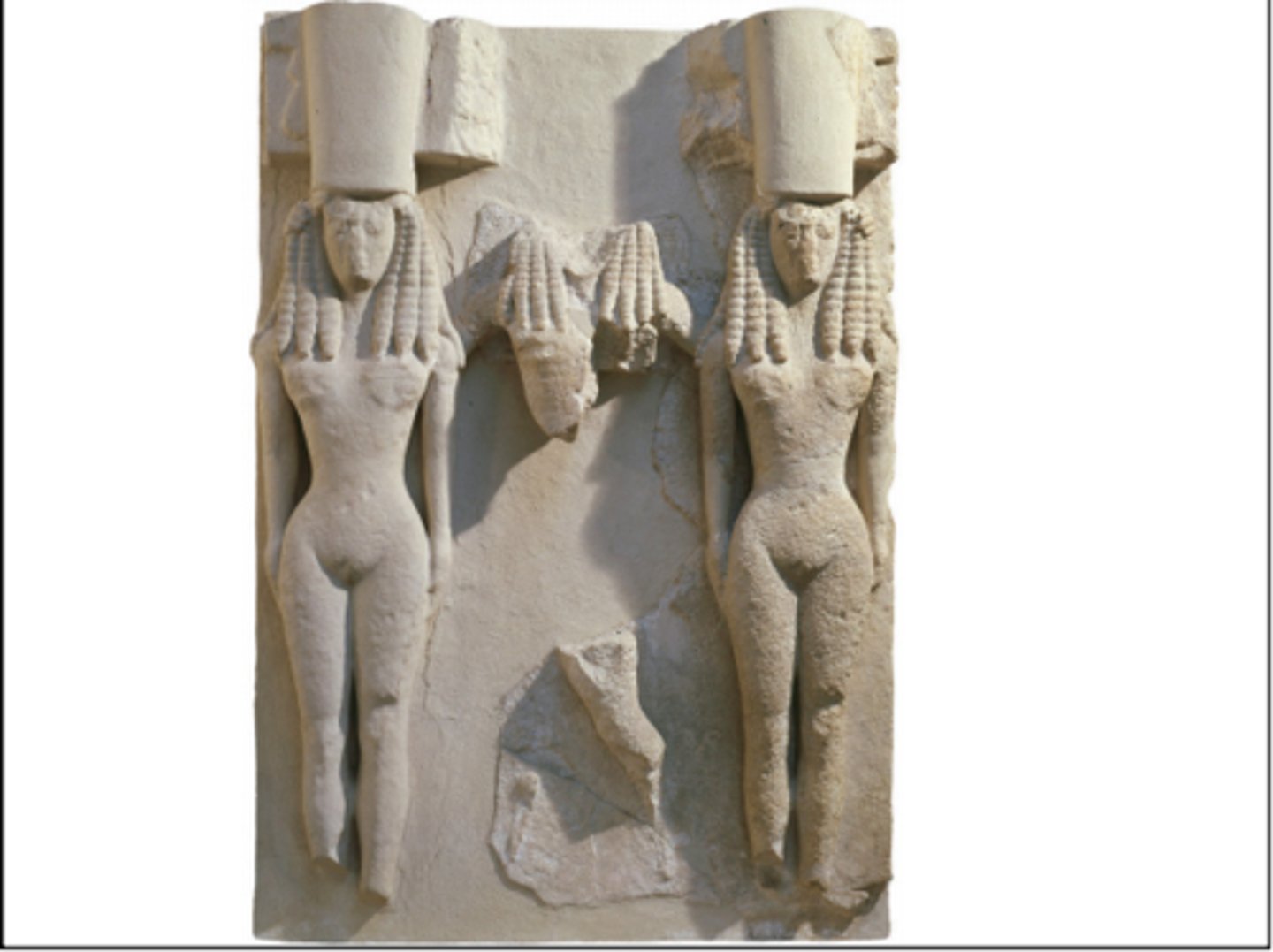
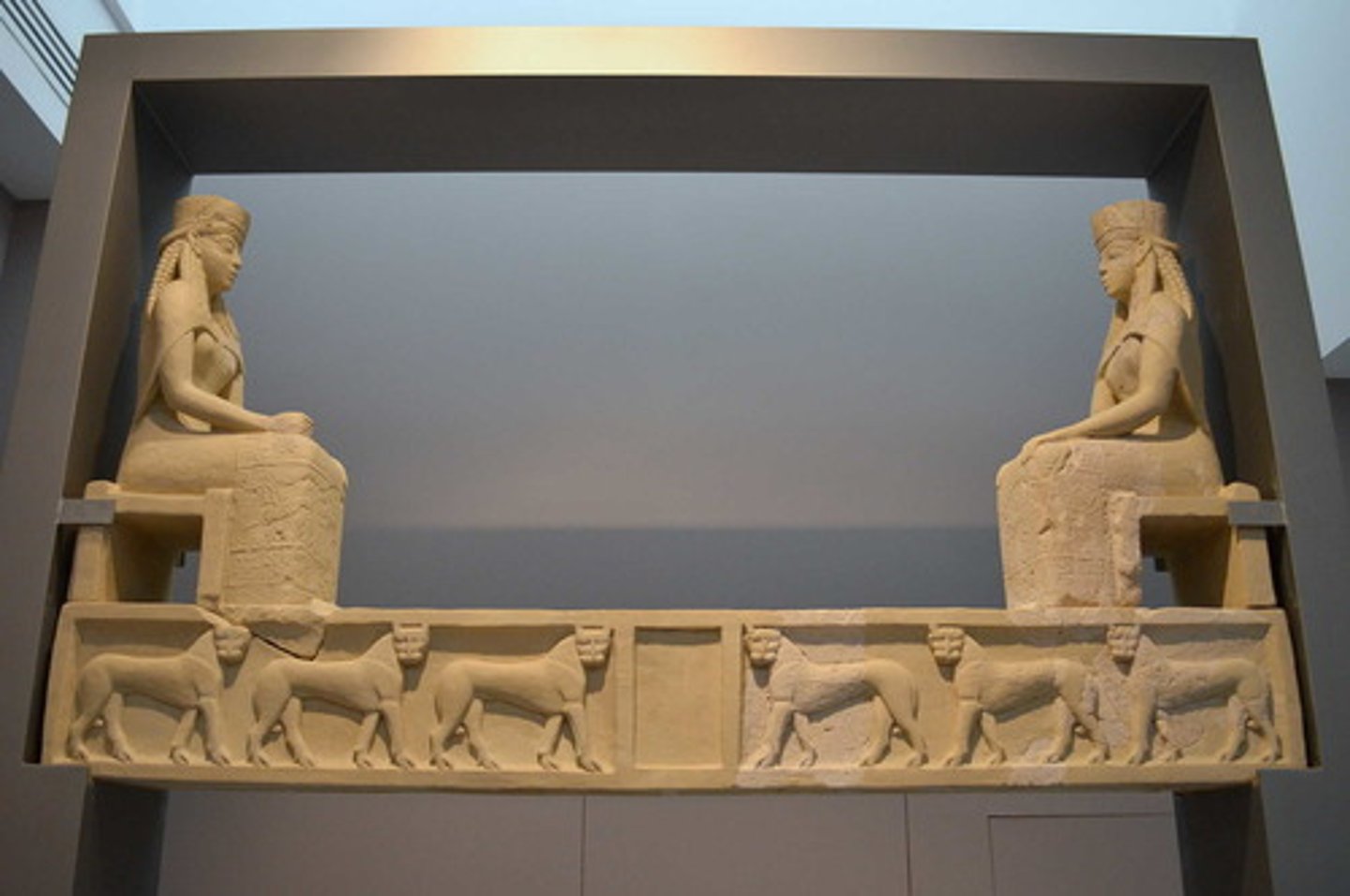
Temple and sculpture from Prinias, Crete, ca. 650-625 BC
Who: The temple and sculpture were created by ancient Greek artisans12.
What: The temple, known as Temple A, is the earliest known Greek temple decorated with sculpture12. The most remarkable surviving detail is a limestone lintel bearing two monumental statues of goddesses, seated facing each other12.
Where: The temple and sculpture were discovered in Prinias, an ancient city located in Crete12. They are currently housed in the Heraklion Archaeological Museum1.
When: The temple and sculpture date back to around 650-625 BC12.
Why it's interesting and important: The temple and sculpture from Prinias are significant for several reasons:
They provide valuable insights into the art and architecture of this era in Crete1.
The sculptures from the temple are the earliest known example of the seated deity type1.
The divine nature of the figures is indicated by their expression of calm detachment1.
Under the goddesses, the epistyle of the doorway is decorated with six panthers in relief1.
Despite their partial state of preservation, which allows different proposed reconstructions, the sculptures of the temple of Prinias are a unique source of information on the art and architecture of this era in Crete1.
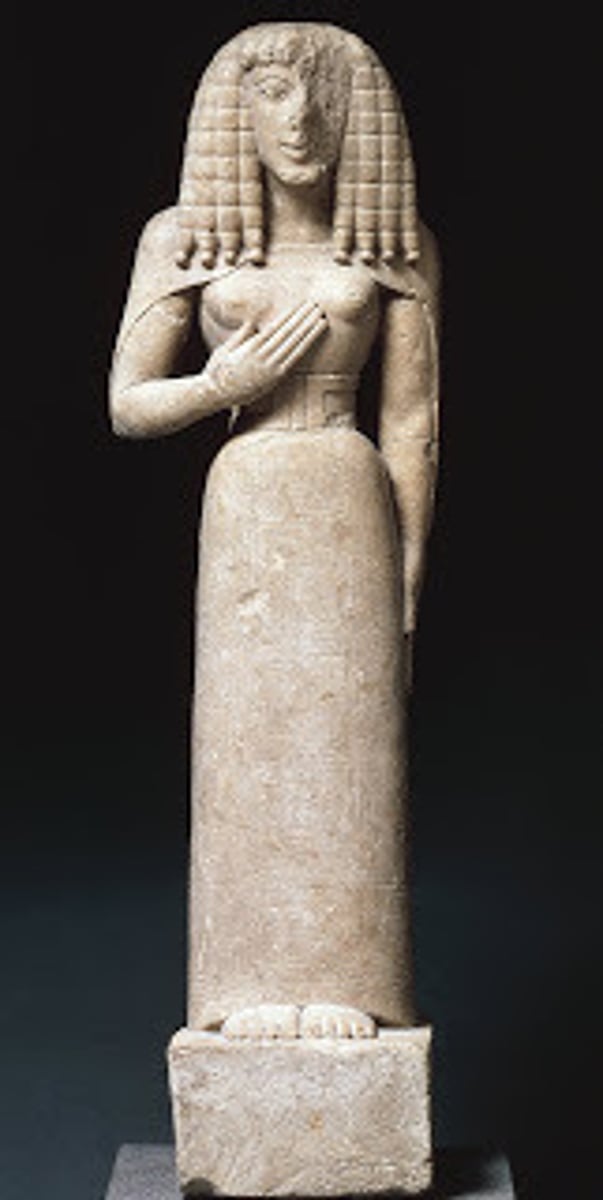
Auxerre Kore
Who: The Auxerre Kore was created by an unknown ancient Greek artist1.
What: The Auxerre Kore is a small (75 cm high) limestone Cretan sculpture1. It is a Kore ("maiden"), perhaps a votary rather than the maiden Goddess Persephone herself1.
Where: Probably from crete The Kore was found in a vault in the Museum of Auxerre in France1. It is currently housed in the Louvre Museum in Paris1.
When: The Kore dates back to around 650 - 625 BCE1.
Why it's interesting and important: The Auxerre Kore is significant for several reasons:
It is one of the earliest known Greek sculptures1.
The Kore still has the narrow waist of a Minoan-Mycenaean goddess, and her stiff hair suggests Egyptian influence1.
The early Archaic style of the Kore has been fancifully termed "Daedalic"1.
Its mysterious arrival at a provincial French museum gave it a journalistic allure1.
Excavations in the 1990s by Nikolaos Stampolidis at Eleutherna in Crete have helped establish more precisely a date and place of origin for the Dame d'Auxerre, in the region of Eleutherna and Gortyn, with the recovery from gravesites of very similar carved ivory faces and phallic symbols1.
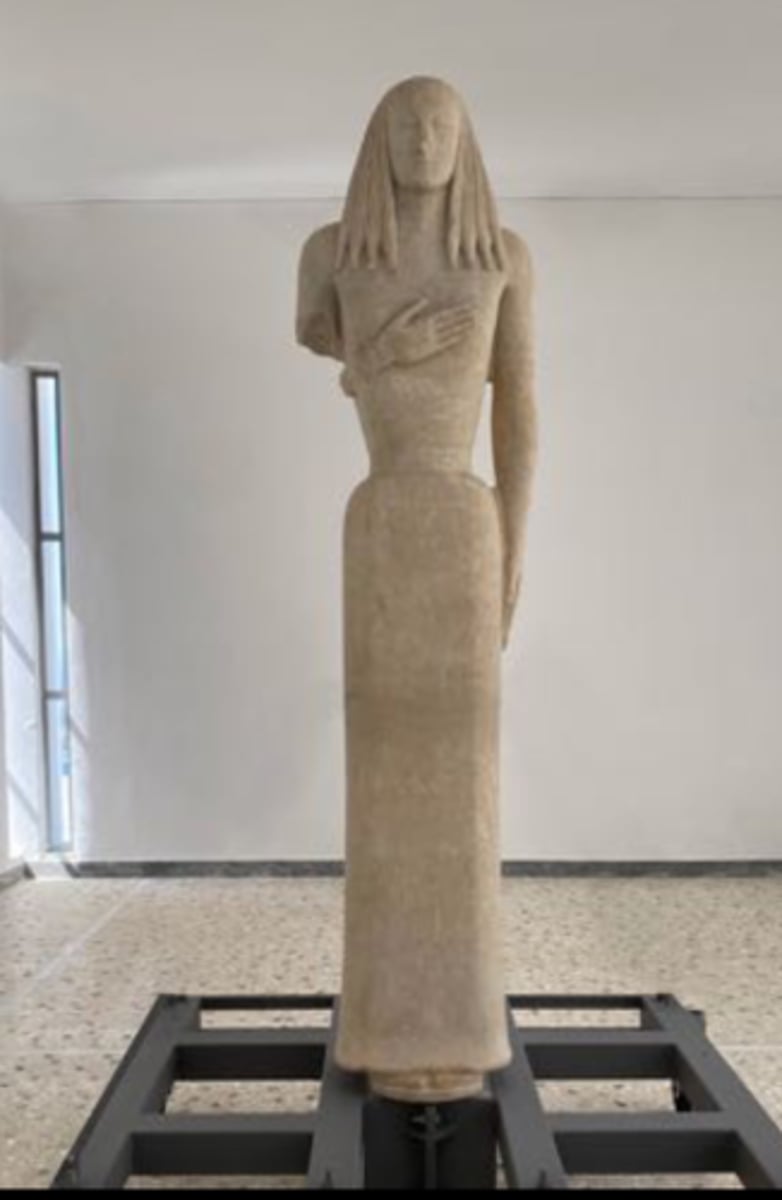
Kore of Nikandre of Naxos
Kore dedicated by Nikandre, from Delos. Inscription: "Nikandre daughter of Deinodikos the Naxian, outstanding amongst women, sister of Deinomenes and now wife of Phraxos, dedicated me to the far-shooting Archeress [=Artemis]"
Who: The Kore was dedicated by Nikandre, a woman from the island of Naxos12.
What: The Kore of Nikandre is a Greek marble sculpture, made approximately around 650 BCE2. It is one of the earliest surviving korai, or statues of women2.
Where: Nikandre, a woman from the island of Naxos, dedicated the statue in the temple of Artemis at Delos, the birthplace of Apollo and Artemis2. The statue is held in the National Archaeological Museum, Athens, Greece2.
When: The Kore dates back to around 650 BCE2.
Why it's interesting and important: The Kore of Nikandre is significant for several reasons:
It displays one of the oldest inscriptions of Ancient Greek in stone2.
Its representation and its placement within the existing stylistic periods of Greek sculpture have become the subject of extensive scholarship2.
Though the inscription may imply that the statue was made on the island of Naxos, where Nikandre's family resided (an implication corroborated by the type of stone used to make the statue), it is unclear who the sculptor was or where he lived2.
From this inscription, we know the name and gender of the dedicant, Nikandre, as well as some vague hint of her intention (to please the goddess). In addition to defining herself by her relationship to her father (Deinodikos), husband (Phraxos), and brother (Deinomenes), she refers to herself as "distinguished among women", claiming some amount of glory and emphasizing her reputation in her community2.
![<p>Kore dedicated by Nikandre, from Delos. Inscription: "Nikandre daughter of Deinodikos the Naxian, outstanding amongst women, sister of Deinomenes and now wife of Phraxos, dedicated me to the far-shooting Archeress [=Artemis]"</p><p>Who: The Kore was dedicated by Nikandre, a woman from the island of Naxos12.</p><p>What: The Kore of Nikandre is a Greek marble sculpture, made approximately around 650 BCE2. It is one of the earliest surviving korai, or statues of women2.</p><p>Where: Nikandre, a woman from the island of Naxos, dedicated the statue in the temple of Artemis at Delos, the birthplace of Apollo and Artemis2. The statue is held in the National Archaeological Museum, Athens, Greece2.</p><p>When: The Kore dates back to around 650 BCE2.</p><p>Why it's interesting and important: The Kore of Nikandre is significant for several reasons:</p><p>It displays one of the oldest inscriptions of Ancient Greek in stone2.</p><p>Its representation and its placement within the existing stylistic periods of Greek sculpture have become the subject of extensive scholarship2.</p><p>Though the inscription may imply that the statue was made on the island of Naxos, where Nikandre's family resided (an implication corroborated by the type of stone used to make the statue), it is unclear who the sculptor was or where he lived2.</p><p>From this inscription, we know the name and gender of the dedicant, Nikandre, as well as some vague hint of her intention (to please the goddess). In addition to defining herself by her relationship to her father (Deinodikos), husband (Phraxos), and brother (Deinomenes), she refers to herself as "distinguished among women", claiming some amount of glory and emphasizing her reputation in her community2.</p>](https://knowt-user-attachments.s3.amazonaws.com/18062d65-7e89-4dfb-b51e-b65eb2b31a94.jpg)
Kore from Thera
Who: The Kore from Thera was created by ancient Greek artisans1.
What: The Kore from Thera is a statue made of white Naxos marble1. It is dressed in a long Doric veil and highlights the stylistic features of a woman's dress in the second half of the 7th century BC1.
Where: The Kore was discovered on the island of Santorini1. It is currently displayed at the renovated local museum, the Greek Culture Ministry1.
When: The Kore dates back to the second half of the 7th century BC1.
Why it's interesting and important: The Kore from Thera is significant for several reasons:
It is a rare masterpiece of Greek sculpture from the 7th century BC1.
It is one of the few surviving examples of archaic large-scale stone sculpture, which typically features standing statues of either a Kouros (male youth) or a Kore (young maiden), expressing that era's archetype of beauty1.
The almost intact female figure dressed in a long Doric peplos uniquely complements our knowledge on the development of the Kore type in the second half of the 7th century BC, as its perfect preservation highlights its stylistic characteristics and unique artistic value1.
It also reveals the economic prosperity but also the ostentation of the islands aristocracy, as well as their aesthetic preferences and their understanding of the arts1.
Selinus in Sicily
Plan of Selinus, founded ca. 650 BC from another colony, Megara Hyblaia
Selinus, also known as Selinunte, is an ancient Greek city located on the southwestern coast of Sicily in Italy12. Here's more information about it:
Who: Selinus was founded by colonists from Megara Hyblaea and from Megara in Greece1.
What: Selinus is famous for its ruined Doric temples1. It was one of the most important of the Greek colonies in Sicily1.
Where: The city is situated on the southwestern coast of Sicily, between the valleys of the Cottone and Modione rivers1. It now lies in the comune of Castelvetrano, between the frazioni of Triscina di Selinunte in the west and Marinella di Selinunte in the east1.
When: Selinus was founded in 651 or 628 BCE1. It was destroyed and abandoned in 250 BC and never reoccupied1.
Why it's interesting and important: Selinus is significant because it provides valuable insights into the history, culture, and architecture of ancient Greece. The city got its name from the wild celery that grew on the spot2. The archaeological site contains many great temples, with five centered on an acropolis1. At its peak before 409 BC, the city may have had 30,000 inhabitants, excluding slaves
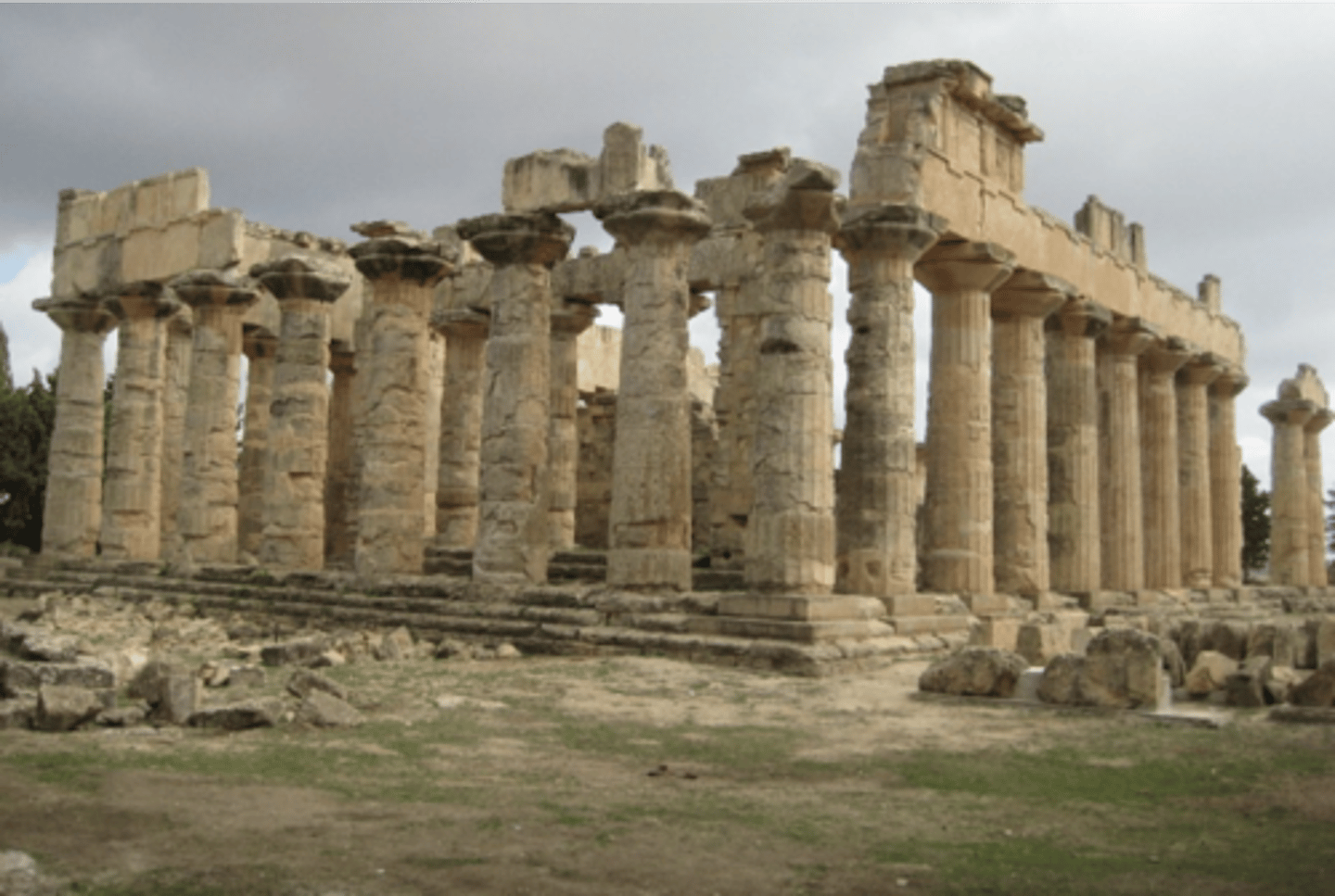
Foundation of Cyrene
Coin of Cyrene showing silphium - Temple of Zeus at Cyrene, Libya
Who: Cyrene was founded by a group of Greek colonists from the island of Thera, under the leadership of Battus I12.
What: Cyrene was an ancient Greek colony in Libya12. It was one of the most important of the Greek colonies in Sicily2.
Where: Cyrene is located in modern-day Shahhat, Libya12.
When: Cyrene was founded around 631 BC12.
Why it's interesting and important: The foundation of Cyrene is significant for several reasons:
It was a vital cultural center and port of trade in North Africa3.
It is best known as the birthplace of the philosopher Aristippus of Cyrene, the poet/scholar Callimachus, and the polymath Eratosthenes3.
The city is also referenced as an early center of Christianity3.
The Foundation Decree of Cyrene (c. 322 BCE) is a covenant between the citizens of Cyrene in North Africa in the 4th century BCE and those of their mother-state of Thera granting any who wish to become Cyrenean citizens the same rights and freedoms as those who settled the colony in 631 BCE4.
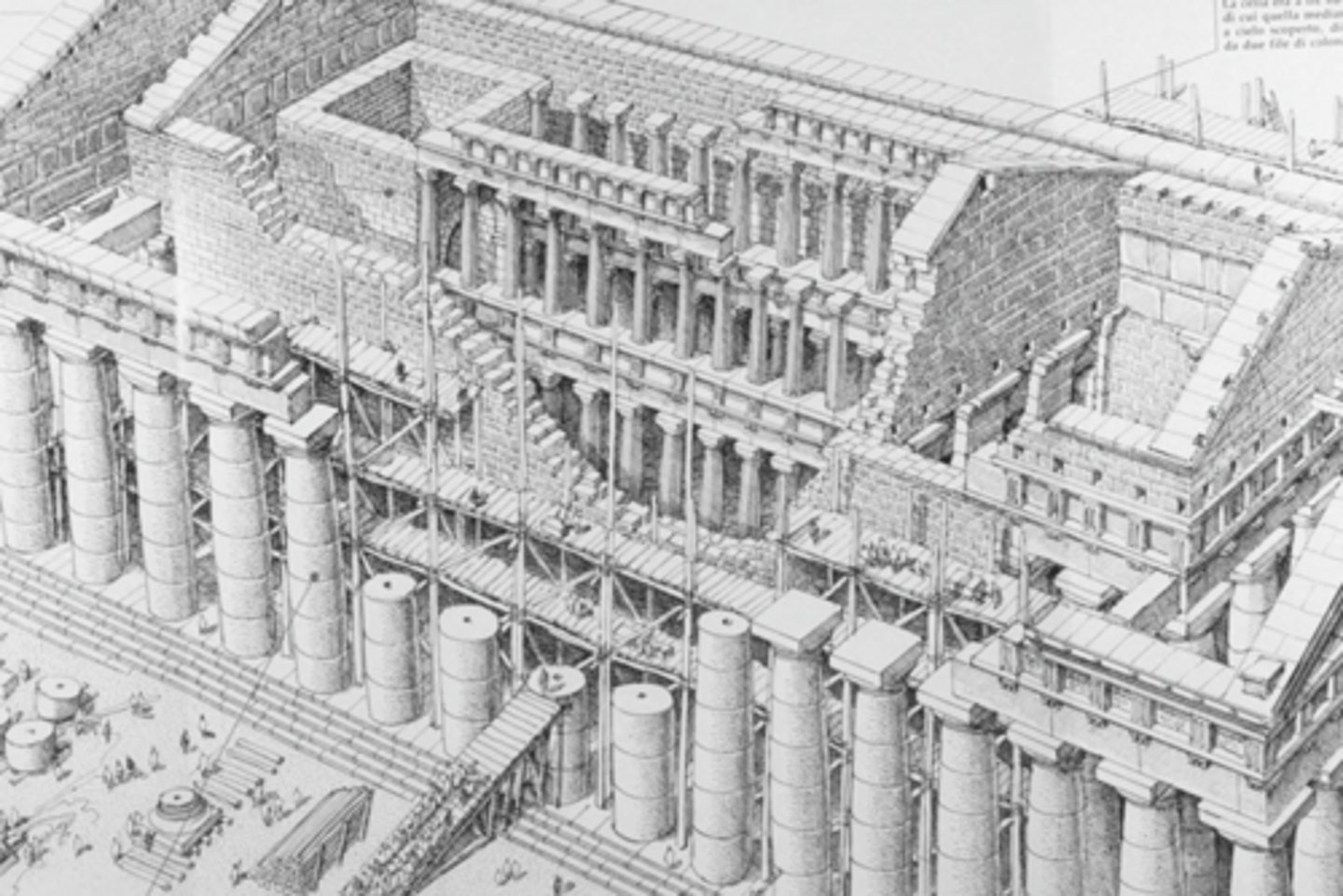
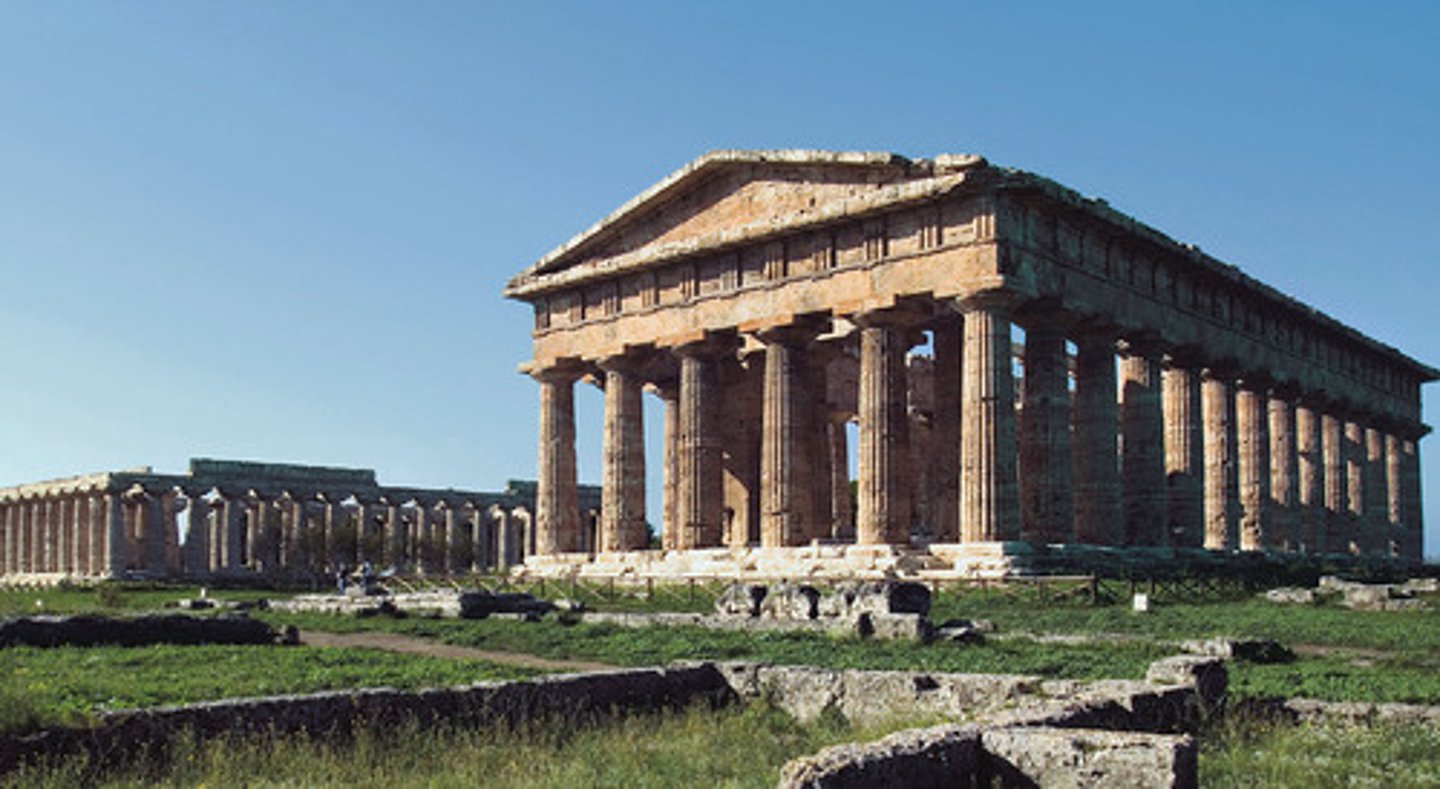
Paestum: City, Temples, Ekklesiasterion (assembly area), and Underground Shrine
Who: Paestum was founded by colonists from Sybaris and/or Troezen1.
What: Paestum is an ancient Greek city known for its three well-preserved Greek temples in the Doric order1. The city walls and amphitheatre are largely intact, and the remains of many other structures, as well as paved roads, can still be seen1. There is also a small circular council hall (bouleuterion) or assembly space (ekklesiasterion), with seats in tiers23.
Where: Paestum is located on the coast of the Tyrrhenian Sea in Magna Graecia1. It now lies in the comune of Castelvetrano, between the frazioni of Triscina di Selinunte in the west and Marinella di Selinunte in the east1.
When: Paestum was founded around 600 BC1. It was abandoned in the Early Middle Ages, and left undisturbed and largely forgotten until the eighteenth century1.
Why it's interesting and important: Paestum is significant because it provides valuable insights into the history, culture, and architecture of ancient Greece. The city got its name from the wild celery that grew on the spot4. The archaeological site contains many great temples, with five centered on an acropolis1. At its peak before 409 BC, the city may have had 30,000 inhabitants, excluding slaves1.
Metapontum: Ekklesiasterion, City and Chora
Who: Metapontum was founded by colonists from Sybaris and/or Troezen1.
What: Metapontum was an important city of Magna Graecia, situated on the gulf of Tarentum1. The Ekklesiasterion in Metapontum was a circular structure on flat terrain with elevated steps2. A walkway intersected through the center, where a podium was placed2.
Where: Metapontum is located in modern-day Metaponto, in the comune of Bernalda, in the Province of Matera, Basilicata region, Italy1.
When: Metapontum was founded between 700 and 690 BCE1. The Ekklesiasterion could accommodate 7,500 to 8,000 people in the beginning of the fifth century BC, after it was expanded2.
Why it's interesting and important: Metapontum is significant because it provides valuable insights into the history, culture, and architecture of ancient Greece. The city got its name from the wild celery that grew on the spot1. The archaeological site contains many great temples1. At its peak before 409 BC, the city may have had 30,000 inhabitants, excluding slaves1. The Ekklesiasterion is significant because it was a meeting place of the popular assembly (ekklesia) in a democratic Greek city-state (polis)2.
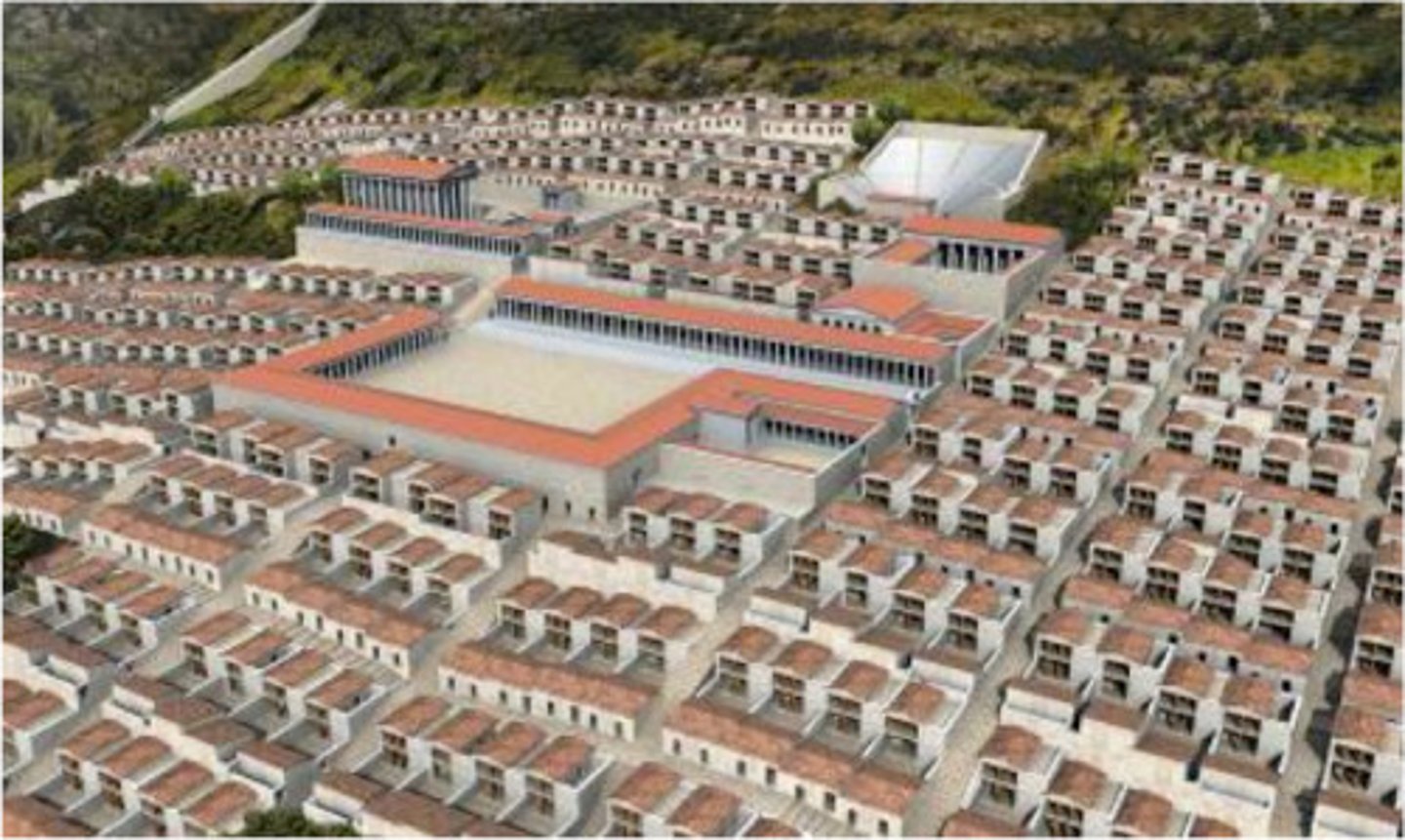
Priene: City Plan
Who: Priene was an ancient Greek city of Ionia1.
What: Priene is known for its well-preserved city plan123. The city was laid out on a grid plan, with six main streets running east-west and 15 streets crossing at right angles, all being evenly spaced2. The town was thereby divided into about 80 blocks, or insulae, each averaging 150 by 110 feet (46 by 34 m)2.
Where: Priene is located at the base of an escarpment of Mycale, about 6 kilometres (3.7 mi) north of what was then the course of the Maeander River (now called the Büyük Menderes or "Big Maeander")1.
When: The city visible on the slopes and escarpment of Mycale was constructed according to plan entirely during the 4th century BCE1.
Why it's interesting and important: The city plan of Priene is significant because it provides valuable insights into the urban planning practices of ancient Greece23. It is generally considered to be one of the first examples of city planning on a sophisticated grid, as well as a prime example of passive solar orientation3. The grid system allowed for efficient organization and use of city space, and this type of planning was later adopted by many other cities in the Hellenistic world4.
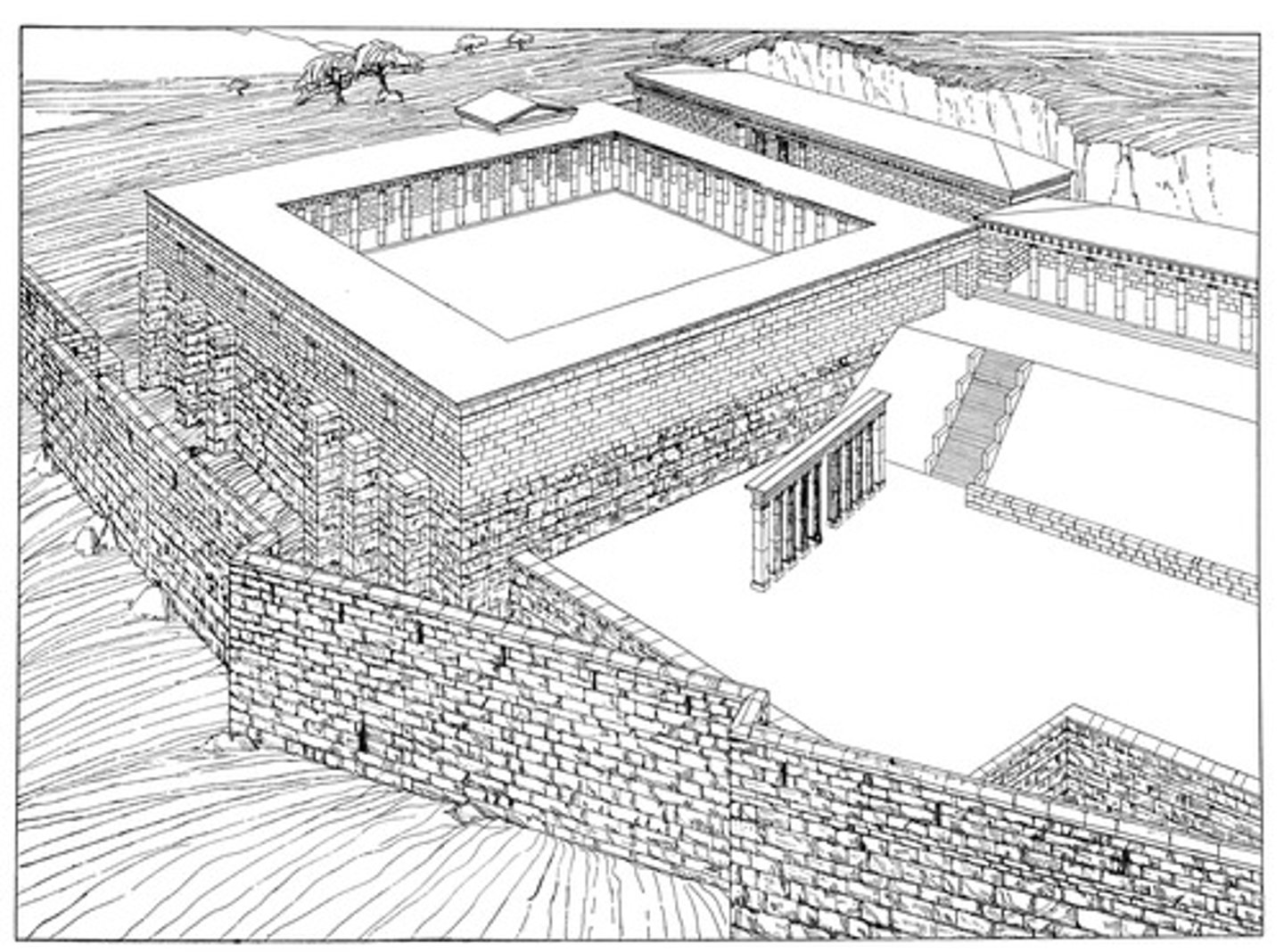
The Agora at Priene
Who: These structures were built by the inhabitants of Priene, an ancient Greek city123.
What:
The Sacred Stoa is a two-aisled stoa located in the north of the agora in the center of the city1. It was not built until the middle of the second century BC1.
The Ekklesiasterion, also known as the Bouleuterion, provided seating for 600-700 people3. It may have been a meeting hall for the Assembly of citizens, rather than a meeting hall for council members alone3.
The Prytaneion was a meeting house and dining room for senate members, adjacent to the Bouleuterion, in the center of the city2. It was built in its present state during the Roman Imperial period, but an older building existed on the site2.
Where: These structures are located in Priene, an ancient Greek city of Ionia123.
When: While there is little secure evidence for the initial construction date of these structures, they are believed to have started around 350 BC and were built over time123.
Why it's interesting and important:
The Sacred Stoa is significant because it provides a secure terminus ante quem of ca. 130 B.C. An inscription on a block presumed to be an architrave of the exterior colonnade names Orophernes (or Ariarathes?) as dedicator; if the association of the block with the building is correct, the stoa should be dated to ca. 155 B.C1.
The Ekklesiasterion is significant because it provided seating for a large number considering the population of Priene3.
The Prytaneion is significant because it was a meeting house and dining room for senate members2. A third-century A.D. dedicatory inscription is preserved on a column shaft in the courtyard2.
Gymnasium and Stadium, Priene
Who The Gymnasium and Stadium at Priene were built by the people of Priene, an ancient Greek city. The construction was funded by two brothers, Moschion and Athenopolis1.
What The site is a Gymnasium, which is a typical feature of Classical Greek urban life. It served as a central place for education and athletic training for male youth2. The Gymnasium is adjacent to a Stadium1.
Where The Gymnasium and Stadium are located in Priene, an ancient Greek city of Ionia, now in modern-day Turkey3.
When The Gymnasium dates back to around 130 BC - 100 BC1.
Why The Gymnasium and Stadium at Priene are interesting and important for several reasons:
Architectural Significance: The Gymnasium combines the characteristics of a simple, square palaestra surrounded by Doric colonnades, with characteristics reminiscent of agora architecture1. This combination of architectural styles is unique and provides valuable insights into the architectural practices of the time.
Cultural Significance: The Gymnasium served as a central place for education and athletic training for male youth2. This highlights the importance of physical education in ancient Greek society.
Historical Significance: The construction of the Gymnasium was funded by two brothers, Moschion and Athenopolis1. This indicates the role of private citizens in funding public works, shedding light on the socio-economic dynamics of the time.
Preservation: Unlike many Hellenistic gymnasia of Asia Minor, it was not converted into a bath building in the Roman Imperial period1. This has allowed for better preservation of its original structure and function.
Overall, the Gymnasium and Stadium at Priene provide a wealth of information about ancient Greek architecture, society, and history. They serve as a testament to the cultural and historical richness of ancient Greece.
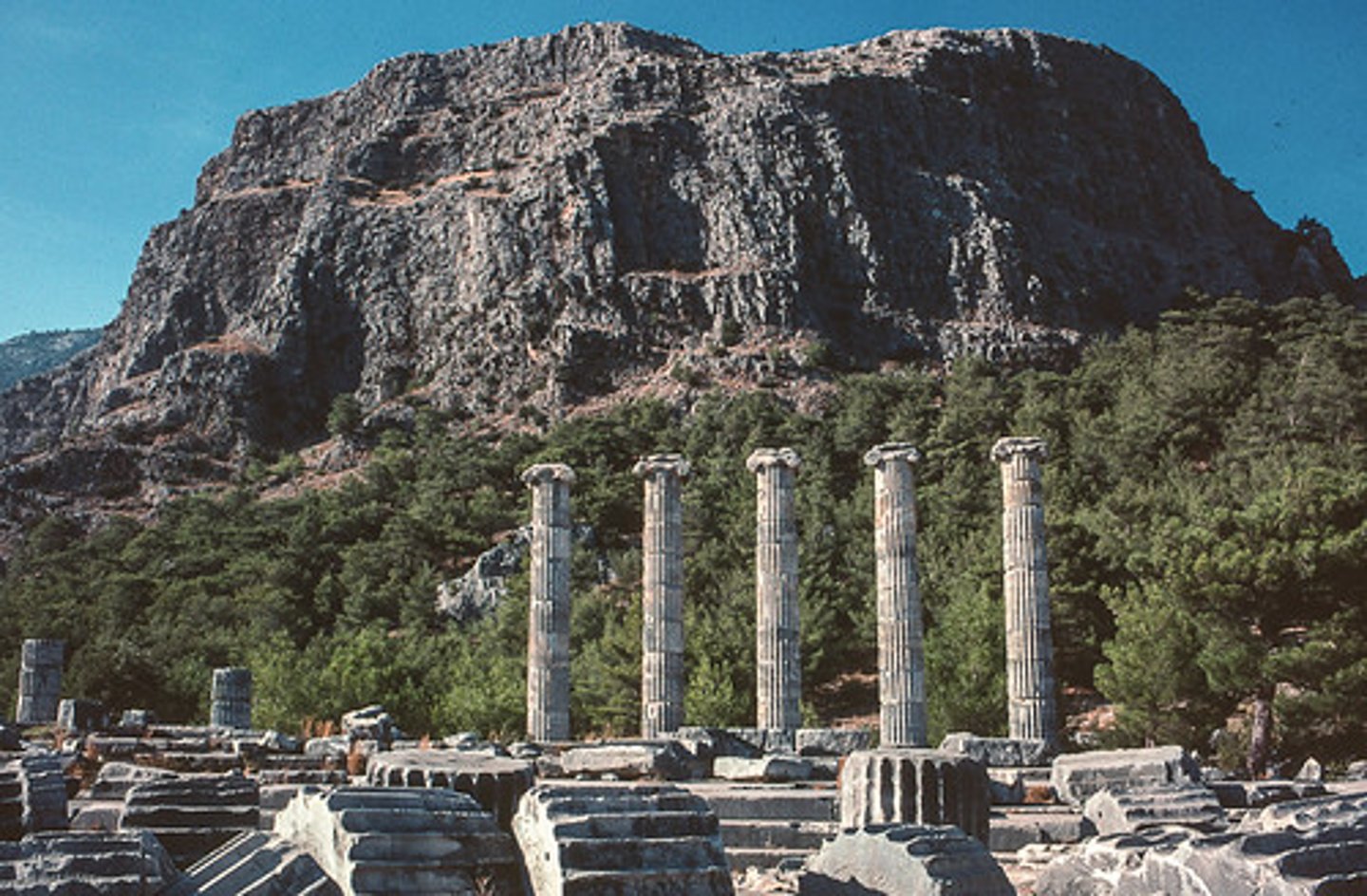
Temple of Athena, Priene
Who The Temple of Athena Polias at Priene was designed by Pythius1, a Greek architect, architecture theorist, and sculptor of the 4th century BC1. The construction was sponsored by Alexander the Great2.
What The Temple of Athena Polias is an Ionic Order temple located northwest of Priene's agora, inside the sanctuary complex2. It was dedicated to Athena Polias, the patron deity of Athens2.
Where The Temple of Athena Polias is located in Priene, an ancient Greek city of Ionia, now in modern-day Turkey2.
When The temple was built around 350-330 BC2.
Why The Temple of Athena Polias at Priene is interesting and important for several reasons:
Architectural Significance: The temple is the best example of classic Ionic known, with no eccentricity of plan or detail3. It was believed to have been constructed and designed by Pytheos, who was also the architect of the great Mausoleum of Halicarnassos, one of the Seven Wonders of the Ancient World1.
Cultural Significance: The temple was dedicated to Athena Polias, also the patron deity of Athens. It was the main temple in Priene, although there was a temple of Zeus2.
Historical Significance: Its construction was sponsored by Alexander the Great during his anabasis to the Persian Empire2. An inscription on a marble flank wall block of the temple records this funding gift2.
Preservation: It was one of the Hellenistic temples that were not reconstructed by Romans2. This has allowed for better preservation of its original structure and function.
Overall, the Temple of Athena Polias at Priene provides a wealth of information about ancient Greek architecture, society, and history. It serves as a testament to the cultural and historical richness of ancient Greece.
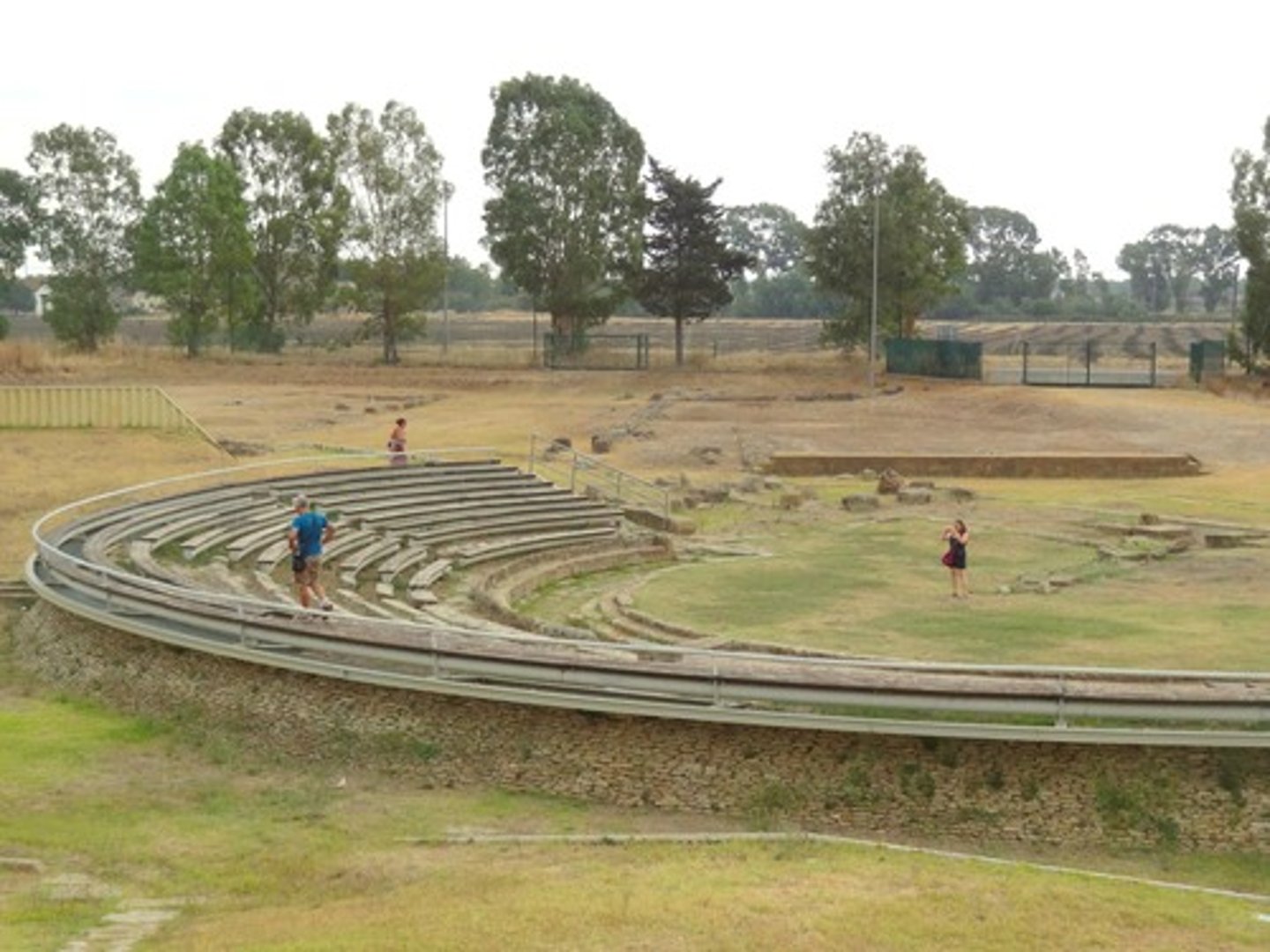
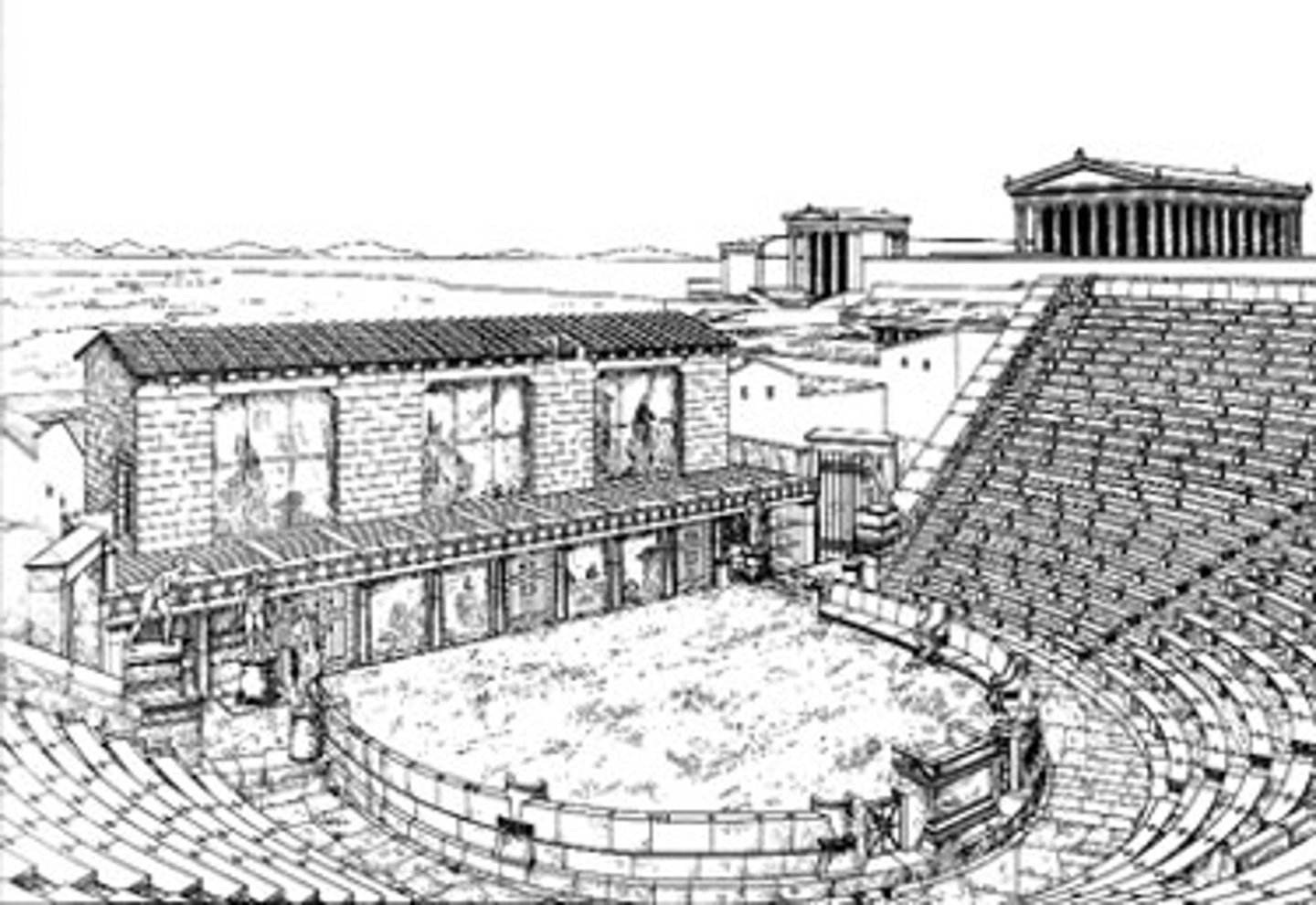
Theater at Priene
Who The Theater at Priene was built by the people of Priene, an ancient Greek city1.
What The Theater at Priene is a horseshoe-shaped structure built using the Doric architectural order. It features half-columns engaged to rectangular piers2. The seating in the auditorium was greater than a semi-circle and had stone parodos walls2. The ruins of the skene (stage) building can still be seen at Priene2.
Where The Theater is located in Priene, an ancient Greek city of Ionia, now in modern-day Turkey1.
When The building history of the theater at Priene spans a number of centuries. Sometime after the refounding of the city (ca. 350 B.C.), the seats of the auditorium and the central orchestra were prepared (ca. 300 B.C.)1.
Why The Theater at Priene is interesting and important for several reasons:
Architectural Significance: The theater was built using the Doric architectural order and featured half-columns engaged to rectangular piers2. This provides valuable insights into the architectural practices of the time.
Cultural Significance: The theater was a central place for dramatic performances, highlighting the importance of theater in ancient Greek society1.
Historical Significance: The building history of the theater at Priene spans a number of centuries, providing insights into the evolution of theater construction over time1.
Preservation: The theater is especially well known for its acoustics. A 2007 study indicates that the astonishing acoustic properties may be the result of its advanced design3.
Unique Features: The proscenium at Priene must represent a later addition. A nicety of design of the theater at Priene is the fact that the face of the proscenium stylobate coincides with the side of a theoretical square inscribed within the circle created by the orchestra, as prescribed by Vitruvius in his description of the Greek theater1.
Overall, the Theater at Priene provides a wealth of information about ancient Greek architecture, society, and history. It serves as a testament to the cultural and historical richness of ancient Greece.
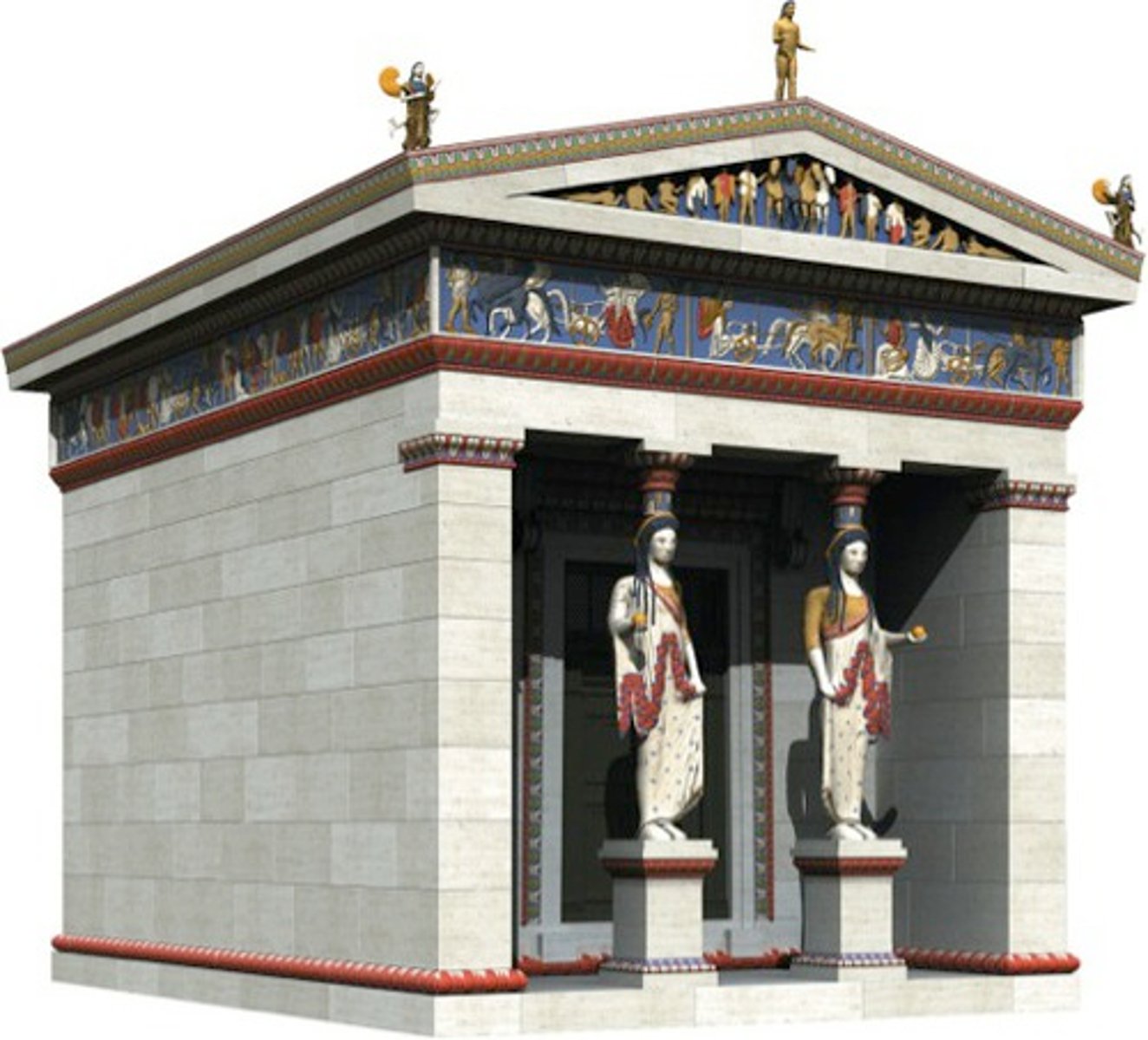
Delphi, Treasury of the Siphnians
Who The Treasury of the Siphnians at Delphi was built by the people of Siphnos, an ancient Greek city-state1.
What The Treasury of the Siphnians is a building erected to host the offerings of the city-state of Siphnos1. It was one of the earlier surviving buildings of this type, and its date remains a matter for debate1. The treasury was one of the first religious structures made entirely out of marble1. The sculptural decoration of the Siphnian Treasury exhibits two rather distinct styles, probably attributable to the division of work between two sculptors and their workshops2.
Where The Treasury of the Siphnians is located in Delphi, Greece1.
When The most plausible date for the construction of the treasury is around 525 BC1.
Why The Treasury of the Siphnians at Delphi is interesting and important for several reasons:
Architectural Significance: The treasury was one of the first religious structures made entirely out of marble1. The sculptural decoration exhibits two rather distinct styles, probably attributable to the division of work between two sculptors and their workshops2.
Cultural Significance: The treasury was erected to host the offerings of the city-state of Siphnos1. It was one of a number of treasuries lining the "Sacred Way", the processional route through the Sanctuary of Apollo, erected to win the favor of the gods and increase the prestige of the donor city-state1.
Historical Significance: The people of Siphnos had gained enormous wealth from their silver and gold mines in the Archaic period and used a tithe of their income to erect the treasury1.
Preservation: The treasury fell to ruins over centuries, although it stood for much longer than many other monuments, probably due to its decoration which was venerated by following generations
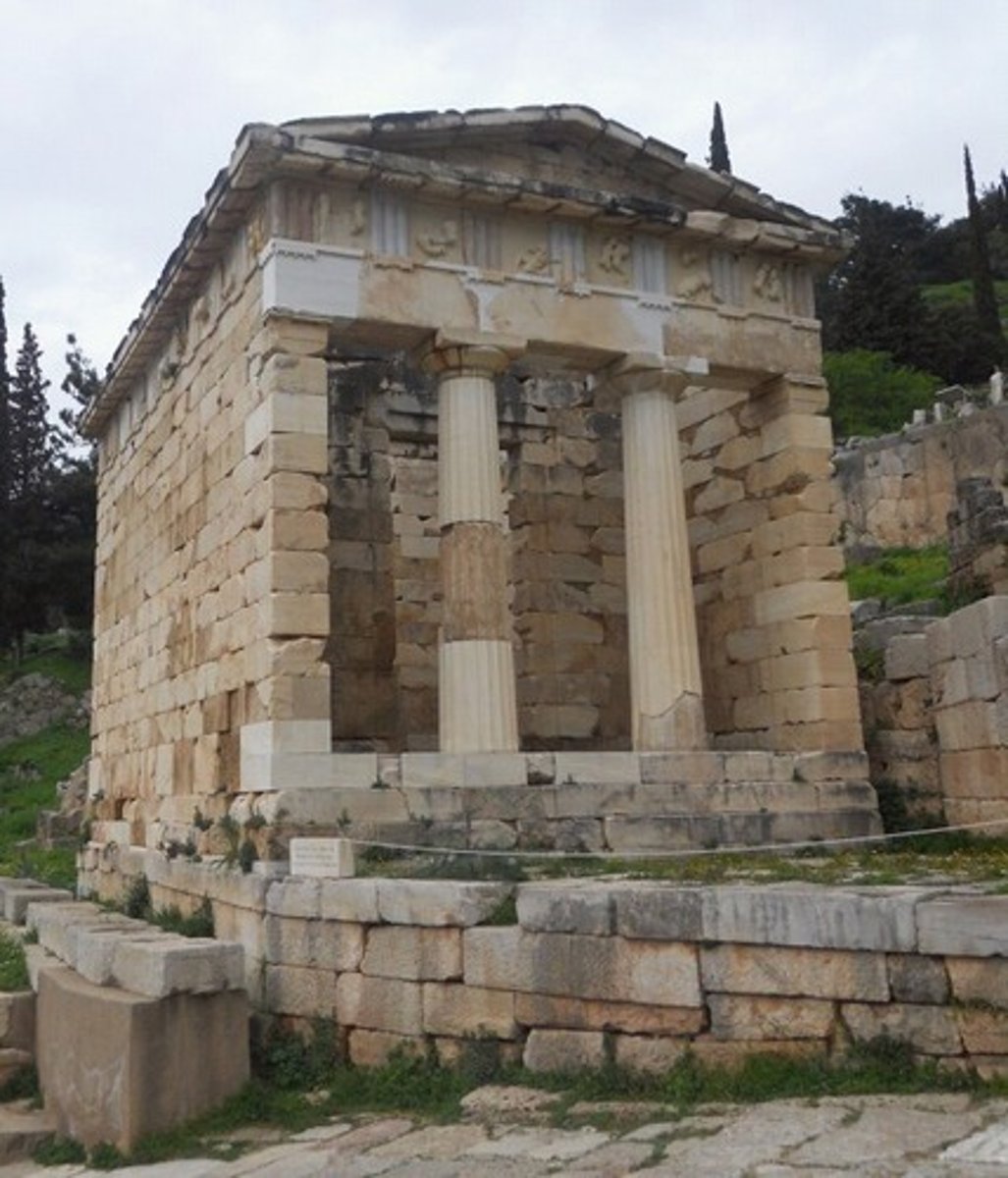
Delphi, Treasury of the Athenians
Who The Treasury of the Athenians at Delphi was built by the people of Athens, an ancient Greek city-state1.
What The Treasury of the Athenians is a Doric treasury made out of marble2. It was constructed to house dedications and votive offerings made by their city and citizens to the sanctuary of Apollo1. The entire treasury, including its sculptural decoration, is built of Parian marble1.
Where The Treasury of the Athenians is located in Delphi, Greece2.
When The Athenians built the Treasury most probably after 490 B.C., in order to thank the god Apollo for their victory at the Battle of Marathon2.
Why The Treasury of the Athenians at Delphi is interesting and important for several reasons:
Architectural Significance: The treasury represents the earliest specimen of a Doric treasury made out of marble2. The frieze had 6 metopes on the narrow sides and 9 on the long ones1. The roof was made of marble painted in red color2.
Cultural Significance: The treasury was erected to host the offerings of the city-state of Athens1. It was one of a number of treasuries lining the "Sacred Way", the processional route through the Sanctuary of Apollo, erected to win the favor of the gods and increase the prestige of the donor city-state1.
Historical Significance: According to Pausanias' testimony, the Athenians built the Treasury possibly after 490 B.C., in order to thank the god Apollo for their victory at the Battle of Marathon2. The walls are covered with inscriptions, including hymns to Apollo with musical notation3.
Preservation: The building was excavated by the French School at Athens, led by Pierre de La Coste-Messelière, and reconstructed from 1903 to 19061. The structure is still visible in situ, although the metopes are reproductions; the originals are in the museum of Delphi1.
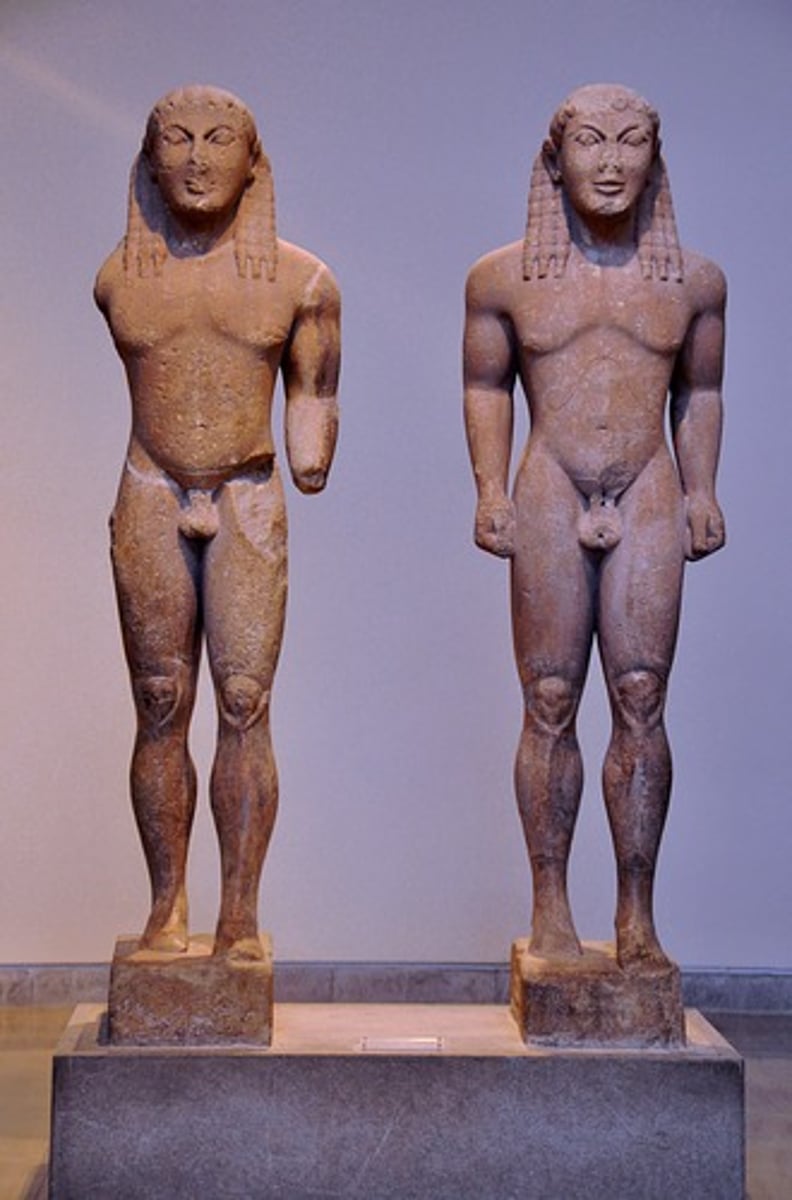
Kleobis and Biton
Who Kleobis and Biton are two figures in Greek legend1. The statues of Kleobis and Biton were sculpted by Polymides of Argos2.
What Kleobis and Biton are a pair of lifesize Archaic Greek statues, or kouroi1. These kouroi are over-life-size, standing at 6.5m tall2.
Where The statues were found at the sanctuary of Apollo at Delphi, Greece3. They originally come from Argos in the Peloponnese4.
When The statues date from about 580 BC4.
Why The statues of Kleobis and Biton are interesting and important for several reasons:
Cultural Significance: The statues represent two figures in Greek legend. In the story, the brothers Kleobis and Biton pulled their mother's cart to a temple when their mother's oxen could not be found. They were praised for their strength and devotion. Their mother asked Hera to bestow a gift upon her sons, which Hera listened and rewarded the sons. They fell asleep in the temple of Hera and died peacefully1.
Historical Significance: The people of Argos dedicated statues of them to the temple of Apollo at Delphi, allowing for these statues to be seen as funeral memorials1. The first known version of the story was described by Herodotus1.
Architectural Significance: These kouroi are over-life-size, standing at 6.5m tall2, and are considered typical examples of the kouros type3.
Chryselephantine Statues of Apollo and Artemis, from Delphi
Who The Chryselephantine Statues of Apollo and Artemis at Delphi were created by artists from workshops in Ionia, or, to a certain extent, Corinth1.
What The Chryselephantine Statues of Apollo and Artemis are made with gold and ivory, a technique known as chryselephantine2. They were built around a wooden frame with thin carved slabs of ivory attached, representing the flesh, and sheets of gold leaf representing the garments, armor, hair, and other details2. In some cases, glass paste, glass, and precious and semi-precious stones were used for detail such as eyes, jewelry, and weaponry2.
Where The statues are located in the Delphi Archaeological Museum1.
When The statues are magnificent creations of the mid-6th century B.C., coming from workshops in Ionia, or, to a certain extent, Corinth1.
Why The Chryselephantine Statues of Apollo and Artemis at Delphi are interesting and important for several reasons:
Architectural Significance: The statues are excellent specimens of mid-6th century B.C. art1. The use of chryselephantine technique is significant as it was a popular method for creating statues in Ancient Greece2.
Cultural Significance: The statues depict Apollo and Artemis, two important deities in Greek mythology1. They were part of a group depicting the Apollonian triad, namely Apollo, Artemis and Leto1.
Historical Significance: The scholars have related these finds to the sumptuous ex-votos of Croesus, king of Lydia, which Herodotus so eloquently describes. This identification is however uncertain; the only certain fact is that the works are magnificent creations of the mid-6th century B.C., coming from workshops in Ionia, or, to a certain extent, Corinth1.
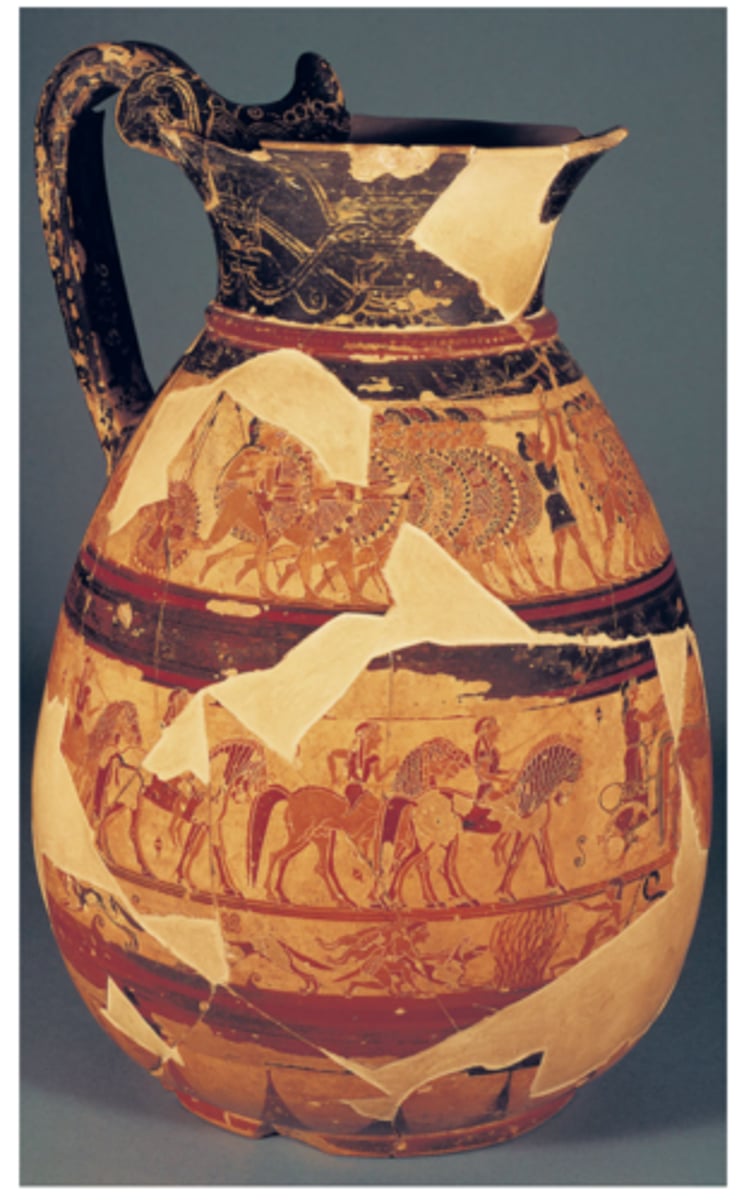
Protocorinthian Olpe ("Chigi Vase,") by the Macmillan Painter, ca. 640 BC
Who The Protocorinthian Olpe, also known as the "Chigi Vase," was created by the Macmillan Painter1, an artist from the ancient Greek city-state of Corinth2.
What The Chigi Vase is a Proto-Corinthian olpe, or pitcher3. It is decorated in four friezes of mythological and genre scenes and four bands of ornamentation3. Among these tableaux is the earliest representation of the hoplite phalanx formation3. The vase stands 26 cm (10.2 inches) tall3.
Where The Chigi Vase was found in an Etruscan tomb at Monte Aguzzo, near Veio, on Prince Mario Chigi's estate in 18813. It is now housed in the National Etruscan Museum, Villa Giulia, Rome3.
When The Chigi Vase dates back to around 640 BC2.
Why The Chigi Vase is interesting and important for several reasons:
Architectural Significance: The vase is a technical masterpiece of Archaic painting4. It contains the earliest known representation of the hoplite phalanx formation3, providing valuable insights into military tactics during the mid- to late-7th century.
Cultural Significance: The vase depicts various scenes from everyday life and mythology, including hunts, horsemanship, and a hoplite battle4. These scenes reflect the penetration of the everyday, the exotic, the heroic, and the divine into Greek art4.
Historical Significance: The vase provides a glimpse into the stages of maturation of Corinthian male society during its time4. It also provides evidence of the influence of neo-Assyrian art forms on Corinthian art3.
Overall, the Chigi Vase provides a wealth of information about ancient Greek art, society, and history. It serves as a testament to the cultural and historical richness of ancient Greece.
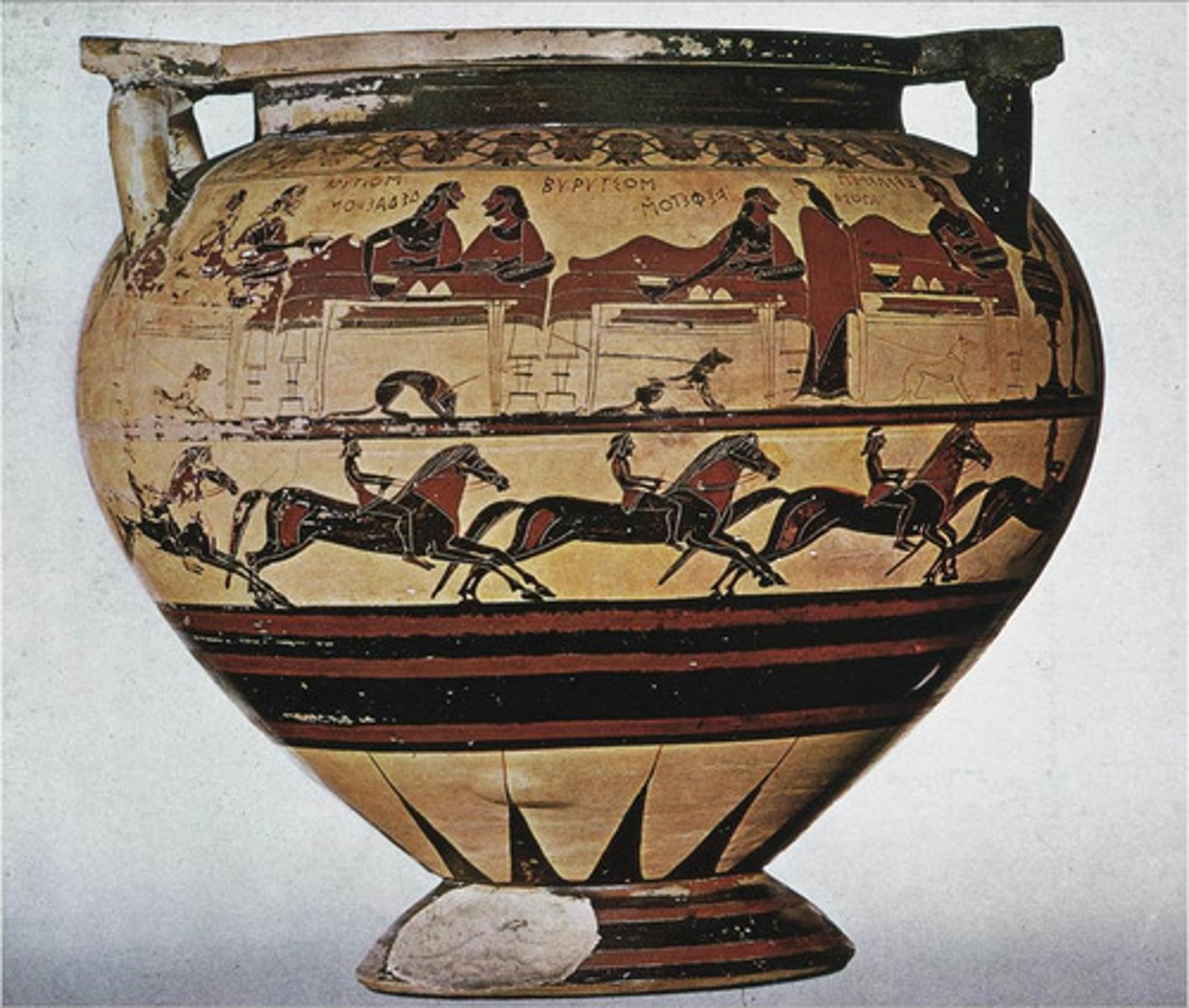
Corinthian column krater showing Herakles, king Eurytios, and others dining (symposium),
Who The Corinthian column krater, also known as the "Eurytios Krater," was created by the Macmillan Painter1, an artist from the ancient Greek city-state of Corinth.
What The Eurytios Krater is a Corinthian black-figure column-krater made around 600 BC2. The main panel represents Heracles and Eurytios at a symposium with Iole; all characters are named in Corinthian script2.
Where The Eurytios Krater was found at Cerveteri and is now on display in the Louvre3.
When The Eurytios Krater dates back to around 600 BC2.
Why The Eurytios Krater is interesting and important for several reasons:
Artistic Significance: The vase combined the possibilities of the recently invented or introduced styles of black-figure vase painting and polychrome painting in terms of shape and decoration of the vase with a particularly high quality of artisanship3.
Cultural Significance: The front of the krater depicts Eurytus (Eurytos) feasting Herakles. This scene, after which the vase was named, is unique in Corinthian vase painting3.
Historical Significance: In addition to the painting itself, several of the figures are named by accompanying inscriptions. The back is decorated with a battle scene, possibly from the Trojan War. Below the handles are a kitchen scene and the probably earliest depiction of the suicide of Ajax3.
Overall, the Eurytios Krater provides a wealth of information about ancient Greek art, society, and history. It serves as a testament to the cultural and historical richness of ancient Greece.
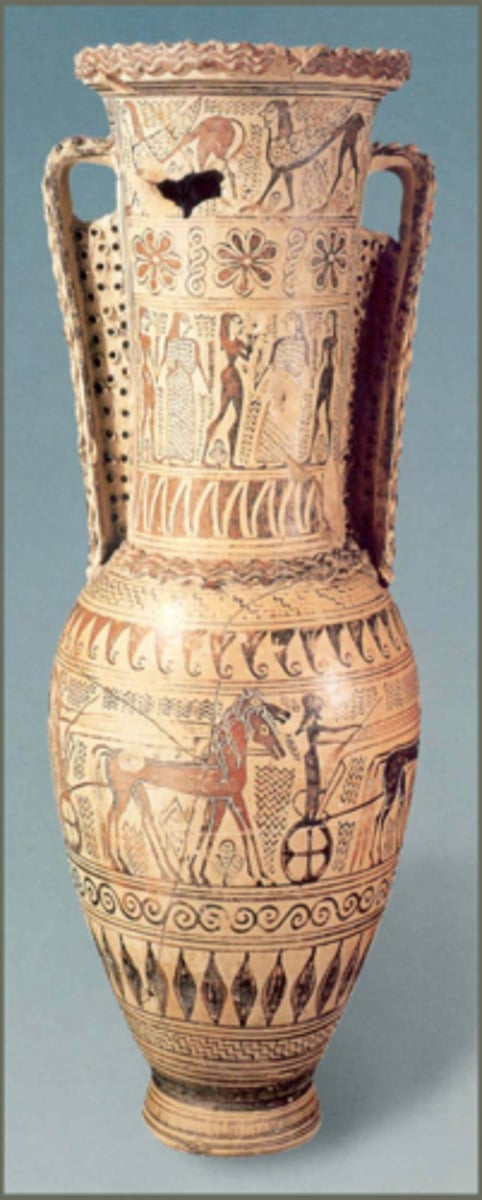
Protoattic Loutrophoros by the Analatos Painter
Who The Protoattic Loutrophoros, also known as the "Chigi Vase," was created by the Analatos Painter1, an artist from the ancient Greek city-state of Corinth1.
What The Chigi Vase is a Protoattic loutrophoros-amphora2. A loutrophoros is a distinctive type of Greek pottery vessel characterized by an elongated neck with two handles2. It is decorated in four friezes of mythological and genre scenes and four bands of ornamentation1. Among these tableaux is the earliest representation of the hoplite phalanx formation1.
Where The Chigi Vase was found in Athens and is now housed in the Louvre Museum, Paris, France3.
When The Chigi Vase dates back to around 680 BC3.
Why The Chigi Vase is interesting and important for several reasons:
Artistic Significance: The vase is a technical masterpiece of Archaic painting1. It contains the earliest known representation of the hoplite phalanx formation1, providing valuable insights into military tactics during the mid- to late-7th century.
Cultural Significance: The vase depicts various scenes from everyday life and mythology, including hunts, horsemanship, and a hoplite battle1. These scenes reflect the penetration of the everyday, the exotic, the heroic, and the divine into Greek art1.
Historical Significance: The vase provides a glimpse into the stages of maturation of Corinthian male society during its time1. It also provides evidence of the influence of neo-Assyrian art forms on Corinthian art1.
Overall, the Chigi Vase provides a wealth of information about ancient Greek art, society, and history. It serves as a testament to the cultural and historical richness of ancient Greece.
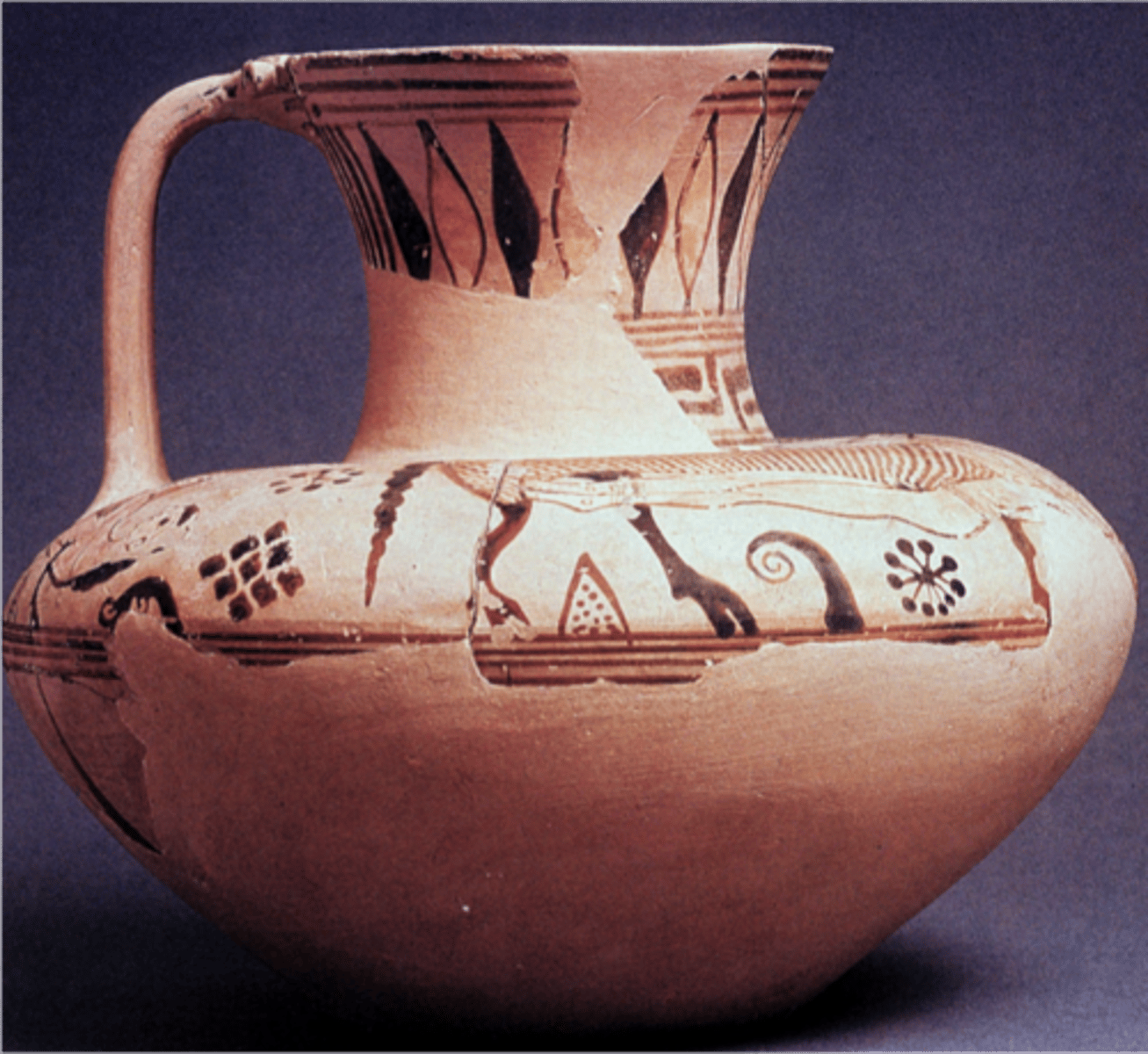
Protoattic oinochoe from Aegina showing Odysseus escaping from Polyphemos' cave, by the Ram Jug Painter, ca. 675-650 BC
Who The Protoattic oinochoe from Aegina, also known as the "Ram Jug," was created by the Ram Jug Painter1, an artist from the ancient Greek city-state of Corinth2.
What The Ram Jug is a Protoattic oinochoe, or jug3. It depicts Odysseus escaping from the cave of the Cyclops Polyphemus3. The scene is enclosed within a panel, incised with added white and purple paint: a ram emerges from the cave on the left with the head of Odysseus visible under its body3.
Where The Ram Jug was found at Aegina and is now housed in the Louvre Museum, Paris, France2.
When The Ram Jug dates back to around 675-650 BC1.
Why The Ram Jug is interesting and important for several reasons:
Artistic Significance: The vase is a technical masterpiece of Archaic painting2. It contains the earliest known representation of Odysseus escaping from the cave of the Cyclops Polyphemus3, providing valuable insights into mythological depictions during the mid- to late-7th century.
Cultural Significance: The vase depicts a scene from Homer's Odyssey, one of the two major ancient Greek epic poems attributed to Homer3. This scene reflects the penetration of mythological narratives into Greek art2.
Historical Significance: The vase provides a glimpse into the stages of maturation of Corinthian pottery during its time2. It also provides evidence of the influence of neo-Assyrian art forms on Corinthian art2.
Overall, the Ram Jug provides a wealth of information about ancient Greek art, society, and history. It serves as a testament to the cultural and historical richness of ancient Greece.
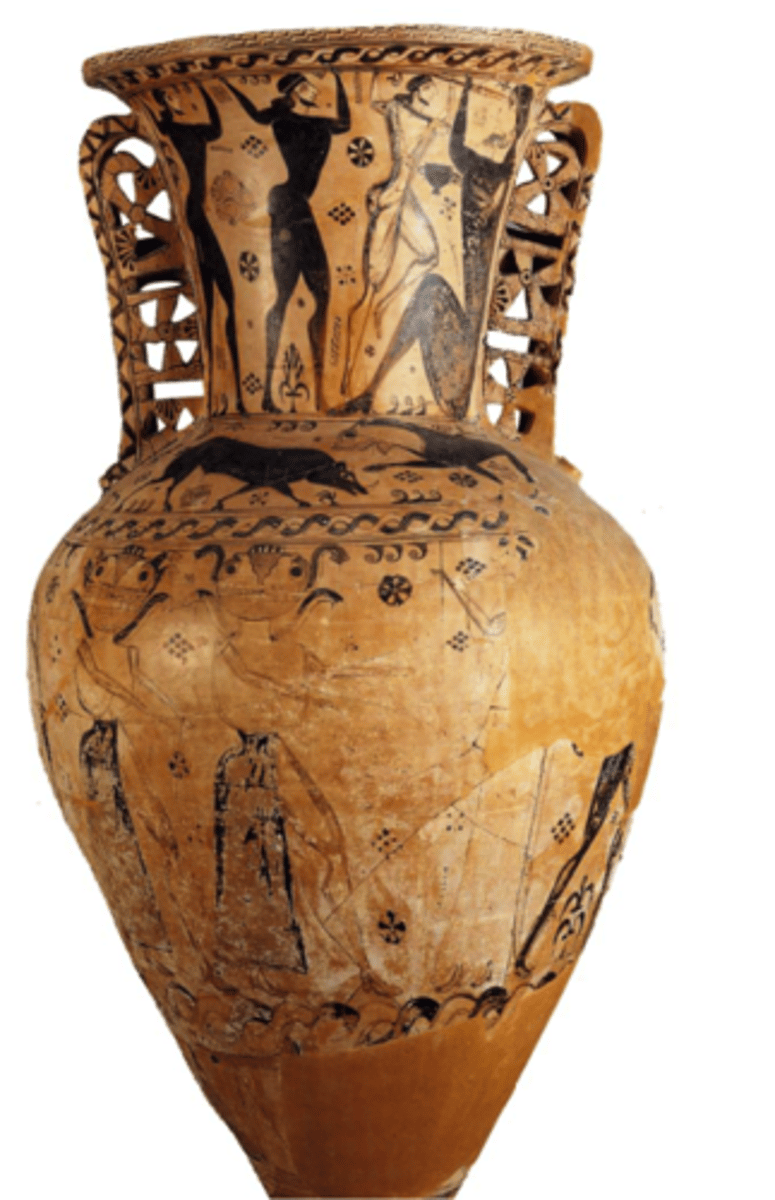
Protoattic Amphora from Eleusis, ca. 650 BC
Who The Protoattic Amphora from Eleusis was created by an unknown artist from the ancient Greek city-state of Corinth1.
What The Protoattic Amphora from Eleusis is an ancient Greek neck amphora, now in the Archaeological Museum of Eleusis1. It is decorated with black and white painted figures on a light-colored background, which is characteristic of the "Black and White" style commonly seen in Middle Protoattic pottery1. The amphora's decoration reflects the pottery of the Orientalizing period (ca. 710-600 BCE)1, a style in which human and animal figures depict mythological scenes1.
Where The Protoattic Amphora from Eleusis was found at Eleusis and is now housed in the Archaeological Museum of Eleusis1.
When The Protoattic Amphora from Eleusis dates back to the Middle Protoattic period (ca. 650-625 BCE)1.
Why The Protoattic Amphora from Eleusis is interesting and important for several reasons:
Artistic Significance: The amphora is a prime example of Protoattic Oriental period Greek pottery2. Though the large 650 BCE black and white figure vessel is greatly damaged, the visible narratives show us an important development in style2.
Cultural Significance: The amphora shows some of the earliest artistic depictions of Greek mythology. On the neck of the vase, the figures depict Odysseus and his men blinding the cyclops Polyphemus1. The register just below the neck shows a lion chasing a boar. Although it is hard to see because the amphora was found in pieces and then reconstructed, the central register shows Athena and Perseus escaping after Perseus beheads Medusa1.
Historical Significance: The size and shape of the amphora, as well as the fact that it is highly decorated, indicate that it was created as a tomb marker or monument1. However, the remains of a 10-12-year-old boy were found inside the amphora1, meaning that it was ultimately used as an urn. This type of urn burial was commonly used to bury the remains of children from the Iron Age (1100-900 BCE) to the Archaic period (600-500 BCE)1.
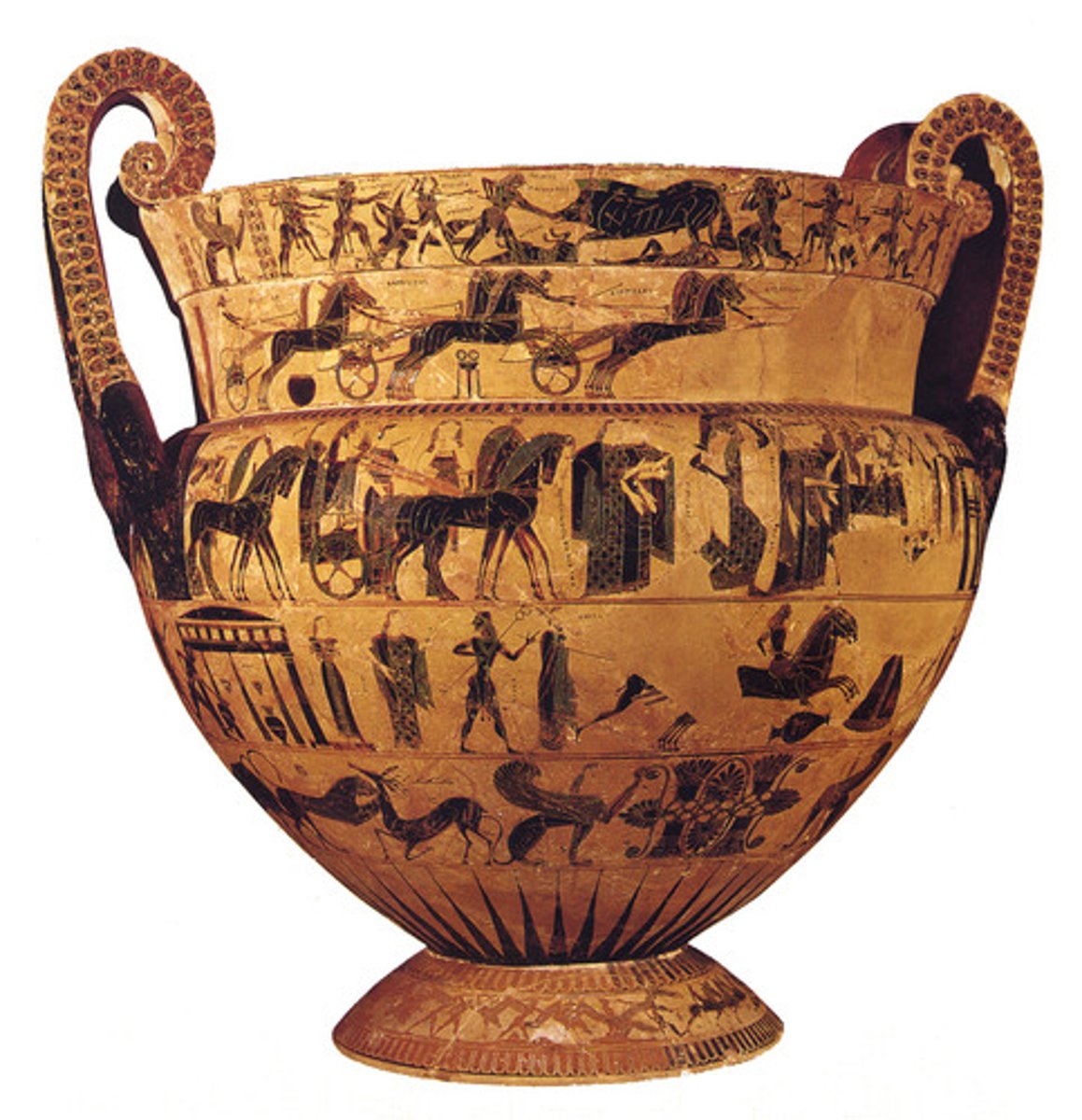
The François Vase, ca. 570 BC
Who The François Vase was created by Ergotimos (potter) and Kleitias (painter)1. It was named after its discoverer, Alessandro François2.
What The François Vase is a large Attic volute krater decorated in the black-figure style2. It stands at 66 cm in height and was inspired by earlier bronze vases2. It was used for wine2. The vase is decorated with 270 figures running, fighting, and dancing across its surface3. Among these figures, 121 have accompanying inscriptions2.
Where The François Vase was discovered in 1844 in an Etruscan tomb in Chiusi, Italy3. It is now housed in the Museo Archeologico in Florence2.
When The François Vase dates back to around 570-565 BCE2.
Why The François Vase is interesting and important for several reasons:
Artistic Significance: The vase is a technical masterpiece of Archaic painting3. It contains the earliest known representation of the hoplite phalanx formation2, providing valuable insights into military tactics during the mid- to late-7th century.
Cultural Significance: The vase depicts various scenes from everyday life and mythology, including hunts, horsemanship, and a hoplite battle3. These scenes reflect the penetration of the everyday, the exotic, the heroic, and the divine into Greek art3.
Historical Significance: The vase provides a glimpse into the stages of maturation of Corinthian male society during its time3. It also provides evidence of the influence of neo-Assyrian art forms on Corinthian art2.
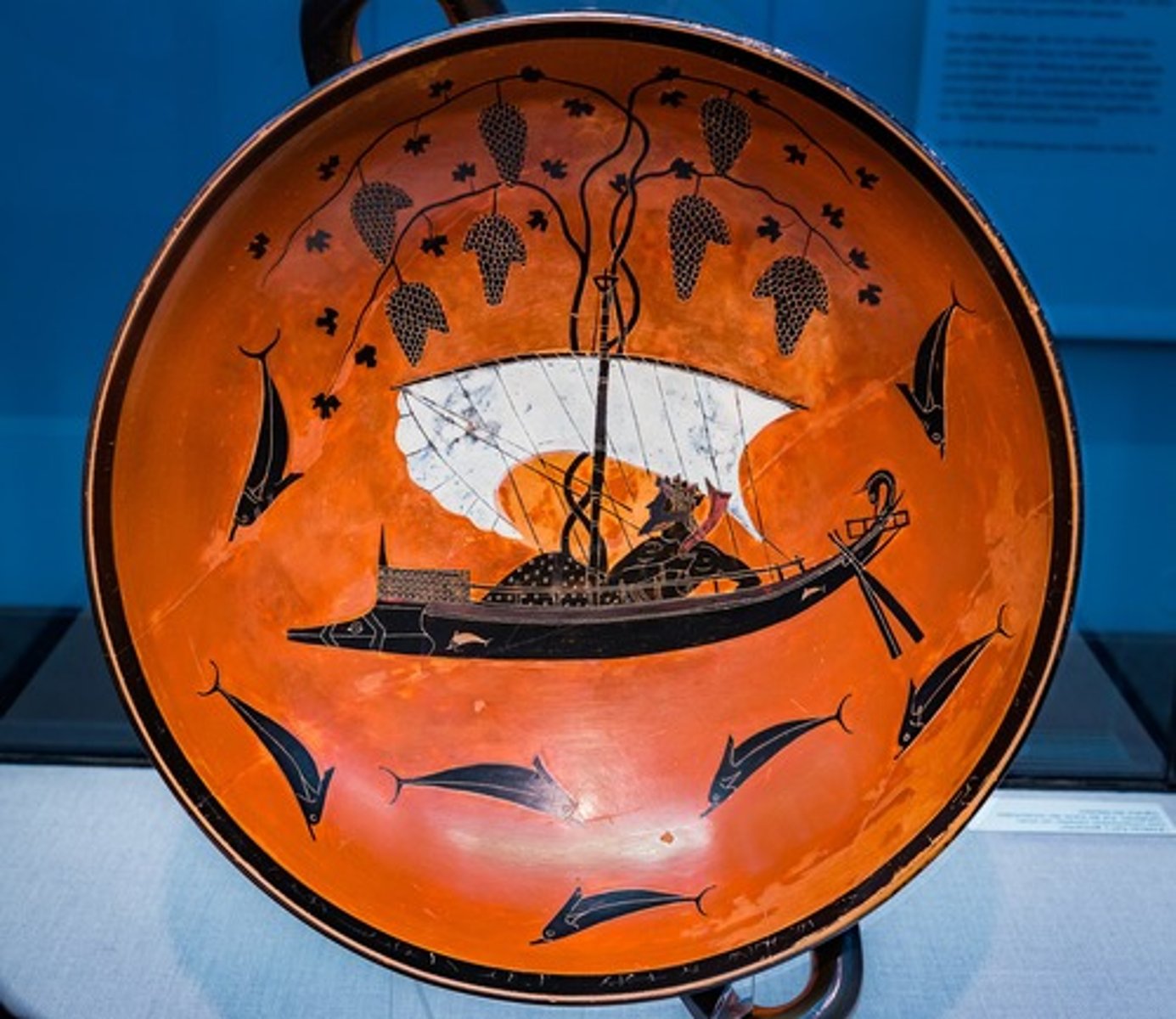
Eye-cup by Exekias: Dionysos sailing the wine-dark sea, with dolphins,
Who The Eye-cup, also known as the "Dionysus Cup," was created by Exekias1, an artist from the ancient Greek city-state of Athens1.
What The Dionysus Cup is a kylix (drinking cup) dating to 540-530 BC1. It is one of the masterpieces of the Attic black-figure potter Exekias1. The inside image, the tondo, takes up almost the entire interior of the cup. In the center, a sailing ship is depicted, traveling from right to left. Within the ship is a well over life-sized figure, the god Dionysus1. Vines grow from the mast, with three large clusters of grapes on the right and four on the left. Dolphins swim below the ship—two towards the right, three towards the left—and a further dolphin is found on the right and the left-hand sides of it1.
Where The Dionysus Cup is now housed in the Staatliche Antikensammlungen in Munich1.
When The Dionysus Cup dates back to around 540-530 BC1.
Why The Dionysus Cup is interesting and important for several reasons:
Artistic Significance: The cup shows numerous technical innovations. As a potter, Exekias took older forms and reshaped them into a completely new one2. This form, the so-called Cup type A with a thicker foot, a ring around the stem, and a deep, broad bowl, would quickly become the dominant form2.
Cultural Significance: The cup depicts Dionysus in a sailing ship surrounded by dolphins3. This scene could be a reference to the seventh Homeric Hymn, in which it is explained how Dionysus was kidnapped by Etruscan pirates, who were unaware of his identity. The god confuses their thoughts and causes them to jump into the water, where they transform into dolphins2.
Historical Significance: The images around the handles probably depict the battles for the corpses of Patroclus and Achilles, with the naked corpse being Patroclus2.
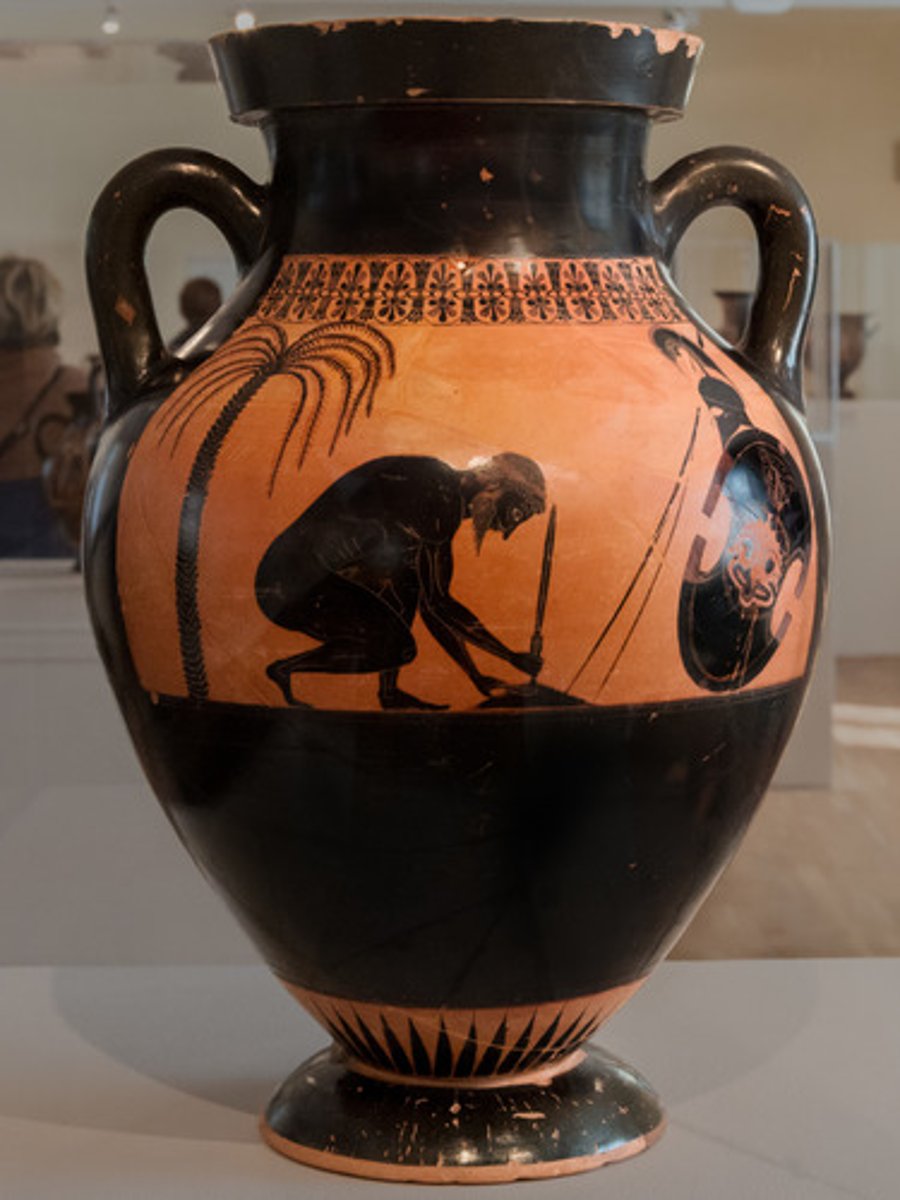
Amphora by Exekias: Ajax preparing to commit suicide, ca. 540 BC
Who The Amphora depicting Ajax preparing to commit suicide was created by Exekias1, an artist from the ancient Greek city-state of Athens1.
What The Amphora is a neck amphora, painted in the black-figure style1. It depicts Ajax, the second-best hero at Troy after his cousin Achilles, preparing for his suicide1. Ajax appears in the middle, bent over his sword which he is placing in the ground2. There is a tree to one side of him and his suit of armor to the other side1.
Where The Amphora is now housed in the Château-musée de Boulogne-sur-Mer in France1.
When The Amphora dates back to around 530 BC1.
Why The Amphora is interesting and important for several reasons:
Artistic Significance: The vase is a technical masterpiece of Archaic painting1. It contains the earliest known representation of Ajax preparing for his suicide2, providing valuable insights into mythological depictions during the mid- to late-6th century.
Cultural Significance: The vase depicts Ajax preparing for his suicide, which no other known images of this event do2. All other representations show Ajax once he has already done the act of falling on his sword2.
Historical Significance: The vase provides a glimpse into the stages of maturation of Athenian pottery during its time1. It also provides evidence of the influence of neo-Assyrian art forms on Athenian art1.
Amphora by the Amasis Painter: Dionysos and Nymphs, ca. 540 BC
Who The Amphora depicting Dionysos and Nymphs was created by the Amasis Painter1, an artist from the ancient Greek city-state of Athens1.
What The Amphora is an Attic black-figure neck amphora2. It depicts a mythological, mundane snapshot of Dionysus and two of his female followers, The Maenads, who are shown to be in the middle of offering the god a hare and a fawn2.
Where The Amphora is now housed in the Bibliotheque Nationale at Paris2.
When The Amphora dates back to around 540-535 BCE2.
Why The Amphora is interesting and important for several reasons:
Artistic Significance: The vase is a paragon of Archaic vase painting with its palmette compositions, mythological depictions, and use of the Black figure technique2. The fine incisions in Dionysus' hair would have been created through the use of a needle, whereas his garments and the panther skin dresses of The Maenads, which was cleverly used by The Amasis Painter as a homage to Dionysus' symbol, the panther, would have been delineated through the black clay pigment2.
Cultural Significance: The vase depicts Dionysus and The Maenads. Dionysus is one of the Twelve Olympians who was the god of wine and fertility. The Maenads are female worshippers of Dionysus2.
Historical Significance: The Black-Figure Technique was born in Corinth in 700 BCE. The movement into naturalism and the portrayal of everyday life with the use of mythological figures also began to dominate the art scene, particularly in the Archaic era (699 - 480 BCE)2.
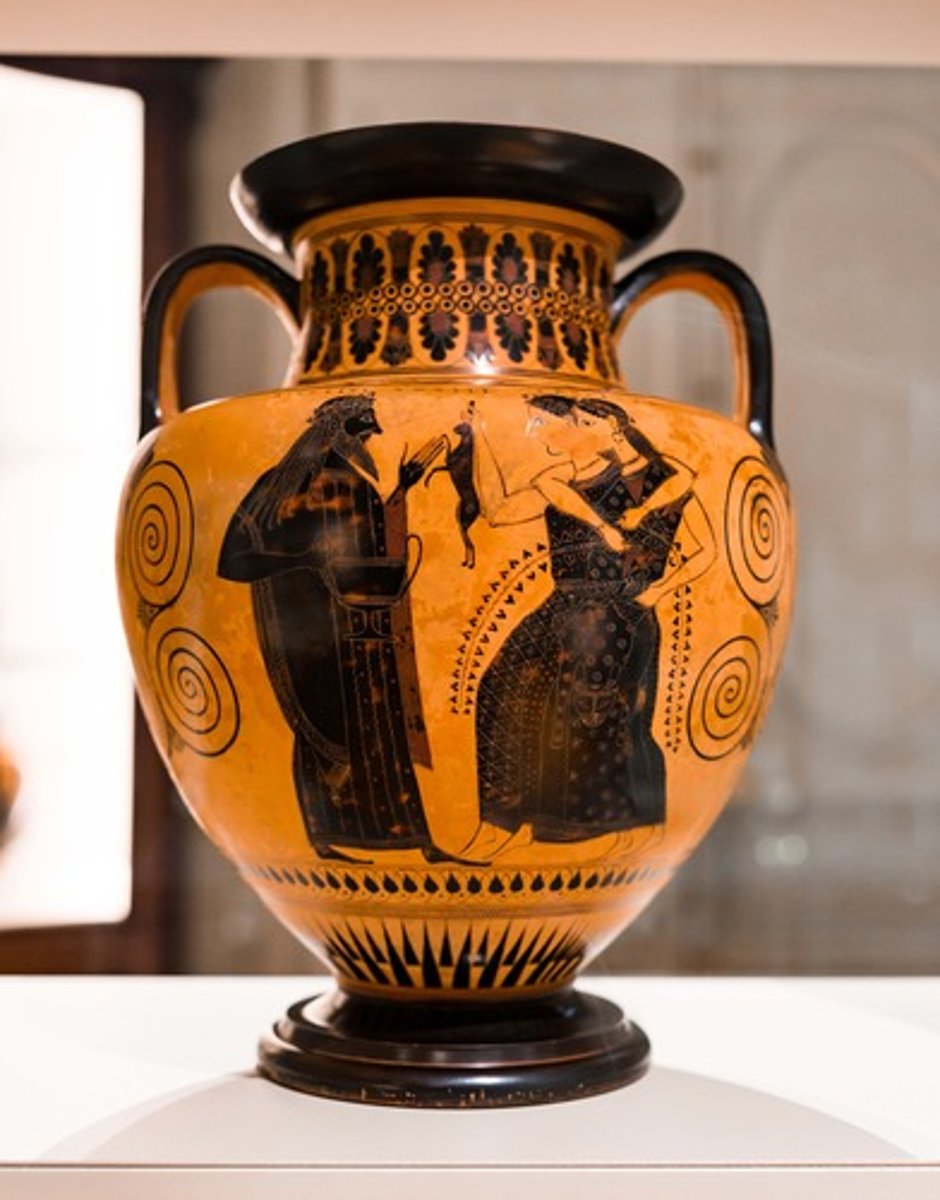
Amphora by the Andokides Painter: Apollo and Herakles Struggling for the Tripod, ca. 525 BC
Who The Amphora depicting Apollo and Herakles Struggling for the Tripod was created by the Andokides Painter1, an artist from the ancient Greek city-state of Athens1.
What The Amphora is an Attic black-figure neck amphora1. It depicts the hero Herakles and the god Apollo vying for possession of the Delphic tripod, which was central to the oracle of Apollo1. On the reverse side, Dionysos, the god of wine, is depicted between a satyr and a maenad1.
Where The Amphora is now housed in The Met Fifth Avenue in Gallery 1551.
When The Amphora dates back to around 530 BCE1.
Why The Amphora is interesting and important for several reasons:
Artistic Significance: The vase is a technical masterpiece of Archaic painting1. It contains one of the earliest known representations of Apollo and Herakles struggling over the Delphic tripod1, providing valuable insights into mythological depictions during the mid- to late-6th century.
Cultural Significance: The vase depicts a scene from Greek mythology where Herakles tries to steal the sacred tripod after being enraged that Apollo's priestess at the sanctuary of Delphi would not provide him with an answer to his question2. This scene reflects the penetration of mythological narratives into Greek art1.
Historical Significance: The introduction of the red-figure technique is attributed to the workshop of Andokides. While we think of red-figure mainly in terms of drawing, it differs from black-figure also in the very different apportionment of glazed and unglazed surfaces on a vase. The preparation of these surfaces was probably the responsibility of the potter, and for this reason, the new technique is associated with a potter rather than a painter1.
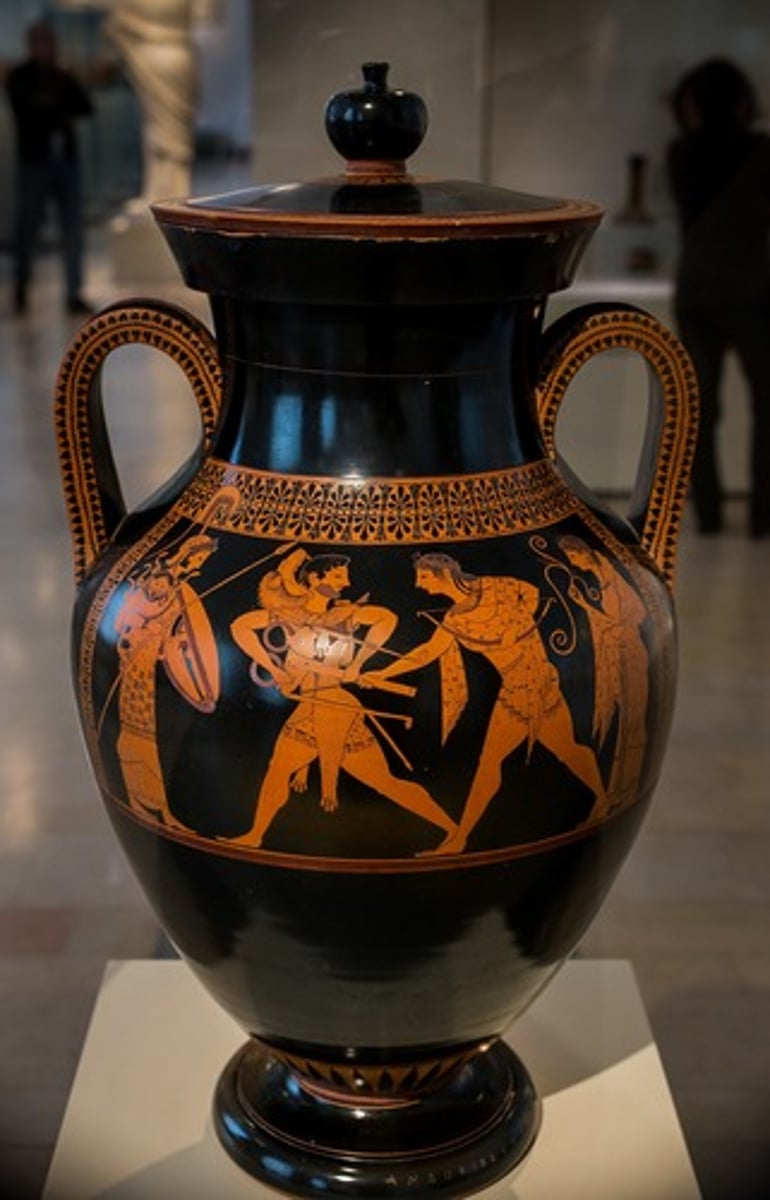
Gold coin (croeseid coin, minted first by king Croesus) with lion and bull, from Sardis
Gold coin (croeseid coin, minted first by king Croesus) with lion and bull, from Sardis.
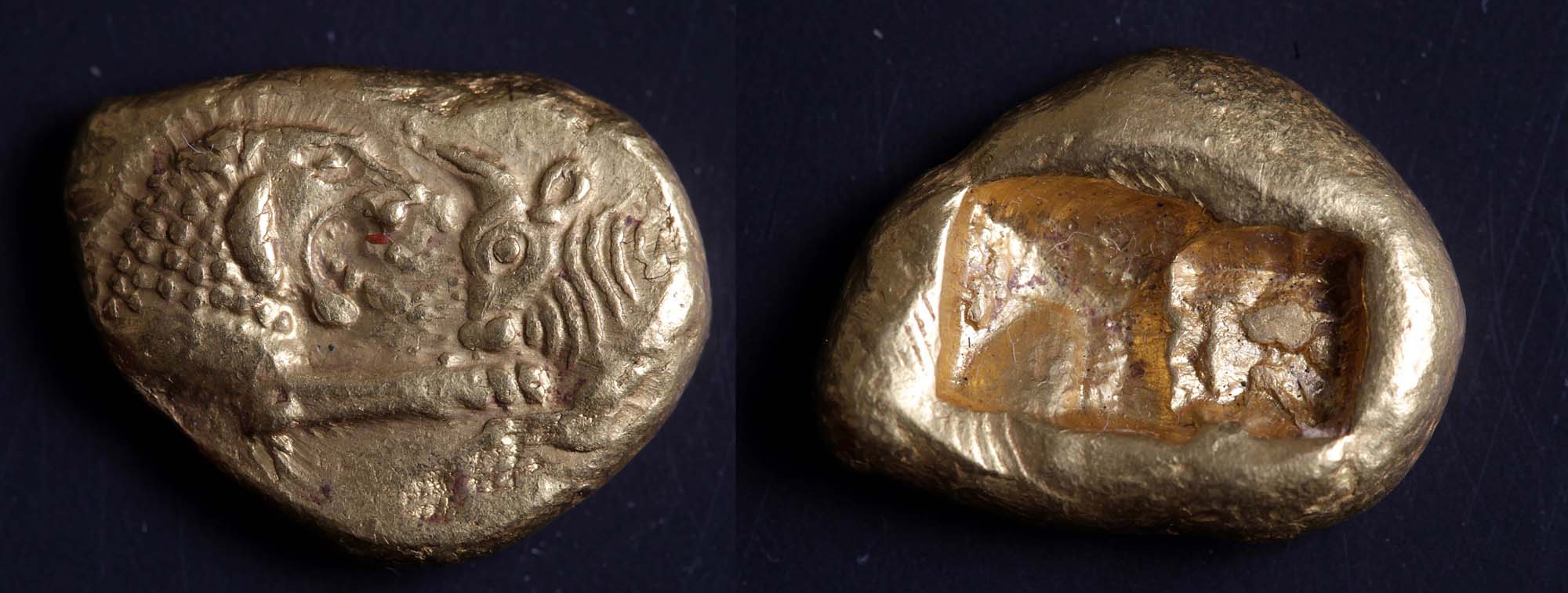
|
|
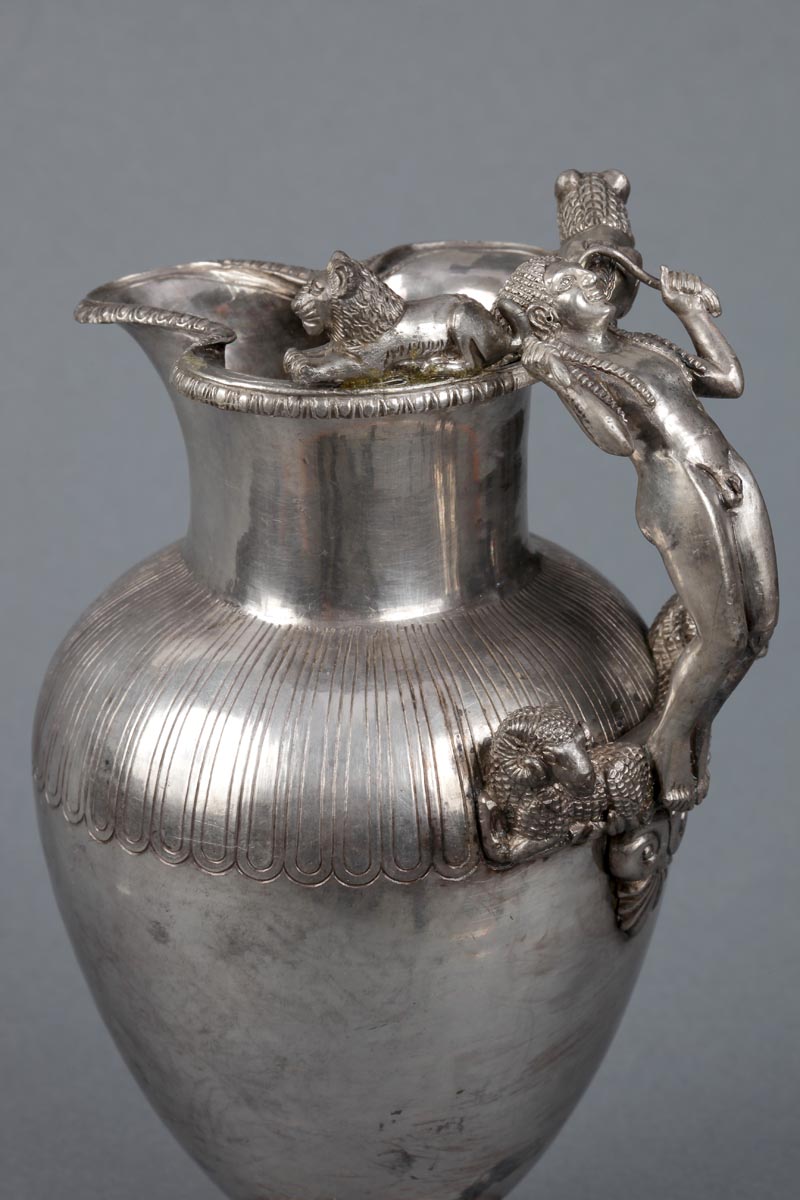
Krater from Vix, ca. 530-520 BC
Krater from Vix, ca. 530-520 BC