Lecture 11: Development of Permanent Dentition
 Call Kai
 Learn
Learn Practice Test
 Spaced Repetition
 Match
Match Flashcards
 Knowt Play
1/56

There's no tags or description
Looks like no tags are added yet.
Name | Mastery | Learn | Test | Matching | Spaced | Call with Kai |
|---|
No analytics yet
Send a link to your students to track their progress
57 Terms
What is the most important characteristic of permanent tooth eruption compared to primary dentition?
Permanent teeth show much more variation in eruption timing and sequence
Which gender erupts permanent teeth earlier?
Girls by 5-6 months (except 3rd molars)
What is the most common eruption sequence in the lower arch?
Canine → first premolar → second premolar
What eruption sequence is associated with serial extraction cases?
First premolar → second premolar → canine
Which lower arch eruption pattern minimizes crowding?
Canine → first premolar → second premolar
What eruption sequence is associated with crowding?
First premolar → second premolar → canine
What does the eruption order chart show for the lower arch?
First molars, incisors, premolars, canines, and second molars
Around what age do first molars erupt?
6 years
Around what age do incisors erupt?
7-8 years
Around what age do premolars erupt?
10-12 years
Around what age do canines erupt?
11-12 years
Around what age do second molars erupt?
12 years and up
What clinical problem is associated with high buccal canines?
Ectopic eruption due to lack of arch space
What is the recommended management for palatally displaced canines?
Redirect eruption path by extracting primary canines
What is the most common eruption sequence in the maxilla, with 1 being the central incisors and 7 being the second molars?
6-1-2-4-5-3-7
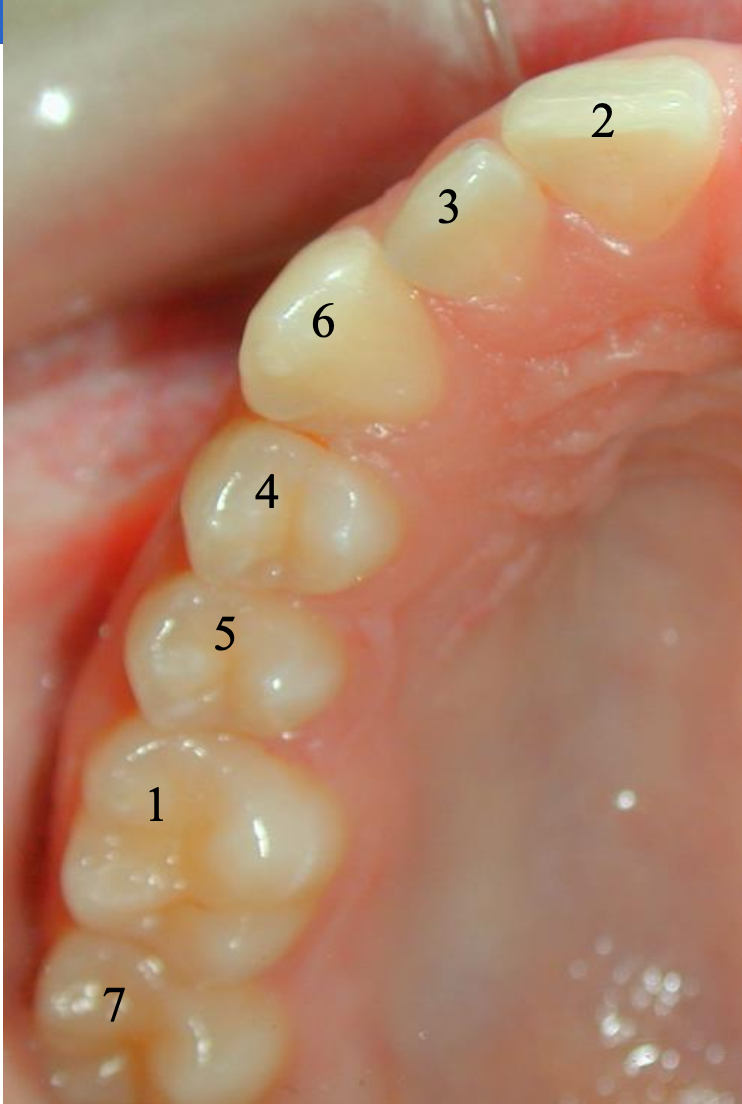
What is the most common eruption sequence in the mandible, with 1 being the central incisors and 7 being the second molars?
6–1–2–3–4–5–7
What does the “timing is consistent within a dentition” principle mean?
Early eruptors tend to erupt all teeth early, and late eruptors erupt all teeth late
What should be investigated if eruption is asymmetric between left and right sides?
Pathology, ankylosis, impaction, or eruption disturbance.
Which teeth are most commonly crowded due to eruption sequence issues?
Maxillary canines and mandibular second premolars
What local factor can hasten permanent tooth eruption?
Periapical pathology of a primary tooth
If a primary tooth is extracted during active eruption, what happens to eruption time?
Eruption accelerates
If a primary tooth is extracted BEFORE root formation of the permanent tooth, what happens to eruption time?
Eruption is delayed
What does the “2/3 root formed” rule refer to?
Extraction accelerates eruption only when the permanent tooth has ≥ 2/3 root formation.
If a patient has a pulpotomy, what happens to the eruption of the permanent tooth?
May accelerate eruption if inflammation stimulates the follicle
What local factor slows eruption?
Premature extraction of a primary tooth before root formation of the permanent successor
What are the three major dimensional changes in dental arches?
Arch width
Arch length
Arch perimeter
What drives arch width increase in the maxilla?
Alveolar process growth and buccal eruption of premolars and canines
Why does the maxilla gain more arch width than the mandible?
The divergent maxillary alveolar process allows more lateral growth
True or False: The sequence 4–5–3 is associated with crowding.
True
True or False: Premature extraction slows eruption
True
True or False: Arch width increases after canine eruption
False: it stops after canine eruption
Why does crowding occur?
Crowding occurs when the arch perimeter is insufficient for erupting teeth
How does poor eruption sequence effect the first molars?
It can cause mesially tipped first molars, blocking second molars
What does “dental eruption → wider placement” mean?
Permanent teeth erupt more buccally, requiring alveolar bone apposition
Why does intercanine width stop increasing after canine eruption?
Because the canines lock the arch form, preventing further lateral expansion
At what ages does the arch width growth?
4, 7 and 10 years, corresponding to general somatic growth spurts
Why does the maxilla gain more width than the mandible?
The divergent maxillary alveolar process allows more lateral bone apposition
Why do premolars erupt buccaly in the maxilla?
It contributes to arch width increase in the maxilla
What is arch perimeter?
The total length of the dental arch measured along the contact points
Which arch is easier to expand— maxilla or mandible? Why?
Maxilla— there’s more bone to grow
Why is mandibular expansion difficult?
The mandible lacks midline sutures and has dense cortical bone
What factors limit arch perimeter loss in the maxilla?
Greater labial angulation of incisors
Greater arch width increases
Smaller leeway space
The maxilla may gain ______ of arch perimeter during eruption
Up to 3 mm
______ can create space when arch perimeter is insufficient.
Interproximal reduction
What happens to the occlusion when the Curve of Spee is flat? When it’s steep?
Flat curve = stable occlusion
Steep curve = deep bite tendency
Mandibular function influences _____ development.
Curve of Spee
When do third molars erupt?
17-18 years, often impacted
Removing impacted third molars is reasonable to prevent _____.
Pathology
Extracting third molars does NOT prevent ____ — correlation ≠ causation.
Relapse
What could happen to chin projection if the Curve of Spee became steep?
May coincide with growth spurts and chin projection
Why does arch perimeter decrease during mixed dentition?
Because primary molars are wider mesiodistally than premolars, and their loss reduces available space
Why is mandibular expansion unstable?
The mandible lacks sutural adaptability, so expansion relies on tooth tipping, which relapses
True or False: Extraction decisions should be based on pathology risk, not relapse prevention.
True
True or False: Maxillary arch perimeter is identical in males and females.
True
True or False: Retaining third molars always causes pathology.
False: risk increases but is not universal
Arch form is typically ______ and should guide treatment.
Stable
Arch perimeter loss is greatest in the _____.
mandible