(9) Evolution and Classification
 Call Kai
 Learn
Learn Practice Test
 Spaced Repetition
 Match
Match Flashcards
 Knowt Play
1/46

Earn XP
Description and Tags
the darwin theorem
Name | Mastery | Learn | Test | Matching | Spaced | Call with Kai |
|---|
No analytics yet
Send a link to your students to track their progress
47 Terms
What was early earth like?
Constant, hot meteorite bombardments
Volcanic eruptions that produced gases such as water vapor, carbon dioxide, and other gases
NO OXYGEN
What was the earliest living thing on Earth like?
Most likely a prokaryotic anaerobic (no oxygen) organism
What did scientists Miller and Urey do?
Carried out a experiment that simulated the atmosphere of early Earth. They shocked water vapor, methane, ammonia, and dihydrogen with electricity (simulated lightning) and created amino acids.
Abiogenesis/spontaneous generation?
The idea that living things come randomly from non-living things.
Biogenesis?
The idea that living things come only from living things.
What did the scientist Pasteur do?
Carried out a broth and curved-neck flask experiment in which he boiled the broth inside of a curved-neck flask and left it to sit. The broth wasn’t contaminated due to microorganisms being stuck on the flask’s neck. When the curved-neck was broken however, the broth was soon (quickly) contaminated.
What was Lamarck’s theory regarding evolution (it’s wrong nooo)? (Larmarckism Inheritance of Acquired Traits)
Parents acquire traits during their lifetime and pass those acquired traits onto their offspring.
What was Darwin’s theory regarding evolution (it’s right whaaaa)? (Darwin’s Theory of Natural Selection)
All organisms in a population will have different traits. Some will have more favorable traits. As the weaker organisms die off as they can’t compete with the “fit” organisms, the “fit” organisms survive and reproduce, passing their traits to their offspring.
What is the endosymbiotic theory?
The idea that a larger cell with a nucleus engulfed smaller bacteria that begun to live inside the bigger cell. This creates a mutual relationship where the bacteria gets a safe space while the big cell gets help from the smaller bacteria. This theory is the proof of why mitochondria and chloroplasts have ribosomes and circular DNA in eukaryotic cells.
What was Darwin’s five points on his theory of natural selection?
1. Variation - Organisms within the same species will have different traits
2. Overproduction - Organisms produce more offspring than can survive, which can also cause a shortage of resources in the environment
3. Competition - Organisms compete for limited resources
4. Adaptation (Survival of the Fittest) - Organisms better suited to their environment will survive and reproduce.
5. Evolution - Species today come from a common ancestor, but soon evolve as favorable traits are more common, causing the the chance to form a new species
Types of Natural Selection?
Stabilizing selection - The average/middle trait has the survival advantage (ex. weight of human baby)
Directional selection - One extreme trait has the survival advantage (ex. Brown v. White bunnies in snowy environments)
Disruptive/Diversifying selection - Two extreme traits has the survival advantage (ex. birds having small or large beaks to be better at eating food sources than average beaks)
Speciation?
The creation of a new species.
What makes organisms apart of a species?
They must be able to interbreed and produce viable offspring.
What is geographic isolation?
A factor that can cause speciation. When a population is divided into two or more smaller populations due to geographic barriers. (continental drift)
What is behavioral isolation?
A factor that can cause speciation. When there are no positive interaction between closely related species, preventing mating from them. Examples are bird calls, nest construction, and courtship displays.
What is mechanical/reproductive isolation
A factor that can cause speciation. Mating between species fail due to incompatible anatomy and differences in chromosome numbers. An example is the mule, bred from a female horse and male donkey. Although it is possible, the offspring is sterile (cannot produce their own offspring).
What is temporal isolation?
A factor that can cause speciation. When time causes barriers that prevent organisms from mating. Examples are timing of maturity and different times/seasons of mating.
What is genetic drift?
The change in allele frequencies (different genes) of a population over generations, due to random chance events. Significantly impacts smaller populations.
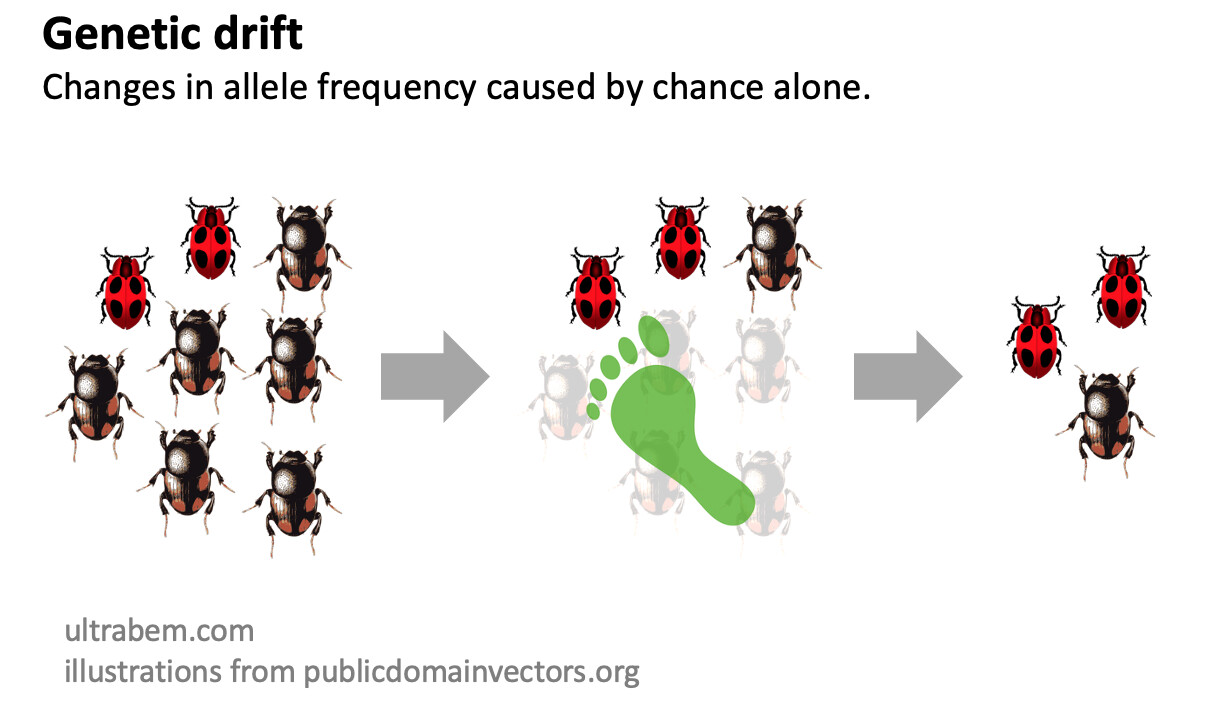
What are the two main types of genetic drift and their effects?
Founder Effect - When a small, isolated group separates from a larger group to establish a new population with different allele frequencies compared to the original group.
Bottleneck Effect - A sharp decrease in genetic diversity and population size caused by environmental events or human activities.
How does bacterial resistance to antibiotics start and progress?
Mutations randomly occur within a few cells while reproducing, causing it to be resistance to antibiotics
Antibiotics are used, killing off the non-resistant bacteria
Resistant bacteria survive and reproduce, slowly turning the entire bacterial population to antibiotic-resistant variant
What is convergent evolution?
When organisms from unrelated species independently evolve to have similar traits. (ex. dolphins and sharks)
What is divergent evolution?
When organisms from closely related species evolve to have traits different from a common ancestor and each other due to environmental pressures.
What is coevolution?
When two or more species simultaneously affect each other’s evolution. (ex. predator and prey arms race)
What is carbon dating (method of absolute dating)?
Measurement of the decay of carbon-14 to get the exact age of a fossil (half life).
What is the best evidence to support evolution?
DNA.
What are homologous structures?
Body parts of organisms with the same structures but different functions. (ex. human and whale)
What are analogous structures?
Body parts of organisms with different structures but the same functions. (ex. birds and butterflies)
What are vestigial structures?
Body parts that was once important for organisms but is now no longer used or functional. (ex. human tail bones)
What is taxonomy?
The science of grouping and naming organisms based on their characteristics.
What groups did the Greek philosopher Aristotle classify organisms as?
Plants and Animals.
What is Binomial Nomenclature?
A 2-part naming system; includes the animal’s genus and species. (ex. Homo sapien)
also when typing, type in italics
What is the order of biological classification from broad to more specific?
Domain
Kingdom
Phylum
Class
Order
Family
Genus
Species
What are the three domains of organisms?
Archaea (thrives in extreme environments; extremophile, either good or neutral, more closely related to eukaryotes than bacteria, all prokaryotic)
Bacteria (some can cause disease but most can be helpful, all prokaryotic)
Eukarya (all eukaryotic; with membrane bound organisms, more complex)
What does organisms need to be able to do in order to be considered a species?
They need to be able to reproduce and create viable offspring.
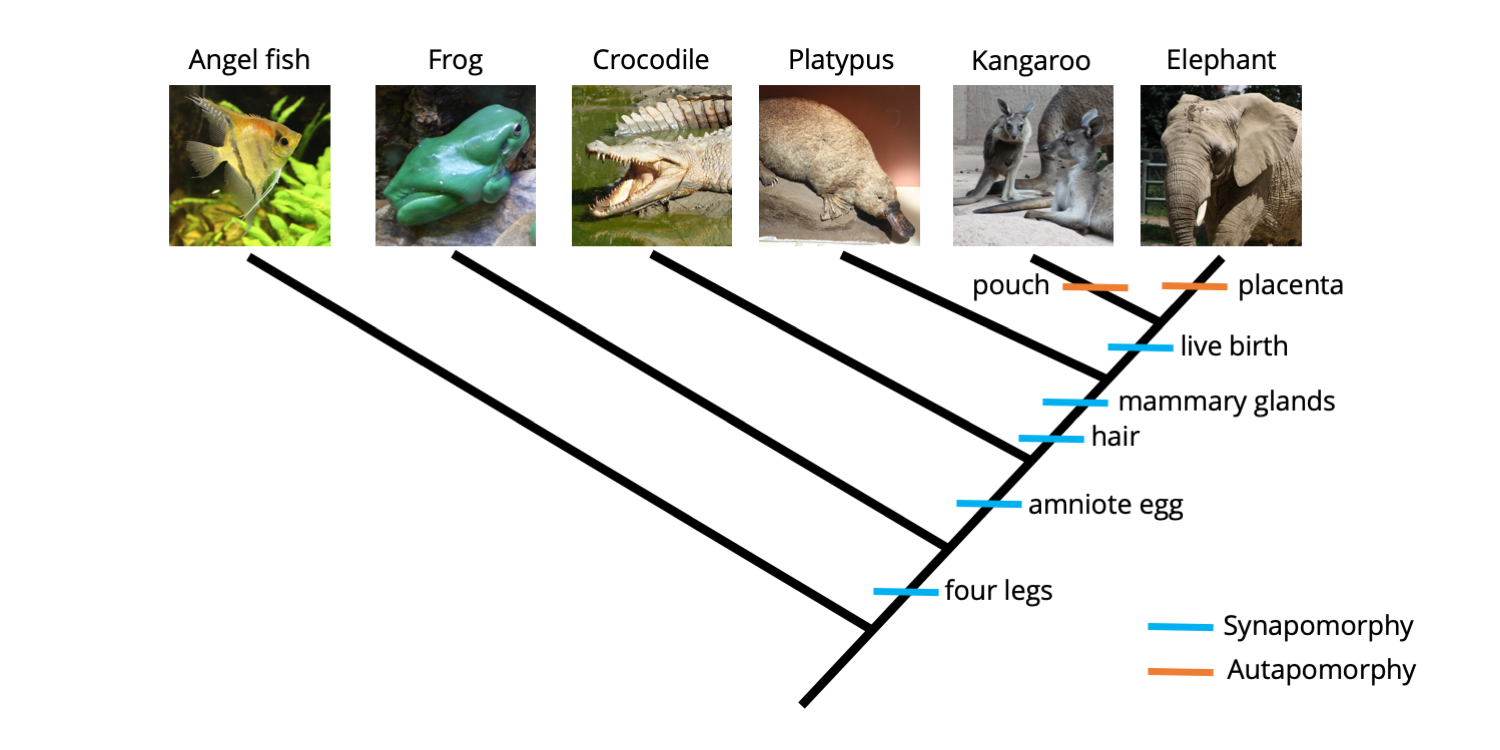
Which organism is closest to the ancestor? Which organism is closest to the elephant?
The Angel fish is closest to the ancestor (ancestor is left). The kangaroo is closest to the elephant (shares a lot of traits).
What are the number of cells in Eubacteria and Archaebacteria?
Unicellular
What are the number of cells in protists, fungi, plants, and animals?
Protists (both; mostly unicellular, algae is multicellular)
Fungi (both; mostly multicellular, yeast is unicellcular)
Plants (multicellular)
Animals (multicellular)
What are the mode of nutrition on Eubacteria and Archaebacteria?
Both some autotrophic and heterotrophic
What are the mode of nutrition on protists, fungi, plants, and animals?
Protists (both; some autotrophic and heterotrophic)
Fungi (heterotrophic)
Plants (autotrophic)
Animals (heterotrophic)
What are some examples of Eubacteria and Archaebacteria?
Eubacteria (E. coli, salmonella, lactobacillus)
Archaebacteria (Thermophiles)
What are some examples of protists, fungi, plants, and animals?
Protists (Euglena, paramecium, amoeba)
Fungi (Yeast, mushrooms, mildew)
Plants (Trees, grass, shrubs)
Animals (Humans, horses, dogs)
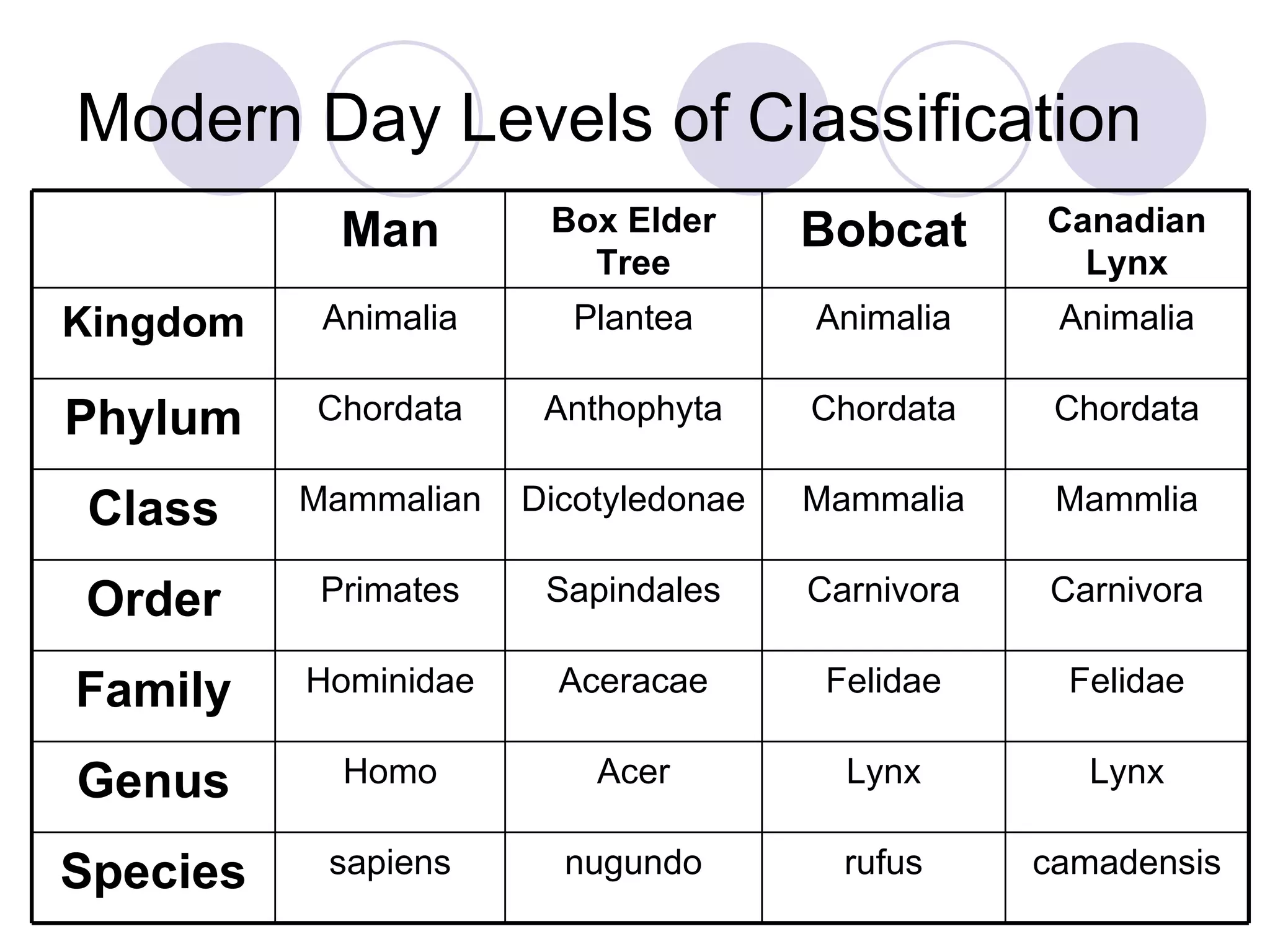
Which organisms are the most closely related with each other?
Bobcat and Canadian Lynx
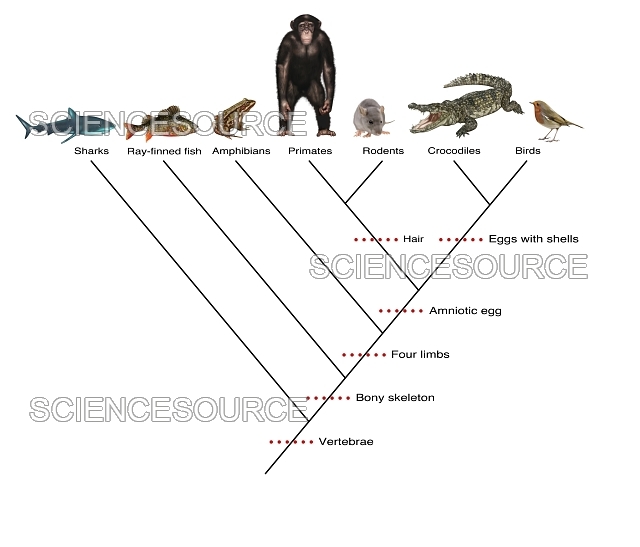
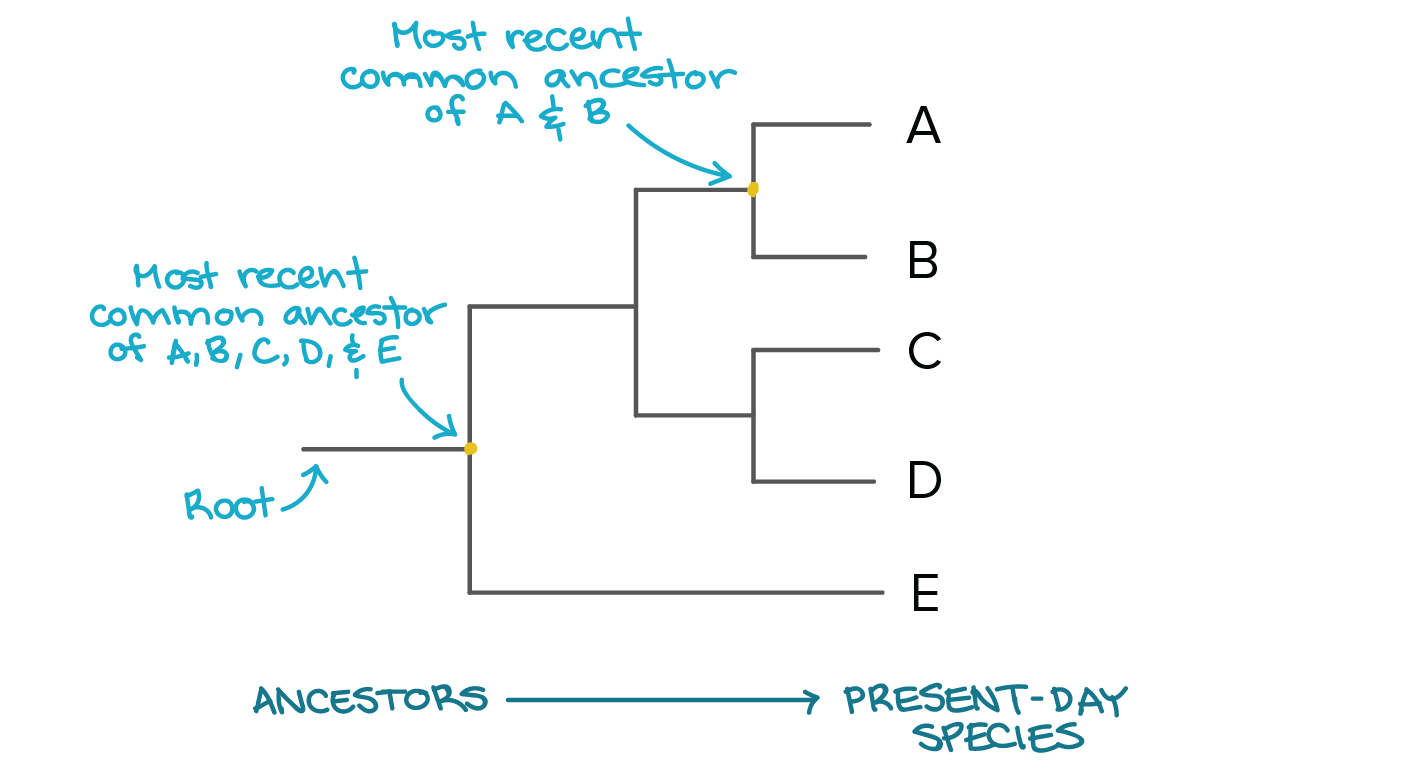
What is a cladogram?
A branching, tree-like diagram that shows how organisms branch off from common ancestors.
What is a clade?
A section of a cladogram that includes a mutual common ancestor and all descendants of the ancestor.
What are derived characters and what does it mean when two species share a lot of these?
They’re a trait evolved from an earlier ancestor and was passed along to it’s descendants. If they share a lot, it means they are more closely related.
click here to know how to read phylogenic tree (unless you already know)
Root of the tree is the common ancestor
Branches are the descendants of the ancestor
As you move from root to branch/tips you are moving forward in time
The area where the line “branches off (node)” is to indicate a new species has been formed
Which organisms is most related to rodents? Which organisms is the most closest related to sharks?