Exam 1
 Call Kai
 Learn
Learn Practice Test
 Spaced Repetition
 Match
Match Flashcards
 Knowt Play
1/111

There's no tags or description
Looks like no tags are added yet.
Name | Mastery | Learn | Test | Matching | Spaced | Call with Kai |
|---|
No analytics yet
Send a link to your students to track their progress
112 Terms
What are the 3 types of diversity?
Genetic — variation w/ in a spp
Species — types of organisms
Ecosystem — different types of habitats, biotic communities, or ecological processes
What are two methods for measuring biodiversity?
Species richness
Species abundance
Define species richness
Rich in number of species / Number of diff. species in habitat
Presence / absence
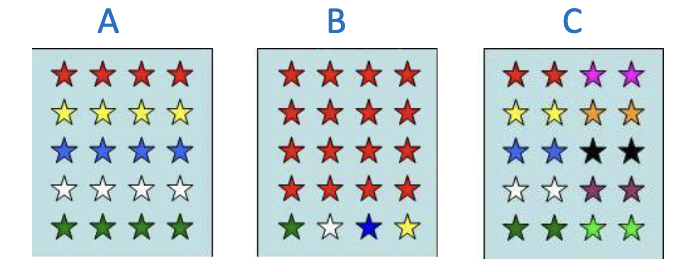
From image: C represents best richness
Define species abundance (evenness)
How evenly distributed a species is / Relative number of each type in a particular habitat
From image: A represents best evenness
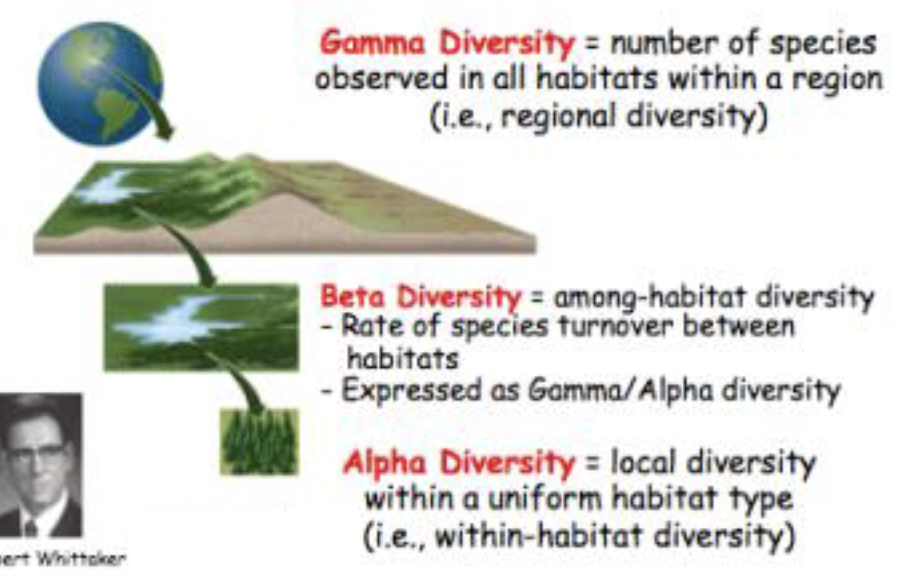
Define Alpha diversity
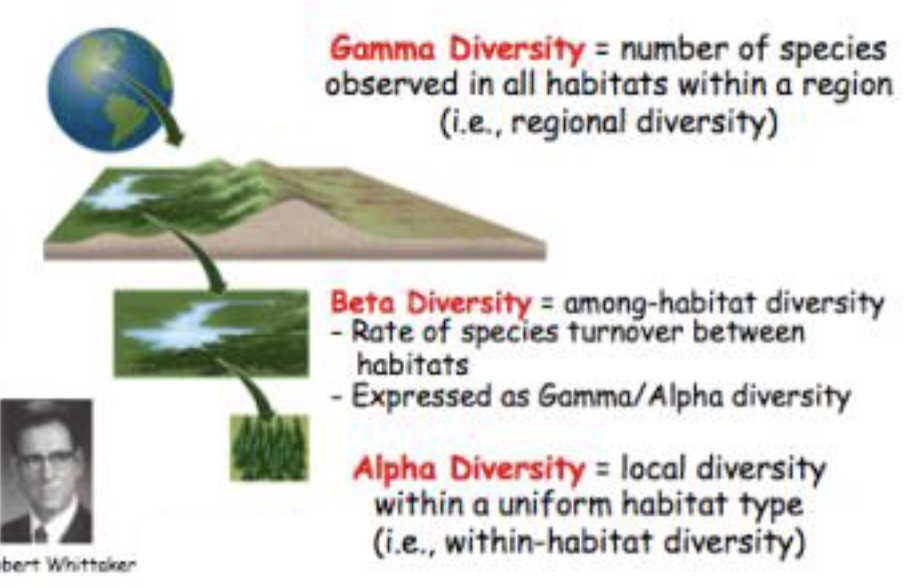
local diversity, or species diversity at a site
estimated by spp richness or by one of the alpha diversity indices
Define Beta diversity
spatial differentiation, or the variation in species composition among sites within a region of interest
Define Gamma biodiversity
regional diversity, or species diversity in a region of interest
estimated by pooling observations from a large number of sites in the area and computing an alpha diversity index
Why is biodiversity calculated based on genus or phyla, instead of species?
It can depend on your research question. As a scientist, you decide what is meaningful
Does marine biodiversity generally increase or decrease after a mass extinction?
increases
90% of all marine spp may have gone extinct, now twice as many marine invertebrates since 200 mya
What are the 10 factors that correlate with biodiversity species richness? (BIG 10)
sample size and sampling effort
body size
depth
lat and long
habitat size
habitat complexity
disturbance
productivity
grazing and predation
genetics and dispersal
BIG 10: Sampling size and effort
how many samples taken
how much info is in each sample
how large is each sample
BIG 10: Body size
small size tends to be more abundant
sampling and sorting size are selective
difficult to compare spp richness between samples collected using different methods
Within a habitat, is there a greater number of large or small individuals?
small
BIG 10: Depth
species richness tends to decrease with depth (deeper = harder to survive) - lower temps, productivity, and habitat heterogeneity
Rappaport’s rule — zones with higher species richness should also contain spp with smaller depth ranges, species diversity, and spread out into different depth niches
What is Rappaport’s Rule?
zones in the sea with higher spp richness should also contain spp with smaller depth ranges
BIG 10: Latitude and Longitude
generally higher diversity and richness in low latitude tropics, higher richness on western side of oceans
longitude: is there greater spp richness on the western or eastern side of the ocean? why?
western
more upwelling occurring creating more productivity
latitude: is there greater spp richness at the poles or the equator? and exceptions to this?
the equator
sharks, tuna, and swordfish have hotspots near mid-latitudes which are good hunting grounds for them
pycnogonids are diverse in antarctic waters
brachiopods are not found north of equator in Pacific, and have typical latitudinal gradient in Atlantic
why are there more species in the tropics?
still debated in literature
different reasons for different organisms
a few compelling hypotheses:
longer evolutionary history
higher productivity (can support more species)
shorter generation times and faster rates of evolution
BIG 10: Habitat size
larger habitats support higher number of species and more niches for species to diversify into
primarily through decreased extinction
depth or latitude ranges are not considered habitats
BIG 10: Habitat complexity
large areas of homogenous habitat are unlikely to support large number of species
BIG 10: disturbance
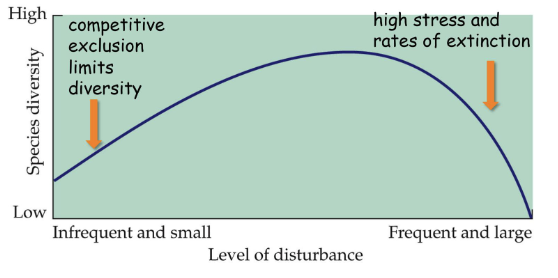
the greatest biodiversity in found in intermediate areas of disturbance
intermediate disturbance hypothesis
BIG 10: Productivity
high nutrient levels and higher productivity can cause higher OR lower species diversity (depends on habitat or species)
coral reefs more diverse in lower nutrient concentrations
bivalve mollusks more species rich in high nutrients
eutrophication can be an issue with excessive nutrient concentrations
Define: Eutrophication
when a body of water receives an excessive nutrient load, resulting in an overgrowth of algae
algae dies and decomposes, depleting oxygen from water and causing mass death
BIG 10: Grazing and predation
higher trophic levels affect lower trophic levels
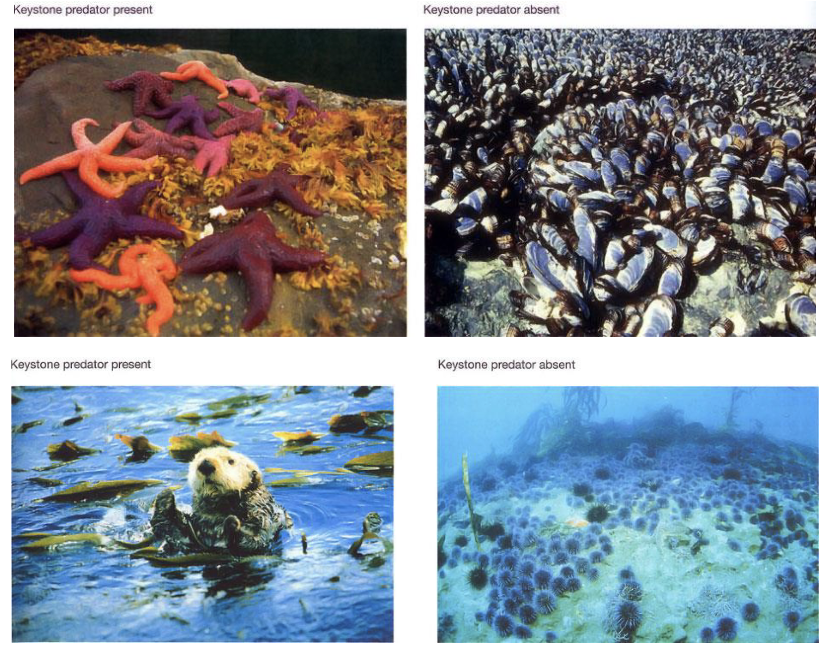
top-down forcing
trophic cascades
keystone predators
regime shifts / phase shifts
BIG 10: Genetics and dispersal
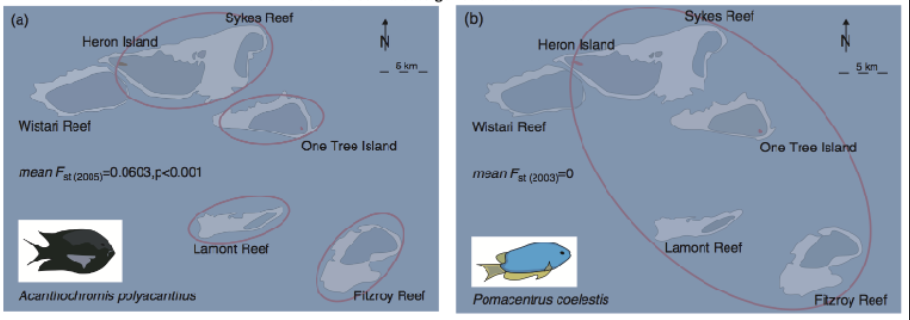
how far apart populations are and how far species can spread genetic information (species moving, spores traveling, etc.)
spatial genetic variability is linked to geographic distances between populations and the ability of species to disperse
You will have more species in a habitat when…
the environment is productive and has favorable conditions to support life
increase in colonization
decrease in extinction
a dominant competitor is suppressed
What is dispersal vs. migration?
Dispersal — movement of members of a spp or population from one place to another (one-time)
Migration — daily, seasonal, annual and multi-annual movement - OFTEN repeated
What are the three stages of dispersal?
departure (emigration)
vagrant (traveling)
settling (immigration)
Why disperse?
Chance of survival
spread biological material
seek out more resources
avoid predators
avoid competition and resource limitation
increase genetic diversity (reduce inbreeding)
escape stressful area or conditions
reduce risk of disturbance (disease, parasites, etc.)
Departure: what are brooders?
Spp that:
care for young
generally few offspring at once
internal fertilization (shelled eggs or live birth)
quality over quantity
Departure: what are broadcast spawners?
Spp that:
release hatched larvae, fertilized eggs, or sperm and unfertilized eggs (fertilization away from adults)
larvae mature and travel in water before settling
quantity over quality
Departure: Eggs (two locations)
Demersal (near bottom):
laid close or attached to substrate
female lays eggs, male then fertilizes
larger and fewer eggs (energy)
limited dispersal
Pelagic (open ocean)
broadcast spawning
large dispersal
Departure: Larvae (two types)
Planktotrophs — feed for themselves, longer development time
Lecithotrophs — limited or no feeding, relies on energy stores supplied by adult, development success depends on egg size
What are advantages of planktonic life stages?
water or longer dispersal
can stay in water column longer since they feed
moving away helps avoid resource competition and reduces inbreeding
lower energy investment for parents, more can be released
higher genetic diversity with larger numbers
short lifespan, faster evolution
reduce benthic mortality by predation
What are disadvantages of planktonic life stages?
vulnerable to predation in open water
need to seek out food
reliant on environment for survival
risky to disperse away from home habitat
different needs between larval and juvenile life stages
larvae need a cue signal to signal metamorphosis and settlement
Departure: spawning and hatching
timing is important
determined by env. cues (moon, tidal height, temp.)
spawning aggregations
sessile spp (release of gametes usually determined by temp._
What is the “mismatch hypothesis”?
implies that variability in timing of phytoplankton production leads to variability in larval mortality and hence possible fish year class strength
Dispersal stage: traveling
Planktonic Larval Duration (PLD)
higher temp, higher metabolism and development, shorter PLD
PLD affects dispersal distances and genetic structures of populations
Traveling: Connectivity
release frequency affects population networks
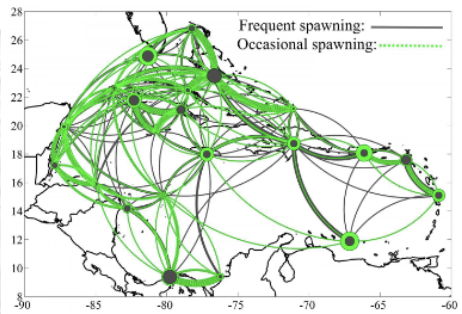
Traveling: Currents
affects dispersal distances and direction
adjust release timing
selective tidal stream transport (go to surface on flood tides and sink to bottom on ebb tides to get back to shore)
Traveling: Retention
never leave home
wander planktonically, return
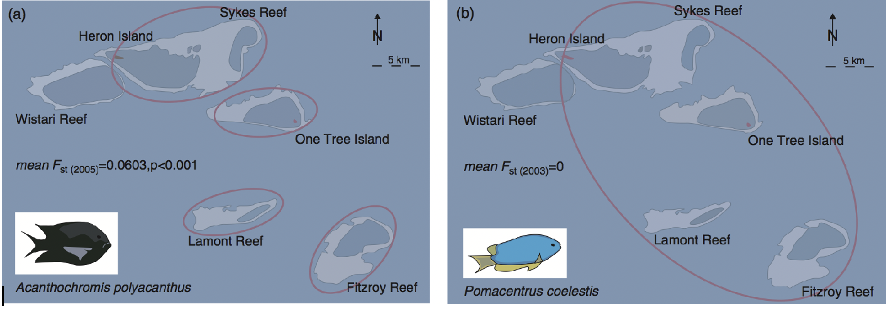
Which species lacks a planktonic stage?
A
What mechanisms are in place to guide settlement success?
ecological / biological — presense of predators or competitors
physical — wind, tides, currents
chemical — water or substrate chemistry
combination of all
What are some cues and stimuli to aid settlement?
biological / ecological — biofilms, conspecifics
physical — temperature, current flow, tidal height, substrate preference
chemical — scents and smells
Why migrate?
food availability
avoid predation
breeding / spawning grounds
avoid physical stress
what are the two types of fish migration? what do they mean?
Anadromy — freshwater to saltwater (salmon)
Catadromy — saltwater to freshwater (eels)
During migration, how do you know where to go?
olfactory cues
the sun
geomagnetic / electrical signals (turtles, sharks)
How do benthic invertebrates migrate?
they have a seasonal migration of inshore and offshore
Why are there vertical zones, with dominance often of a single sessile species within a zone?
possible explanations:
differences in tolerance of env conditions across species at different tidal heights
competitive interspecific interactions
predation changes with tidal level
is the upper or lower intertidal more exposed in the rocky intertidal?
the upper intertidal is more exposed
what are some stresses in zonation in the rocky intertidal?
Physical —
desiccation
wave action
temperature
Biological —
predation
competition
in what rocky intertidal zone is physical stress the greatest? why?
the upper intertidal
more variation in salinity, moisture, and temperature, but less species living there so less competition
in what rocky intertidal zone is biological stress the greatest? why?
lower intertidal
more marine organisms and you must be able to compete with them and defend yourself
in a salt marsh, where is physical and biological stress the greatest?
Biological — upper intertidal
Physical — lower intertidal
It is the opposite of the rocky intertidal
What are adaptations to intertidal challenges (biological and physical)
Desiccation - shells, behavior changes
Salinity - euryhaline (adapted to wide range of salt) vs. stenohaline (adapted to narrow level of salt)
just know some species more adapted to salt than others
oxygen consumption - breathe in air and water, some close in shell
wave action - attachment and body shape adaptations
three phases of salt pan disturbance?
killing of grass by wrack (salt accumulation on blades)
wrack carried away - high salt prevents seed germination plant growth
(possible) rain dissolve salts, recolonization by runners of grasses, germination by some seeds in sediment
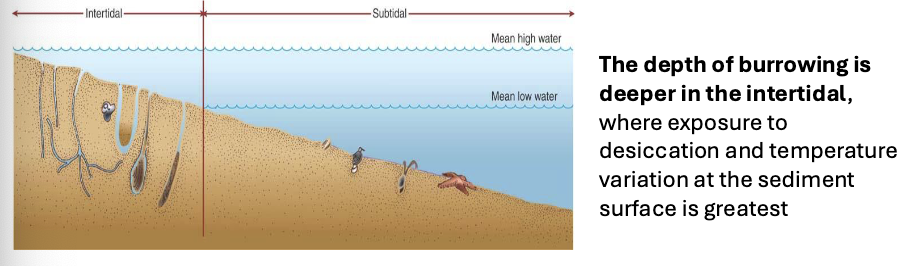
soft sediments: vertical stratification
dominant species found at different levels below sediment-water interface
experimentally reduce density of deep-dwelling clams, remaining individuals grow faster; demonstrates effect of density
removal of shallow dwelling species of bivalves has no effect on growth of deeper-dwelling species
what are angiosperms?
flowering plants, mostly living on land
salt is stressful and few can withstand, so angiosperms want to get away from it, where most comp. will be with herbivore / terrestrial wildlife
Types of coral growth forms zonation: vertical gradient
- Flatter forms tend to be more common in deeper areas of the reef, probably to help with capturing all possible light available
- Taller, more branching colonies tend to be more common in the shallower areas of the reef, due to intense competition for space and light
what are two strategies to deal with desiccation?
hiding - moving to a tide pool with more moisture (motile organisms) or only living in areas where moisture remains when tide is out (shallow rocks / crevices)
clamming up - closing shells in attempt to conserve moisture
what is the trade-off or risk when “clammed up”?
they’re not foraging
challenges with oxygen consumption in the intertidal?
usually cannot respire at time of low tide
respiratory organs (gills) must be moist to acquire oxygen and so are usually withdrawn at low tide
some animals reduce rate at time of low tide
some high intertidal animals can respire from air even at low tide, as long as air is not too dry
challenges with oxygen availability in the intertidal?
O2 can be exhausted if organism clams up during low tide
can also be exhaused in tide pools if high density of organisms, particularly algae, at night (no photosynthesis)
CO2 can build up
some organisms have evolved the ability to exchange gases in both air and water
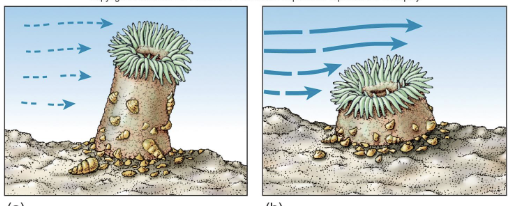
would you expect organisms to be taller / larger in high or low wave energy?
shorter in high wave energy
taller in low wave energy
scientific name for the American Eel?
Anguilla rostrata
define: metapopulation
a group of populations that are separated by space but consist of the same species
spatially separated populations interact as individual members and can move from one population to another
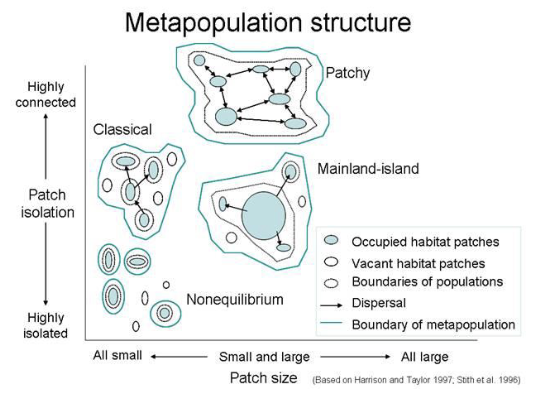
define: population
a group of the same species living together, that have the potential to breed
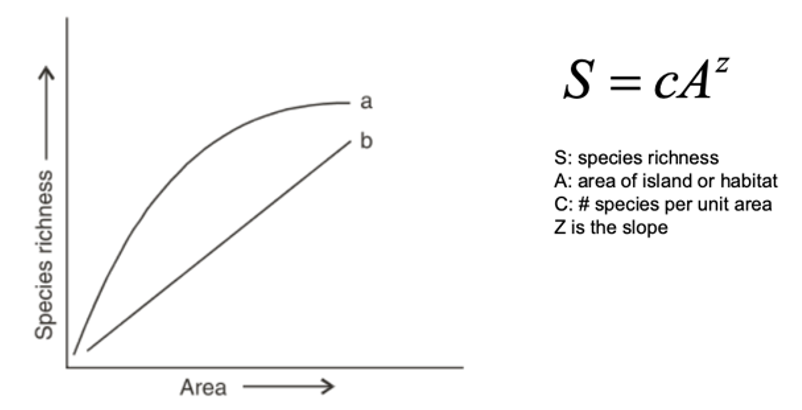
does this equation describe curve A or linear curve B?
this equation describes curve A
its a power function, or sigmoidal curve, because species are not uniformly distributed across the landscape
also, habitat heterogeneity increases with area
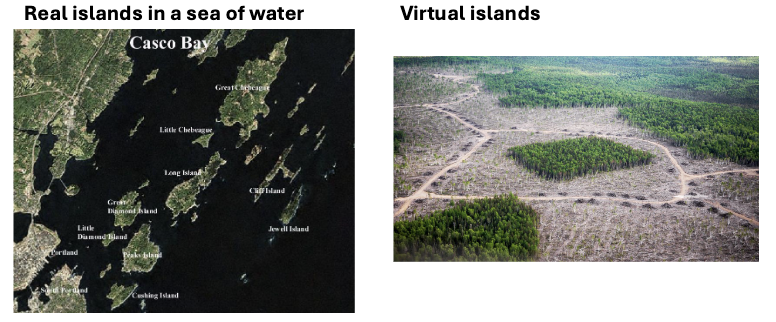
what are habitat patches referred to in terms of metapopulations?
they’re islands
separation can be natural OR anthropogenic
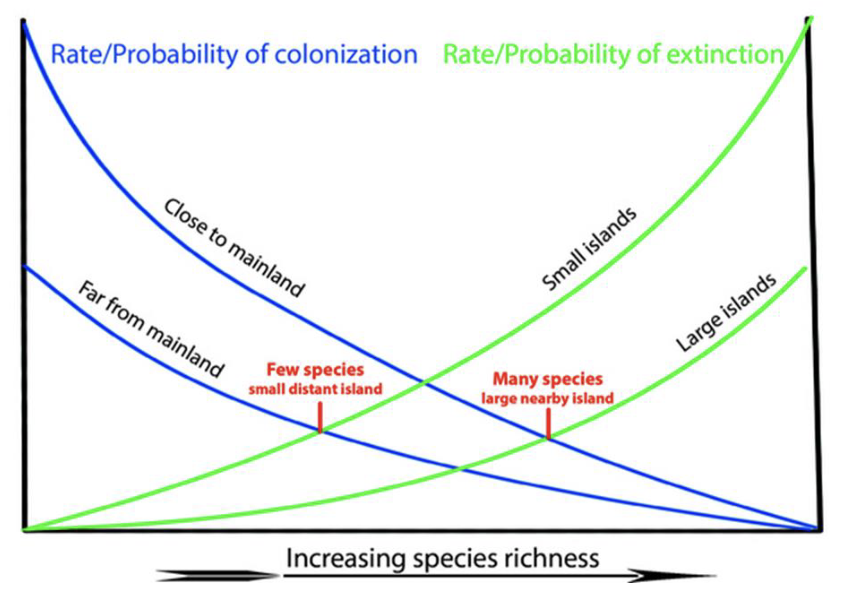
draw the Equilibrium Theory of Island Biogeography ***
island size affects extinction rates
island remoteness affects immigration rates
predictions on long term trends
number of species reaches constant level
continual species turnover
what is the species-area relationship?
larger patches can hold more species
what’s a pioneer species
1st species to colonize a newly disturbed area
r-selected
what are characteristics of an r-selected species
high reproductive effort
high growth rate
short life span
low competitive ability
parental investment is all pre-fertilization (massive amt of gamete production)
what is a late successional / k-selected species?
low reproductive output
higher maternal investment per offspring
high competitive availability
long life span
slow growth rate
offspring nourished / protected / learn by parents
traits of intermediate r/k selected species?
nest building, guarding
carrying eggs in / on the body
mouth brooding (some through early larval stage)
(some invertebrates, some fish, turtles)
disturbances are physical events that can…
influence mortality
affect reproduction
influence distribution and abundance of organisms
reduce abundance of competing species
allow colonization of species adapted to disturbance
allow coexistent of competitively inferior species
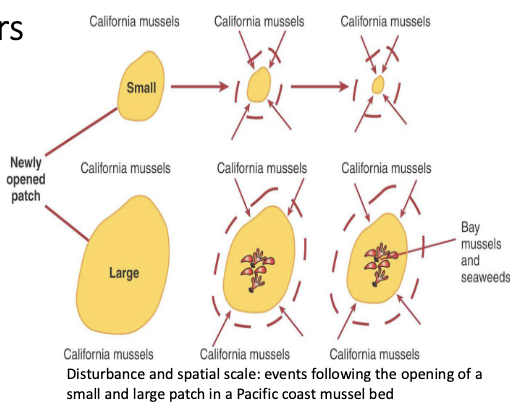
spatial scale of disturbance is crucial in subsequent colonization events, how? **
a very small scale disturbance (small patch) in mussel bed might just result in them moving and sealing off opened patch
larger patches might be colonized by other species, and patch might last many months or indefinitely
therefore, spatial scale of disturbance might affect spatial pattern of dominance of species, creating a mosaic of long-lived patches
in terms of disturbance, why do spatial scales matter?
cannot extrapolate all interactions at small → large scale
larger patches created by disturbance may be qualitatively diff than small scale - outcomes may be diff
at habitat scale, potential for alternative stable states
what is abrasion (wave shock)?
particles (rock, sand, etc.) in suspension scrape delicate structures
define: disturbance
usually refers to physical change in environment that causes mortality or affects reproduction (storm, ice scour)
what is the intermediate disturbance hypothesis?
low levels — competitive dominant species takes over
intermediate levels — promotes coexistence, more species present
high levels — most individuals removed, reduces total number of species
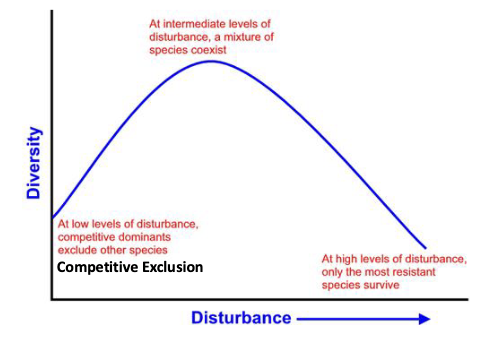
what is competitive exclusion? at what level of disturbance does this occur?
whoever is most competitive, wins. they are excluding everyone else, and this happens as LOW levels of disturbance
at high levels of disturbance, only the most successful, top dog predator wins
define: succession
predictable order of appearance and dominance of species, usually following a disturbance
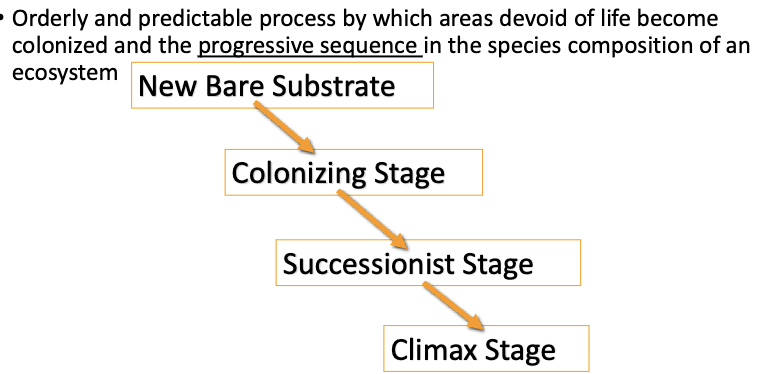
some examples of disturbance and colonization?
volcanism (surface lava flow) → coral colonization
volcanism (hydrothermal vent) → deep-sea invertebrate colonization
deposition of sand → colonization by burrowers
what are the 2 types of succession? examples?
Primary
growth occurs on newly exposed surfaces where no soil exists
example - natural events such as retreating glaciers scrape existing rock bare or new rock can form when lava cools
Secondary
growth occurring after a disturbance changes a community without removing the soil
example - after a forest fire, or once a cultivated field, or coral bleaching event
what are the three mechanisms of succession? (be able to look at data and state which mechanism it is)
Facilitation
early species improve habitat (early spp. may or may not win)
early marine colonists might provide substrate for settling of later arriving species
Inhibition
early species take precedence (early spp. win)
competition for space, nutrients and light or territoriality
Tolerance
late-successional species are unaffected by earlier ones and can establish and mature in their presence because they are better at tolerating lower resource levels
early species are less able to tolerate limited resources than late spp. or are less capable of directly competing (early spp. lose)
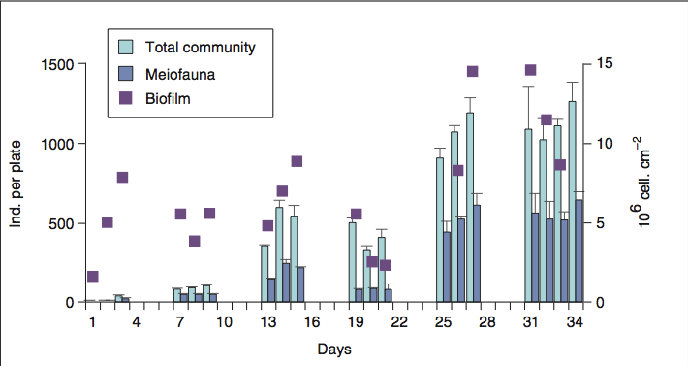
what is the mechanism? (succession)
facilitation
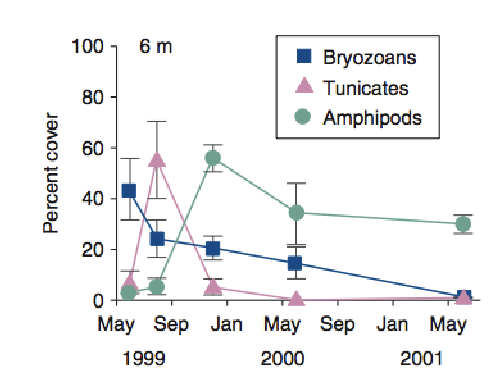
what is the mechanism? (succession)
facilitation AND tolerance
early species are less able to tolerate limited resources than late spp. or are less capable of directly competing (early spp. lose)
what are the stages of succession? examples in different marine communities?
pioneer —> climax
example: whale fall
mobile scavenger stage - active scavengers consume soft tissues
enrichment opportunistic stage - warm of invertebrates move in, colonizing in the bones as they are supported by the organic matter left in carcass
sulfophilic stage - bacteria feed on lipids; chemosynthetic bacteria dominates
reef stage - most organisms have been broken down and it’s just the skeleton as habitat
Are climax communities common in marine benthic communities?
yes coral reefs are a prime example - high biodiversity and complex structure
what are the four different types of interactions between species (interspecific interactions)?
competition — two organisms mutually harm one another
predator-prey / parasite-host — one organisms benefits, the other is harmed
mutualism — both organisms’ benefit
commensalism — one organism benefits, the other is not affected
two types of resources that species compete for?
renewable - e.g., copepods exploiting diatom population
non-renewable - space on a rock expoilted by long-lived sessile species
three outcomes of competition?
competitive displacement — one species outcompetes another for a resource
coexistence — two species exploit different resources, some process allows two species to exploit same resource without displacement (resource partitioning, character displacement)
extinction — usually local, habitat shift
what is intraspecific competition?
competition between organisms of the same species
occurs regularly and can maintain, in the long-term, populations around their carrying capacity
density dependence
as organisms approach K, they compete for food, space, refuge, mates
results in reduced population growth due to increase morality / reduce fecundity due to disease, starvation, fighting, etc.
what is interspecific competition?
competition between organisms of two different species
how do individuals in a population compete? (inter- comp)
exploitation competition — use of a resource by one population affects how much is available to other populations (organisms interact INDIRECTLY by consuming scarce resources)
interference competition — one population affects another populations capability by using the resource (organisms interact DIRECTLY by fighting for scarce resources)
define: ecological niche
the sum total of an organism’s use of the biotic and abiotic resources in an environment
includes space utilization, food consumption, temperature range, moisture requirements
what is a niche versus a habitat?
niche
like an occupation
what an organism does
habitat
like an address
where an organism lives
why can’t some species occupy their entire niche?
the presence or absence of other species
interspecific competition
observation of this in nature has led to concepts of fundamental and realized niche