molecular biology final
 Call Kai
 Learn
Learn Practice Test
 Spaced Repetition
 Match
Match Flashcards
 Knowt Play
1/1111

There's no tags or description
Looks like no tags are added yet.
Name | Mastery | Learn | Test | Matching | Spaced | Call with Kai |
|---|
No analytics yet
Send a link to your students to track their progress
1112 Terms
What are spontaneous mutations?
Mutations that occur naturally without external influence, often during DNA replication.
How can DNA polymerase cause mutations?
It may insert incorrect nucleotides due to mispairing during replication.
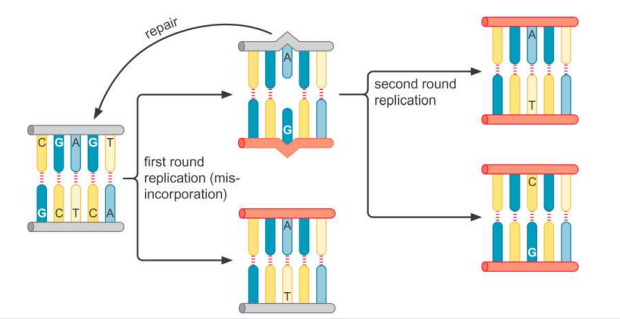
What happens if replication errors are not repaired?
They can become permanent and lead to point mutations.
What is a point mutation?
A change in a single nucleotide in the DNA sequence.
What is replication slippage?
A replication error that causes small insertions or deletions in DNA.
What are insertions and deletions?
Mutations where nucleotides are added (insertions) or removed (deletions) from DNA.
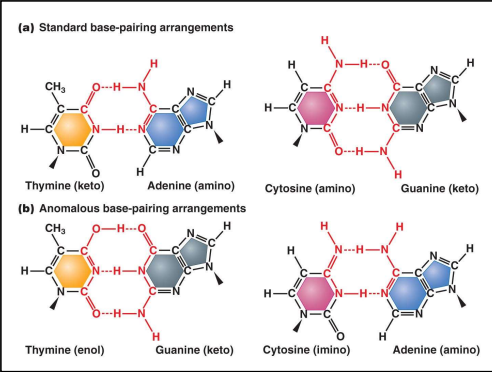
What is a tautomeric shift?
A temporary change in the chemical structure of a nucleotide due to proton movement.
How do tautomeric shifts cause mutations?
They allow abnormal base pairing with noncomplementary bases.
What are tautomers?
Alternate chemical forms of a nucleotide that differ by the position of a proton.
Why do tautomeric shifts affect base pairing?
Because they change the bonding structure, altering hydrogen bonding patterns.
Show a tautomeric shift.
Show the effects of tautomeric shift
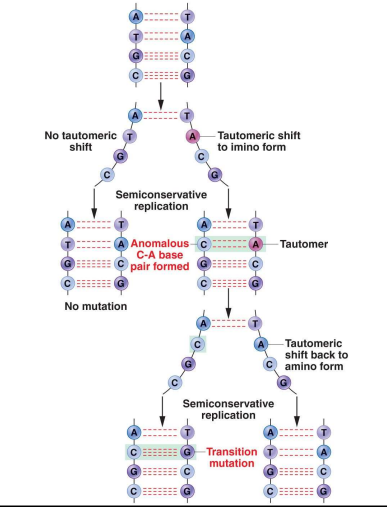
When can a mutation occur due to tautomeric shifts?
During DNA replication when a tautomer in the template strand pairs with a noncomplementary base.
What happens in the next replication cycle after mismatching?
The mismatched bases separate and each serves as a template for correct pairing.
What is the final result of tautomer-induced mismatching?
A permanent point mutation.
What is the most common cause of spontaneous mutations?
DNA base damage such as depurination and deamination.
What is depurination?
The loss of a purine base (adenine or guanine) from DNA.
What happens to DNA during depurination?
A base is removed, leaving an empty site (AP site) in the DNA strand.
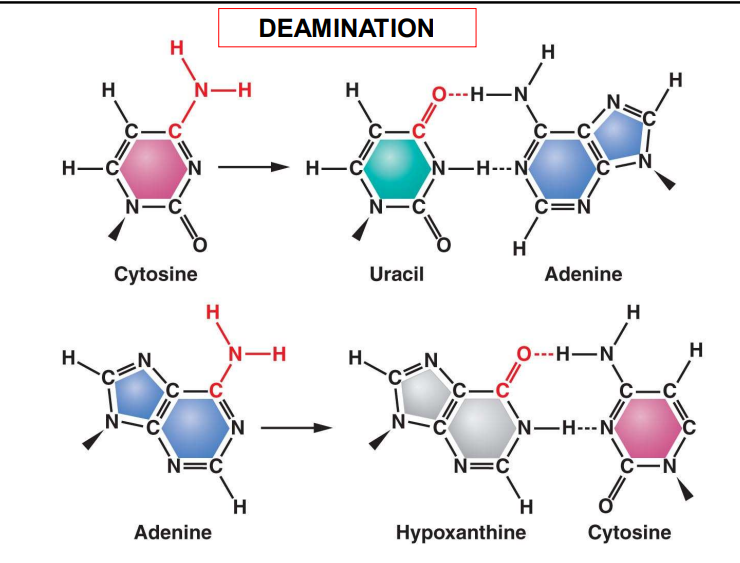
What is deamination?
The removal of an amino group from a nitrogenous base.
What happens when cytosine undergoes deamination?
Cytosine is converted into uracil.
What happens when adenine undergoes deamination?
Adenine is converted into hypoxanthine.
Why do depurination and deamination lead to mutations?
They alter normal base structure and pairing, causing errors during replication.
Show deamination.
What causes oxidative DNA damage?
By-products of normal cellular processes.
What are Reactive Oxygen Species (ROS)?
Highly reactive molecules that can damage DNA.
Name three common Reactive Oxygen Species (ROS).
Superoxide (O₂⁻), hydroxyl radical (·OH), and hydrogen peroxide (H₂O₂).
Why are ROS dangerous to DNA?
They threaten DNA integrity by causing damage and mutations.
Besides cellular processes, what else generates ROS?
Exposure to high-energy radiation.
What are transposons?
DNA elements that can move within or between genomes.
In which organisms are transposons found?
In the genomes of all organisms.
Why are transposons considered mutagens?
Because their insertion into new locations can cause mutations.
How can transposons affect coding regions?
They can alter the reading frame or introduce stop codons.
How can transposons affect gene regulation?
They can disrupt gene expression when inserted into regulatory regions.
What types of chromosomal damage can transposons cause?
Double-strand breaks, inversions, and translocations.
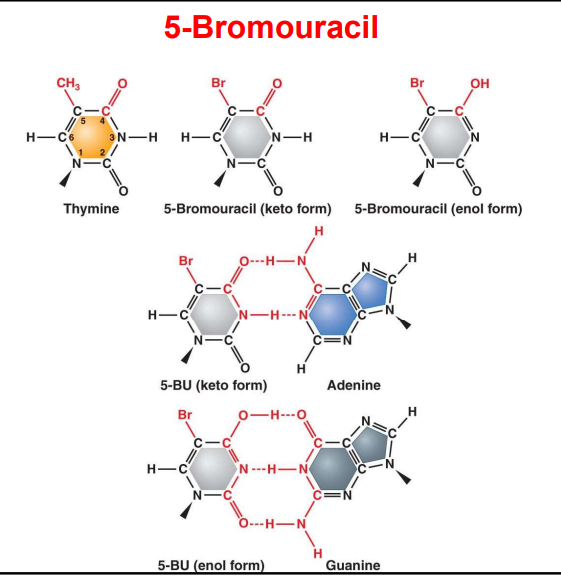
Show 5-Bromouracil
What are induced mutations?
Mutations caused by external agents such as chemicals and radiation.
What are mutagens?
Natural or artificial agents that induce mutations.
Give examples of natural mutagens.
Fungal toxins, cosmic rays, and UV light.
Give examples of artificial mutagens.
Industrial pollutants, medical X-rays, and chemicals in tobacco smoke.
What are base analogs?
Mutagenic chemicals that can replace normal DNA bases during replication.
What is an example of a base analog similar to thymine?
5-bromouracil (5-BU).
Why is 5-bromouracil mutagenic?
It can pair with adenine or guanine, causing mismatches.
What is an example of a base analog similar to adenine?
2-aminopurine (2-AP).
Why is 2-aminopurine mutagenic?
It can pair with thymine or cytosine.
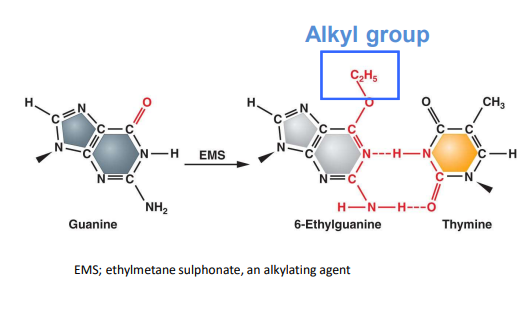
What are alkylating agents?
Chemicals that add alkyl groups to DNA bases, altering base pairing.
What is a historical example of an alkylating mutagen?
Sulfur-containing mustard gas.
How do alkylating agents cause mutations?
By modifying amino or keto groups in nucleotides, changing base-pairing affinity.
Show an alkyl group.
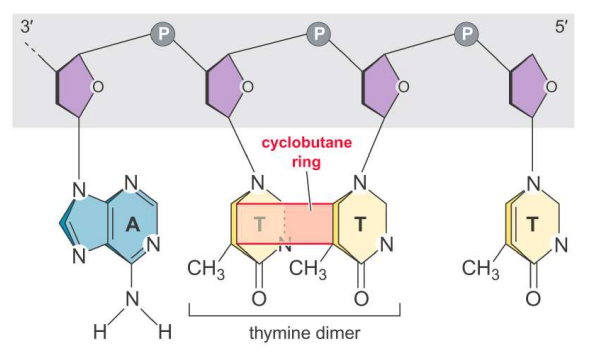
Show a thymine dimer.
What are intercalating agents?
Molecules that insert (wedge) between DNA base pairs due to their shape and size.
How do intercalating agents affect DNA?
They distort DNA structure and can cause mutations during replication.
What type of mutation do acridine dyes cause?
Frameshift mutations.
How do acridine dyes cause frameshift mutations?
By intercalating between purines and pyrimidines in DNA.
Why are intercalating agents used in cancer chemotherapy?
Cancer cells replicate DNA more frequently, making them more sensitive to DNA damage.
What is an example of an intercalating agent used to treat Hodgkin lymphoma?
Doxorubicin.
What is an example of an intercalating agent used to treat sarcomas?
Dactinomycin.
What causes induced mutations?
DNA damage from chemicals and radiation.
What is the relationship between wavelength and energy in electromagnetic radiation?
Energy is inversely proportional to wavelength.
Which electromagnetic waves are generally harmless?
Visible light and longer wavelengths.
Why are shorter wavelength radiations more dangerous?
They have higher energy and can disrupt organic molecules.
What type of DNA damage does UV light cause?
Pyrimidine dimers.
At what wavelength is UV radiation most strongly absorbed by DNA?
Around 260 nm.
How do pyrimidine dimers affect DNA?
They distort DNA structure and lead to replication errors.
What types of radiation are considered ionizing?
X-rays, gamma rays, and cosmic rays.
How does ionizing radiation damage cells?
By creating free radicals that damage DNA and other molecules.
Show DNA replication without and with repair.
How many DNA-damaging events occur in a human cell per day?
Tens of thousands per cell per day.
Why is DNA integrity important?
Because DNA stores all genetic information in living cells.
How can DNA damage affect cellular processes?
It can interfere with transcription and replication.
What can DNA damage lead to if not repaired?
Mutations, cancer, diseases, and aging.
Why are DNA repair systems essential?
They maintain genetic integrity and ensure organism survival.
What have cells evolved to deal with DNA damage?
A network of DNA repair mechanisms.
Do all DNA damages require the same repair mechanism?
No, different types of damage require different repair mechanisms.
What is the DNA Damage Response (DDR)?
A coordinated series of events that detects, signals, and repairs DNA damage.
What are the main steps of the DNA Damage Response?
Detection, signaling, and repair of DNA damage.
When does DNA damage become especially harmful?
When there is overexposure to mutagens.
Why is excessive mutagen exposure dangerous?
Because the cell cannot repair all damage in time.
How does aging affect DNA repair?
Repair effectiveness decreases with age.
Show accumulation of DNA damage.
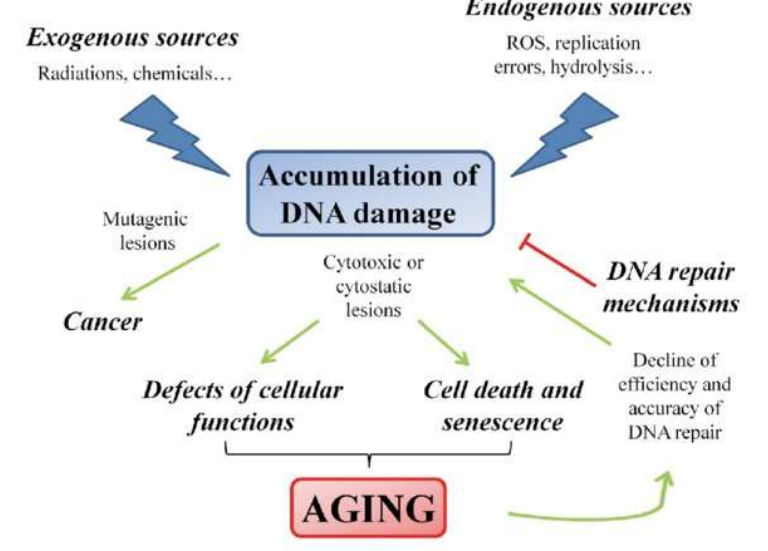
Show an diagram about DNA repair system.
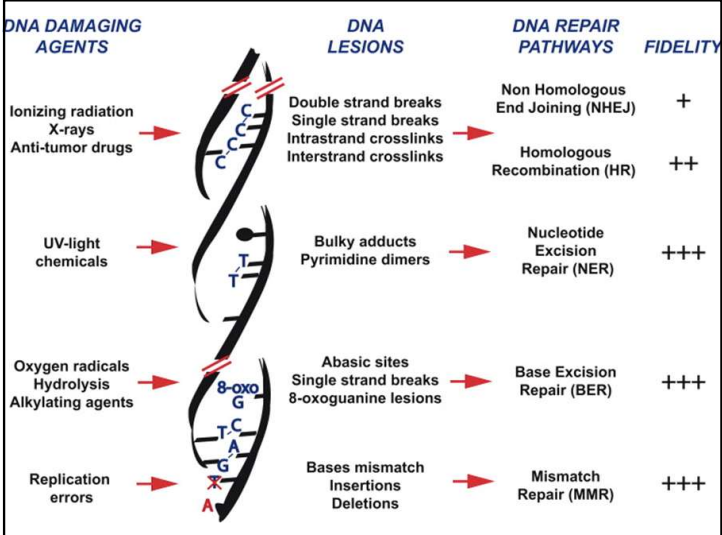
What are the types of repair mechanisms?
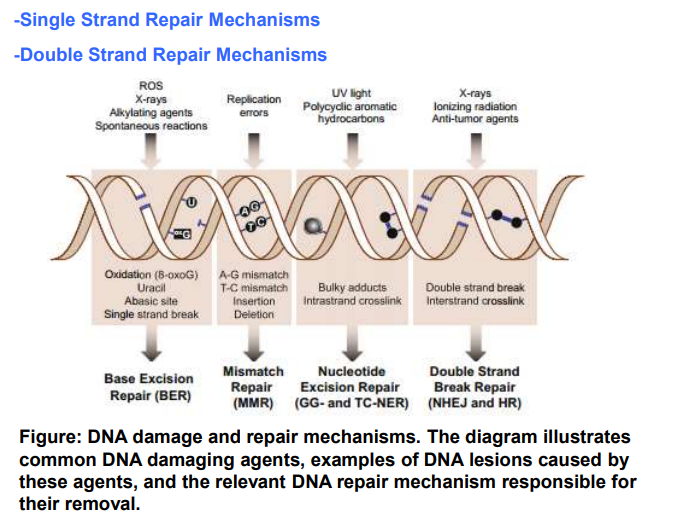
Types of repair mechanisms?
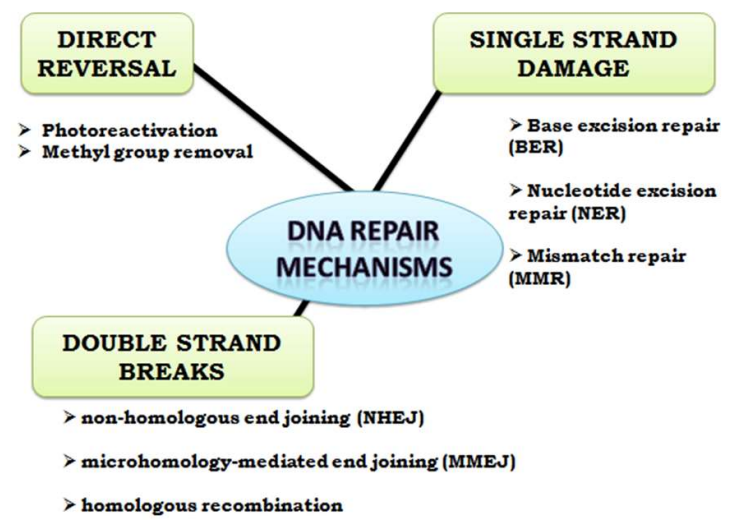
Why have cells evolved DNA repair mechanisms?
To remove different types of DNA damage.
Do all DNA damages use the same repair mechanism?
No, different damages require different repair mechanisms.
What is the DNA Damage Response (DDR)?
A coordinated cascade of cellular events activated after DNA damage.
What are the main functions of the DNA Damage Response (DDR)?
Detecting DNA damage, signaling its presence, and mediating repair.
What happens when cells are overexposed to mutagens?
The damage exceeds repair capacity and leads to serious problems.
Why is excessive mutagen exposure harmful?
Because cells cannot repair all DNA damage in time.
How does aging affect DNA repair?
Repair efficiency decreases with age.
What type of mechanisms repair DNA damage in cells?
Enzyme-based repair mechanisms.
What is the role of enzyme-based DNA repair systems?
To prevent and repair DNA damage and mutations.
In which organisms do DNA repair mechanisms occur?
Both prokaryotes and eukaryotes.
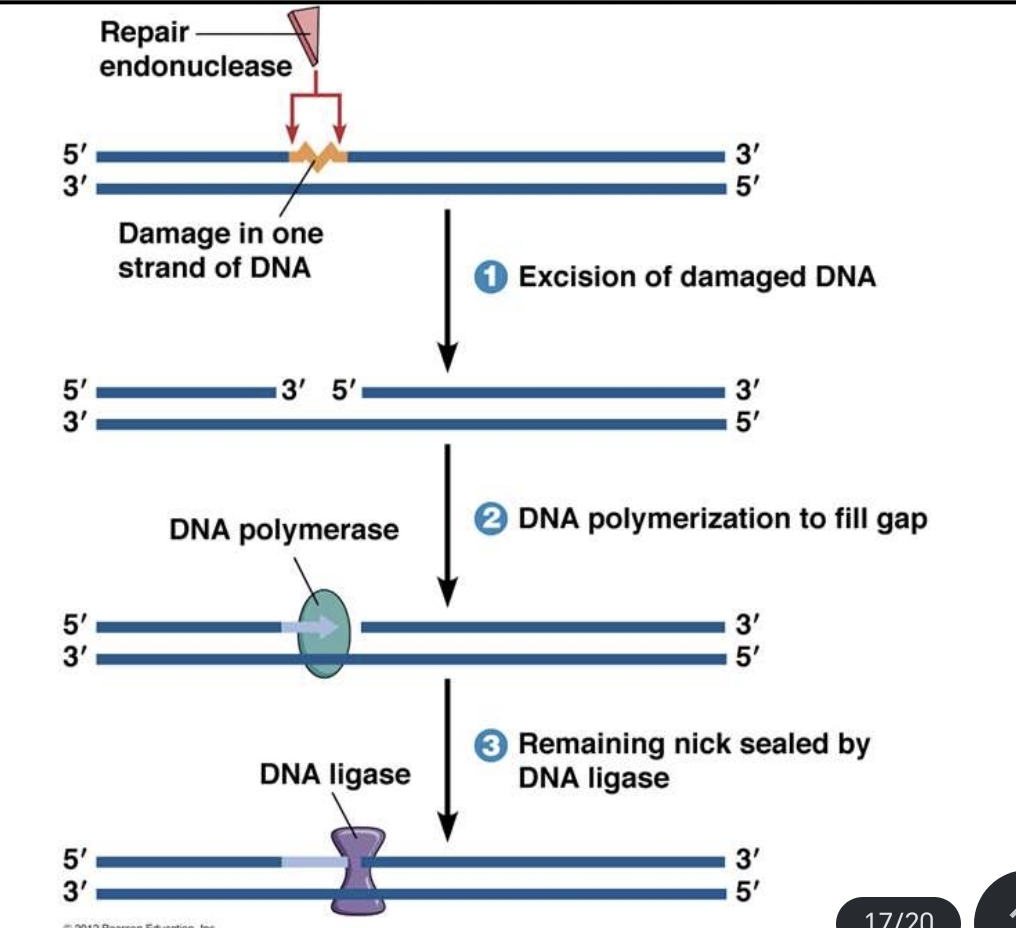
What are the basic DNA repair mechanism?
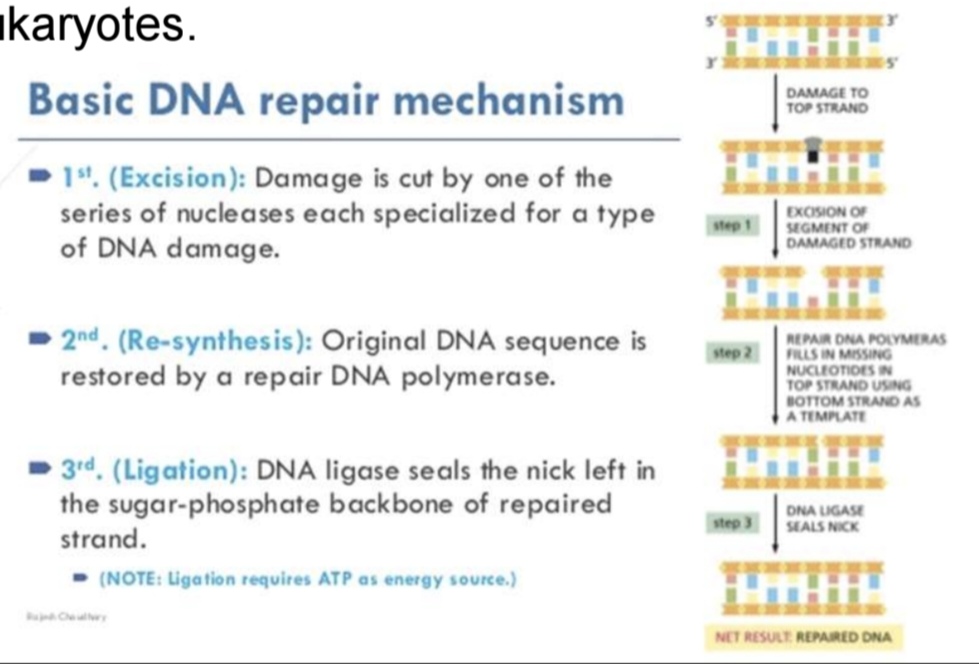
Show the steps of DNA repair.
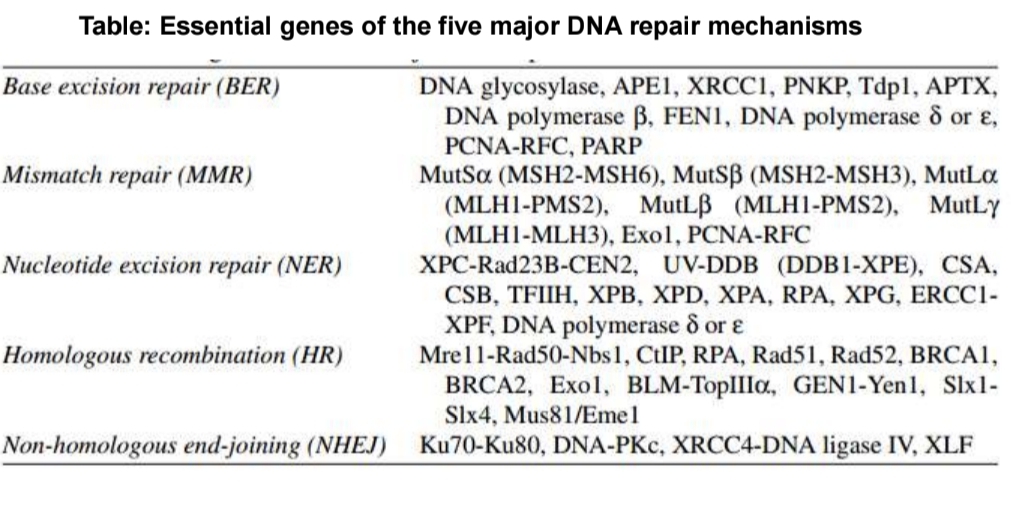
Show the essential genes of the five major DNA repair mechanisms
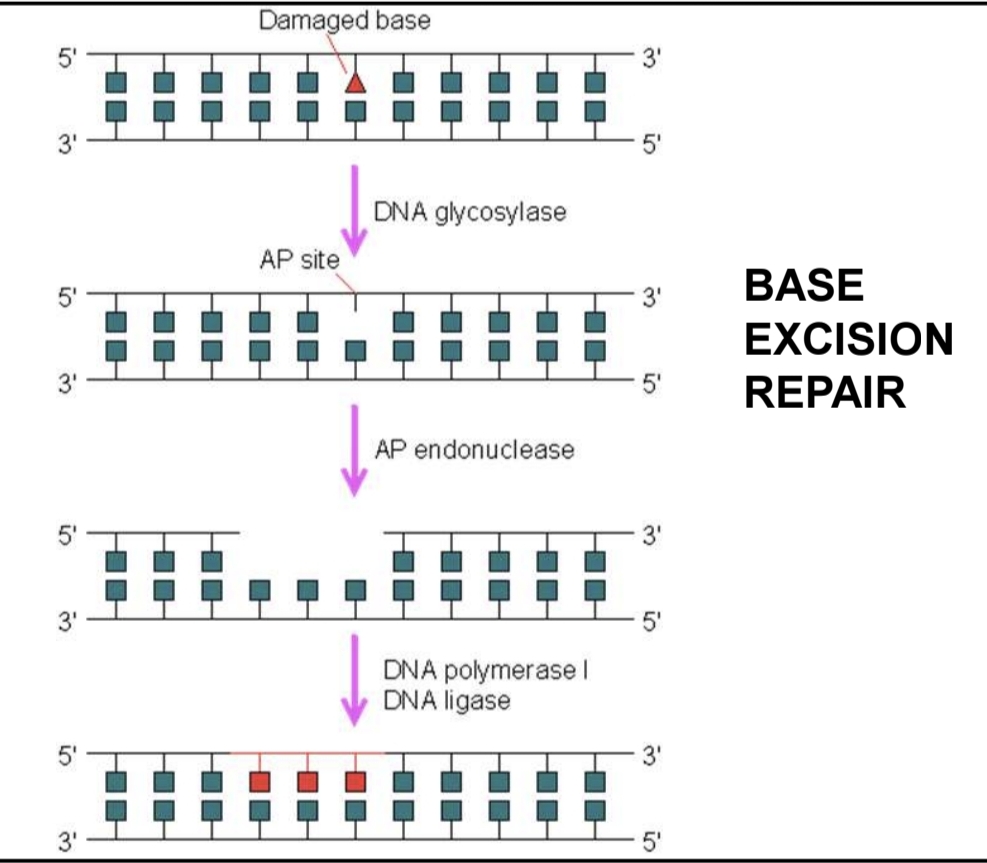
Show the base excision repair
What is the main function of DNA repair mechanisms?
To prevent and repair mutations and DNA damage.
In which organisms do DNA repair mechanisms occur?
Both prokaryotes and eukaryotes.
What is DNA polymerase proofreading?
A mechanism that corrects errors during DNA replication.
Which activity is responsible for proofreading?
3′ → 5′ exonuclease activity.