Exam 3- Orthopedic Test of the Elbow, Wrist and Hand
 Call Kai
 Learn
Learn Practice Test
 Spaced Repetition
 Match
Match Flashcards
 Knowt Play
1/57

There's no tags or description
Looks like no tags are added yet.
Name | Mastery | Learn | Test | Matching | Spaced | Call with Kai |
|---|
No analytics yet
Send a link to your students to track their progress
58 Terms
Elbow flexion test
Seated
Flexes elbow, asymptomatic first
Held in flexion for 5 minutes or until symptoms occur
Elbow flexion test tests for?
Cubical tunnel syndrome
How does cubical tunnel syndrome occur during the elbow flexion test
Position causes stress to the ulnar nerve at the cubical tunnel
______________during the elbow flexion test in less than 5 minutes suggest cubital tunnel syndrome
Ulnar parenthesia
Tingling or parestheisa in the ulnar distribution of the forearm and hand during the elbow flexion test suggests?
Cubital tunnel syndrome
Tinel`s sign at the elbow
Tap with reflex hammer 1 inch above and 1 inch below the olecranon process and lateral epicondyle on asymptotic side first
During tinel`s sign at the elbow, hypersensitivity indicates?
Neuritis or neuroma of the respective nerve
Hypersensitivity at the medial epicondylar groove during tinel`s sign at the elbow suggests?
Ulnar neuropathy
Hypersensitivity at the lateral epicondylar groove during tinel`s sign at the elbow suggest
Radial neuropathy
Cozen`s test
Seated, forearm over thigh, clenches fist tightly and extends wrist, maintaining a pronated position
Examiner stabilizes forearm and applies resistance to patients extended wrist
(Same as muscle testing wrist extension)
Positive Cozens test is
Pain over the lateral epicondyle
Positive Cozens test indicates
Lateral epicondyle irritation
When Cozens test is positive is it significant for/
Epicondylitis or radiohumeral bursitis
Golfers elbow test
Seated, forearm on thigh
Clenches fist, flexes wrist and maintains supination position
Patient flexes wrist and elbow against resistance
Pain?
Positive golfers elbow test
Pain over medial epicondyle
Positive golfers elbow test indicates
Medial epicondylitis
A positive golfers elbow test is common in who?
Kids from baseball
Lift test is good for?
Quantifying how bad the irrigation is by using weights
Lift test
Seated, forearm on thigh
Clenches sandbag or barbell tightly, extends wrist, maintains pronated position
Do it again but flexing instead while supinated
Positive lift test when doing extension
Pain over lateral epicondyle
Positive lift test when doing extension indicates
Lateral epicondylitis
Positive lift test when doing flexion
Pain over medial epicondyle
Positive lift test when doing flexion indicates
Medial epicondylitis
Ligamentous instability test
Seated with elbow slight flexed
Test abduction and abduction of the elbow joint
Adduction during the ligamentous instability test tests
Lateral collateral ligament
Abduction during the ligamentous instability test tests
Medial collateral ligament
Mill`s test
Seated, examiner passively flexes elbow then flexes patients wrist and fingers then supinates the forearm
Maintains the wrist and finger flexion and supination, extend the patients elbow
Then extends the elbow to maximum extension with wrist and fingers still flexed, forearm is pronated
Pain, point to it
All the moves of Mill`s test should be?
Smooth and continuous manner
Positive Mill`s test
Elbow pain increases
Positive Mill`s test indicates
Lateral epicondylitis (tennis elbow)
What is the gold standard for testing for carpal tunnel syndrome
Tinels sign at the wrist
Tinels sign at the wrist
Seated, elbow flexed and forearm supinated
Slight dorsiflex the patients wrist and hand
Hit with the reflex hammer on the wrist over the carpal tunnel
What is the median nerve distribution
Thumb, index finger, middle finger, lateral half of ring finger
Positive Tinels sign at the wrist
Tingling/pain felt along the median nerve distribution distal or below to the pint of percussion
Positive Tinels sign at the wrist when distal to the point of percussion indicates
Regeneration of the nerve
CARPAL TUNNEL SYNDROME
Positive Tinels sign at the wrist when below the point of percussion indicates
Neural inflammation and generation
CARPAL TUNNEL SYNDROME
What is the 2nd best test for Carpal Tunnel Syndrome
Phalens test
Phalen`s test Part 1
Seated with both elbows flexed and arms pronated
Wrist are flex, and the dorsal surface of the hands are approximated together
Hold for 60 seconds
Phalens test part 1 looks for?
Neural ischemia of the median nerve
Phalens test part 2 is also called
Reverse Phalens
Phalens test part 2 (Reverse Phalens)
Seated with both elbows flexes and arms pronated
Wrist are extended and the palms of the hands are approximated to each other
Hold for 60 seconds
Phalens test part 2 (reverse Phalens) looks for
Neural stretch and compression of the median nerve
Froments test
Seated
Adducts thump to the tip of the index finger
Place paper between the fingers and resist allowing the paper to be pulled form the grip of the index finger and thumb
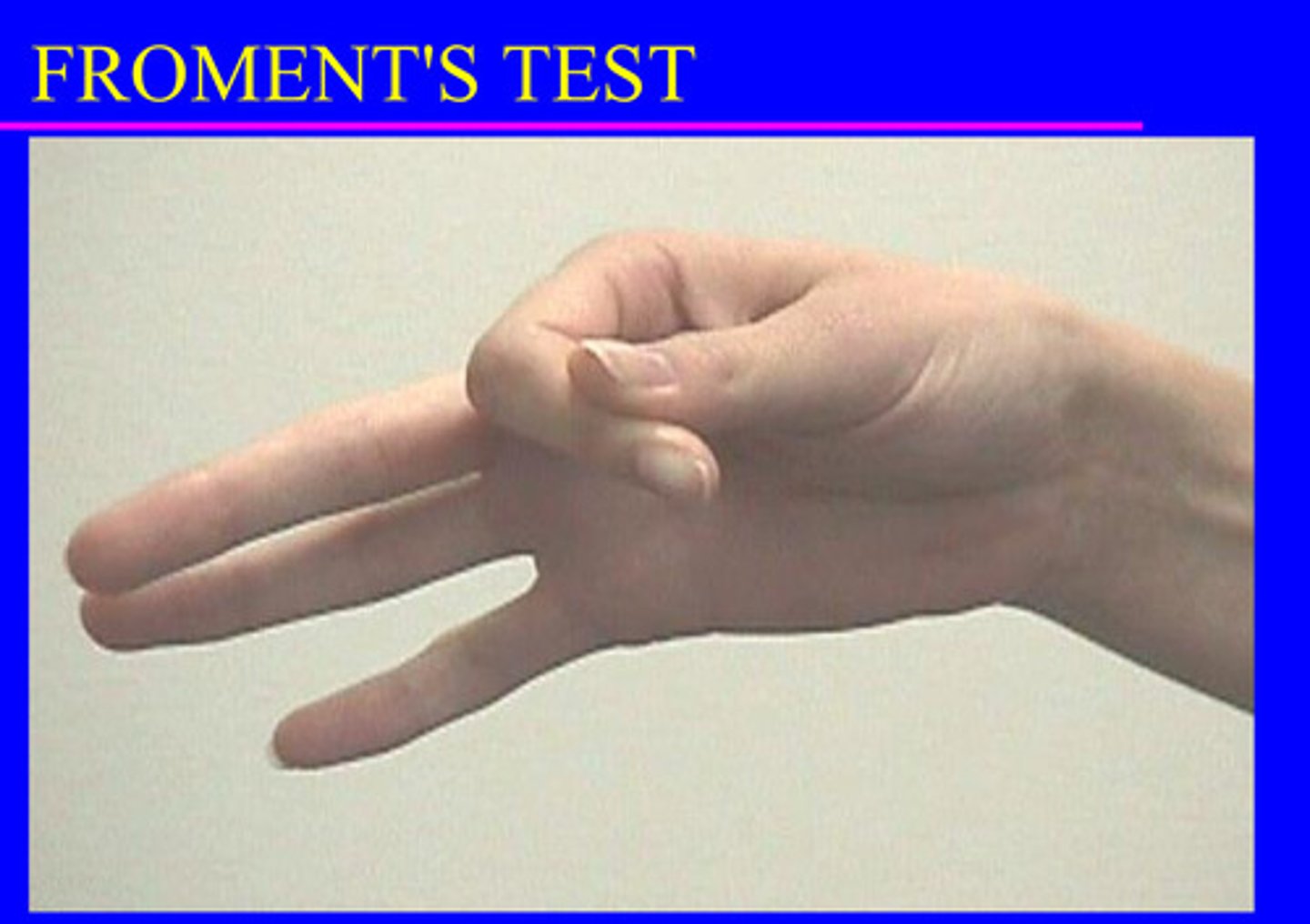
Positive froments test
When paper is pulled and see the terminal phalanx of the thumb go into flexion to add support
Positive froments test indicates
Paralysis of the adductor polices muscle and suggest ulnar nerve injury-palsy
Pinch grip test
Seated
Pinches tips of index finger to the tip of the thumb
Paper between, resist allowing the paper to be pulled out
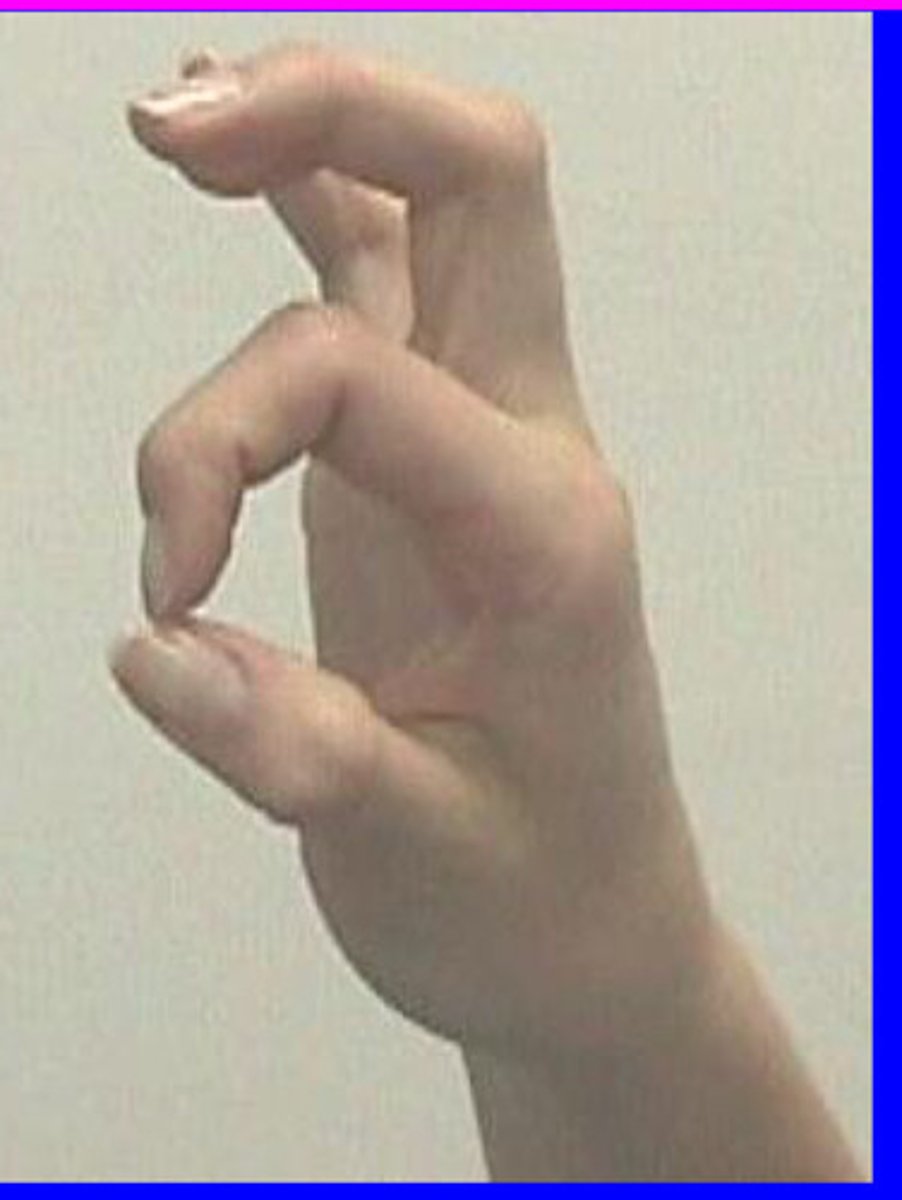
Positive pinch grip test indicates
Weakness of the anterior interosseous nerve
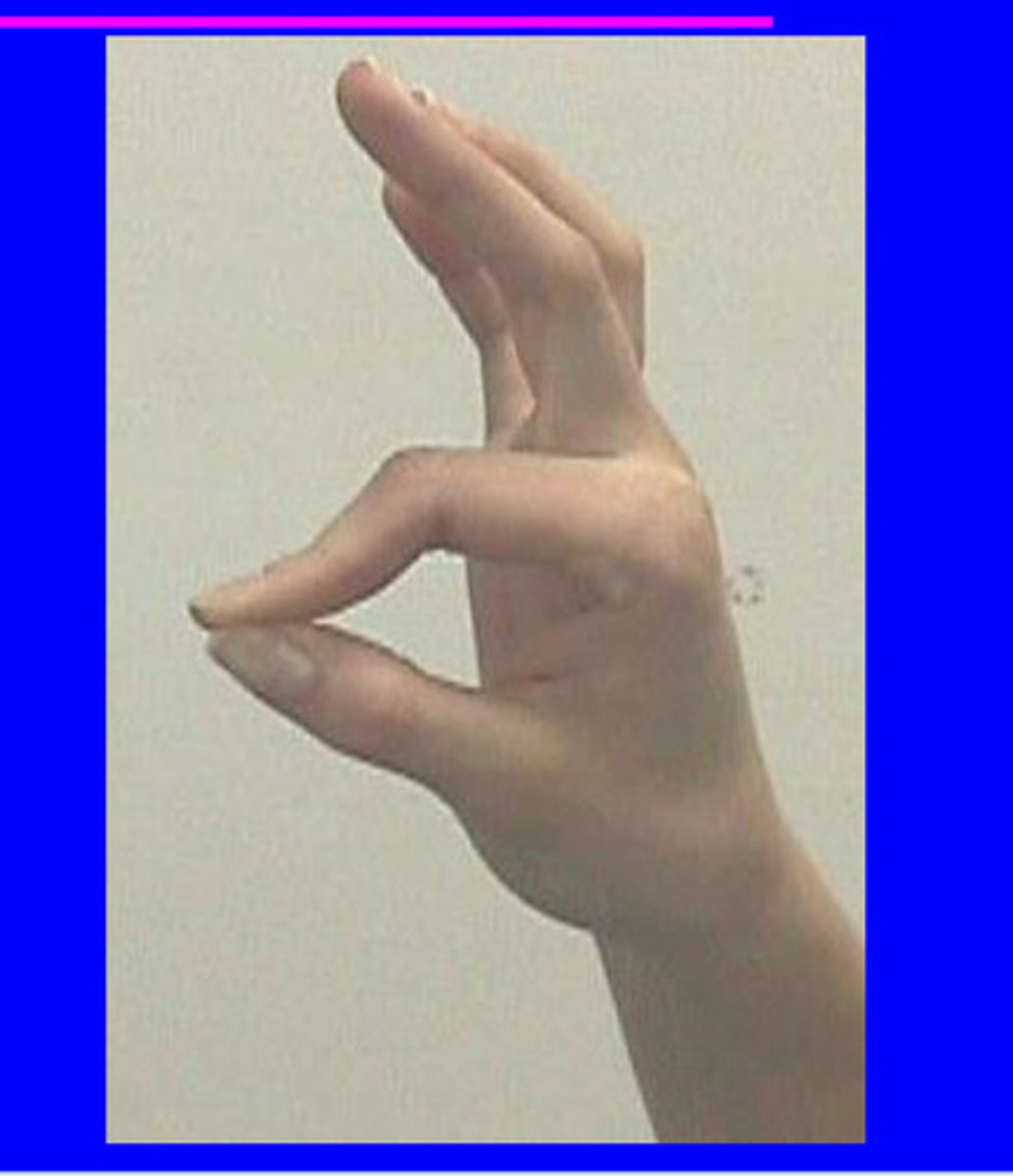
Positive pinch grip test
When pulling the paper out you see the terminal phalanx of the thumb go into the pulp of the finger to a pulp of the thumb grip
Bunnell-Littler test
Seated, elbow flexed, forearm pronated and wrist extended
Examiner slightly extends MCP of the digit under examination
Then flexes PIP and DIP joints
During the Bunnell-Littler test if the joint under examination cannot be passively flexed then this suggests?
Tight intrinsic musculature or contracture of the joint capsule
Pain and or joint contracture of the PIP and DIP during the bunnell-littler test suggest
Osteoarthritis
Finkelstein`s Test
Seated, makes a fist with thumb inside fingers
Examiner passively decimates wrist in ulnar direction
Pain, point to i
Positive Finkelstein`s test
Pain over abductor policy's longus and extensor pollicis brevis tendons
Positive finkelsteins test indicates
Stenosing tenosynovitis in the tendons of the abductor pollicus longus and extensor pollicus brevis tendons
Mannkopf`s sign
Establishes patients resting heart rate
Applies mechanical pressure or electrical stimulation over painful area while monitoring pulse
Positive Mannkopf`s sign
Increase in pulse rate of 10 or more BPM
Positive mannkopfs sign indicates
Pain is organic
Sign would be absent in simulated pain
Sometimes you can have a negative Mannkopf`s but still have true pain because the patients pain tolerance is high.... How can you confirm this?
Littmanns test