Immune System
 Call Kai
 Learn
Learn Practice Test
 Spaced Repetition
 Match
Match Flashcards
 Knowt Play
1/54

There's no tags or description
Looks like no tags are added yet.
Name | Mastery | Learn | Test | Matching | Spaced | Call with Kai |
|---|
No analytics yet
Send a link to your students to track their progress
55 Terms
immediate, general defense against pathogens present from birth.
innate (nonspecific) immunity
Slower, targeted immune response that develops after exposure and forms memory.
adaptive (specific) immunity
Innate =
fast, no memory, nonspecific
Adaptive =
slow, memory, highly specific
Where do T cells mature?
the thymus
What is the main function of helper T cells (CD4⁺)?
Activate B cells and cytotoxic T cells using cytokines.
What is the main function of cytotoxic T cells (CD8⁺)?
Directly kill infected or cancerous cells.
What do regulatory T cells do?
Suppress immune responses to maintain tolerance
Where do B cells mature?
bone marrow
What is the main function of B cells?
produce antibodies
What do activated B cells differentiate into?
plasma cells and memory B cells.
Large phagocytic cells that engulf pathogens and present antigens.
macrophages
Where are macrophages found?
tissues throughout the body
Cells that ingest and destroy pathogens.
ex. Neutrophils, macrophages, dendritic cells.
phagocytes
What process do phagocytes use to destroy pathogens?
phagocytosis
What is the role of bone marrow in immunity?
Production of blood cells; B-cell maturation.
Filters blood, removes pathogens, stores immune cells.
spleen
What is the function of the thymus?
Maturation of T lymphocytes.
What happens to the thymus with age?
It shrinks (involution)
What is the function of lymph nodes?
Filter lymph and activate immune responses.
Why do lymph nodes swell during infection?
Rapid lymphocyte proliferation.
Any substance that triggers an immune response
antigen
A protein made by B cells that specifically binds an antigen.
antibody
What is the main function of antibodies?
Neutralize pathogens and tag them for destruction.
Display of antigen fragments on MHC molecules for T-cell recognition.
antigen presentation
Which cells present antigens?
Macrophages, dendritic cells, B cells
Which MHC presents to helper T cells?
MHC II
Which MHC presents to cytotoxic T cells?
MHC I
Process where antigen activates only specific lymphocytes.
clonal selection
What happens after clonal selection?
Proliferation and differentiation into effector and memory cells.
What determines antigen–antibody binding specificity?
Shape and chemical complementarity.
the specific antigen region that an antibody binds.
epitope
What is the basic structure of an antibody?
two heavy and two light chains
What bonds hold antibody chains together?
disulfide bonds
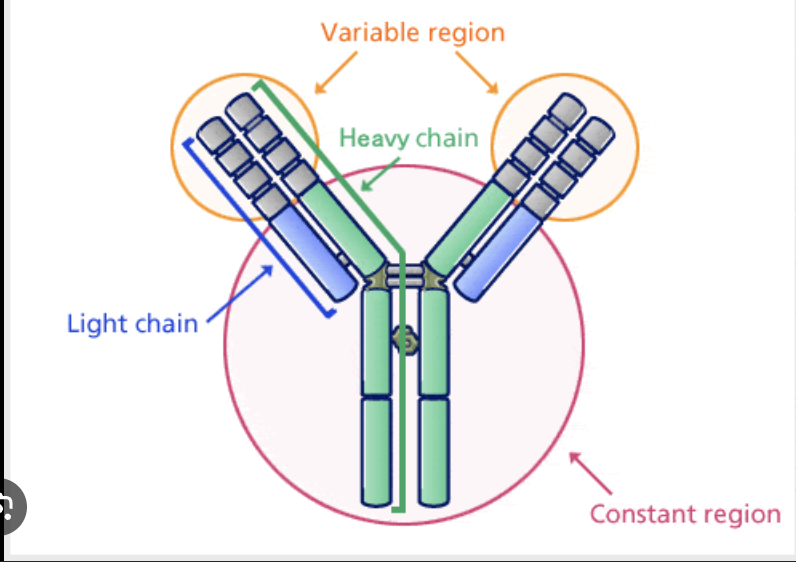
which region binds antigen?
Variable (Fab) region.
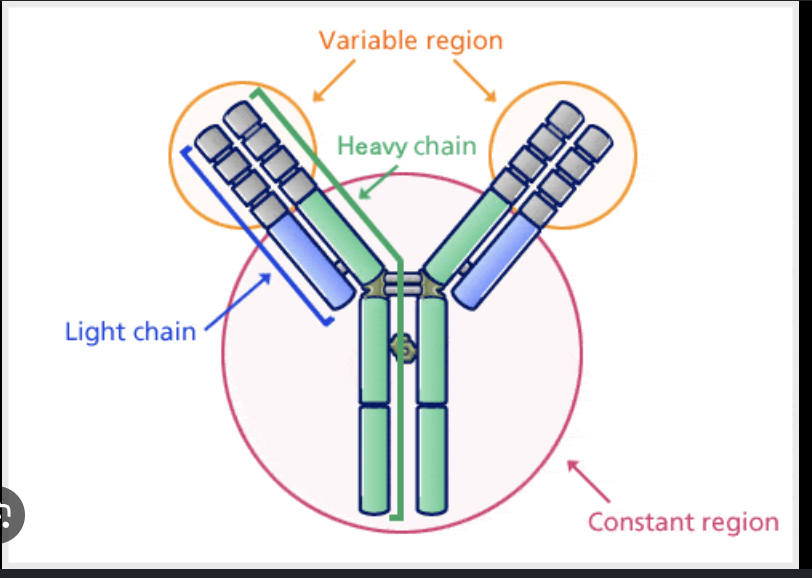
Which region determines immune response type?
Constant (Fc) region.
Ability to avoid attacking self tissues.
immune tolerance
A condition where the immune system attacks self tissues.
ex. type 1 diabetes, lupus, rheumatoid arthritis
autoimmune disease
Set of cell-surface proteins that display antigen fragments.
MHC
What is the role of MHC I?
Displays intracellular antigens to cytotoxic T cells.
What is the role of MHC II?
Displays extracellular antigens to helper T cells.
Why is MHC important in organ transplantation?
Mismatched MHC leads to graft rejection.
B cells =
antibodies
T cells =
regulation + killing
Macrophages + dendritic =
antigen presentation
Bone marrow =
B cells
Thymus =
t cells
Spleen =
blood filter
Lymph nodes =
lymph filter
Antigen =
trigger
Antibody =
binding protein
Clonal selection =
specific activation
MHC I →
CD8
MHC II →
CD4
Autoimmunity =
self-attack