Micro economics
 Call Kai
 Learn
Learn Practice Test
 Spaced Repetition
 Match
Match Flashcards
 Knowt Play
1/16

There's no tags or description
Looks like no tags are added yet.
Name | Mastery | Learn | Test | Matching | Spaced | Call with Kai |
|---|
No analytics yet
Send a link to your students to track their progress
17 Terms
Who does the tax burden fall on when a product is price inelastic?
The majority of the tax would fall on the consumer
As it is an addictive
So a 1% increase in price causes a less than proportional decrease in the quantity demanded
Firms have little incentive to reformulate
Who does the tax burden fall on when a product is price elastic?
The majority of the tax burden would fall on the producer
As a 1% increase in price cause a greater than proportional decrease in quantity demanded
Consumers will find a substitute
Firms will loose a lot of revenue, large incentive to reformulate
What 2 ways and how can the government solve excess demand when using a Pmax?
Put a subsidy to decrease the costs so that more can be produced and supplied, everyone who wants an appartment at price Pmax can get one
Direct provision the government will directly build and rent out houses at price Pmax although building is expensive they would earn some government revenue from renting them out
What can the government do to reduce the excess supply when a price Pmax is implemented?
The government buys the excess demand
So all the butter produced is sold at a gauranteed high price
Money spent by govt buying and storing goods could have been used elsewhere
Legislation and Regulations
Class A drugs are illegal in the UK to improve health care
Primary and Secondary education is compulsory in the UK to increase education of workforce
How effective is a legislaton
It would decrease consumption as it forces people to behave in a certain way however parallel markets may form with no regulations
It needs to be effectively enforced and monitored
Examples of nudges
Packaging regulations on cigarrates to improve health
Automatic enrollment as an organ donor and opt out to encourage organ donation
Perfectly rational thinker
They think every decision through carefully and have access to all the information so always make efficient choices to maximise their benefit
Irrational thinker
make decisions impulsively with limited information and they have self-control issues so are biased towards short term satisfaction. They also consider the tastes of other people
Two types of cognitive biases
Anchoring bias
Consumer make irrational decisions because their tastes are anchored to the first thing they see
Social conformity bias
Consumers make irrational decisions because they just copy what other people buy
Choice architecture
Default option
Change the option that consumers end up with if they choose nothing. As consumer will usually stick with this option the default option should be the most efficient choice
Mandated choices
Take aways the default option and force consumers to make a decision this encourages them to think more carefully about their choice
Examples of public goods
Street lights
Public parks
Free rider problem
Because public goods are non-excludable and non-rivalrous if one person pays for the good “free riders” will benefit without paying
In a free market the good will not be provided it is optimal to wait for someone else to buy the good
Solutions to non-provision of public goods
Direct provision the government pays for the good itself and makes all those benefiting from the good pay a little towards it to collect revenue
Contracting out to private sector government could provide infrastructure around the good but the give goods to private firms allowing them to use the infrastructure to provide for consumers
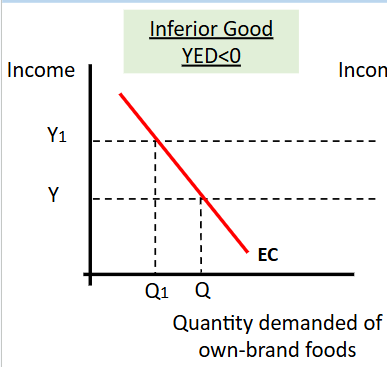
For an inferior good what is its YED
An increase in Y causes a decrease in QD
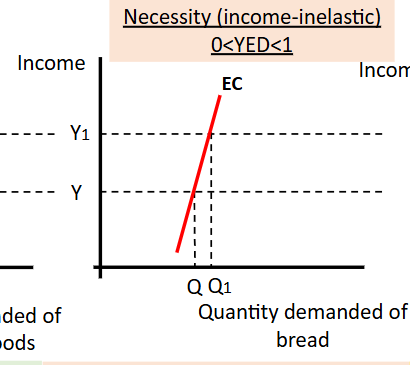
For a necessity what is its YED
An increase in income leads to a less than proportional increase in QD
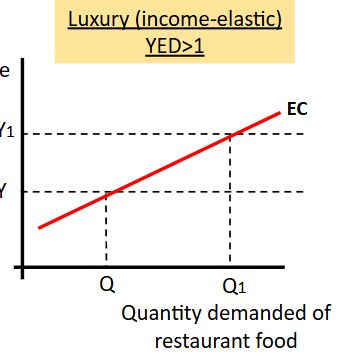
For a luxury Good what is its YED
An increase in Y leads to a greater than proportional increase in QD