section bank number 1 - Bio
 Call Kai
 Learn
Learn Practice Test
 Spaced Repetition
 Match
Match Flashcards
 Knowt Play
1/154

There's no tags or description
Looks like no tags are added yet.
Name | Mastery | Learn | Test | Matching | Spaced | Call with Kai |
|---|
No analytics yet
Send a link to your students to track their progress
155 Terms
kinase -
adds phosphate
phosphatase -
removes phosphate
synthase -
adds bonds (no ATP)
phosphorylase -
breaks bonds with PI
What is G-actin?
Monomeric (single-unit) actin
What is F-actin?
Filamentous actin (polymer of G-actin)
If G-actin decreases, what happens to F-actin?
F-actin increases (polymerization)
What happens to actin during contraction?
More F-actin (filament formation)
Does contraction correlate with more or less G-actin?
less G actin
F-actin / G-actin increases means what biologically?
More filament formation → more contraction (they are oppisite, more G actin means less F actin, more F actin means less G actin (increases in ratio)
Depolymerization means:
breaking filaments → into monomers (F actin decreses, G actin increases)
depolymerization -
G actin increases, F actin decreases
Intermediate -
integrity (structure/support); keratin
Thick filaments=
myosin (tension (muscle contraction)
microfilaments -
actin
microtubules -
tubulin
an amino acid can be phosphorylated if it
has an OH group
the process of joining many small molecules (monomers) together to form a large molecule (polymer)
polymerization
When you see:
germ-free
no colonization
sterile
this means
no microbiota present
insulin
lower glucose
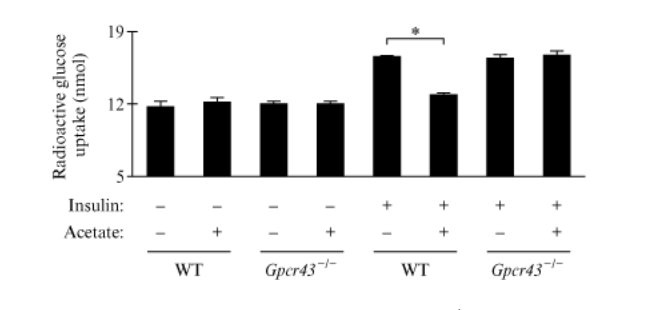
read this chart
- insulin - without insulin
+ insulin - with insulin
- acetate - without acetate
+ acetate - with acetate
What do antibiotics do to gut microbiota?
increase them
increased volume of adipocytes would do what
increase weight
Which amino acid contains an unbranched alkyl side chain?
alanine
The stereochemical designators α and β distinguish between:
epimers at an anomeric carbon atom
“What bond is cleaved” means
what bond is broken
what bonds do DNA form and what are they made out of
phosphodiester and oxygen bonds
how would you find the molecular weight of a tetramer of 288-residue amino acid
round - 300 = 30 dKa, tetramer - 4. 30×4 120
what does mean D64 and what would least alter its function
aspartic acid and glutamate since it is an acid
define denaturing, reducing, native
Denaturing → breaks proteins apart
Reducing → breaks disulfide bonds
Native → keeps structure/complexes intact
in order to confirm that a small molecule induces the formation of integrase tetramers from integrase dimers, it is necessary to visualize the proteins
in their native state
Unfold proteins → linear chains
Used to measure:
Molecular weight (size)
denaturing (SDS)
Break disulfide bonds
Used when:
Subunits are linked by S–S bonds
reducing conditions (β-mercaptoethanol, DTT)
Keep proteins folded and intact
Used to study:
Oligomerization (dimers, tetramers)
Binding interactions
native conditions
gallblader -
stores bile
stomach -
produce hydrochloric acid (HCl) (parietal cells)
pancreas
secrete glucagon (alpha cells)
liver -
detoxify drugs
isoforms are produced through
alternative splicing of pre-mRNA
if something has cooperativty then hills coefficient should be
greater than 1
A characteristic of noncompetitive inhibitors is that they bind the
enzyme and the enzyme–substrate complex with the same affinity
CFU/mL = (colony forming units) =
amount of bacteria
Isoelectric focusing
separates amino acids by their isoelectric points (proteins move until they reach the spot where pH = their pl and net charge = 0 /they stop moving)
post-translational modification
That means:
Protein is already made
Then it gets modified (phosphorylation, etc.) which creats mkdified forms of the same protein
if PKA or GSK-3 autophosphorylate, what do they need in order to do that
ATP
Ovarian cells are
epithelial cells
osteoclasts are
connective tissue cells
When is uncompetitive inhibition most effective?
High substrate concentration
High inhibitor concentration
Why does uncompetitive inhibition increase with ↑ substrate?
inhibitor binds ONLY to ES complex
More substrate → more ES → more inhibition
Can adding substrate overcome uncompetitive inhibition?
no (opposite of competitive)
Why would a peptide homrone not need a transport protein?
peptides contain hydrophilic tails → soluble in blood
Which hormones need transport proteins?
Steroid hormones (lipophilic)
Do peptide hormones diffuse through membranes?
No → they use receptors (can’t cross membrane)
What tissue type are ovarian cells?
connective
What makes a GOOD control?
Removes the variable you're testing
How can one gene produce multiple proteins?
Alternative splicing (different exon combinations)
What level of protein structure affects binding interactions most?
Tertiary (3D folding)
Why might a full protein bind worse than a peptide fragment?
Tertiary structure blocks binding sites
What tissue type are osteoclasts?
connective (bone cells)
What does LOWER Kd mean?
higher affinity
How do you recognize higher affinity on a graph?v
binding happens at lower concentration
What mutation is detectable?
One that creates or destroys restriction site
What is a palindromic sequence?
Same forward/backward (e.g., GAATTC)
restriction enzymes recognize what?
Palindromic sequences
What is special about retroviruses?
RNA → DNA → integrates into host genome
If given mRNA, what matches viral genome?
Same sequence (still would contain U)
How do you detect different protein isoforms?
Look at mRNA differences (splicing)
Why is genomic DNA NOT useful for isoforms?
Introns still present → doesn’t reflect final protein
What causes muscle depolarization at NMJ?
Na⁺ influx
Does Ca²⁺ cause depolarization?
No → Ca²⁺ causes contraction, not depolarization
Ovarian cells
Skin (epidermis)
Alveoli (lungs)
Adipocytes
GI tract lining (stomach, intestines)
Kidney tubules
Endocrine glands (thyroid, pituitary)
Exocrine glands (sweat, salivary)
epithelial cells (lines things, secretes/hormones/enzymes, absorbs nutrients)
exocrine glands -
sweat, salivary
endocrine glands -
thyroid, pituitary
Bone cells (osteoclasts, osteoblasts)
Cartilage
Adipose (fat)
Tendons & ligaments
Bone marrow
connective tissues - blood, bone, cartilage
nervous tissue compromises:
brain, spinal cord, peripheral nerves, neurons
If a process requires phosphorylation, what inhibits it?
Phosphatase
What activates contraction in VSM?
Ca²⁺ → calmodulin → MLCK → phosphorylates myosin → contraction
If a receptor is NOT expressed in tissue, what happens?
no effect in that tissue
If acetate suppresses insulin signaling in WT but not knockout, what does that mean?
Effect is receptor-dependent (GPR43-dependent)
Rate-limiting enzyme of pentose phosphate pathway
what does pentose phosphate pathway produce?
NADPH + Ribose-5-phosphate
If enzyme activity increases, what happens to products?
Products ↑, substrate ↓
Succinyl-CoA synthetase produces what?
succinate + GTP
Where are protons pumped?
Matrix → intermembrane space
If gradient dissipates, what decreases?
Protons in intermembrane space
What does increased membrane permeability do?
Destroys proton gradient
Why use siRNA controls?
Confirm knockdown works
Ensure specificity
Rule out off-target effects
What is a non-specific siRNA control?
Shows effects are NOT due to random interference
Pyruvate → Acetyl-CoA requires what cofactor?
lipoic acid
If mtKAS is inhibited → lipoic acid ↓ → what happens?
↓ Pyruvate dehydrogenase activity
Which molecules can be used for gluconeogenesis?
Lactate, Glycerol, Glucogenic amino acids
Which molecules CANNOT be used for gluconeogenesis?
aceytyl coa and Even-chain fatty acids
Why can’t acetyl-CoA make glucose?
Carbons are lost as CO₂ in TCA → no net glucose production
What is the fastest way the body increases blood glucose?
Glycogenolysis
What pathway is used after glycogen stores are depleted?
Gluconeogenesis
Key enzyme that releases free glucose into blood?
Glucose-6-phosphatase
What enzyme breaks down glycogen?
Glycogen phosphorylase
What activates a G-protein?
GDP → GTP exchange
What does hexokinase do?
Phosphorylates glucose → traps it in the cell