sedimentary basins
 Call Kai
 Learn
Learn Practice Test
 Spaced Repetition
 Match
Match Flashcards
 Knowt Play
1/15

There's no tags or description
Looks like no tags are added yet.
Name | Mastery | Learn | Test | Matching | Spaced | Call with Kai |
|---|
No analytics yet
Send a link to your students to track their progress
16 Terms
Foreland: Plate Tectonic setting
Adjacent to compressional mountain belts at convergent margins
Load = thrust sheet stack built by plate collision (e.g. Alps & Po Valley)
Strong lithosphere responds by regional flexture
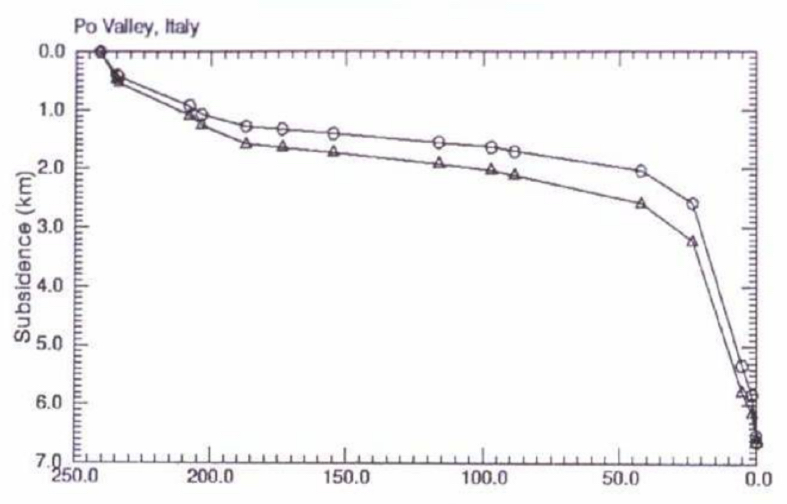
Foreland: subsidence history
Concave-down tectonic subsidence curve — opposite to extensional basins
Subsidence slowest early on when load is far away, accelerating as mountain belt approaches
Location may first experience slight uplift as it rides the flexural forebulge before subsiding
Foreland: faulting
Not primarily fault-controlled like the adjacent thrust belt is
Subsidence is driven by flexure > brittle extension
Reverse, normal , and thrust faults may propagate as the load advances
Foreland: sedimentary infill
Directly from uplifting mountain belt into basin
Sorted: coarse conglomerates/alluvial fan deposits are near the thrust front, grading basinward into finer marine sediment
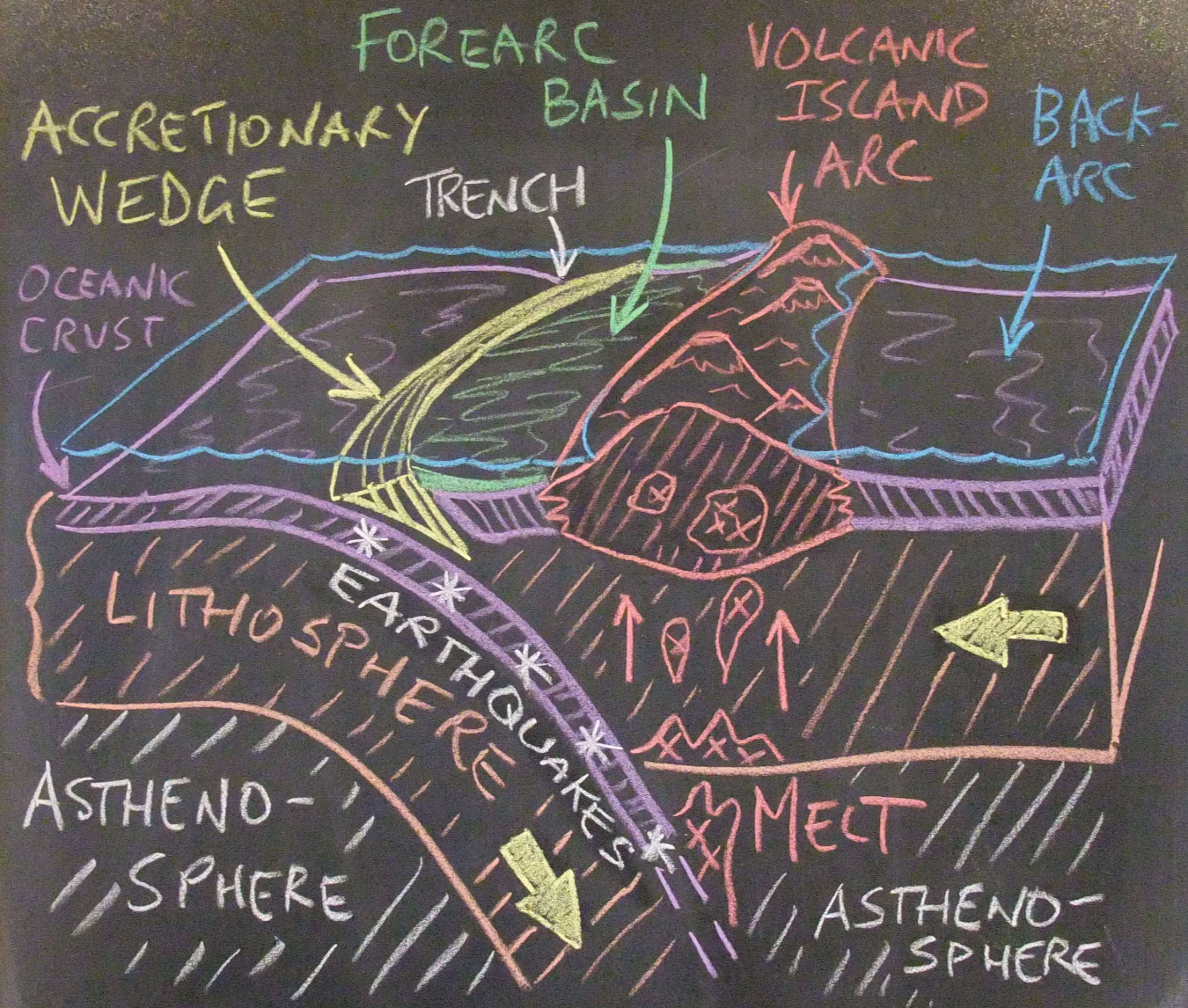
Subduction: plate tectonic setting
Forearc basin: downward flexure is produced in younger plate at point of contact, right behind the accretionary wedge
Backarc basin: behind volcanic island arc; formation is debated but lithosphere stretches due to secondary circulation current forming, or plate moving away from subduction zone
Trench basin: where the two plates meet; where accretionary wedge forms
Subduction: subsidence history
Trench basin: subsides rapidly similar to foreland basin due to mechanical load of overriding plate
Forearc basin: variable due to accretionary wedge growth, underplating, erosion
Backarc basin: similar to extensional; fast and then slow
Subduction: faulting
Forearc basin: thrust faults from accretionary wedge on one side, and normal faults where Forearc extends
Trench basin: décollement, prism thrusts, megasplay faults
Backarc basin: extensional aka normal faulting
Subduction: sedimentary infill
Trench: highly deformed through folding, mélanges common (chaotic mix of sediment), turbidities and mass flow deposits from overriding plate (younger is closer to subducting)
Forearc: less deformation = more layered/coherent; marine clastics, e.g. turbidites, siltstones, and coarser volcaniclastic material
Backarc: layered, undeformed strata; mix of volcanic material and marine sediments
Strike slip: tectonic setting
Along transform/strike-slip fault systems at releasing bends
I.e. Dead Sea along Dead Sea Transform
Strike slip: subsidence history
Greater rate of subsidence than rift/foreland type basin
Backstrip curve can show both rift/extensional (rapid early subsidence due to local extension) and foreland basin patterns (high sedimentation/compression rates cause late-stage acceleration)
Strike slip: faulting
Lateral/strike-slip faults dominate; negative flower structure (shallow synform with normal faults fanning out towards surface)
Strike slip: sediment infill
Quick subsidence and small/long structure
Fill with coarse, poorly sorted sediments derived from immediately adjacent uplifted fault blocks
Alluvial fans & coarse fluvial deposits near basin margins
Deeper lacustrine/marine facies in basin center
Sediment very thick relative to basin area
Extensional: tectonic setting
Divergent margins or backarc
Lithospheric stretching model shown by McKenzie
Extensional: subsidence history
Concave up subsidence curve
Fast subsidence during syn-rift, exponential slowing during post-rift thermal cooling
Extensional: faulting
Normal faulting: brittle faulting in upper crust, ductile at depth; domino-style rotating fault blocks
Syn-rift has localized faulting; post-rift sediments are largely unfaulted
Extensional: sediment infill
Syn-rift sediments are faulted and thicken towards the fault
Post rift sediments drape broadly and are unfaulted