Topic A1.2 - Data Representation and Computer Logic
0.0(0)
Studied by 0 people Call Kai
 Learn
Learn Practice Test
 Spaced Repetition
 Match
Match Flashcards
 Knowt Play
Card Sorting
1/38

Earn XP
Description and Tags
Last updated 2:24 AM on 10/4/26
Name | Mastery | Learn | Test | Matching | Spaced | Call with Kai | Chat |
|---|
No analytics yet
Send a link to your students to track their progress
39 Terms
1
New cards
What is a Bit and what are its possible values?
The smallest unit of data in computing, representing a single binary digit that can only have a value of 0 (OFF/FALSE) or 1 (ON/TRUE).

2
New cards
What is a Byte and how many bits does it contain?
A group of 8 bits used as a fundamental unit of digital storage.

3
New cards
Why do computers use Binary (Base-2) for processing, storage, and transmission?
Because electronic circuits and transistors operate using two distinct electrical states (ON/OFF or high/low voltage), making binary reliable and straightforward to process logic and math.
4
New cards
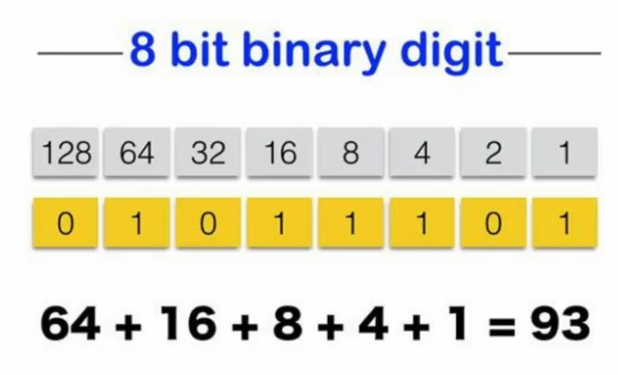
Convert the 8-bit binary number 01011101 into base 2 (Decimal).
93 (Calculated as 64 + 16 + 8 + 4 + 1 = 93).
5
New cards
How many binary bits does a single Hexadecimal (Base-16) digit represent?
4 binary bits (1 nibble).
6
New cards
Convert the Hexadecimal value 2A5 into Denary (Decimal).
677 (Calculated as 2*(16^2) + 10*(16^1) + 5*(16^0) = 512 + 160 + 5 = 677).

7
New cards
Convert the Hexadecimal value 3B into Denary (Decimal) and Binary.
Denary: 59 (3*16 + 11*1). Binary: 00111011.

8
New cards
Explain the step-by-step method to convert a Denary number (e.g., 495) into Hexadecimal.
1. Find the highest power of 16 that fits into the number (16^2 = 256). 2. Divide by 256 to get the first hex digit. 3. Take the remainder and divide by 16 to get the second digit. 4. The final remainder gives the last hex digit.

9
New cards
Explain the bit structure and character capacity of standard ASCII.
Uses 8 bits total per character slot (7 bits store character data giving 2^7 = 128 unique characters, while 1 bit is used as a parity bit). Covers uppercase, lowercase, numbers, symbols, spaces, and punctuation.
10
New cards
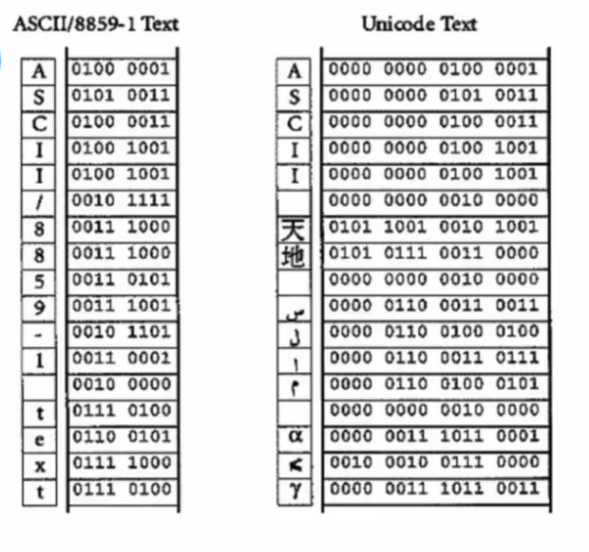
Compare ASCII (and Extended-ASCII) with Unicode in terms of bit size and character support.
ASCII uses 7-8 bits per character (max 128-256 characters, limited to Western alphabets). Unicode uses 16-32 bits per character, supporting millions of characters including non-Western scripts, historical symbols, and emojis.
11
New cards
Contrast Decimal (SI Metric) storage prefixes with Binary (IEC) storage prefixes.
Decimal (SI Metric): Based on powers of 10 (1 kB = 1,000 bytes = 10^3). Binary (IEC): Based on powers of 2 (1 KiB = 1,024 bytes = 2^10, 1 MiB = 2^20, 1 GiB = 2^30, 1 TiB = 2^40).
12
New cards
State typical storage requirements for standard data types: ASCII char, Word 'Monday', Plain-text email, 3-min MP3, 1-hr MPEG4 video.
1 Extended-ASCII char: 1 byte. Word 'Monday': 6 bytes. Plain-text email: ~2 KB. 3-min MP3 audio: ~3 MB. 1-hr MPEG4 video: ~4 GB.
13
New cards
What is a Pixel and how does it function in digital displays?
The smallest controllable element in a display grid, representing a single colored square. Each pixel displays one solid color at a time formed by combining red, green, and blue light (RGB).
14
New cards
What is a Bitmap Image?
An image composed of a grid of individual pixels, where each pixel has a specific binary value defining its color and intensity (e.g., JPEG, PNG, GIF, BMP).
15
New cards
How is 24-bit True Color represented in pixels using Hexadecimal?
Each pixel color is stored as a 6-digit Hexadecimal code (#RRGGBB). The first two digits represent Red, middle two represent Green, and last two represent Blue (giving 256^3 = 16,777,216 color combinations).
16
New cards
Define Color Depth (Bit Depth) in bitmap graphics.
The number of bits used to represent the color of a single pixel. Formula: 2n unique colors, where n is the bit depth (e.g., 3 bits = 8 colors, 24 bits = 16.7M colors).
17
New cards
What factors affect Bitmap Image Quality?
1. Number of pixels (more pixels mean higher detail and smoother transitions); 2. Image resolution (higher PPI creates finer detail); 3. Screen resolution (higher screen PPI displays images sharper); 4. Color/Bit depth (higher depth prevents color banding and increases realism).
18
New cards
What factors affect Bitmap File Size?
1. Higher Image Resolution (more total pixels increase file size); 2. Higher Screen Resolution (indirectly increases size as images are rendered at higher detail); 3. Higher Color/Bit Depth (more bits stored per pixel increase file size).
19
New cards
Explain the 3 steps of Analog-to-Digital Audio Conversion (ADC).
1. Sampling: Measuring the continuous sound wave's amplitude at discrete time intervals (Sample Rate in Hz); 2. Quantization: Rounding sampled amplitudes to the nearest binary value defined by the bit depth; 3. Encoding: Converting quantized values into binary data.
20
New cards
Define Sample Rate and Bit Depth in digital audio encoding.
Sample Rate: The number of audio samples taken per second, measured in Hertz (e.g., 44.1 kHz for CD quality, 48 kHz for professional audio). Bit Depth: The number of bits used per sample to record amplitude accuracy (e.g., 16-bit, 24-bit).
21
New cards
How is digital audio played back through speakers or headphones?
The stored digital binary data is decoded and converted back into a continuous analog electrical signal using a Digital-to-Analog Converter (DAC).
22
New cards
What audio file formats correspond to uncompressed, lossy compressed, and lossless compressed audio?
Uncompressed: WAV. Lossy Compressed: MP3. Lossless Compressed: FLAC.
23
New cards
What is a Video Frame and how is digital video represented?
A video is a sequence of still images called frames played rapidly in sequence. Each frame is a bitmap image made of pixels storing RGB color values.
24
New cards
How does Inter-Frame Video Compression (e.g., H.264) reduce file size?
Instead of saving every full frame, it saves keyframes and stores only the differences/changes between consecutive frames over time.
25
New cards
What is the formula to calculate the raw (uncompressed) file size of a video?
Raw File Size = (Width × Height) × Bit Depth × Frame Rate (fps) × Duration (seconds).
26
New cards
Solve this IB calculation: A 20-second video recorded at 30 fps, 1280×720 resolution, 24-bit color, compressed at a 20:1 ratio. What is the final file size in MB?
Raw Size = (1280 × 720) × 24 bits × 30 fps × 20 s = 13,271,040,000 bits. Convert to Bytes = / 8 = 1,658,880,000 Bytes. Apply 20:1 Compression = / 20 = 82,944,000 Bytes. Convert to MB = / 1,000,000 = 82.94 MB (or ~79.1 MiB using binary IEC).
27
New cards
What is a Logic Gate and how does it relate to physical CPU hardware?
An electronic switch/circuit in a processor that takes 1 or 2 binary inputs (0 = low voltage, 1 = high voltage) and produces a single binary output based on a Boolean operation.
28
New cards
What are Logic Gates used for in computer systems?
1. Performing basic Boolean operations (AND, OR, NOT); 2. Building complex circuits (adders, multiplexers, memory units); 3. Processing binary data to perform calculations and control tasks.
29
New cards

State the logic rules and outputs for AND, OR, and NOT gates.
AND: Output is 1 only if BOTH inputs are 1. OR: Output is 1 if AT LEAST ONE input is 1. NOT: Inverts the single input (0 becomes 1, 1 becomes 0).
30
New cards

State the logic rules and outputs for NAND, NOR, and XOR (Exclusive OR) gates.
NAND: Output is 0 only if BOTH inputs are 1 (inverse of AND). NOR: Output is 1 only if BOTH inputs are 0 (inverse of OR). XOR: Output is 1 if inputs are DIFFERENT (one is 1, the other is 0).
31
New cards

State the logic rule for XNOR (Exclusive NOR) gates.
XNOR: Output is 1 if inputs are identical (both 0 or both 1).
32
New cards
What are the fundamental laws of Boolean Algebra for simplification?
Identity (1A=A, 0+A=A); Null (0A=0, 1+A=1); Idempotent (AA=A, A+A=A); Inverse (A·Ā=0, A+Ā=1); Double Negation (Ā̄=A); Commutative (AB=BA, A+B=B+A); Associative ((AB)C=A(BC)); Distributive (A+BC=(A+B)(A+C), A(B+C)=AB+AC).
33
New cards
State the Absorption Laws and De Morgan's Laws in Boolean Algebra.
Absorption Laws: A(A+B) = A and A + AB = A. De Morgan's Laws: NOT(A AND B) = NOT A OR NOT B (ĀB̄ = Ā + B̄) and NOT(A OR B) = NOT A AND NOT B (Ā+B̄ = Ā·B̄).
34
New cards
What is a Karnaugh Map (K-Map) and what are its key grouping rules?
A visual method used to simplify Boolean expressions. Rules: 1. Group adjacent 1s into powers of 2 (2n: 1, 2, 4, 8); 2. Groups must be rectangular or square (no diagonals); 3. Make groups as large as possible; 4. Use the fewest groups possible; 5. Groups can overlap or wrap around edges.
35
New cards
What is a Half-Adder circuit, its components, and its Boolean expressions?
A digital circuit used to add two 1-bit binary numbers (A and B). Uses one XOR gate for the Sum and one AND gate for the Carry. Expressions: Sum = A ⊕ B; Carry = A · B.
36
New cards
State the complete Truth Table for a Half-Adder.
Inputs (A, B) -> Outputs (Sum, Carry): (0, 0) -> (0, 0); (0, 1) -> (1, 0); (1, 0) -> (1, 0); (1, 1) -> (0, 1).
37
New cards
What is a Full-Adder circuit and how does it differ from a Half-Adder?
A digital circuit that adds three 1-bit binary inputs (A, B, and Carry-In / Cin) to produce a Sum (S) and Carry-Out (Cout). Unlike a half-adder, it accounts for an incoming carry bit from a previous stage.
38
New cards
What are the Boolean expressions for the Sum (S) and Carry-Out (C_out) of a Full-Adder?
Sum (S) = A⊕B⊕Cin; Carry-Out (Cout) = (A⋅B)+(Cin⋅(A⊕B)).
39
New cards
State the key Truth Table outputs for a Full-Adder.
(A, B, Cin) -> (Sum, Cout): (0,0,0)->(0,0); (0,0,1)->(1,0); (0,1,0)->(1,0); (0,1,1)->(0,1); (1,0,0)->(1,0); (1,0,1)->(0,1); (1,1,0)->(0,1); (1,1,1)->(1,1).