Last content (lectures 17-20) - BIEB150
 Call Kai
 Learn
Learn Practice Test
 Spaced Repetition
 Match
Match Flashcards
 Knowt Play
1/100

There's no tags or description
Looks like no tags are added yet.
Name | Mastery | Learn | Test | Matching | Spaced | Call with Kai |
|---|
No analytics yet
Send a link to your students to track their progress
101 Terms
Darwin didn’t discuss what?
origin of species (speciation)
what are species?
Species is Latin for ‘KIND’.
So, in many cases biologist used any
feature that reflected differences
what are dogs?
Dogs descend from a
domesticated population of the
grey wolf (Canis lupus)
Are dogs their own species?
No. They are a subspecies Canis lupus familiaris
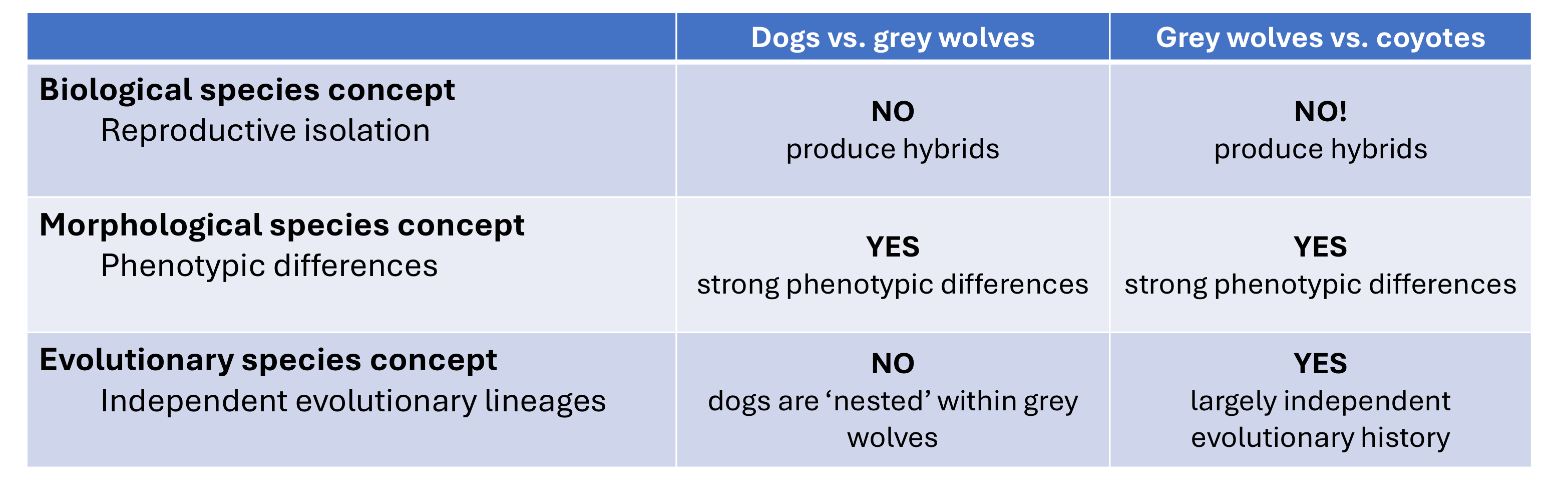
reproductive isolation:
Horses and donkeys: Can produce
hybrids but they are sterile.
asexual species:
Many microbes, including some yeasts, reproduce largely asexually, making it difficult to assess reproductive isolation
species in the fossil record:
Impossible to assess behaviors
cryptic species:
Before 2001, African savanna and forest
elephants were considered the same
species. Now we know these are
independent species.
biological species concept:
“groups of actually or potentially interbreeding natural populations
which are reproductively isolated from other such groups”
Ernst Mayr 1942
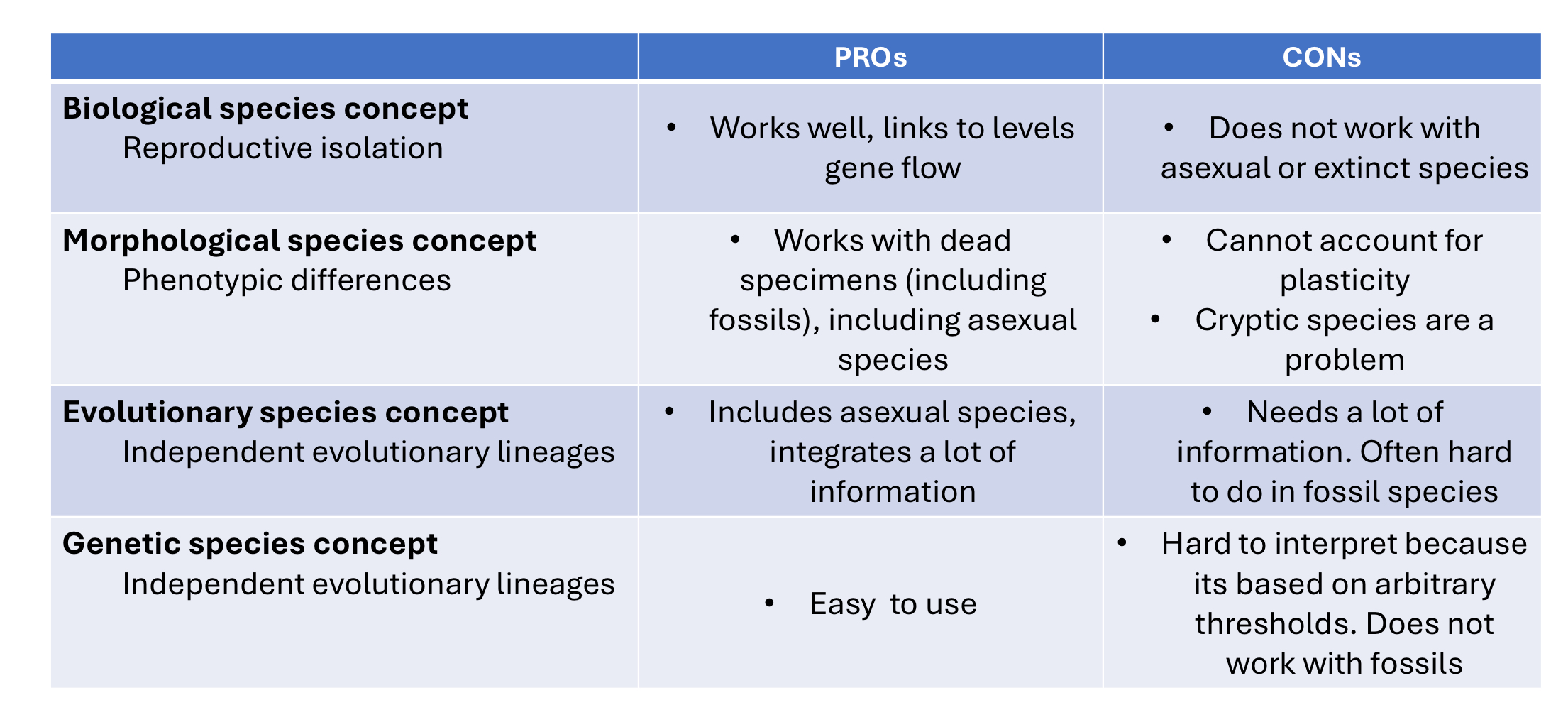
only relevant for sexually reproducing organisms
difficult to assess in some geographic contexts
evolutionary species concept
“a single lineage of ancestor-descendant
populations of organisms which maintains its
identity from other such lineages [in space and
time] and which has its own evolutionary
tendencies and historical fate”
Wiley 1981
developed by simpson in 1951 to include asexual organisms and extinct species
does not work well with fossil data
applying the evolutionary species record to extinct species requires a good fossil record
morphological species concept:
“a species is a community, or a number of related
communities, whose distinctive morphological
characters are, in the opinion of a competent
systematist, sufficiently definite to entitle it, or
them, to a specific name”
Regan 1926
works with asexual organisms as well as fossils
morphological characteristics can be subjective
cryptic species and plasticity are massive problems
genetic species concept
Defines a species based on genetic similarity. Species are
considered distinct groups of organisms that are reproductively
isolated from each other, not through direct observation of
reproductive behaviors, but through evidence of significant
genetic divergence.
very useful, expecially because of the availability of genetic data (now also from museum specimens, and very old samples)
totally arbitrary thresholds (often 2-3% divergence in mtDNA)
species concepts: a comparison
see image
giraffes, one species or several?
• Giraffes were historically classified as one species with multiple populations.
• Researchers later found:
• 6 distinct genetic clusters
• Populations differ in coat patterns and morphology
• Populations are geographically separated
• They can still interbreed and produce fertile offspring
using gene flow to define species - biological species concept
Species are groups of actually or potentially interbreeding populations, which are reproductively isolated from other such groups
gene flow (migration) is the movement of genes into or out of a population
no or low gene flow = reproductive isolation
therefore the study of speciation under this definition is really the study of evolution of reproductive isolation
what is reproductive isolation:
mechanical = can’t (some sort of physical/size difference that prevents breeding)
ecological = don’t (can physically interbreed but don’t due to geographic isolation due to habitat differences or due to breeding at different times of the year)
behavioral = won’t (Taxa may be reproductively isolated even if they can interbreed AND they still come into contact … but they choose not to mate. There may be the evolution of a strong mating preference, and they don’t find individuals of opposite sex attractive from the other species)
reproductive isolating barriers - two flavors
prezygotic - occur before fertilization
postzygotic - occur after fertilization
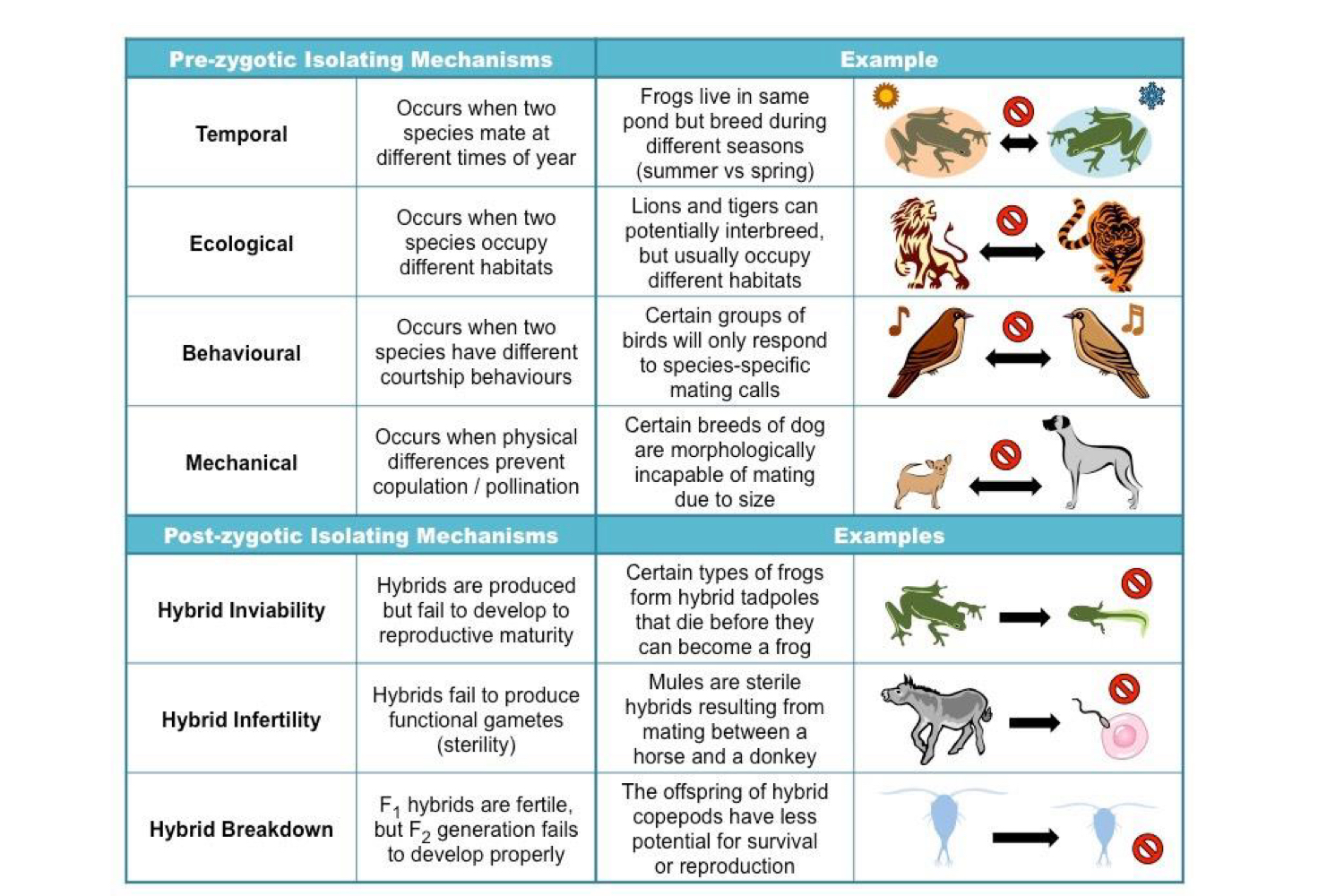
prezygotic:
premating barriers, prevent mating (habitat isolation, temporal isolation, behavioral isolation)
postmating barriers, prevent zygote formation (mechanical isolation, gametic isolation)
temporal prezygotic isolation example:
Eastern Spotted skunk (Spilogale putorius)
- Eastern spotted skunks mate in late winter.
- Western spotted skunks mate in late summer.
- They come into contact but never have the
opportunity to breed due to timing.
ecological prezygotic isolation:
Example: Walking stick insects in California
(Timema cristinae)
• Live on different host plants Adenastoma or
Ceanothus.
• These bugs are adapted to the different plants
and if they wander onto the wrong plant they get
eaten by predators.
• Since they have to stick to their own plant they
don’t often mate.
• This is a vey common mechanism of isolation!
mechanical prezygotic isolation:
• Lock and key fit between male
and female genitals in many
species.
• Due to coevolution and often
sexual conflict!
• Example Ground
another example of prezygotic isolation:
Can also occur in plants although the morphologies were are talking about are often matched to pollinators
behavioral prezygotic isolation:
Example: “behavioral sterility” in hybrid hummingbird displays
hybrids inherit a “weird” display pattern, that females of both species do not refer
Postzygotic barriers: Hybrid inviability
• Hybrids don’t completely develop, die before birth or die before reaching maturity.
• Example: goat-sheep hybrids are stillborn.
Postzygotic barriers: Hybrid sterility
• Hybrids are healthy (viable) and survive but aren’t fertile.
• Evolutionary dead end.
can be due to differences in chromosome number
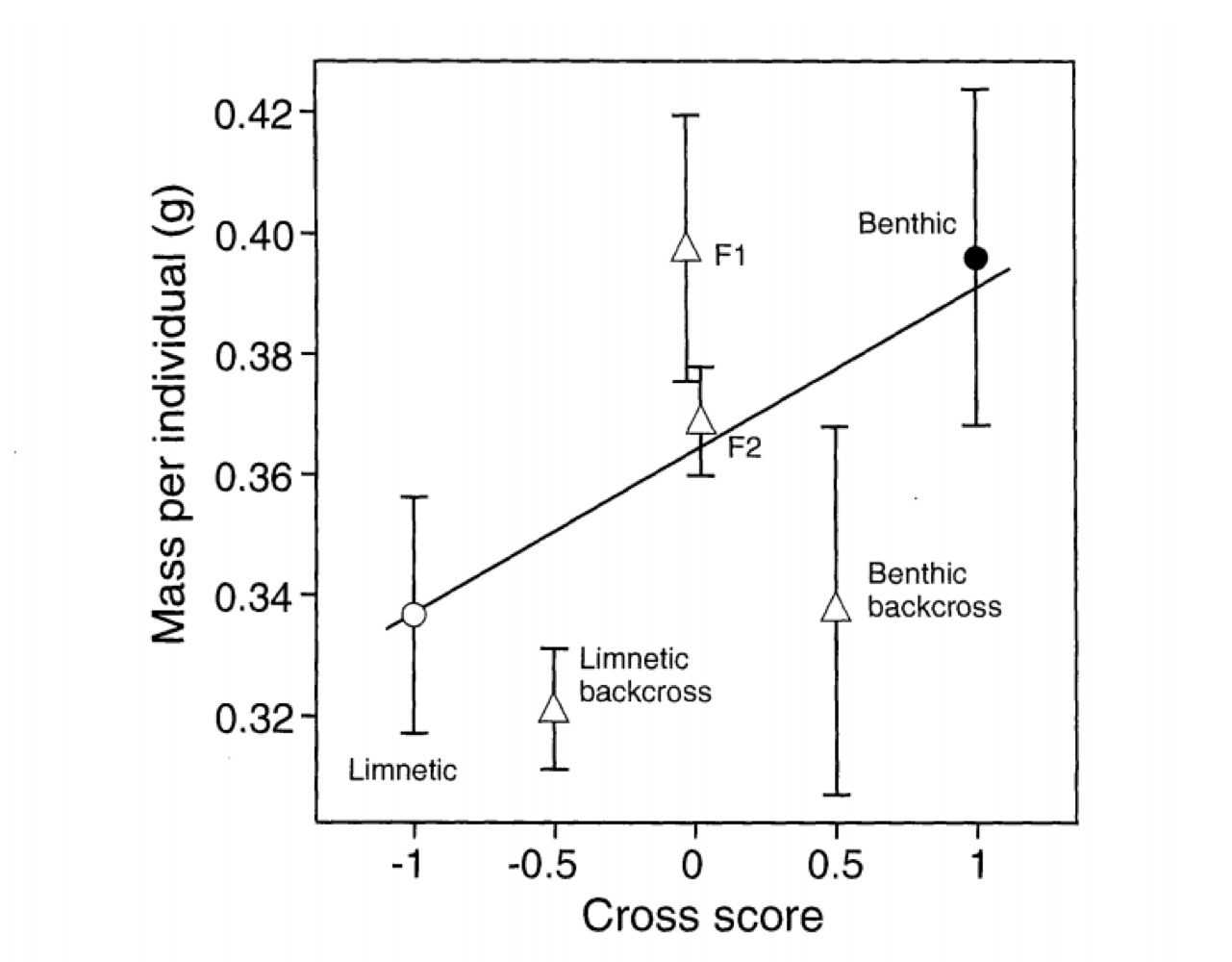
Postzygotic barriers: Hybrid breakdown
Hybrid breakdown is a type of post-zygotic reproductive failure where first-generation hybrid offspring are viable and fertile, but subsequent generations have low fitness.
• Caused by the separation of co-adapted gene complexes (epistatic interactions) from the parent species
• Example: Growth in stickleback hybrids
which evolves faster - prezygotic or postzygotic reproductive isolation? Why?
prezygotic, as it prevents mating from even taking place
Genetic basis of reproductive isolation: Intrinsic Postzygotic Isolation - DMIs
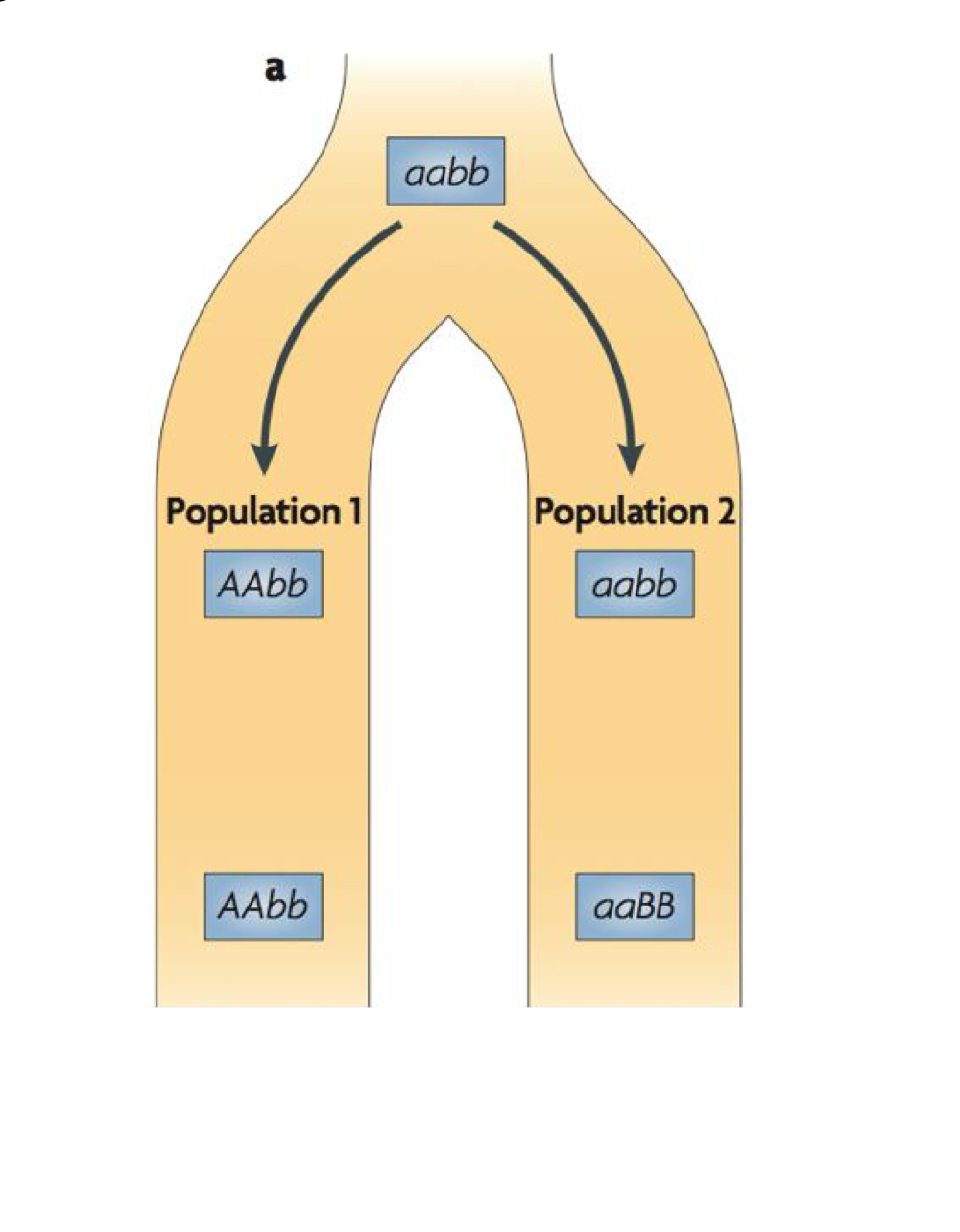
Dobzhansky-Muller Incompatibilities (DMIs)
• As populations diverge, different alleles may become fixed in each by natural selection or genetic drift (less likely to be important)
DMIs can help explain how hybrid dysfunction evolves
w DMIs evolution of reproductive isolation occurs as a byproduct of selection acting on other characteristics
Haldane’s Rule
• When in the offspring of two different animal (species) it is found that one sex is absent, rare, or sterile, that sex is usually the heterozygous [heterogametic, i.e. XY or ZW] sex J.B.S. Haldane (1922)
• Consistent across 95% of taxa surveyed (from birds to mammals to Drosophila!)
what could cause Haldane’s rule?
Dominance hypothesis (most widely accepted)
Many harmful genetic incompatibilities are recessive and located on the X (or Z) chromosome.
The heterogametic sex has only one copy of the X (or Z) chromosome.
Because there is no second copy to mask recessive harmful alleles, these incompatibilities are fully expressed.
This can lead to hybrid sterility or death.
faster-male evolution hypothesis
faster-X hypothesis
genetic incompatibilities
geographic context of speciation, allopatric:
The divergence and differentiation of populations that leads to a reduction of interbreeding can occur in several geographic contexts.
allopatric speciation is considered the predominate mode of speciation
can be a consequence of drift alone
due to adaptation to contrasting conditions
Example: Allopatric speciation in Hawaiian fruit flies
Limited gene flow between islands leads to speciation
Geographic Context of Speciation (sympatric)
Reproductive isolation in sympatry due to adaptation to contrasting conditions.
• Can occur if a trait simultaneously affects adaptation and mate preference
• These traits are called “magic traits”
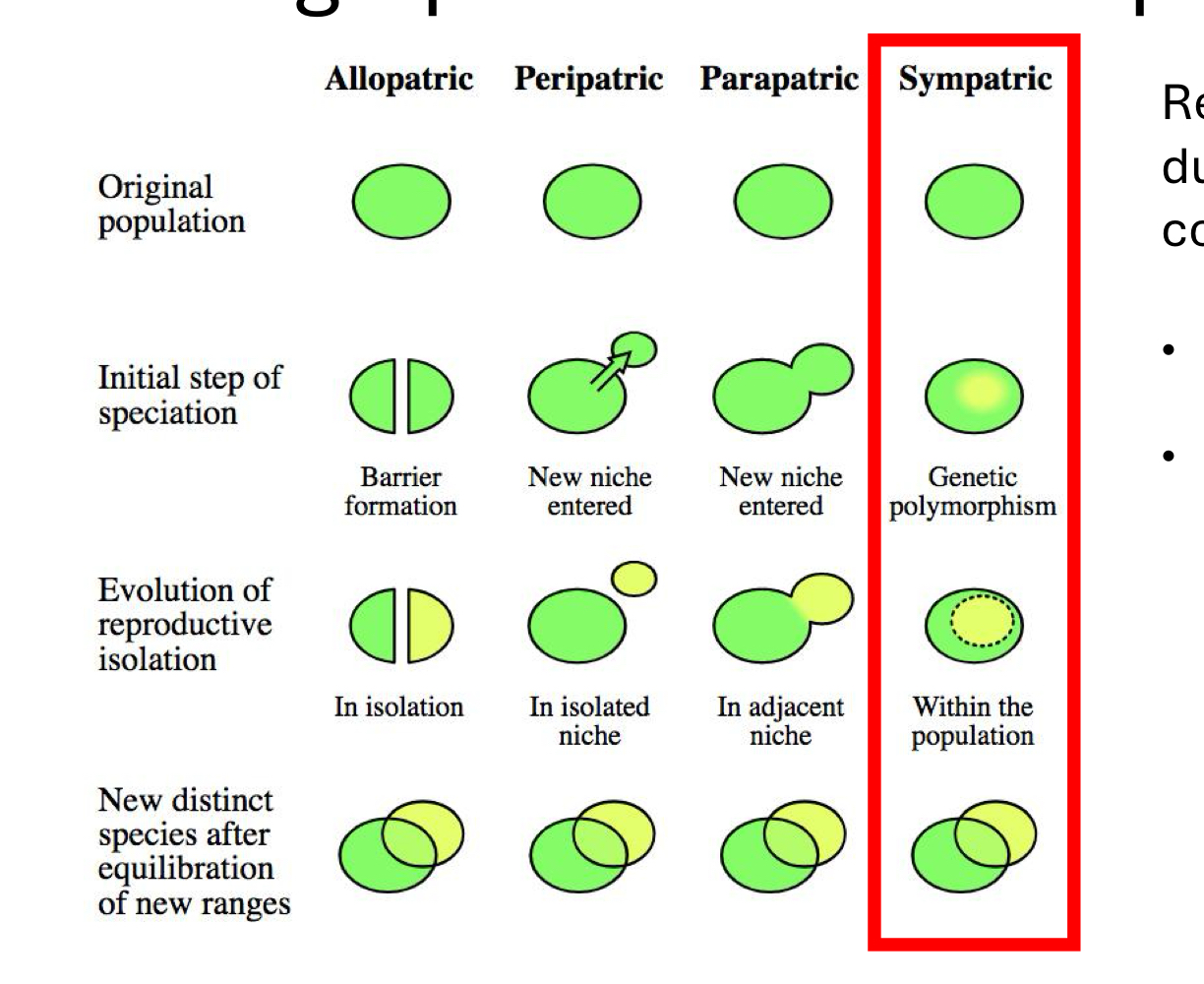
sympatric speciation: Lord Howe Palms
• Lord Howe Island is exceptionally small: 15 km2! More than 1/3 of the plant species occur
nowhere else in the world.
• Lord Howe Palms are wind pollinated, so unlikely they were ever microgeographically isolated. But there are ecological differences.
Outcomes of hybridization:
Hybrids are often unfit.
• Can be sterile – if this is the case there is no gene flow
• Trouble attracting mates – low to no gene flow
• Reduced survival – low to no gene flow
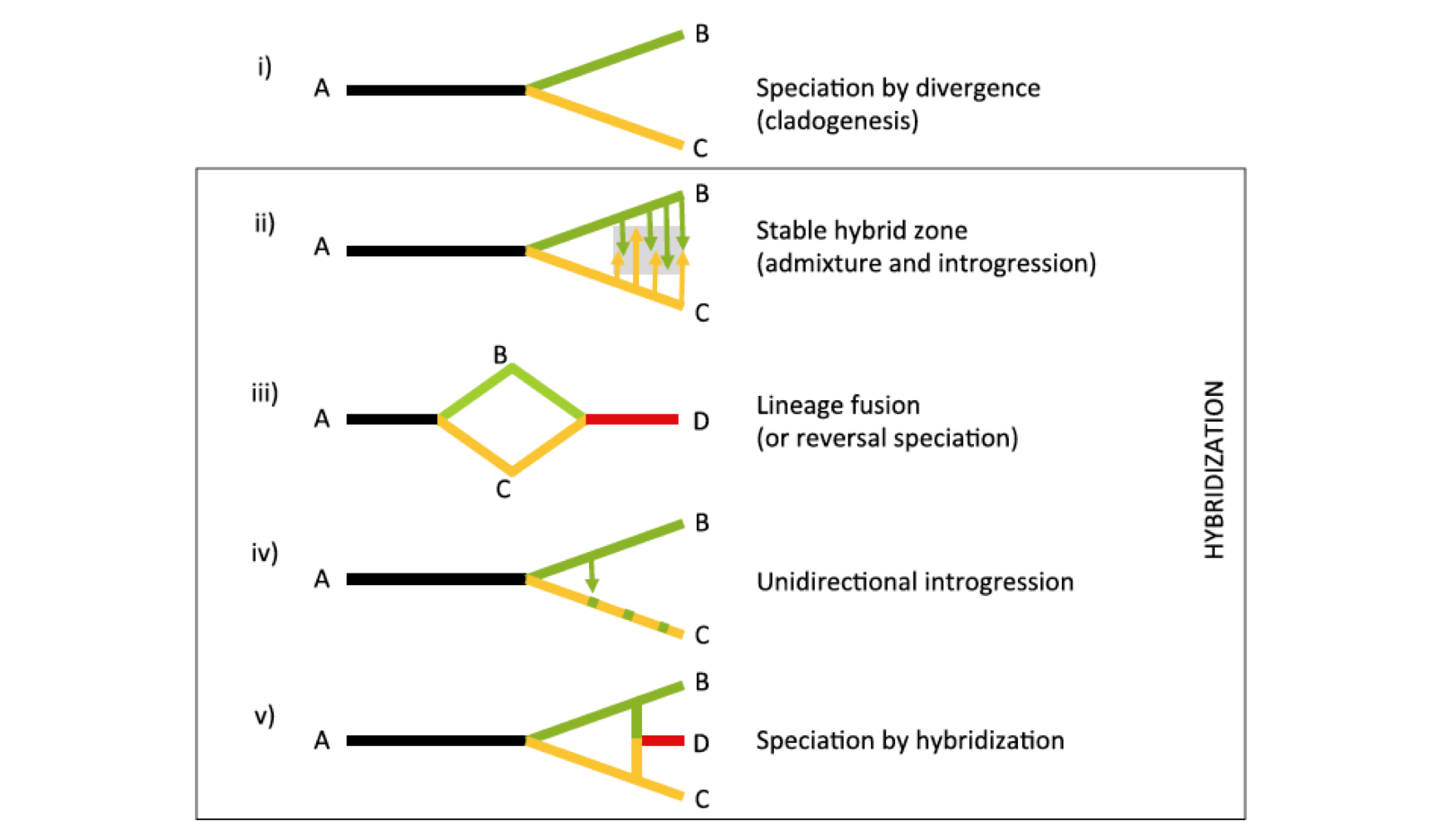
categories of outcomes of hybridization:
speciation by divergence (cladogenesis) may not be hybridization?
stable hybrid zone (admixture and introgression)
lineage fusion (or reversal speciation)
unidirectional introgression
speciation by hybridization
tension zone - hybridization
balance between dispersal into contact zone and selection against hybrids
introgression - hybridization
incorporation of alleles from one species into the gene pool of a divergent species via hybridization and backcrossing
Lake Victoria became so muddy that ongoing fish hybridization was reversed
• Females had species-specific mate preferences
• Due to human activity, water became so turbid that females could not use coloration as cue anymore
• Lineages started to interbreed
lineage fusion/reversal speciation
reinforcement
• You might be thinking that given the severe cost of hybridization, there might
be a tendency to try to avoid these heterospecific pairings.
• Well, this is in fact what is thought to be occurring, and this process has a
special name, it’s called reinforcement!
• Reinforcement occurs when there is natural selection for a decreased rate of maladaptive mating.
natural selection AGAINST maladaptive hybridization
reproductive character displacement occurs when?
species differences become more exagerated in sympatry compared to allopatry
reinforcement bird example:
- One avian system where evidence suggests this type of post-mating isolation may be important is in the Ficedula flycatchers in Europe and Asia.
- Two populations on the islands of Oland and Gotland in the Baltic sea are areas where they hybridize extensively, and long-term pedigree’s have been studied
- If reinforcement is occurring, we would expect that traits that can be used to distinguish the taxa are more different where they occur together, in sympatry
- Indeed, pied and collared flycatchers look different where they occur together than where they occur apart – pied are slightly brown, whereas collared have a much broader collar.
reproductive character displacement in snail genitalia:
in those places where they coexist, they evolved differences in genital morphology, preventing costly matings
Macroevolutionary patterns
• Emergence of new species through speciation
• Disappearance of species through extinction
Contrasts to microevolutionary patterns which
involve shifts in traits and allele frequencies
within populations/species and can occur within
a few generations
Macroevolution: Diversification
An evolutionary increase in the number of species in a clade,
usually accompanied by divergence in phenotypic characters.
Macroevolution: Speciation
Process of evolution that leads to the formation of new, distinct species,
reproductively isolated from one another.
See this as the splitting of lineages
Speciation Rates
• Track origination of species over time.
• Not constant - change over time.
• Often, we see a trend of decreasing speciation rates over time as species saturate the available niche space.
• Also see variation in rates among different clades.
Macroevolution: Extinction
The dying out or extermination of a species or clade
can be a ‘mass’ extinction or loss of a single species/lineage
anthropocene:
increased extinction rates
humans have always had an impact on extinction in large mammals
extinction rates
rates of species loss over time
can vary over time and across clades
background extinction rate:
number of species expected to go extinct over a period of time - generally a steady rate
diversification rates
diversification rates are the combined effect of speciation and extinction and measure the accumulation of species over time
diversification equation
diversification = speciation - extinction
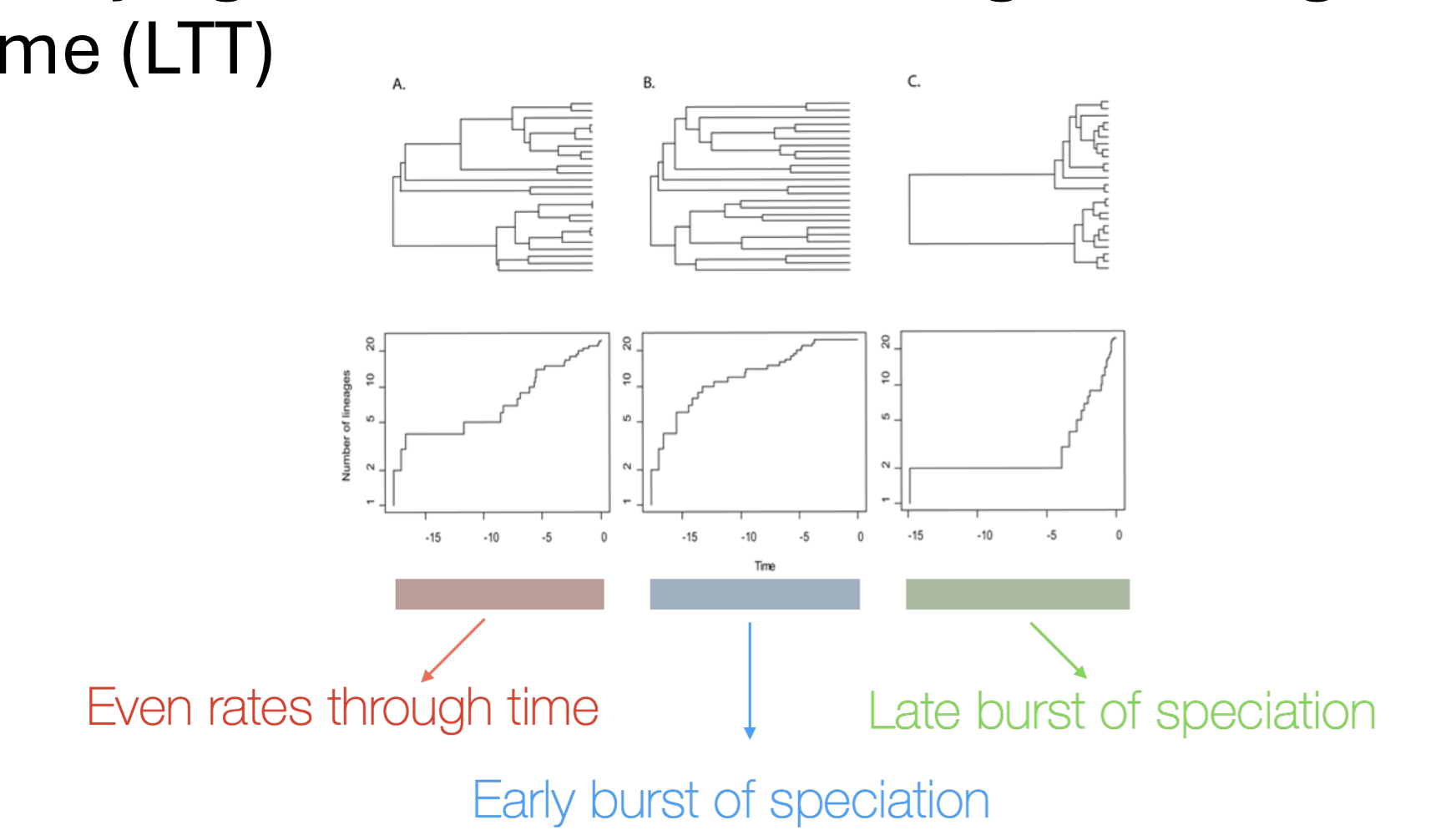
studying diversification - lineages through time (LTT)
even rates through time
early burst of speciation
late burst of speciation
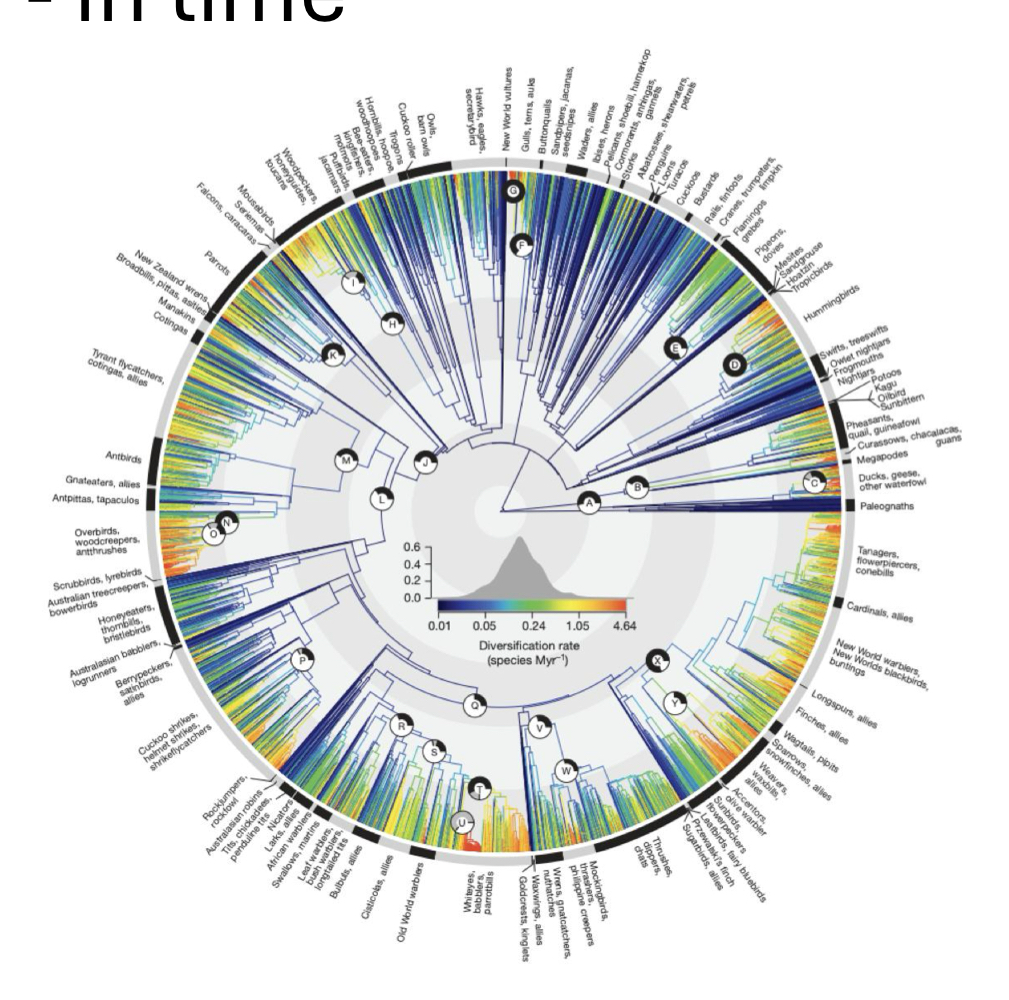
variation in diversity - in time
tree includes nearly every single species of bird on Earth
branches are colored by diversification rate
blue clades tend to be early burst
red clades are mostly late burst
why diversification? - Ecological Opportunity
Defined as: the availability of ecologically accessible resources that may be evolutionarily exploited
Generally impossible to measure in nature!
ecological opportunity - Geographic Colonization
The colonization of an isolated area (e.g., an island or lake) can provide a release from
competition and predation pressures, allowing a clade to diversify into a variety of
ecological niches from which they were previously blocked
ecology opportunity - extinction
Lineages able to survive extinction events may be presented with access to ecological space previously occupied by members of their own clade or by other competitors
ecological opportunity - New Resources
The appearance of new resources may provide ecological opportunities for species that can utilize them.
ecological opportunity - key innovations
The evolution of a feature that allows a lineage to interact with the environment in a novel way may provide the ability to utilize formerly unavailable resources.
Key adaptations facilitating diversity—Insects
Is a trait consistently associated with increased diversity in independent
groups? “
Non-herbivorous sister groups of 13 herbivorous clades. 11 of 13 the
herbivorous clades had more species!
Key adaptations facilitating diversity—Latex
Farrel et al. (1991) in another sister species comparison, looked at sister species of plant
where groups did or did not have latex. 13 of the 16 clades with latex had higher diversity
Lack of opportunity - Competitive Displacement
Competitive displacement occurs when one species (or population) is pushed out of part of its niche because another species is a better competitor there.
Adaptive Radiation
• When a single ancestor rapidly diversifies into a variety of types that occupy different niches.
an evolutionary increase in the number of species in a clade, usually accompanied by divergence in phenotypic characters
Two components:
ecological diversity (via natural selection)
many species from a single ancestor
Adaptive radiation—cichlid fishes in east Africa
• In East African lakes, cichlid fish are immensely diverse, in both foraging ecology and coloration.
• In the three rift lakes, this diversity arose extremely rapidly.
• There is also phenotypic convergence between lakes.
The pharyngeal jaw: a key innovation
Cichlids evolved a second set of “throat” jaws that help with food processing
while the “regular” oral jaws can specialize on food capture
what drives diversification in African drift lakes?
deeper the lake the more diversity there is
non-adaptive radiations
Non-adaptive radiations: collections of related ecologically similar species that are allopatric replacements of one another
Example: The Achatinella land snails of Hawaii.
• Diversification of these snails is suggested to be the result of persistence in nearly identical environments among the eroded valleys and ridges of the Hawaiian Islands.
• Species are distinguished based on color and shell shape, as well as by geographic
distribution.
• High species diversity, but low ecological differentiation
in non-adaptive radiation, species diversify without ecological differentiation
non-adaptive radiation example:
• Island populations of monarch flycatchers from
northern Melanesia
• Evolved within 1 million year
• Ecologically very similar
• No strong differences in what they eat, or where they next, or when they reproduce
Macroevolutionary patterns – Evolutionary rates
Rate of evolution of body size.
• Evolutionary change appears much faster in living species than fossils.
• Actual changes in the trait don’t appear to accumulate until there are larger time scales. This is what we call the paradox of stasis.
How can evolution be very fast over short timescales, but only lead to phenotypic
differences between lineages over very long timescales?
Evolution can occur rapidly because allele frequencies can change within a few generations, but substantial phenotypic divergence between lineages usually requires the accumulation and persistence of many genetic changes over long periods, while stabilizing selection and changing environments often limit or reverse short-term evolutionary changes.
Does speciation affect the rate of evolution?
Two competing hypotheses:
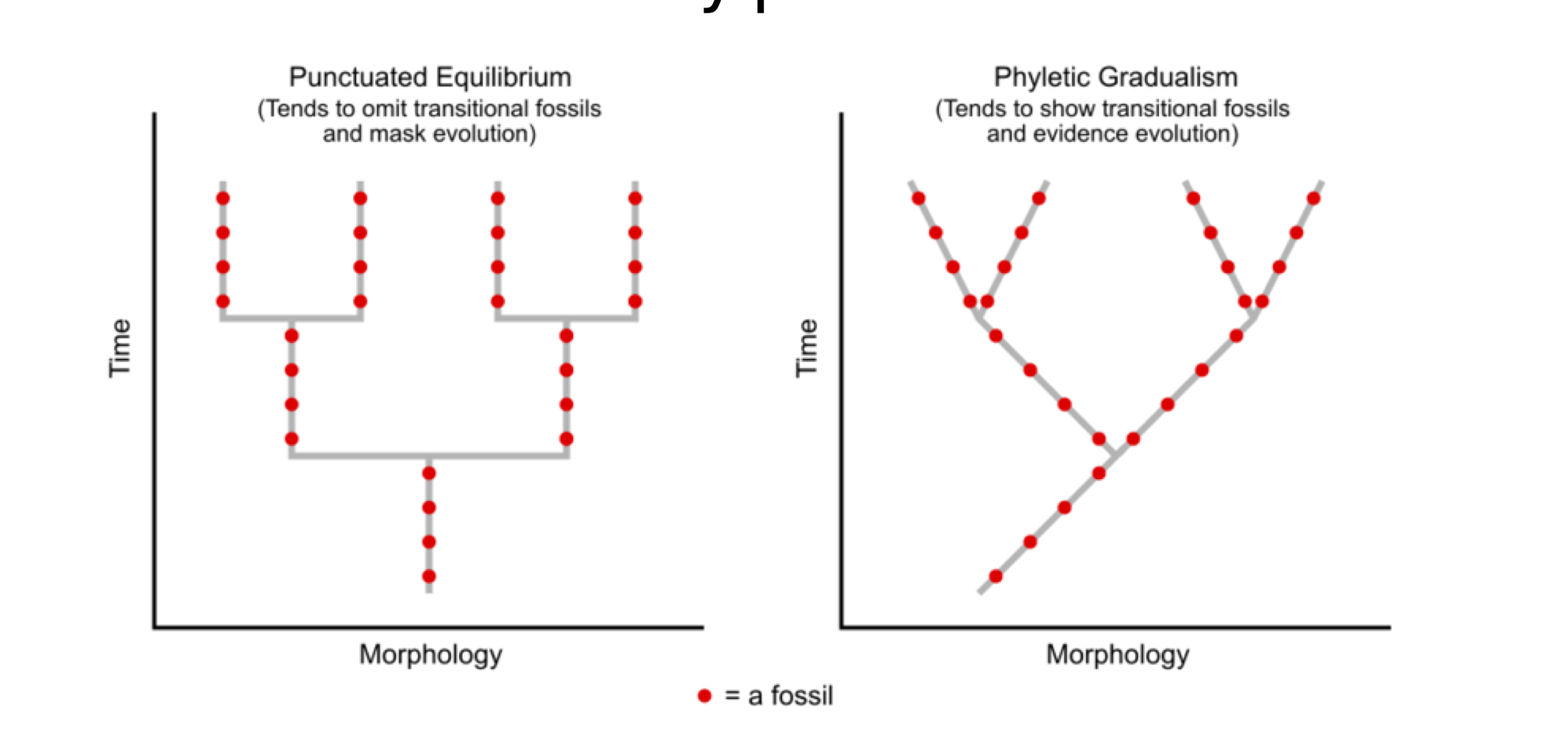
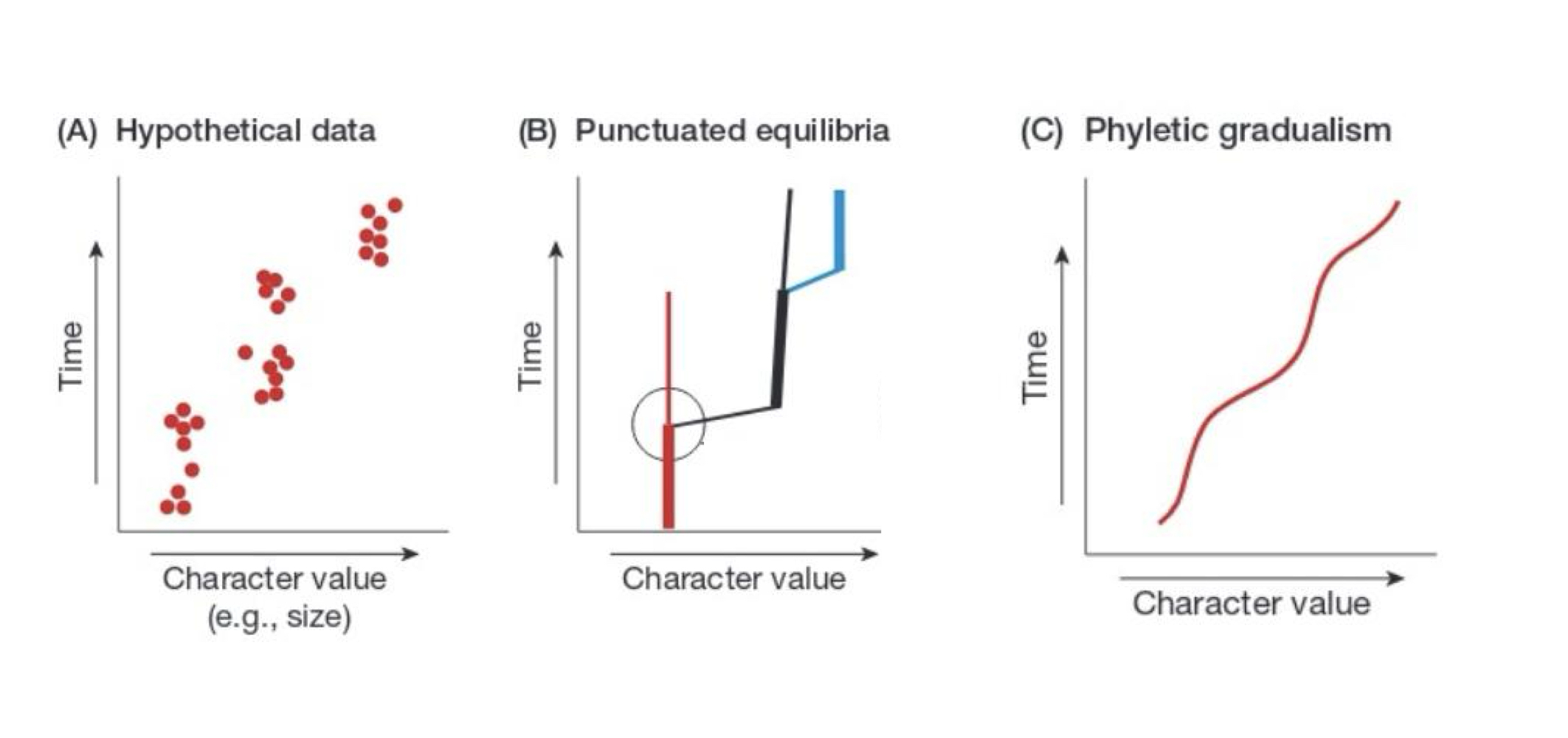
• Punctuated equilibrium: Evolutionary change is marked by isolated episodes of rapid speciation between long periods of little or no change (stasis).
• Gradualism: Evolutionary change occurs sat a steady (continuous) speed, which results in the gradual transformation of whole lineages.
ecidence of both in fossil record - ongoing debate which is more important/common
macroevolutionary patterns
hypothetical data
punctuated equilibria
phyletic gradualism
phylo - genetic
phylo = tribe or race
genetic = origin/development of
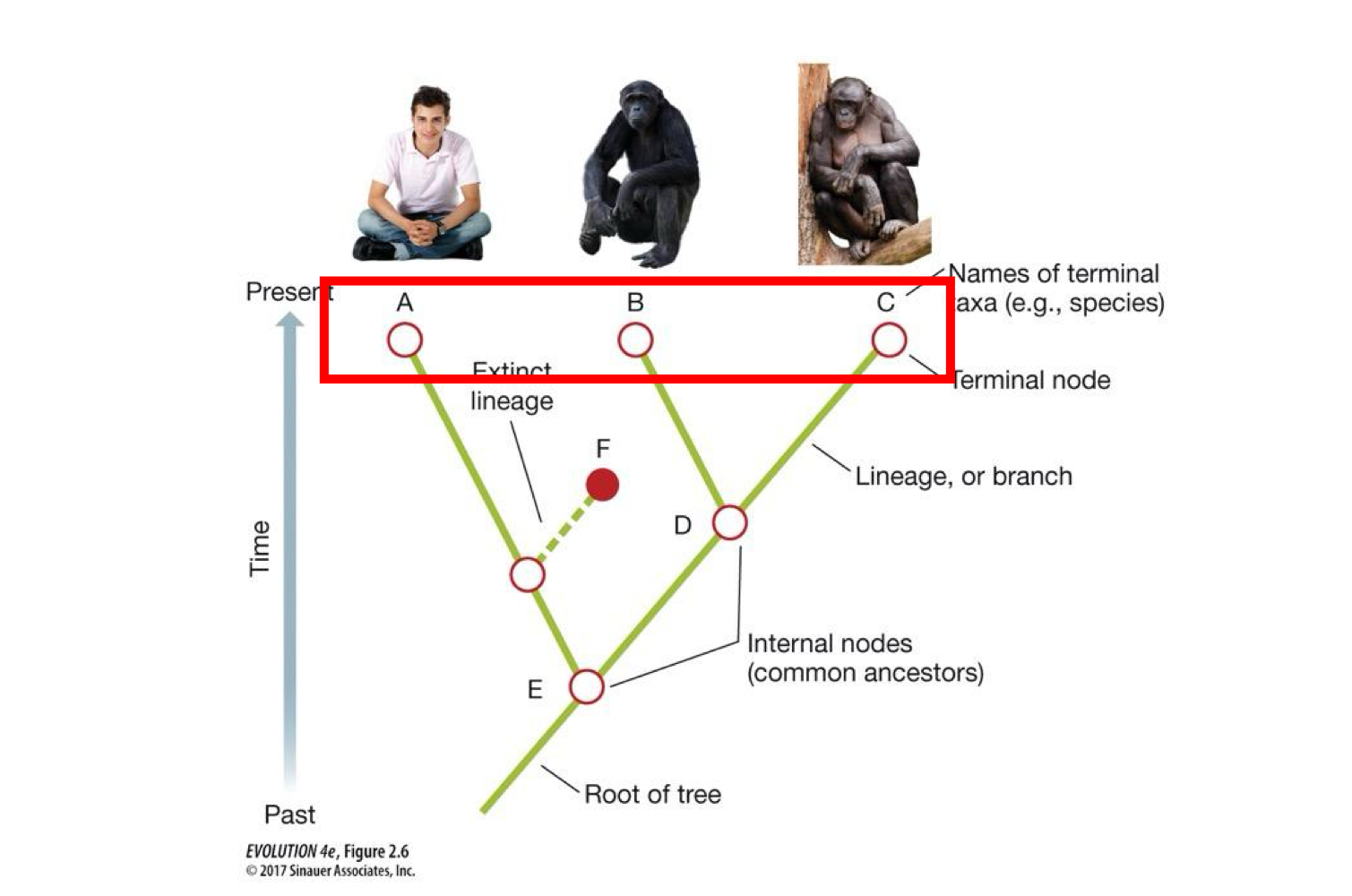
phylogenetic terminology
see pic
rooted vs. unrooted trees
root = comon ancestor of all taxa in the tree
rooted trees incorporate relative time
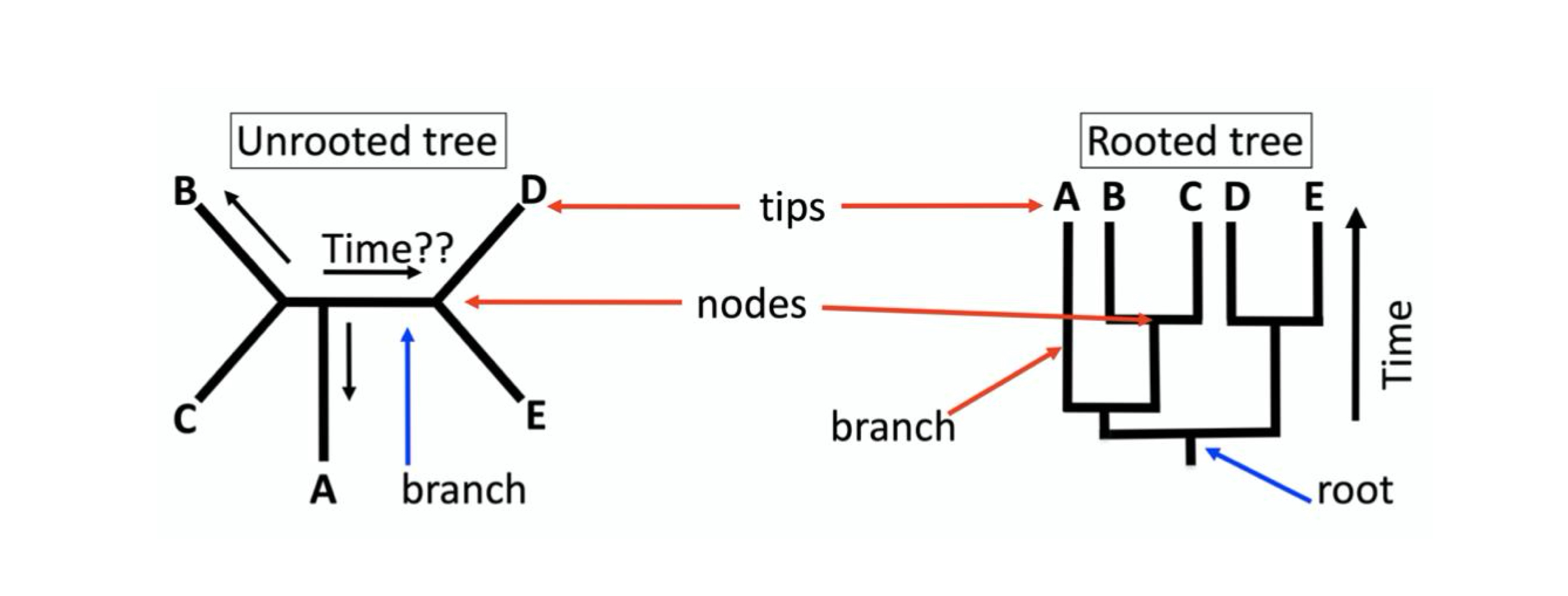
example of unrooted tree
tree of life
classic unrooted tree, for a long time, it was hard to infer where to root the tree, because there is no known outgroup
example of a rooted tree:
hominin tree
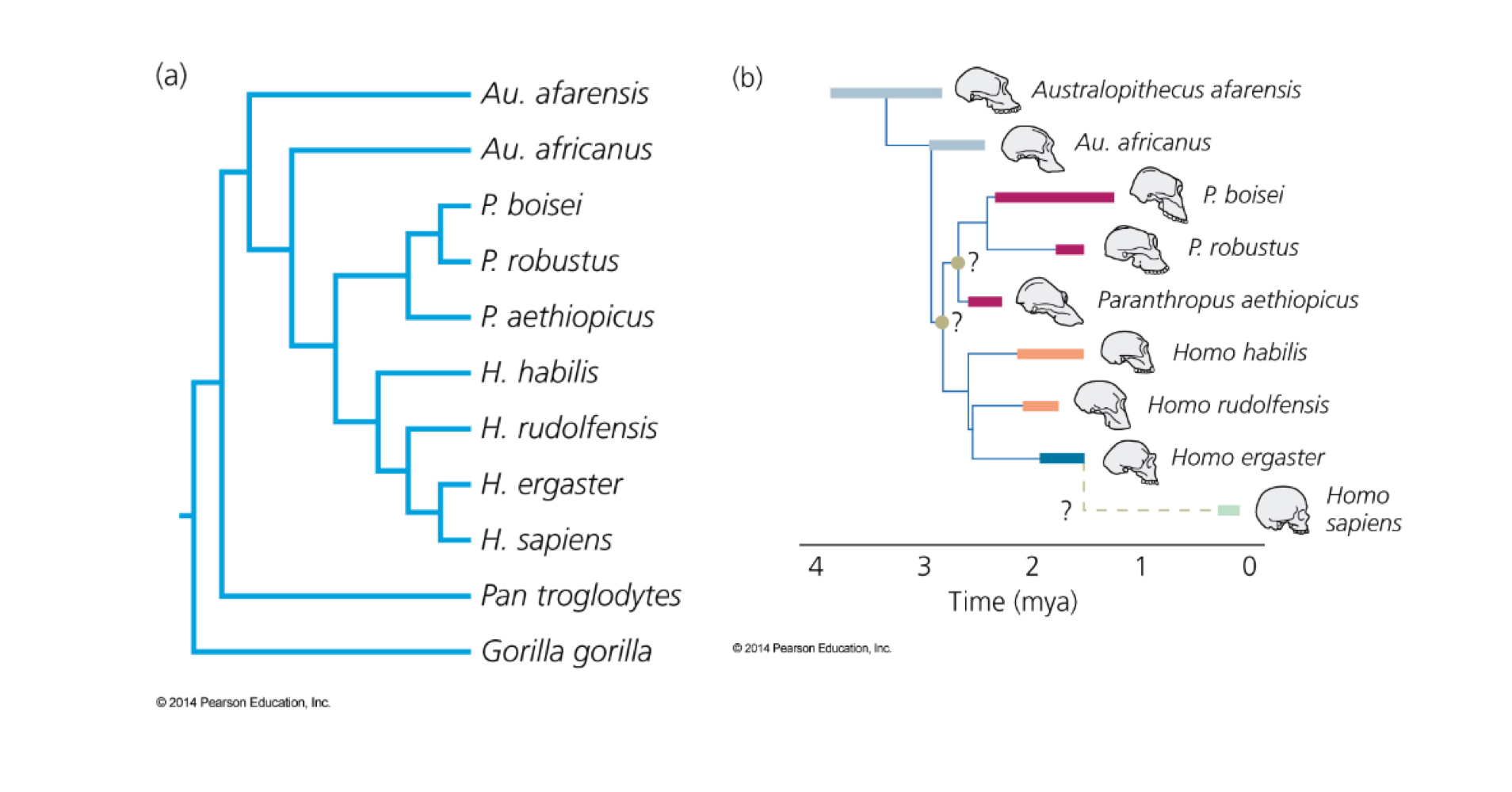
where does the root come from?
outgroup: a taxon outside of the group of interest. All the members of the group of interest are more closely related to each other than they are to the outgroup. Hence, the outgroup stems from the base of the tree. an outgroup can give you a sense of where on the bigger tree of life the main group of organisms falls
dated tree - where does the node age come from?
fossils
carbon dating
geological time series
molecular clocks (which are themselves calibrated)
using the molecular clock to date a phylogeny
If two species share a common ancestor, what happens to their
DNA over time?
• Mutations occur every generation
• Most mutations are neutral
• Neutral mutations accumulate approximately steadily
through time
→ The number of DNA differences between two species
reflects how long ago they diverged
Genetic distance ≈ mutation rate × time
different groupings:
monophyletic - includes an ancestor and all of its descendants
paraphyletic - includes ancestor and some, but not all of its descendents
polyphyletic - includes two convergent descendants but not their common ancestor
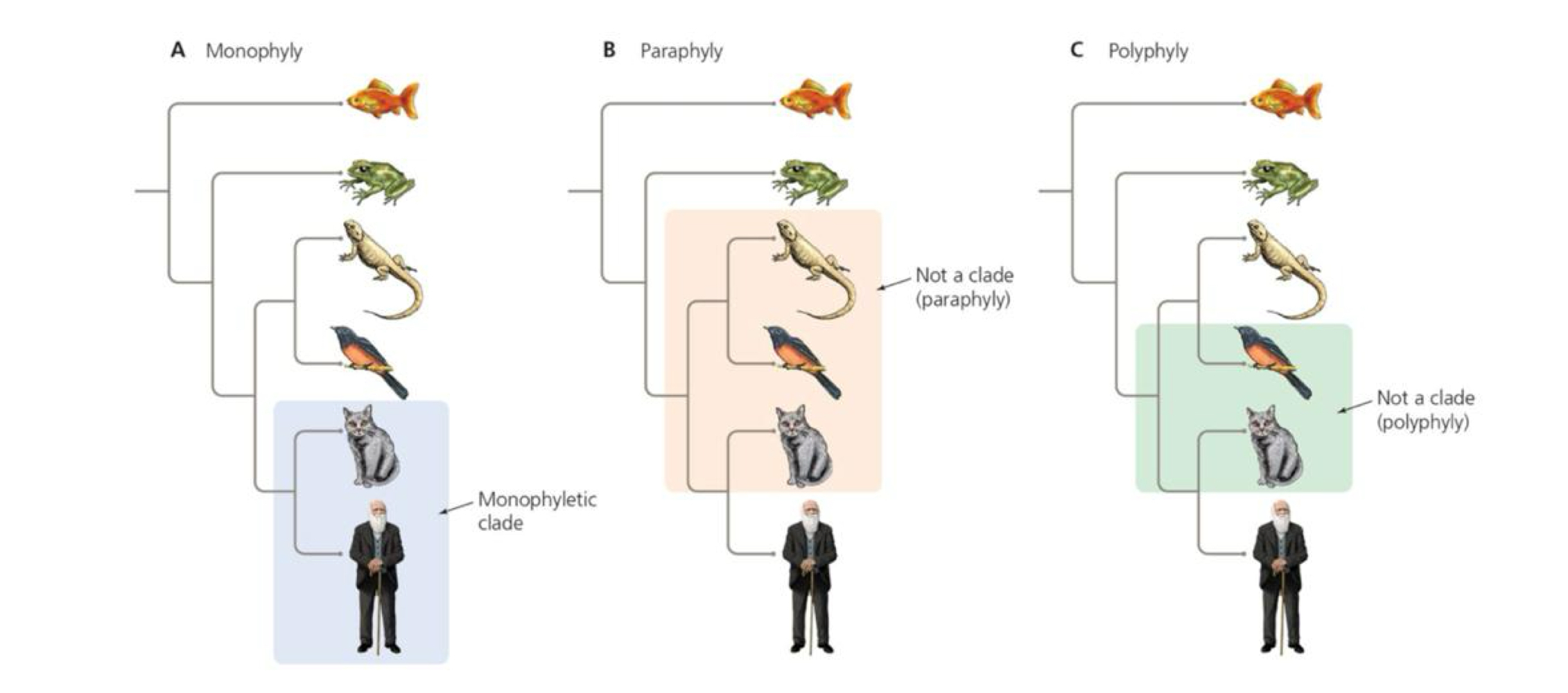
monophyletic group":
consists of a node and all of its descendants, aka a “clade”. Clade is also used to describe the entire group (i.e. including those not on the tree in question, and including the common ancestor)
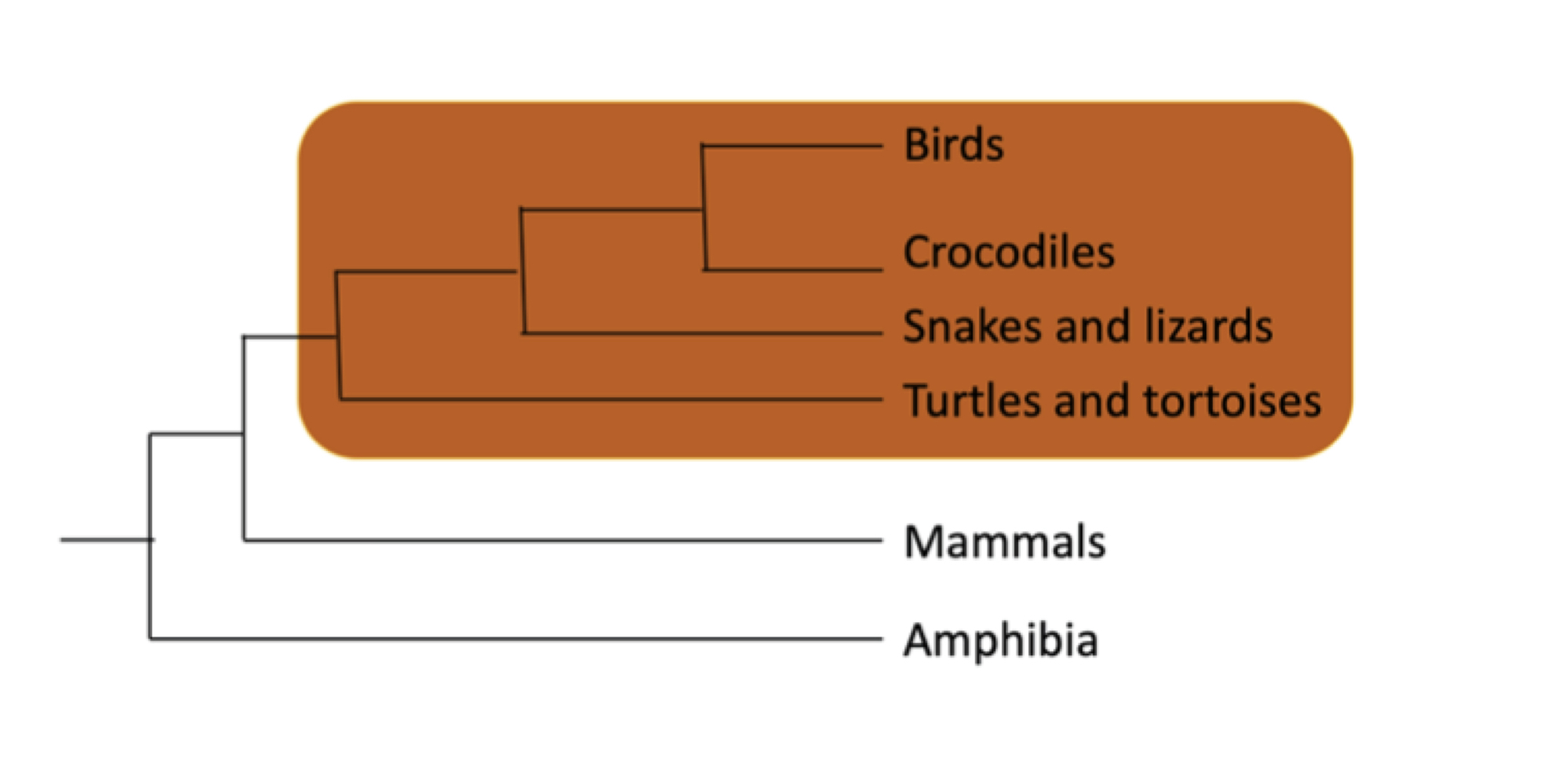
paraphyletic group:
contains a node and some, but not all, of its descendants. Either on the tree, or more generally
the group reptiles does not include birds although they descended from the same common ancestor
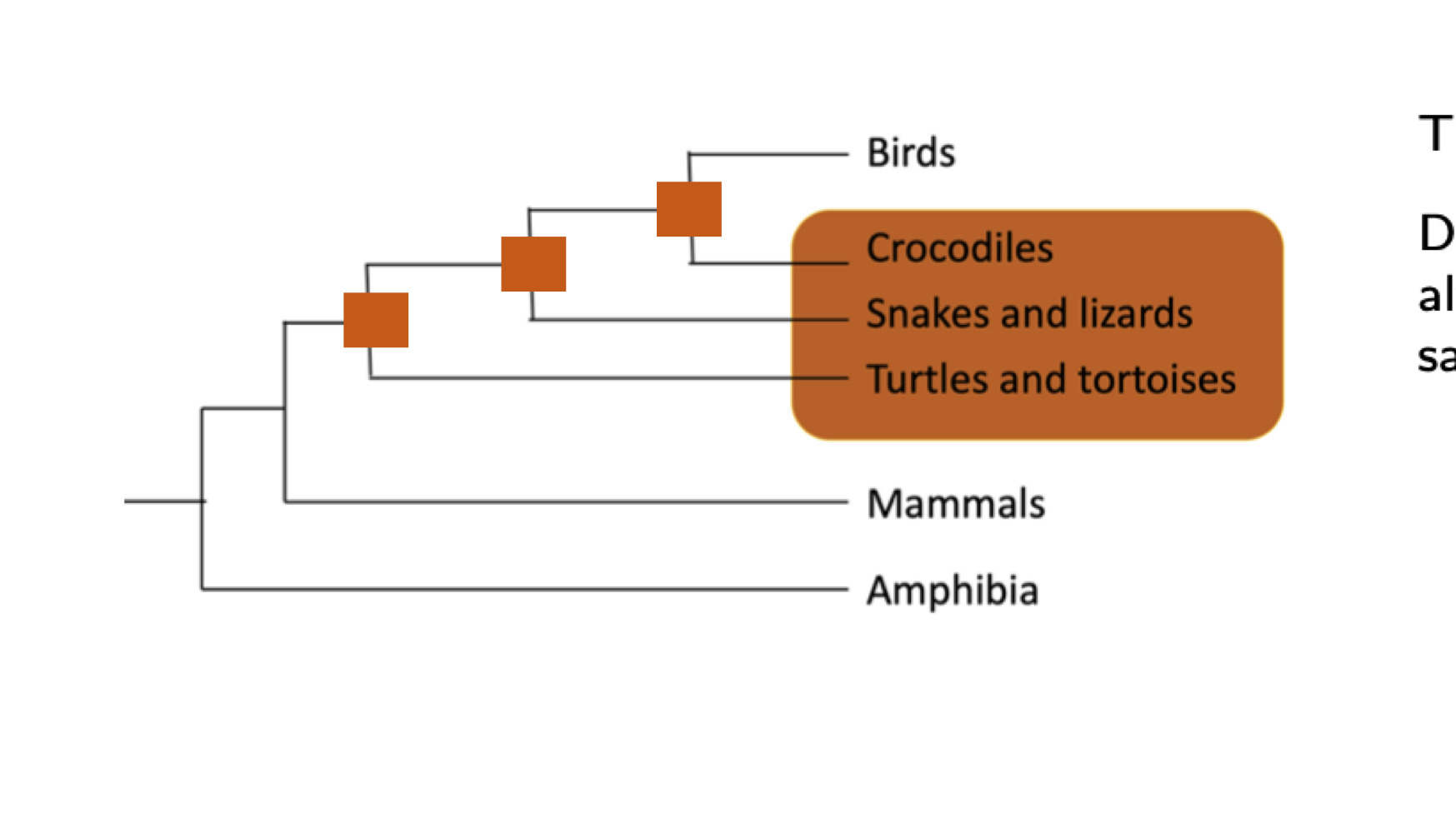
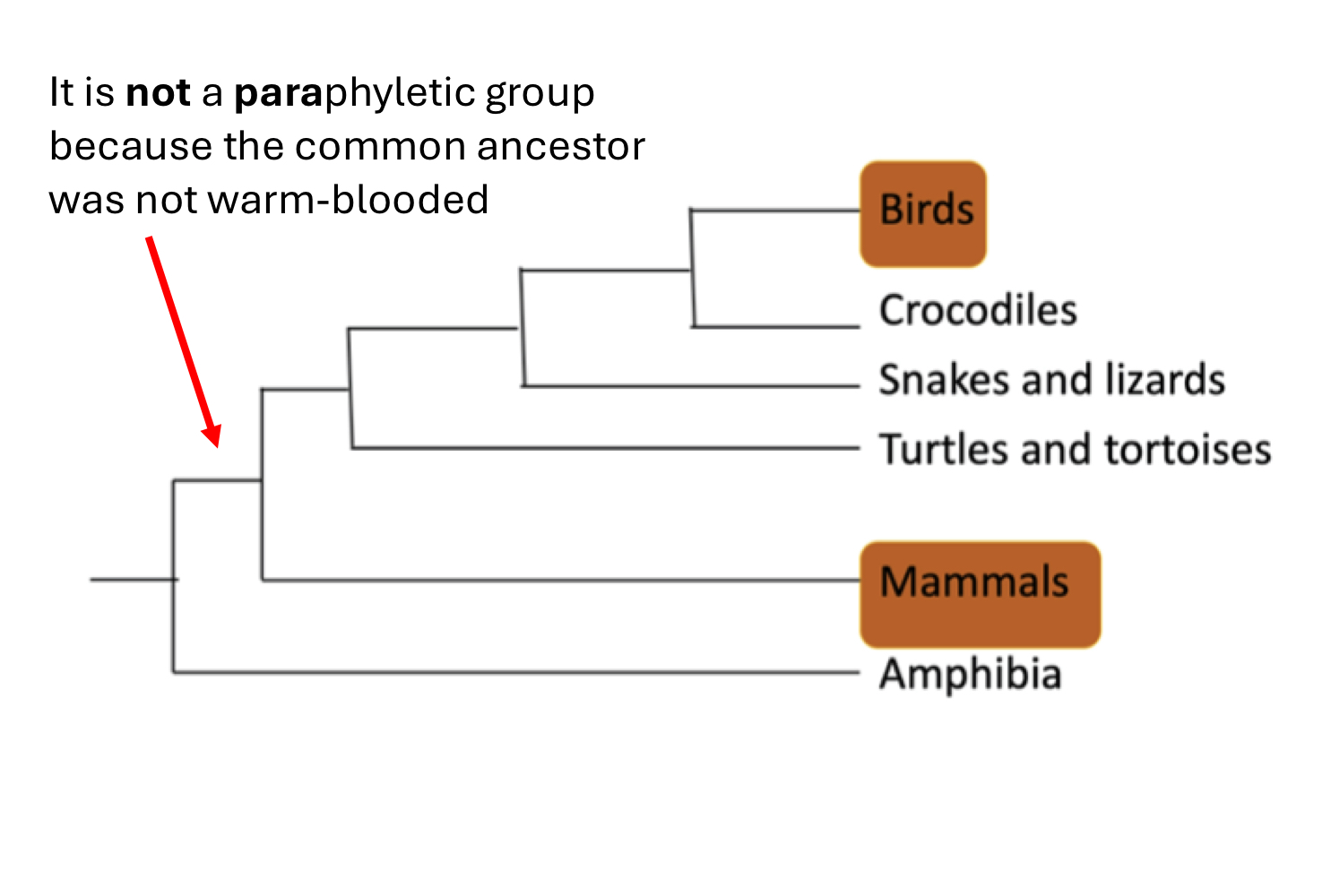
polyphyletic group:
contains some, but not all, of a node’s descendants, and that also excludes that node
warm blooded vertebrates
endothermy evolved separately in mammals and birds
birds and mammals are not close relatives, latest common ancestor is not the same
why do we care about monophyly?
Monophyletic groups represent true evolutionary lineages
• all members share a single common ancestor
• It’s a natural evolutionary unit.
In contrast:
• Paraphyletic groups leave out some descendants
• Polyphyletic groups group species that do not share a recent ancestor
identifying monophyletic clades:
“Synapomorphy”: a derived character shared by all members of the group
• e.g., All animals that have vertebrae form a single, monophyletic clade.
Vertebrae are a shared, derived character, not present in their ancestors
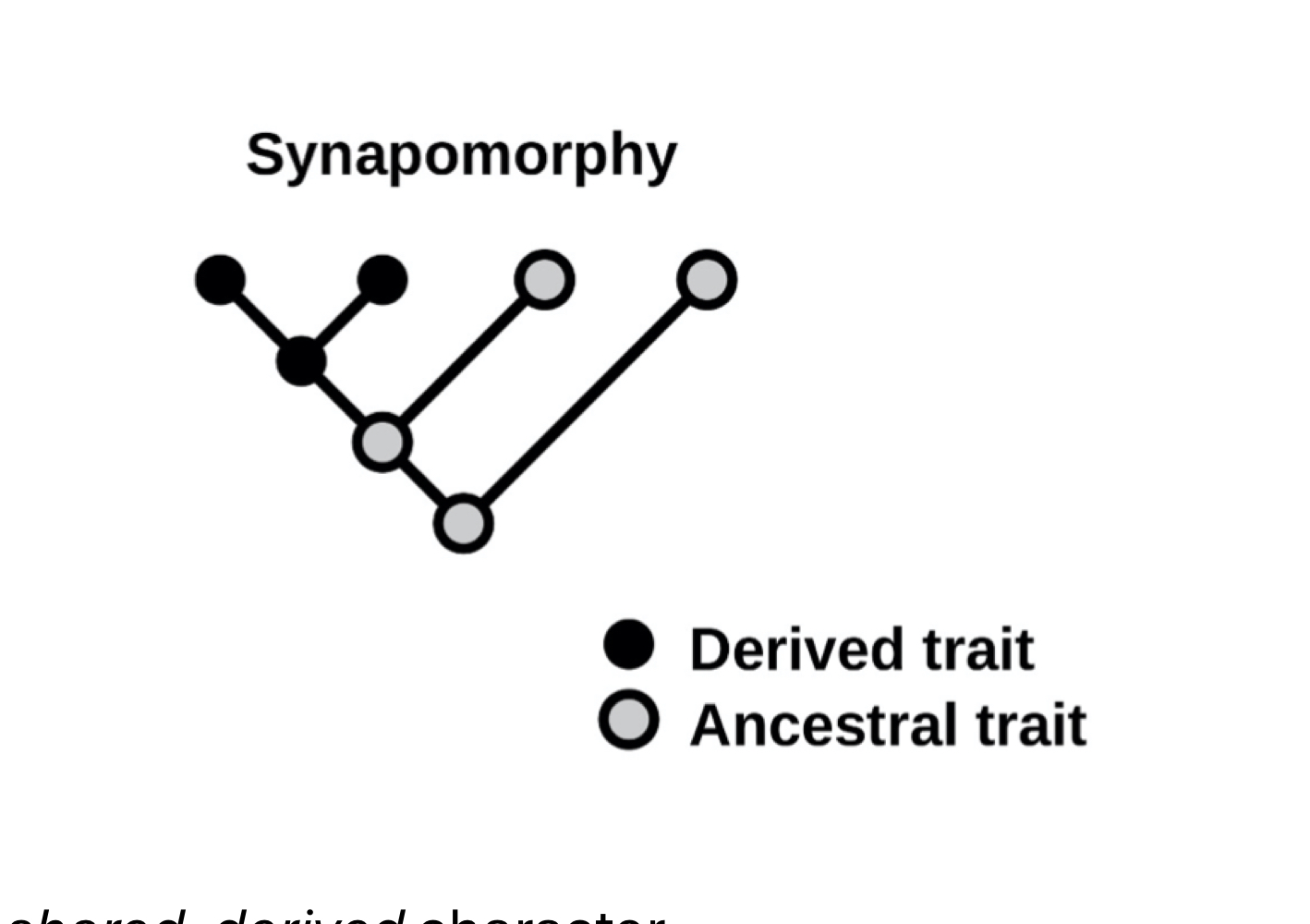
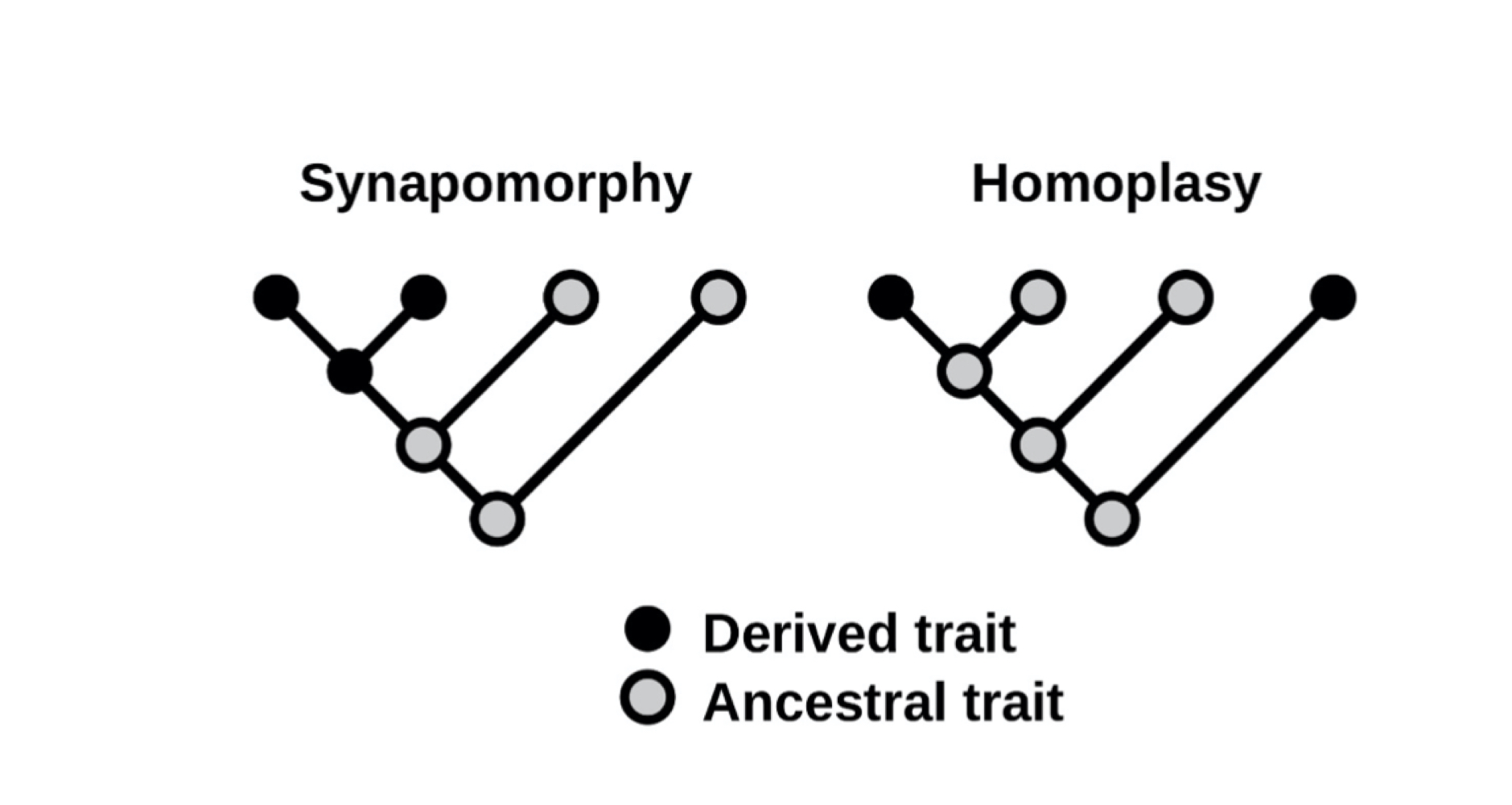
synapomorphy vs. homoplasy
Homoplasy: a character shared by a set of species but not present in their
common ancestor.
homology
Homologous traits are traits that are shared among species because they are
inherited from a common ancestor.
The arrangement of limb bones is a synapomorphy of tetrapods (four-legged
land vertebrates)
synaptomorphy is a subcategory of homology
homology vs. homoplasy
Homology – wings are shared among penguins and falcons due to common descent
Homoplasy – independent evolution of wings in insects and birds
how do we build phylogenies?
• Parsimony is the idea that the best phylogenetic tree is the one that requires the fewest evolutionary changes.
• We use parsimony all the time in our daily life:
• If your friend doesn't answer your text, the simplest explanation is that they're busy, not that they were abducted by aliens.
• Likewise, when reconstructing evolutionary history, we prefer the scenario that requires the fewest DNA mutations unless there is evidence otherwise.
least amount of genetic changes will always be assumed
some biological “difficulties” in generating phylogenies:
1. Horizontal Gene Transfer
2. Hybridization/ Introgression
3. Incomplete Lineage Sorting
4. Homoplasy
5. Saturation of DNA mutations
incomplete lineage sorting:
• Occurs when looking at several species recently diverged from a common ancestor.
• Due to the sorting of variation that was present in the ancestor.
• Causes gene trees to have a different topology than the species phylogeny.
rapid speciation:
cichlids speciated very rapidly, adaptive radiation
solution: more characters
consider lots of traits like
wings
mouth structure
antennae
leg number
include genes!
some genes evolve too fast!
• DNA sites can undergo substitution multiple times.
• If there are too many or too little mutations, it becomes hard to reconstruct phylogenies
Solution: Different Data Types
• Because there are more codons than amino acids, the genetic code is redundant, and most redundancy occurs at the third codon position (the ‘wobble’ position)
• The third position experiences less intense selection and therefore accumulates mutations faster
what do we use trees for?
• To graphically represent how evolution has unrolled.
• To make our organization of biodiversity rational.
• To test hypotheses about evolutionary change
• To make inferences about evolution for practical reasons.
• To help guide conservation planning.
• To help explain patterns of biodiversity!
resolving classification - to make our organization of biodiversity rational
Linnaean approach: organisms grouped by shared characteristics
Darwinian approach: shared characteristics are (usually) due to common ancestry
common ancestry provides the basis for phylogeny and classification
why were phylogenies important during COVID?
By sequencing SARS-CoV-2 genomes from infected individuals, scientists could build phylogenetic trees and use them to:
• Trace how the virus spread between regions and countries
• Identify transmission clusters and superspreader events
• Distinguish local transmission from new introductions
• Estimate how quickly the virus was evolving
• Phylogenetic trees revealed the emergence of new SARS-CoV-2
variants
• As mutations accumulated, some lineages began to diversify rapidly:
• Alpha, Delta, Omicron
• Researchers could identify these expanding branches early and ask:
• Is this variant spreading faster?
• Is it better at evading immunity?
• Is it replacing other variants?
• Phylogenetics was critican in guiding public health responses, vaccine
updates, and global surveillance.