Food state part C (q.60-70, legislations)
 Call Kai
 Learn
Learn Practice Test
 Spaced Repetition
 Match
Match Flashcards
 Knowt Play
1/10

There's no tags or description
Looks like no tags are added yet.
Name | Mastery | Learn | Test | Matching | Spaced | Call with Kai |
|---|
No analytics yet
Send a link to your students to track their progress
11 Terms
60. Framework for official controls. Subject matter and scope. The role of the official veterinarian in food chain.
Framework for Official Controls
Regulation (EU) 2017/625
➡ Official Controls Regulation (OCR)
Purpose:
✅ Protect public health, Protect animal health, animal welfare, and plant health
Official Controls
👨⚖ =Activities performed by competent authorities according to Regulation (EU) 2017/625.
Verify compliance by operators with rules referred to in Article 1(2)
Verify that animals and goods meet the requirements in Article 1(2), e.g., Official certificates and Official attestations
White Paper on Food Safety (2000): ⭐ Stable-to-Table / Farm-to-Fork concept 🐮 ➜ 🏭 ➜ 🍖 ➜ 🛒 ➜ 👨👩👧👦. Goal: High level of food safety and Control throughout the whole food chain. (general food roles & controls, involves rules and laws for all processes in animal food production, from farm to fork / from stable-to-table)
Current Food Law covers all stages of food production
Controls and monitoring throughout the whole food chain
Subject Matter and Scope (Hva kontrolleres for å sikre mattrygghet?)
Regulation (EU) 2017/625
Official controls cover all aspects important for:
🩺 Public health
🐮 Animal health
🐾 Animal welfare
🌱 Plant health
♻ Animal by-products
Scope Includes:
🔍 Verification of compliance with:
🍖 Food law
🌾 Feed law
🐮 Animal health rules
🐾 Animal welfare rules
🌱 Plant health rules
♻ Animal by-product legislation
In Practice: (disse reglene kontrolleres ved disse stegene)
Inspection, Monitoring, and Sampling throughout the entire food chain
👨⚕ Role of the Official Veterinarian (OV)
➡ Veterinarian appointed by the competent authority
➡ Qualified to perform official controls according to Regulation (EU) 2017/625
🏷 In Fresh Meat
✅ Apply health marks after successful AMI and PMI
Main Roles of the OV:
1⃣ Inspection and Certification
🔍 Carry out official controls at 🏭 Slaughterhouses, 🦌 Game handling establishments, 🔪 Cutting plants
📄 Certification
2⃣ Risk Assessment and Risk Management
⚠ Identify hazards
📊 Evaluate risks
Implement: HACCP and GMP (Good Manufacturing Practice)
3⃣ Sampling and Testing
🧪 Sample collection
🔬 Laboratory testing
📊 Interpretation of results
4⃣ Disease Control and Prevention
🦠 Surveillance
🦠 Outbreak investigation
🦠 Prevention programmes
🚨 Notification of diseases
5⃣ Compliance and Enforcement
📋 Verify legal compliance
⚖ Enforce legislation
🚫 Restrict products when necessary
6⃣ Collaboration and Communication
🤝 Farmers
🤝 Food Business Operators
🤝 Laboratories
🤝 Competent Authorities
🤝 Consumers
7⃣ Border Control
✈ Import controls
🚢 Export controls
🐮 Animal movement controls
🚚 Animal transport requirements
8⃣ Fishery Sector
🐟 Health management
🍣 Food safety
🧪 Testing and control
🌍 Public health protection
"OV kontrollerer hele matkjeden fra gård til bord. På gården kontrollerer OV registrering og godkjenning av besetningen, dyrehelse, dyrevelferd og sporbarhet. På slakteriet utfører OV AMI, PMI og helsemerking. OV arbeider også med HACCP-kontroller i næringsmiddelbedrifter, grensekontroll av importerte dyr og produkter, samt kontroll av fiskeri- og sjømatproduksjon”
🌈 HIGH-YIELD EXAM POINTS
⭐ Main legislation = Regulation (EU) 2017/625
⭐ Official controls = performed by competent authorities
⭐ Concept = Stable-to-Table / Farm-to-Fork
⭐ Scope:
Food law
Feed law
Animal health
Animal welfare
Plant health
Animal by-products
⭐ OV = veterinarian appointed by competent authority
⭐ OV applies health mark on fresh meat
⭐ HACCP + GMP are important risk-management tools
🧠 Memory Picture
🌾 FARM ↓ 🐮 ANIMAL HEALTH ↓ 🚚 TRANSPORT ↓ 🏭 SLAUGHTERHOUSE ↓ 🍖 PROCESSING ↓ 🛒 MARKET ↓ 👨👩👧👦 CONSUMER 👨⚕️ OV CONTROLS EVERYTHING
🎓 Committee Memory Sentence
Regulation 2017/625 establishes official controls from stable-to-table, and the official veterinarian verifies compliance with food law, animal health, animal welfare and food safety requirements throughout the food chain. 🚜➡🍖➡🍽
🚨 Committee Notes for Q60 (Very Important)
Committee questions seem to focus on the practical role of the OV outside slaughterhouses and the legal framework around 2017/625.
📜 Regulations Related to Official Controls
Main Framework
📜 Regulation (EU) 2017/625
➡ Official Controls Regulation (OCR)
Implementing Regulations
📜 Regulation (EU) 2019/624
➡ Specific rules for performance of official controls on production of meat and live bivalve molluscs
📜 Regulation (EU) 2019/627
➡ Practical arrangements for official controls on products of animal origin intended for human consumption
⭐ Committee apparently wanted these together with 2017/625.
🏭 Regulations for Food Business Operators (FBO)
Hygiene Package
📜 Regulation (EC) 852/2004
➡ General food hygiene rules
📜 Regulation (EC) 853/2004
➡ Specific hygiene rules for food of animal origin
(Students often accidentally say 652/653.)
🧠 Remember:
852 = all food
853 = animal-origin food
👨⚕ OV Outside the Slaughterhouse:
Committee wanted more than AMI/PMI.
🏠 On the Farm
Before performing controls:
✅ Verify registration of the holding
✅ Verify approval of the holding (when required)
Other Farm Duties
🐮 Animal health surveillance
📋 Verification of identification and traceability
💊 Monitoring use of veterinary medicinal products
🦠 Disease investigation
🐾 Animal welfare controls
📄 Verification of Food Chain Information (FCI)
Fisheries:
🐟 Health management
🐟 Food safety controls
🐟 Inspection of fishery products
🧪 Sampling and testing
✈ Border Control Posts (BCP)
🐮 Import of animals
🍖 Import of animal products
📄 Checking certificates
🆔 Identity checks
📦 Physical inspections
🚫 Refusing non-compliant consignments
🏭 Food Processing Plants
📋 HACCP verification
🧼 Hygiene audits
🧪 Sampling programmes
📄 Documentation checks
🧠 Committee Memory Map
🏠 FARM │ ├─ Registration ├─ Approval ├─ Welfare ├─ Traceability └─ Disease surveillance ↓ 🚚 TRANSPORT ↓ 🏭 SLAUGHTERHOUSE ├─ AMI ├─ PMI └─ Health mark ↓ 🏭 PROCESSING PLANT ├─ HACCP ├─ GMP └─ Sampling ↓ ✈️ BORDER CONTROL ├─ Certificates ├─ Identity checks └─ Physical checks ↓ 🐟 FISHERIES ├─ Food safety └─ Health control
🎓 High-yield oral exam sentence
"The OV performs official controls throughout the entire food chain. At farm level, the OV first verifies registration and approval of the holding, then performs controls related to animal health, welfare, traceability and food safety. The OV also works in slaughterhouses, processing establishments, fisheries and border control posts."
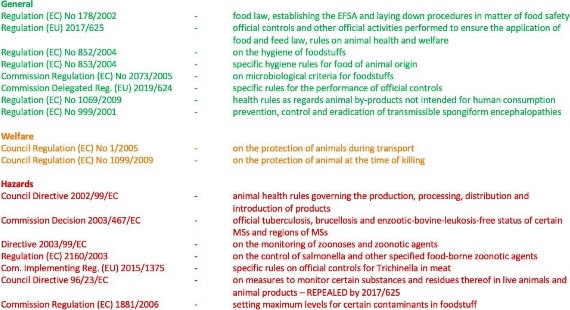
61. Regulation (EU) of the European Parliament and of the EU Council No 2017/625 – general obligations with regard to the organisation of official controls, competent authorities, control staff, control methods and techniques.
Legislation
Regulation (EU) 2017/625 of the European Parliament and of the Council (15 March 2017)
➡ Official controls and other official activities performed to ensure compliance with:
🍖 Food law
🌾 Feed law
🐮 Animal health
🐾 Animal welfare
🌱 Plant health
🛡 Plant protection products
♻ Animal by-products
🏛 General Obligations concerning the Organisation of Official Controls
Competent Authorities are responsible for organisation of official controls
Minimum level of official controls is necessary to identify hazards and risks
Official controls are carried out on all operators and performed regularly with frequency to idenify any violations of the rules
Official controls normally carried out without prior notice, ⚠ Exception: Prior notice allowed if necessary for the control to be carried out
Controls cover all stages of 🐮 Production, 🏭 Processing, 🚚 Distribution (✈ Import, 🚢 Export), 👨👩👧👦 Use of products
🏢 General Obligations concerning the Competent Authorities
Competent authorities must ensure:
1⃣ Effective Official Controls: Effectiveness and Appropriateness
2⃣ Quality of Controls: Impartiality, Quality, Consistency
3⃣ No Conflict of Interest: 🚫 Staff performing controls must be free from conflicts of interest
4⃣ Laboratory Access: Adequate laboratory available for analysis, testing, and diagnosis
5⃣ Qualified Personnel:👨⚕ Sufficient number of: Qualified staff, Experienced staff, Suitable facilities
6⃣ Legal Powers: ⚖ Competent authorities must have legal powers to perform official controls
7⃣ Legal Procedures: Appropriate legal procedures in place
8⃣ Contingency plans available, Ability to operate plans during emergencies
👨⚕ General Obligations concerning the Control Staff
Control staff must:
Have appropriate training ➡ To perform official controls
Continuous Education: Additional training when necessary, keep competence up to date
Knowledge of Competent Authority Duties
Training regarding obligations of competent authorities
Keep up to date with changes in legislation
🔍 General Obligations concerning Control Methods and Techniques
Official controls may include examination of:
Facilities and Equipment: Equipment, 🚚 Means of transport, 🏢 Premises
Animals and Goods: 🐮 Animals, Goods, 🌾 Feed for animals, Products used for animal treatment
Hygiene Conditions: 🧼 Cleaning procedures, Maintenance products, Maintenance processes
Traceability and Information: Traceability, 🏷 Labelling, 📢 Advertising, 📦 Packaging, 📋 Presentation
HACCP Verification: HACCP system, Procedures at all stages, Staff interviews
Documentation: Records, Documents, Documentation systems
Examination Procedures:🔍 Physical checks, 🧪 Sampling, 🧫 Analysis, 🔬 Diagnosis, 🧪 Testing
Audits: Official audits. "An audit is a systematic examination of the operator's procedures, documentation and HACCP system to verify compliance with legislation. The outcome may be compliance or non-compliance, which can lead to corrective actions, follow-up controls or fines."
Border controls
🌈 HIGH-YIELD EXAM POINTS
⭐ Main legislation = Regulation (EU) 2017/625
⭐ Controls are:
Regular, Risk-based, Usually without prior notice
⭐ Competent authorities must have:
Qualified staff, Laboratories, Legal powers, Emergency plans
⭐ Control staff must:
Be trained, Receive continuous education, Stay updated on legislation
⭐ Main control methods:
Inspection, Sampling, Testing, HACCP verification, Documentation review, Audits
🧠 Memory Picture
📜 2017/625 ↓ 🏛 COMPETENT AUTHORITY ↓ 👨⚕ TRAINED STAFF ↓ 🔍 OFFICIAL CONTROLS 🏭 Premises 🚚 Transport 🐄 Animals 🌾 Feed 📦 Goods 🏷️ Traceability 📋 HACCP 📄 Records 🧪 Sampling ↓ 🍖 SAFE FOOD
🎓 One-Sentence Exam Answer
Regulation (EU) 2017/625 establishes the framework for official controls. Competent authorities must organize regular, risk-based controls using qualified staff, laboratories, inspections, sampling, testing, HACCP verification and audits to ensure compliance throughout the food chain.
🚨 Committee 2 Additions for Q61
These are exactly the kind of follow-up questions they like after you've listed the control methods.
📋 Audit Outcomes
If they ask:
"What are the possible outcomes of an audit?"
Answer:
🟢 Compliance
✅ Requirements fulfilled
✅ No corrective action needed
🔴 Non-compliance
❌ Requirements not fulfilled
➡ Corrective measures required
➡ Follow-up inspection
➡ Increased frequency of controls
➡ Administrative measures
➡ Fines / penalties
➡ Restriction or suspension of activities in serious cases
✈ Veterinary Checks at the Border (BCP)
Another favourite Committee 2 question.
Three Types of Border Checks
1⃣ 📄 Document Check
Verify:
Official certificates
Attestations
Import documents
2⃣ 🏷 Identity Check
Verify:
Ear tags
Microchips
Seals
Labels
Match animal/product to documentation
3⃣ 🔍 Physical Check
Verify:
Animal health status
Animal welfare
Product condition
Sampling when necessary
🧠 Easy Memory
Border Control
📄 Document check
🏷 Identity check
🔍 Physical check
Audit
🟢 Compliance
🔴 Non-compliance
💰 Fine
📋 Corrective action
If they ask:
"What methods are used during official controls?"
You can finish with:
"Official controls include inspections, audits, sampling, laboratory testing, HACCP verification, documentation review, and at border control posts document, identity and physical checks."
62. Regulation (EU) of the European Parliament and of the Council No 2017/625 – financing of official control, calculation of fees or charges, control plans, annual reports.
Legislation
Regulation (EU) 2017/625 and of Council of 15 March 2017 – on official controls and other official activities performed to ensure the application of food and feed law, rules on animal health, welfare, plant health and protection.
💰 General obligations concerning the: Financing of official control
• ⭐ Member States (MSs) are required to ensure sufficient financial resources for official controls, and provide necessary staff and other resources for control through general taxation and fees.
• 💶 Fee or charges: MSs shall publish methods of calculation of fees and distribution, including salaries of staff, cost of staff (equipment etc.), laboratory analysis and sampling costs
• ✅ All routine control required under EU is paid from this budget
• 🚨 Expenses from additional controls:
o Faults leading to exceeding normal control activities → responsible operator is charged
o Extra checks: samples, control required to check extent of problem, control to verify corrective actions has been taken or to detect faults.
• 🏭 Competent authorities shall collect fees or charges for official controls in:
slaughterhouses, cutting plants, game-processing plants, milk production, border control points
• 💰 Competent authorities shall collect fees or charges to recover the costs of the work during the official controls (OC):
o On animal and goods from third countries causing a temporary increase of border controls
o On animals and goods subject to emergency measures to enter the Union
o At the request of the operator to obtain approval of feed premises
o Not originally planned which are necessary following detection of faults or which are performed to assess the extent and impact of faults
🧮 General obligations concerning the: Calculation of fees or charges
According to one of the following methods of calculation or a combination of them:
1⃣ Flat rates calculate
Overall costs of official controls by the competent authorities over a given period of time
Applied to all operators charged
Determine the fees charged for each sector, activity and category of operators, including size of activity and risk factors
2⃣ Actual costs calculate
Calculate the actual costs for each individual official control
📢 Transparency
MSs shall make sure that all costs and fees are available to public – with explanation of the costs
📋 General obligations concerning the: Control plans
⭐ Each MS should set up and regularly update a multi-annual national control plan (MANCP).
📄 Control plan:
Description made by competent authorities on organization of official control system
Operation of the control
Planning and how it is performed
✅ MS shall ensure that official controls are performed by the competent authorities based on MANCP
✅ MANCPs shall ensure that official controls are planned in all areas governed by the rules laid down
✅ MANCPs shall contain general information on structure and organization of official control
🔄 Regularly updated:
Legislation
Diseases
Performing official controls
Scientific findings
Other
📊 General obligations concerning the: Annual reports
• ⭐ MSs are required to give report to Commission with information on implementation of MANCPs.
• 📋 Report provides:
o The results of the official controls and audits carried out previous year
o The type of and number of cases of faults identified
• ⏳ MSs shall finalize report and transmit them to Commission within 8 months of the end of the year
• 📑 Commission shall then establish an annual report on overall operation of official controls in MSs
• 🏛 The Commission shall submit its report to the European Parliament and Council and make it available to the public
🧠 MEMORY TRICK
💰 Financing → Who pays?
🧮 Fees → How calculated?
📋 MANCP → Control plan
📊 Annual report → Results sent to Commission
🎯 Committee Memory Sentence
📜 2017/625 = Money 💰 + Fees 🧮 + MANCP 📋 + Annual Reports 📊
follow-up questions Committee 2:
❓ How often is the MANCP created?
📋 Multi-Annual National Control Plan (MANCP)
Answer:
Every 3 years (according to your committee notes).
🧠 Remember:
Annual report = every year
MANCP = every 3 years
❓ When must Member States submit annual reports?
🇪🇺 Member States → Commission
📅 31 August (within 8 months after the end of the year)
They report on the previous year's official controls and implementation of the MANCP.
❓ When must the Commission issue its report?
🏛 Commission → European Parliament and Council
📅 31 January (within 1 month of end of the year?)
❓ In which cases will there be increased controls?
✅ Non-compliance is the key answer.
Examples: ❌ Hygiene failures, Positive laboratory results, Food fraud, Repeated violations, Failure to implement corrective actions, Increased risk to public or animal health
Then the competent authority may perform:
🔍 Additional inspections, 🧪 Additional sampling, 📋 Follow-up audits, 🚚 Increased border checks
→ 💰 Extra costs charged to the operator
🎯 Committee 2 Short Answers
❓ MANCP?
➡ Every 3 years.
❓ Member State annual report?
➡ 31 August.
❓ Commission annual report?
➡ 31 January.
❓ When are increased controls performed?
➡ In cases of non-compliance, food fraud, positive findings, or other situations requiring additional official controls.
🧠 Q62 Kort Sammendrag
📜 Regulation (EU) 2017/625
💰 Finansiering
✅ Vanlige/offentlige kontroller betales av medlemsstaten gjennom skatter og gebyrer.
❌ Hvis det oppdages feil (non-compliance) må operatøren betale for:
Ekstra inspeksjoner
Ekstra prøvetaking
Oppfølgingskontroller
Kontroll av korrigerende tiltak
🧮 Gebyrberegning
1⃣ Faste satser (flat rates)
ELLER
2⃣ Faktiske kostnader for hver kontroll
➡ Alle gebyrer må være offentlig tilgjengelige.
📋 MANCP
Multi-Annual National Control Plan
Beskriver hvordan offisielle kontroller organiseres og utføres.
Oppdateres regelmessig.
📝 Committee 2: ny plan hvert 3. år
📊 Årsrapporter
🇪🇺 Medlemsland → Kommisjonen
📅 31. august
➡ Resultater av kontroller og avvik fra foregående år.
🏛 Kommisjonen → Parlamentet og Rådet
📅 31. januar
➡ Samlet rapport for hele EU.
🎯 Typiske eksamensspørsmål
❓ Hvem betaler vanlige kontroller?
➡ Medlemsstaten.
❓ Hvem betaler ekstra kontroller?
➡ Operatøren ved non-compliance.
❓ Hvor ofte lages MANCP?
➡ Hvert 3. år.
❓ Når sender medlemsland rapport?
➡ 31. august.
❓ Når sender Kommisjonen rapport?
➡ 31. januar.
63. Regulation (EU) of the European Parliament and of the Council No 2017/625 – administrative assistance and cooperation, information management system for official controls (IMSOC).
Legislation
Regulation (EU) 2017/625 and of Council of 15 March 2017 – on official controls and other official activities performed to ensure the application of food and feed law, rules on animal health, welfare, plant health and protection.
🤝 General obligations concerning: Administrative Assistance and Cooperation (AAC system)
⭐ Very important at national and EU level
🚨 Detect/report food fraud = intentional economical gain by misleading the consumer
📅 Developed in 2015 by the Commission for handling cases requiring administrative assistance
✅ AAC enables competent authorities to share:
Information
Detect
Investigate
Take effective and proportionate action to pursue violations of Union agri-food chain legislation
🚨 When can administrative assistance be activated?
🇪🇺 Upon request from an EU country
➡ When needing information to verify compliance with EU requirements🇪🇺 When a competent authority becomes aware of a non-compliance that can have implications in another EU country
➡ Required to inform that EU country without delay🇪🇺 Where official controls in another EU country identify a serious non-compliance or a risk to health on goods coming from another EU country
➡ EU country of dispatch of the goods shall be informed without delay
🌍 Upon request from a third country
💻 General obligations with concerning: Information Management System for Official Controls (IMSOC)
📜 Regulation (EU) 2019/1715
💻 The Integrated Management System for Official Controls (IMSOC)
➡ Computerized system that integrates all the existing (and future) information exchange computer systems
Examples:
🚚 TRACES (Trade Control and Expert System): 🇪🇺 European veterinary network which Notifies, Certifies, Monitors movement, imports, exports and intra-EU trade in: 🐮 Animals, 🍖 Food, 🌾 Feed, 🌱 Plants
🚨 RASFF (Rapid Alert System for Food and Feed)
⭐ Key tool to ensure good reaction when risks to human health are detected in the food chain
🌱 Europhyt
🌱 European phytosanitary system (plant diseases)
➡ Notification and rapid alert system dealing with interceptions for plant health
➡ Reasons of consignments of plants and plant products imported into the EU or traded within the EU
🐮 BOVEX
🔗 Specific interface linked to TRACES
➡ Automatic exchange of bovine identification data across relevant national databases
🎯 Objective: Digitalize bovine passports, Save time, Avoid errors while introducing passport data into national databases upon reception of cattle
📜 Regulation (EC) 1760/2000 ➡ Electronic identification of bovine animals
💻 The IMSOC shall
✅ Allow for the computerized exchange of information, data and documents necessary for official controls, and results from official controls
✅ Provide a mechanism for exchange of data, information and documents
✅ Provide a tool to collect and manage reports on official controls provided by Member States to the Commission
✅ Allow for electronic form of:
Journey log
Records obtained by navigation system
Official certificates
CHED (Common Health Entry Document)
✅ Integrate existing Commission-managed computerized systems for rapid data exchange on health and welfare risks, establishing links with other components
🌈 HIGH-YIELD EXAM POINTS
⭐ AAC = Cooperation between countries
🚨 Food fraud
🚨 Non-compliance
🚨 Health risks
⭐ IMSOC = Umbrella computer system
💻 IMSOC contains:
🚚 TRACES = trade, imports, exports, animal movements
🚨 RASFF = food/feed alerts
🌱 Europhyt = plant health alerts
🐮 BOVEX = bovine identification data
🧠 Memory Trick
🤝 AAC = Countries helping countries
💻 IMSOC = Computer helping countries
Inside IMSOC:
🚚 TRACES
🚨 RASFF
🌱 Europhyt
🐮 BOVEX
➡ One integrated EU information system 🌍📡
Helt ærlig, dette er et av de verste spørsmålene i hele pensumet. Det er bare masse EU-forkortelser. 😅
Det de egentlig spør om er:
Hvordan samarbeider landene i EU når det oppstår problemer med mat, dyr eller sykdommer?
Del 1: AAC 🤝
AAC = Administrative Assistance and Cooperation
Tenk:
🇸🇰 Slovakia finner et problem med kjøtt som kom fra 🇵🇱 Polen.
Hva gjør de?
➡ De sender informasjon til Polen.
➡ Polen undersøker saken.
➡ Landene samarbeider.
Det er AAC.
Eksempel
En bedrift i Polen merker hestekjøtt som storfekjøtt 🐴➡🐮
Dette er:
🚨 Food fraud (matsvindel)
Slovakia oppdager det.
Gjennom AAC kan de:
dele informasjon
undersøke saken
finne ansvarlig bedrift
gi bøter
Del 2: IMSOC 💻
IMSOC er bare en stor EU-database.
Tenk på IMSOC som:
💻 "EU sitt datasystem for offisielle kontroller"
Alle landene legger inn informasjon der.
Inne i IMSOC finnes flere systemer
🚚 TRACES
Dette er det viktigste.
Brukes for: Dyr, Kjøtt, Fôr, Planter som flyttes mellom land.
Eksempel
Du sender en ku fra Polen til Slovakia.
🐮 🇵🇱 ➡ 🇸🇰
Da registreres dette i:
➡ TRACES
🚨 RASFF
RASFF = alarmknapp
Når farlig mat oppdages.
Eksempel
Salmonella i kylling.
🐔🦠
Slovakia oppdager det.
De legger melding inn i:
➡ RASFF
Alle EU-land får beskjed med en gang.
🌱 Europhyt
Samme prinsipp.
Men for planter.
🌱🌱🌱
🐮 BOVEX
Spesielt for storfe.
Brukes til:
🏷 Øremerker
📄 Pass
🐮 Identifikasjon
Hvis sensor spør:Hva er AAC?
Svar:
"AAC is a system that allows competent authorities of different countries to cooperate and exchange information about food fraud, non-compliance and health risks."
Hva er IMSOC?
Svar:
"IMSOC is the integrated EU computer system for exchange of information related to official controls."
Hva er TRACES?
Svar:
"TRACES is used for movement, import, export and trade of animals, food, feed and plants."
Hva er RASFF?
Svar:
"RASFF is the rapid alert system used when a food or feed risk is detected."
Min huskeregel
🤝 AAC = land snakker sammen
💻 IMSOC = datamaskinen de bruker
🚚 TRACES = flytting av dyr og varer
🚨 RASFF = alarm ved farlig mat
🌱 Europhyt = planter
🐮 BOVEX = storfe
Det er egentlig hele spørsmålet. Du trenger ikke forstå alle EU-formuleringene rundt det. 🎯
Comittee questions:
Regulation names:
📜 Regulation (EU) 2017/625
= Official Controls Regulation
📜 Regulation (EU) 2019/1715
= IMSOC Regulation
De ville visstnok bare høre navnene.
🤝 AAC deles i to deler?
1⃣ Non-compliance = Regelbrudd
Eksempel:
❌ Manglende merking
❌ Manglende dokumentasjon
❌ Hygieneproblem
Her er det ikke nødvendigvis svindel.
2⃣ Fraudulent activities (Food Fraud)
= Bevisst svindel for økonomisk gevinst
Eksempel:
🐴 Hestekjøtt selges som storfekjøtt
🐟 Billig fisk selges som dyr fisk
🥩 Feil opprinnelsesland oppgis
Dette er det AAC ofte brukes til.
❓ "How do you make a request?"
Jeg tror sensor refererte til:
Når et land trenger informasjon fra et annet land.
Eksempel:
🇸🇰 Slovakia finner et problem med kjøtt fra 🇵🇱 Polen.
Da sender den kompetente myndigheten en:
📨 AAC request
til Polen gjennom AAC/IMSOC-systemet.
Polen må undersøke og svare.
Du trenger neppe mer detalj enn:
"A competent authority can submit a request through the AAC system when information is needed to verify compliance."
💻 Goal of IMSOC?
Dette er veldig sannsynlig et eksamensspørsmål.
Kort svar:
"The goal of IMSOC is to improve the efficiency of official controls by allowing rapid electronic exchange of information between Member States."
Eller enda enklere:
"IMSOC connects systems such as TRACES and RASFF and allows Member States to exchange information related to official controls."
🎯 Hvis Committee 2 spør
What are the two parts of AAC?
🟡 Non-compliance
🔴 Fraudulent activities (food fraud)
Goal of IMSOC?
💻 Exchange information quickly between Member States
💻 Improve efficiency of official controls
💻 Connect TRACES, RASFF, Europhyt and BOVEX
Easy memory
🤝 AAC = countries cooperate
🟡 Non-compliance
🔴 Fraud
💻 IMSOC = computer system
🚚 TRACES
🚨 RASFF
🌱 Europhyt
🐮 BOVEX
That is probably exactly what Committee 2 was aiming for. 🎯
64. Regulation (EU) of the European Parliament and of the Council No 2017/625 - specific rules on official controls in relation to the production of products of animal origin intended for human consumption.
Regulation (EU) 2017/625 and of Council of 15 March 2017 – on official controls and other official activities performed to ensure the application of food and feed law, rules on animal health, welfare, plant health and protection.
👨⚕ Who can do official controls
⭐ Official veterinarian (OV)
A veterinarian appointed by a competent authority, either as staff or otherwise, and appropriately qualified to perform official controls
⭐ Official auxiliary (OA)
A representative of the competent authorities trained in accordance with the requirements, and employed to perform official controls related to food products and animals
⚠ OV is responsible for the decisions taken following official controls provided for, even if the performance of an action is assigned by him to the OA.
📚 Minimum training requirements for the staff of the competent authorities and for OV and OA
🔍 Official controls are according to Regulations:
📜 (EC) No 852/2004 - general hygiene
📜 (EC) No 853/2004 - hygiene on foodstuffs
📜 (EC) No 1069/2009 - animal byproducts not intended for human consumption
📜 (EC) No 1099/2009 - animal welfare, euthanasia
1⃣ The official controls referred to above shall include:
🩺 AMI: AMI performed in the slaughterhouse by an OV.🐔 For poultry and lagomorphs: OV may only supervise or be responsible for the AMI performed by OA.
🔬 PMI: PMI is performed by an OV
⭐ Specific rules on official controls by an OV, or under supervision of OV, is to verify:
→ 🧼 Hygiene of meat production
→ 💊 Presence of residues of veterinary medicinal products and contaminants
→ 📋 Audits of good hygiene practices and procedures based on HACCP principles
→ 🧪 Laboratory tests to detect the presence of zoonotic agents and animal diseases and to verify compliance with microbiological criteria (Regulation (EC) No 2073/2005)
→ ♻ Handling and disposal of animal by-products and of specified risk material
→ 🐾 The health and welfare of animals
2⃣ The competent authority may allow slaughterhouse staff to assist in official controls if
✅ Act independently from the production staff of the slaughterhouse
✅ Have undergone appropriate training to carry out these tasks
✅ Carry out these tasks in presence and following the instructions of the OV or the OA
3⃣ Application of health marks
🏷 When no abnormality making the meat unfit for human consumption
📋 The Commission shall lay down rules on uniform practical arrangements for official controls regarding
⭐ Specific requirements for the performance of official controls
🦪 The condition for the classification and monitoring of classified production and relaying areas for live bivalve mollusks
🩺 The practical arrangements of the AM and PM inspections
🏷 The technical requirements of the health mark and its application
🥛 Specific requirements for the official controls on raw milk, milk products and fishery products
🧠 MEMORY TRICK
👨⚕ OV = Responsible
👨🔬 OA = Assists
🩺 AMI
🔬 PMI
🧼 Hygiene
💊 Residues
📋 HACCP
🧪 Laboratory tests
♻ Animal by-products & SRM
🐾 Animal welfare
🏷 Health mark
🎯 One-Sentence Exam Answer
Official controls on products of animal origin are performed by the OV and OA according to Regulations 852/2004, 853/2004, 1069/2009 and 1099/2009, and include AMI, PMI, hygiene, residues, HACCP audits, laboratory testing, animal by-products, animal welfare and application of the health mark.
Dette er faktisk veldig nyttig informasjon om hva Committee 2 egentlig vil ha på Q64.
De virker ikke så interessert i å høre definisjonen av OV og OA.
De spør heller:
"What products of animal origin are covered by official controls, and what controls are performed?"
🥩 Meat Production
Kontroller:
🩺 AMI
🔬 PMI
🧼 Hygiene of slaughter and processing
💊 Residues and contaminants
📋 HACCP audits
🧪 Laboratory testing
♻ Animal by-products and SRM
🐾 Animal welfare
🏷 Health marking
🥛 Dairy Production
Kontroller:
🌡 Milk temperature
🧫 Total bacterial count
⚪ Somatic cell count
💊 Antibiotic residues
📋 HACCP
🧼 Hygiene of milking and processing
🐟 Fishery Products
Kontroller:
🌡 Temperature
👀 Freshness
🐟 Parasites (e.g. Anisakis)
🧫 Microbiological criteria
📋 HACCP
🧼 Hygiene
🦪 Live Bivalve Molluscs
This is the one they apparently asked specifically.
Controls
🦠 E. coli levels
This is the big answer.
Also:
🌊 Classification of production areas
(A, B and C areas)
🧪 Monitoring of contamination
🚨 Biotoxins
🦠 Microbiological safety
If she asks:
"What sectors are covered?"
Answer:
🥩 Meat
🥛 Milk and dairy products
🐟 Fishery products
🦪 Live bivalve molluscs
If she asks:
"What controls are performed?"
Answer examples:
🥩 Meat → AMI, PMI, residues, HACCP
🥛 Dairy → temperature, somatic cell count, bacterial count
🐟 Fish → temperature, freshness, parasites
🦪 Molluscs → E. coli levels and classification of production areas
🧠 Committee 2 Memory Trick
Q64 = Products of Animal Origin
🥩 Meat → AMI & PMI
🥛 Milk → SCC & bacteria
🐟 Fish → temperature & parasites
🦪 Molluscs → E. coli
That seems much closer to what the examiner was actually asking than the standard notes. 🎯
65. Regulation (EU) of the European Parliament and of the Council No. 2017/625 - specific requirements for the performance of official controls of raw milk, milk products and fishery products in accordance with the implementing acts of Regulation (EU) No 2017/625.
🥛 Specific requirements for the performance of official controls of raw milk and milk products
Animals on milk production holdings must have official controls to verify:
✅ Animals don´t show CS of diseases transmittable to humans through milk:🦠 Brucellosis, 🦠 TBC
✅ Animals are in a good general state of health, no diseases that might contaminate milk
✅ The use of veterinary medicinal products is being complied with:
💊 Absence of prohibited or unauthorized pharmacologically active substances (Raw milk must come from animals free from unauthorized medical products!)
💊 Presence of residues of authorized pharmacologically active substances laid down in: Regulation (EU) No 37/2010, Regulation (EC) No 396/2005, Regulation (EU) No 2023/915, and the withdrawal periods!
All dairy holdings are visited regularly and without prior notice
Milk production holdings are to undergo official controls to verify hygiene requirements:
🧼 Milk equipment and components where milk is stored, handled or cooled - constructed to limit contamination
🧼 Equipment in contact with milk must be easy to clean/disinfect
🚛 Milking, collection, transport must be carried out hygienically (observe milk hygiene programme)
❄ The cold chain (temperature) must be maintained
👨🌾 Person’s handling milk have clean clothes and high degree of personal cleanliness
The official control may involve inspections and/or the monitoring of controls
⚠ If hygiene is inadequate ➡ Competent authority must tell how to correct the situation
Control of raw milk upon collection – testing
⭐ Criteria for raw milk:
🐮 Plate count ≤ 100 000 CFU/ml cow’s milk
≤ 500 000 CFU/ml OR ≤ 1 500 000 CFU/ml (if heat treated) in sheep & goat
📅 Rolling geometric average over a 2-month period, with at least two samples per month
🐮 Somatic cell count: ≤ 400 000 somatic cells/ml cow’s milk
📅 Rolling geometric average over a 3-month period, with at least one sample per month
💊 Antibiotic residues ➡ Regulation (EU) No 37/2010
🐟 Specific requirements for the performance of official controls of fishery products
Controls for the product to be placed on the market include:
✅ A regular check on the hygiene conditions of the landing and first sale
✅ Regular inspections of establishments on land: Fish auctions and Wholesale markets
→ To check: 🧼 Hygiene/cleanliness of establishment, 👨🌾 Staff hygiene, 🐟 Correct handling of fishery products
Checks on storage and transport conditions
🔍 Official controls of fishery products
Carried out at all stages of production, processing, and distribution
Official controls of fishery products are to include at least the following elements:
a) Organoleptic examinations: Appearance, Colour, Odour, Flavour, Consistency, According with EU legislation. ⚠ If doubtful result: Chemical test
b) Freshness indicators: levels of Total volatile basic nitrogen (TVB-N), Trimethylamine nitrogen (TMA-N), ⭐ 25–35 mg nitrogen/100 g
c) 🐟 Histamine, To verify compliance with the permitted levels laid down under EU legislation (Regulation 1019/2013), ⭐ Maximum 200 mg/kg histamine in fresh fish
d) ☣ Residues and contaminants: Control levels in accordance with EU legislation
e) 🦠 Microbial checks: To verify compliance with the relevant rules laid down in EU legislation. Cat A, B and C according to E.coli levels in harvesting area.
f) 🪱 Parasites: To verify compliance with EU legislation.⭐ Must undergo a visual examination (candling) for the purposes of detecting visible parasites (anisakis) before being placed on the market. Regulation 1276/2011 → ❄ Freeze at: −20°C for 24 h OR −25°C for 15 h
g) ☠ Poisonous fishery products: To ensure that fishery product derived from poisonous fish is not used
🟢 Decisions after controls:
Fishery products are to be declared fit for human consumption IF:
✅ There is compliance with: Regulation 853/2004 and Regulation 2073/2005 from the checks above
✅ The residues and contaminants are at acceptable levels
✅ The product does not derive from poisonous fish and fish with marine biotoxins
✅ No other indications that can cause a risk to human and animal health
🎯 EXAM HIGH-YIELD POINTS
🥛 Milk
🦠 Brucellosis
🦠 TBC
💊 Authorized/unauthorized substances
🧼 Hygiene
❄ Cold chain
⭐ Plate count = 100,000 CFU/ml
⭐ SCC = 400,000 cells/ml
🐟 Fish
👀 Organoleptic examination
🧪 TVB-N & TMA-N (25–35 mg/100 g)
⭐ Histamine = 200 mg/kg
🪱 Candling
❄ −20°C/24 h or −25°C/15 h
☠ Poisonous fish not allowed
📜 Compliance with 853/2004 and 2073/2005.
🚨 Committee 1 Additions for Q65
These are classic follow-up questions that are not written in your notes, but examiners like them.
🦪 Bivalve Molluscs – E. coli Categories
Official controls classify harvesting areas according to E. coli levels.
🟢 Category A
⭐ ≤ 230 E. coli / 100 g
✅ Can be placed directly on the market for human consumption.
🟡 Category B
⭐ 90% of samples ≤ 4,600 E. coli / 100 g
❌ Cannot go directly to consumers.
Must undergo:
🧼 Purification (depuration) OR 🌊 Relaying OR 🔥 Heat treatment before marketing.
🔴 Category C
⭐ ≤ 46,000 E. coli / 100 g
❌ Cannot be sold directly.
Must undergo: 🌊 Long-term relaying OR 🔥 Heat treatment before marketing.
🧠 Memory Trick
🟢 A = 230, 🟡 B = 4,600, 🔴 C = 46,000
Every category = one zero more.
🐟 Gempylidae Fish
Examples: Escolar (Lepidocybium flavobrunneum), Oilfish (Ruvettus pretiosus)
Why are they special?
They contain: 🛢 Wax esters (indigestible oils) which can cause:
💩 Diarrhoea
💩 Oily stools (keriorrhoea)
🤢 Gastrointestinal disturbances
Official Requirement: 🏷 Must be marketed with information/labeling for the consumer.
"Label that it should be cooked, otherwise GIT problems."
66. Registration and approval of an establishment in accordance with Regulation (EC) No. 852/2004 and Regulation (EC) No. 853/2004 as amended. Health and identification marking.
Legislation
Regulation (EC) No. 852/2004 – on the hygiene of foodstuffs (H1)
Regulation (EC) No. 853/2004 – on specific hygiene rules for food of animal origin (H2)
National law of the Member State in which the establishment is located
⭐ All food businesses are required to be registered or approved with the competent authority
➡ This is necessary to allow the competent authorities to perform official controls.
🏷 Registration and approval of an establishment
Anyone who runs a food business must inform the local authority about:
✅ Their storing, selling, distributing, or preparing food
✅ Establishment that performs only primary production
📝 Who needs to register?
⭐ All FBO who handle animal products to:
Food premises: Shops, Supermarkets etc.
🏭 Food establishments for foodstuff of animal origin include:
Primary products: Egg, Raw milk, Fishery products, Live bivalve molluscs
🚚 Transport operations of primary products
👨🌾 Primary producers that supply products of animal origin to a final consumer
📦 Storage of products not requiring temperature-controlled storage conditions
🛒 Retail operations: Transport or delivery of foodstuff to other establishments
📝 Registration:
✅ FBO must ask the local authority for registration
Registration must include:
📌 Business name
📌 Name and surname (both the worker and those responsible for hygiene)
📌 Company identification number
📌 Type of activity
⏳ Should be submitted to food authority 28 days before start of food operations
The local authority should record the application for registration
🔢 Local authority must assign a registration number
🏭 Approval:
⭐ Need to meet the relevant requirements according to regulations.
📋 The list of approval must be updated and available for MS and public.
⭐ FBO who need approval are:
🔪 Slaughterhouse
🥩 Meat cutting plants
🦌 Game-handling establishments
📦 Collection centres
🍔 Establishments manufacturing meat preparations (minced meat)
📋 Approval procedure of food business establishments
Firstly, ➡ They must tell the local authority for approval of each establishment that needs to be controlled by them
The sent application for approval must contain:
📌 Business name
📌 Company registration number of the specific person of which it concerns
📌 Name, surname and company ID
📌 Location/address of the establishment, whereabout the food business activity is performed
📌 Type of food business operation/what type of activity that is carried out
📌 The persons who are responsible for the activities, name and address
📌 Other technical documents:
Structural
Technical
Material
Staffing
Other conditions
✅ Approval number is given for a successfully approved establishment
🏷 Health and Identification Marking
Regulation (EU) No 2017/625, Commission Implementing Regulation (EU) No 2019/627
⭐ Applied only on animals that passes AM and PM inspection
👨⚕ Performed by OV or OA
⭐ Mark is placed on external surfaces of carcass
Methods: Stamping or Hot branding
⭐ Oval mark: 📏 6.5 cm wide, 📏 4.5 cm high
Contains:
Upper part: 🌍 Name of country – two letter code (SK, PL, NO)
Centre: Approval number of slaughterhouse
Lower part: 🇪🇺 Location of slaughterhouse within EU – abbreviation EC
In case of Emergency slaughter → ⭐ Must have a special health mark
🎯 EXAM HIGH-YIELD POINTS
Registration (852/2004)
📝 All food businesses
⏳ 28 days before start
🔢 Registration number assigned
Approval (853/2004)
🏭 Slaughterhouses
🥩 Meat cutting plants
🦌 Game-handling establishments
📦 Collection centres
🍔 Meat preparation establishments
➡ Approval number assigned
Health Mark
🩺 Passed AMI, Passed PMI
👨⚕ Applied by OV/OA
⭕ Oval
🌍 Country code, Approval number, EC
🚨 Emergency slaughter = special health mark
🧠 Memory Trick
📝 Register = everyone
🏭 Approval = higher-risk animal origin establishments
⭕ Health Mark = Country → Number → EC
Norsk forklaring på registration VS approval:
📝 Registration
Alle Food Business Operators (FBOs) må registreres hos myndighetene.
Eksempler:
🏪 Butikk
🛒 Supermarked
🥛 Melkegård
🥚 Eggprodusent
🐟 Fisker
🚚 Transportør
📦 Lager
➡ Registrering er i praksis: "Myndighetene vet at du finnes."
🏭 Approval
Bare visse virksomheter med høyere risiko, spesielt de som håndterer mat av animalsk opprinnelse, må i tillegg godkjennes.
Eksempler fra pensum:
🔪 Slaughterhouse
🥩 Meat cutting plant
🦌 Game-handling establishment
📦 Collection centre
🍔 Meat preparation/minced meat establishment
➡ Her må myndighetene kontrollere at kravene er oppfylt før virksomheten får starte.
🧠 Huskeregel
Alle med approval er også registrert.
Men ikke alle registrerte virksomheter trenger approval.
Altså:
Registration ⊃ Approval
(Approval-gruppen er en mindre gruppe innenfor de registrerte virksomhetene.)
Eksempel
🥛 En melkegård → registrering ✅, approval ❌
🔪 Et slakteri → registrering ✅ + approval ✅
Dette er vanligvis det sensor ønsker at du skal forstå på Q66.
67. Audits and monitoring of food business operators. Audits of the competent authorities.
📜 Legislation
Regulation (EU) 2017/625: official controls performed to ensure the application of food and feed law, rules on animal health and welfare, plant health and plant protection products.
⭐ States that official controls are carried out regularly without prior notice, exception being audits.
⭐ Intensity of official controls are based on: Public health risks, Animal health, Animal welfare
Audits and monitoring of food business operators
⭐ Audit ➡ Systematic and independent examination of activities of the FBO
🔍 The official controls carried out in accordance with this regulation include:
✅ Audits of FBOs' activities: Collection, Transport, Storage, Handling, Processing, and inspections, including checks on FBOs' own controls: Documents, Records
✅ Audits of good hygiene practice (GHP) and HACCP-based procedures
✅ Audits and inspections of: Slaughterhouses, Game handling establishments, Certain cutting plants
✅ Official controls on the production of meat
✅ Official controls on the production of live bivalve molluscs and on fishery products
✅ Official controls on the production of raw milk
📋 For that food operators shall:
✅ Offer all assistance needed to ensure that controls can be performed effectively
✅ Give access to all buildings, premises, installations or other infrastructures
✅ Make available any documentation and record required under the present regulation
🧼 Audits of GHP shall verify that FBOs apply all procedures continuously and properly concerning at least
✅ Checks on food-chain information
✅ Design and maintenance of premises and equipment
✅ Pre-operational, operational and post-operational hygiene
✅ Personal hygiene
✅ Training in hygiene and in work procedures
✅ Pest control
✅ Water quality
✅ Temperature control (must be below 12°C)
✅ Controls on food entering and leaving the establishment and any accompanying documentation
📋 Audits based on HACCP-based procedures shall verify that
✅ FBO applies procedures continuously and properly
✅ Procedures guarantee that products of animal origin comply with legislation on: Residues, Contaminants, Prohibited substances
✅ Does not contain physical hazards, such as foreign bodies
🔬 When carrying out auditing tasks
⭐ Determine whether staff comply with requirements of the Regulations
⭐ Verify the FBO's relevant records
⭐ Take samples for laboratory analysis whenever necessary
⭐ Document elements taken into account and the findings of the audit
🏛 Audits of the competent authorities
Regulation (EU) No 2017/625
The competent authorities of the Member States are required to carry out internal/external audits to ensure they are in accordance with the Regulation
🎯 Purpose
Verify whether official controls are:
✅ Effectively implemented
✅ Suitable to achieve the objectives of the relevant legislation
✅ Including compliance with national control plans
🔵 Internal audits
Work of OV or competent authority inspectors is supervised by heads/chiefs in the district
🔵 External audits
Work of the central competent authority/OV or inspector is supervised by: 🇪🇺 Commission experts OR 🏛 Directorate on Health and Food Audits and Analysis
🎯 HIGH-YIELD EXAM POINTS
What is an Audit?
🧐 Systematic and independent examination of activities of the FBO
What is checked in GHP?
🧼 Hygiene
🏭 Premises and equipment
🐀 Pest control
💧 Water quality
🌡 Temperature control (<12°C)
👨🏫 Staff training
What is checked in HACCP?
📋 Procedures applied continuously
💊 Residues
☣ Contaminants
🚫 Prohibited substances
🔩 Foreign bodies
Audits of Competent Authorities
🔵 Internal = District chiefs supervise OV
🔵 External = Commission experts / Directorate on Health and Food Audits and Analysis
🧠 Memory Trick
Audit = Check the SYSTEM, not the product
📋 GHP = Hygiene
📋 HACCP = Safety system
🏛 Internal audit = Boss checks OV
🇪🇺 External audit = EU checks the authority 🎯
Dette spørsmålet ser langt ut, men egentlig handler det om audit = kontroll av systemet, ikke kontroll av selve kjøttet eller maten.
🎯 Hva spørsmålet egentlig handler om
Det er to ting:
1⃣ Audit av Food Business Operator (FBO)
Altså:
"Kontrollerer bedriften seg selv på riktig måte?"
Eksempler:
🏭 Slakteri
🥛 Meieri
🐟 Fiskefabrikk
2⃣ Audit av myndighetene
Altså:
"Hvem kontrollerer de som kontrollerer?"
🇪🇺 EU kontrollerer myndighetene.
🏛 Sjefene kontrollerer OV.
⭐ Viktigste definisjon
Hvis sensor spør:
What is an audit?
Svar:
A systematic and independent examination of activities of the FBO.
Dette er nesten alltid første spørsmål.
🧼 GHP Audit
GHP = Good Hygiene Practice
Her sjekker man:
✅ Hygiene
✅ Lokaler
✅ Utstyr
✅ Personlig hygiene
✅ Opplæring
✅ Skadedyrkontroll
✅ Vannkvalitet
✅ Temperaturkontroll
📋 HACCP Audit
Her sjekker man:
✅ Fungerer HACCP-systemet?
✅ Rester av legemidler
✅ Kontaminanter
✅ Forbudte stoffer
✅ Fremmedlegemer
🔍 Hva gjør auditor?
Når OV gjør audit:
📄 Sjekker dokumenter
📋 Sjekker registreringer
👨🏭 Snakker med ansatte
🧪 Tar prøver ved behov
📝 Skriver rapport
🏛 Audit av myndighetene
Dette er favorittspørsmålet til flere sensorer.
Internal audit
Sjefen kontrollerer OV.
Eksempel:
👨💼 Distriktssjef kontrollerer veterinæren.
External audit
EU kontrollerer myndighetene.
Gjennom:
🇪🇺 Commission experts
eller
🏛 Directorate on Health and Food Audits and Analysis
🎯 Det Committee 2 ofte vil høre
Audit outcome?
🟢 Compliance
🔴 Non-compliance
Konsekvenser:
➡ Corrective actions
➡ Follow-up audit
➡ Fines
🧠 Hvis du bare husker 5 ting
1⃣ Audit = systematic and independent examination
2⃣ GHP = hygiene, pest control, water, temperature
3⃣ HACCP = matsikkerhetssystem
4⃣ Internal audit = sjef kontrollerer OV
5⃣ External audit = EU kontrollerer myndighetene
10-sekunders eksamenssvar
"An audit is a systematic and independent examination of the activities of the FBO. It verifies GHP and HACCP procedures, documentation, hygiene, records and compliance with legislation. Competent authorities are also audited through internal audits by supervisors and external audits by the European Commission."
Hvis du kan den setningen og forskjellen på GHP, HACCP, internal audit og external audit, kan du svare på nesten alle oppfølgingsspørsmålene til Q67. 🎯
68. Official control of intra-EU trade in the animals and goods. Official controls on animals and goods entering the Union at border control posts other points of entry. Certificates and documents. Trade Control and Expert System (Traces).
🇪🇺 Official control of intra-EU trade in animals and goods (handel mellom EU land)
⭐ Intra-EU trade = movement of animals, food, and products of animal origin between EU Member States
🎯 Goal:
Safe movement, Avoid transmission of diseases to the public/other animals
Regulation (EU) 2016/429 – on transmissible animal diseases
Regulation (EU) 2017/625 – on official control for food safety and animal welfare and on safeguard measures in case of serious animal health hazard
📋 Rules
1⃣ All live animals must travel with a health certificate validated by an official veterinarian
2⃣ Products of animal origin must be produced in an approved establishment
3⃣ Random checks on the products and animals may be carried out at the final destination
4⃣ Specific requirements for animal products may be required in disease situations in the MS
Specific animal health certificates may be needed:
Certify the safety requirements
Certify transport condition
5⃣ Trade documents must accompany the delivery (⚠ These are not veterinary documents)
🌍 Official controls on animals and goods entering the Union at border control posts (Import fra land utenfor EU)
Regulation (EU) 2017/625 – veterinary checks on animals entering the Community from third countries (utenfor EU, e.g, USA → slovakia)
Regulation (EU) 404/2021 – on third countries that are allowed to transport to EU
⭐ Official controls must be carried out on all live animals from third countries entering EU
👨⚕ Controlled by:
Official veterinarian
Competent authority
🔍 The veterinary checks include:
📄 Documentary check
Verification of:
Veterinary health certificates
Documents
CVED
🏷 Identity check
Visual inspection to ascertain that the products correspond to the information given
🧪 Physical check
Sensory evaluation
Simple physical tests
Simple chemical tests
⭐ Refers to a check on the product itself to ascertain that product satisfies the requirements
🐮 Animals
⭐ Full veterinary test
📋 Results and decisions
⭐ The OV at the BCP (border control point) uses TRACES to share CHED (common health entry document) information
⭐ OV retains original certificates and health documents
📅 Must be kept at BCP/BIP for 3 years
🚨 Actions in case of non-conformity
❌ If identity check fails ➡ Consignments undergo physical sampling and testing to confirm or rule out
⏳ Pending test results
➡ Consignments are not released
➡ Supervised by authority
➡ Test results reported in TRACES
🚨 Unsatisfactory results ➡ Reported via RASFF
🚫 Serious health threat
Commission can:
Suspend imports
Impose import conditions from the country concerned
📑 Certificates and documents
⭐ Veterinary checks that have taken place at the BCP/BIP (e.g., airport, harbour) must be confirmed by the CHED
1⃣ CHED must be sent to BCP in advance (12–24 hours) of the consignment’s arrival at the BCP
➡ Then signed and original sent to BCP
⚠ If any errors detected:
➡ CHED is returned to importer
2⃣ After veterinary check is carried out
⭐ Signed by OV (Official Veterinarian)
⭐ Check results sent to TRACES system
⭐ Certificate is assigned a serial number by TRACES
⭐ Original certificate and health document is kept at BCP for 3 years
⭐ Authenticated copies of the originals are provided to the importers
💻 Trade Control and Expert System – TRACES
⭐ TRACES is a web-based trans-European veterinary network
Functions: Notifies, Certifies and Monitors
Movement
Imports
Exports
Trade of animals and animal products
⭐ All harmonized (EU):
Veterinary health certificate
CVED/CHED
and non-harmonized (national) veterinary certificates
➡ Are provided by TRACES and translated into all EU official languages
🎯 TRACES is an essential tool that ensures:
✅ Traceability
✅ Information exchange
✅ Risk management
🧠 HIGH-YIELD EXAM POINTS
Intra-EU Trade:
🐮 Health certificate
🏭 Approved establishment
🔍 Random checks
📄 Trade documents
Border Control Checks
📄 Documentary check
🏷 Identity check
🧪 Physical check
🐮 Full veterinary test
Documents
📑 CHED/CVED
📅 12–24 h before arrival
📅 Documents stored 3 years
TRACES
💻 Notifies
💻 Certifies
💻 Monitors
🚚 Imports
🚚 Exports
🚚 Trade
🎯 Traceability – Information Exchange – Risk Management
🌟 Committee Favorite Follow-Ups
🧠 3 Border Checks = Documentary – Identity – Physical
🧠 TRACES = Notifies, Certifies, Monitors
🧠 CHED = Border Entry Document
🧠 Documents kept at BCP/BIP for 3 years
🧠 Intra-EU = Health Certificate + Approved Establishment
Q68 ser komplisert ut fordi det er fullt av forkortelser, men egentlig handler det om:
Hvordan kontrollerer EU dyr og varer som flyttes mellom land, og hvordan kontrolleres dyr og varer som kommer inn i EU fra land utenfor EU?
Del 1: 🇪🇺 Intra-EU trade
Dette betyr:
🐮 En ku sendes fra Polen til Slovakia
🥩 Kjøtt sendes fra Tyskland til Norge
🥛 Melk sendes fra Frankrike til Spania
Altså handel mellom EU-land.
Hva kreves?
✅ Levende dyr må ha helseattest signert av OV
✅ Produkter må komme fra godkjente virksomheter
✅ Det kan gjøres stikkprøvekontroller ved ankomst
✅ Handelsdokumenter må følge varen
Del 2: 🌍 Import fra land utenfor EU
Eksempel:
🐮 Brasil → EU
🐟 Kina → EU
🥩 USA → EU
Når varer kommer inn i EU, må de innom:
🏢 BCP (Border Control Post)
Hvilke kontroller gjøres?
📄 Documentary check
Kontroll av papirene
Sertifikater
Attester
Dokumenter
🏷 Identity check
Stemmer varen med papirene?
Eksempel:
Papirene sier storfekjøtt.
Er det faktisk storfekjøtt?
🧪 Physical check
Man undersøker selve varen.
Eksempel:
Temperatur
Lukt
Utseende
Prøver til laboratoriet
📑 CHED
Når kontrollen er ferdig:
➡ OV fyller ut CHED
(Common Health Entry Document)
Dette bekrefter at kontrollen er utført.
💻 TRACES
TRACES er EU sitt datasystem.
Brukes til:
✅ Registrere handel
✅ Registrere import
✅ Registrere eksport
✅ Dele informasjon mellom land
Eksempel
En hest sendes fra Polen til Slovakia.
🐴 🇵🇱 → 🇸🇰
Informasjonen registreres i:
💻 TRACES
Hvis du kan disse 6 ordene:
Health certificate – Approved establishment – BCP – Documentary check – Identity check – Physical check – TRACES – CHED, så kan du svare på mesteparten av Q68. 🎯
69. Actions in case of non-compliance. Measures. Penalties.
Legislation
Regulation (EU) 2017/625 – official controls performed to ensure the application of food and feed law, rules on animal health and welfare and plant health.
🚨 Action in case of non-compliance
⚠ Action in case of suspicion:
✅ Competent authority conducts official controls to confirm or eliminate the suspicion.
✅ Consigned goods placed under official detention until results of official controls are obtained.
❌ Action in case of non-compliance
✅ Non-compliance identified, and action is taken to rectify the situation.
✅ Competent authority takes necessary steps to determine:
Origin of non-compliance
Extent of non-compliance
Operator's responsibilities
✅ Measures implemented to ensure operator remedies non-compliance and prevents its recurrence.
✅ Measures determined based on:
Nature of non-compliance
Operator's compliance history
⭐ The actions are the following:
1⃣ Order or perform treatments on animals.
2⃣ Order unloading, transfer, and care of animals, including quarantine periods.
3⃣ Order treatments on goods and the alteration of labels or corrective information for consumers.
4⃣ Restrict or prohibit:
Placing on market
Movement
Entry into Union
Export of animals/goods
5⃣ Prohibit the return to the Member State of dispatch or order their return.
6⃣ Order the operator to increase the frequency of their own controls.
7⃣ Order certain activities to undergo increased systematic official controls.
8⃣ Order the recall, withdrawal, removal, and destruction of goods, or authorize alternative use.
9⃣ Order the isolation or closure of all or part of the business for a specified time period.
🔟 Order the cessation of all or part of the activities of the operator concerned for a specified period.
1⃣1⃣ Order the suspension or withdrawal of the registration or approval of the establishment.
1⃣2⃣ Order slaughter/killing of animals if necessary to safeguard human and animal health and welfare.
🚨 In the case of abuse of official certificate by FBO:
➡ Temporary suspension/withdrawal of the authorisation.
🛡 Measures
Regulation 178/2002 – emergency measures for food/feed of EU origin or imported from a third country.
⭐ Safeguard measures shall be taken if
The Commission has evidence of a serious failure in a Member State's control systems.
➡ Such failure may be a risk for: Human health, Animal health, Animal welfare, Directly or through the environment
Measures shall be used only after shown and reported non-compliance with EU legislation.
The Member State concerned has failed to correct the situation upon request and within the time limit.
🚨 Measures provided in Article 53 of Regulation (EC) No 178/2002 🇪🇺 In the case of food or feed of EU origin:
Suspension of the placing on the market or use of the food/feed in question.
Laying down special conditions for the food or feed in question.
Any other appropriate interim measure. Example: Increased level of control of food or feed
🌍 In the case of food or feed imported from a third country:
Suspension of imports of food/feed in question from all or part of third country concerned and, where applicable, from the third country of transit.
Laying down special conditions for the food or feed from all or part of the third country concerned.
Any other appropriate interim measure. Example: Increased level of control on import of food or feed
⚖ Penalties
Regulation (EC) No 178/2002
⭐ Member States shall lay down the rules on penalties applicable to infringements of this Regulation and take all measures necessary to ensure that they are implemented.
💰 All expenses of these actions shall be paid by the responsible food business operator.
⭐ The penalties must be:
✅ Effective
✅ Proportionate
✅ Dissuasive
➡ Due to violation of food law and other EU provisions relating to protection of public/animal health.
🧠 EXAM MEMORY TRICK
🚨 Suspicion → Official detention
❌ Non-compliance → Corrective actions
🏭 Closure / Recall / Quarantine / Withdrawal of approval
🛡 Measures (178/2002) → Suspend market or imports
⚖ Penalties → Effective, Proportionate, Dissuasive
💰 FBO pays all costs. 🎯
Dette spørsmålet handler egentlig om:
"Hva kan myndighetene gjøre hvis de finner feil (non-compliance) hos en bedrift?"
⚠ Mistanke (Suspicion)
Hvis myndighetene mistenker et problem:
🔍 De undersøker saken.
📦 Varene holdes tilbake (official detention) til svar foreligger.
❌ Non-compliance (regelbrudd)
Hvis det faktisk er et problem:
Myndighetene kan:
🐮 Behandle eller avlive dyr
🚛 Stoppe transport
🚫 Stoppe salg eller eksport
📦 Trekke produkter tilbake fra markedet (recall)
🏭 Stenge deler av eller hele virksomheten
📜 Trekke tilbake registrering eller godkjenning
🔍 Kreve flere kontroller
🛡 Emergency Measures (Reg. 178/2002)
Hvis det er alvorlig risiko for folkehelse eller dyrehelse:
🇪🇺 EU-kommisjonen kan:
🚫 Stoppe salg av produkter
🚫 Stoppe import fra et land
📋 Innføre ekstra krav og kontroller
⚖ Penalties
Hvis bedriften bryter reglene:
💰 Bedriften (FBO) betaler alle kostnader.
Straffene skal være:
✅ Effective
✅ Proportionate
✅ Dissuasive
(altså effektive, forholdsmessige og avskrekkende)
🧠 10-sekunders huskeregel
⚠ Mistanke → Hold varen tilbake
❌ Regelbrudd → Recall, stenging, stopp av salg, flere kontroller
🛡 Alvorlig risiko → EU kan stoppe salg/import
💰 FBO betaler
⚖ Straff = Effective, Proportionate, Dissuasive
Det er egentlig hele Q69 i svært kort form. 🎯
Dette er veldig nyttige committee-notater:
Hva Committee 2 egentlig ville høre
Ikke gå dypt inn i 178/2002 eller RASFF hvis du ikke blir spurt.
Fokuser på:
❌ Non-compliance → Measures
Eksempler:
🐮 Treatment of animals
🚛 Quarantine / transfer of animals
🏷 Change labels / corrective information
🚫 Restrict or prohibit trade
📦 Recall or withdrawal from market
🔥 Destruction of goods
🏭 Closure of establishment
📜 Suspension or withdrawal of approval
🔪 Slaughter/killing of animals
⚖ Penalties
Sensor ville ha eksempler.
Eksempler:
💰 Fines
⚠ Warnings
📋 Increased official controls
🏭 Temporary closure
📜 Suspension of approval
📜 Withdrawal of approval
🚫 Trade restrictions
Hvis de spør:
"What should penalties be like?"
Svar:
Penalties must be effective, proportionate and dissuasive.
Eller enklere:
Firm but fair, depending on the severity of the non-compliance and the compliance history of the FBO.
🛡 Measures
Du kan kort nevne:
"There are also safeguarding and emergency measures under Regulation 178/2002."
Men stopp der med mindre de spør videre.
🧠 Kort eksamensoppsummering
Q69 = What happens when rules are broken?
⚠ Suspicion → detention and investigation
❌ Non-compliance → treatment, quarantine, recall, destruction, closure, withdrawal of approval
⚖ Penalties → fines, warnings, increased controls, suspension/withdrawal of approval
⭐ Penalties must be effective, proportionate and dissuasive and depend on the FBO's history.
🚨 Ikke begynn å snakke om RASFF eller finansiering med mindre sensor spør. Det var tydeligvis en felle Committee 2 brukte. 🎯
70. Rapid alert system for food and feed (RASFF). The notification of a direct or indirect risk to human health deriving from food produced in and imported to the EU via the RASFF.
Legislation
Regulation (EC) No 178/2002 – general principles and requirements of food law, establishing the European Food Safety Authority (EFSA) and laying down procedures in matters of food safety.
Regulation (EU) 2019/1715 – implementing measures for the Rapid Alert System for Food and Feed.
🚨 RASFF – Rapid Alert System for Food and Feed
⭐ RASFF = a network to rapidly circulate information about food borne diseases.
Put in place to provide food and feed control authorities with an effective tool to exchange information.
This exchange of information helps Member States act more quickly and in response to a health threat caused by food or feed.
🔄 How RASFF Works
1⃣ Discovery of a health risk by a Member State
⭐ If a RASFF member identifies a direct or indirect health risk in food or feed, they immediately notify the European Commission using RASFF.
⭐ Member States must notify all rejections of food or feed at EU border posts due to health risks and provide detailed explanations.
2⃣ Transmission of information by the Commission
⭐ The Commission promptly shares the information received with the network members, including any supplementary scientific or technical information needed for appropriate risk management.
⭐ In case of a border rejection, the Commission notifies all border posts.
⭐ Participation in RASFF can be extended to applicant countries.
⭐ The Commission informs non-RASFF members (third countries) if a notified product has been exported to or originated from that country.
3⃣ Responsibility of the European Commission
⭐ The Commission manages the RASFF system, handling and transmitting notifications.
⭐ It conducts checks on the notifications before sharing them with the network members, including:
Verifying completeness
Scope compliance
Translation into English
Classification
Identifying recurring issues
4⃣ Measures
⭐ The Commission adopts implementing measures after consulting with relevant authorities.
These measures specify:
Conditions for notification
Procedures for notification
Supplementary information
⭐ RASFF information is generally available to the public.
⚠ Network members are prohibited from disclosing information covered by professional secrecy.
🚨 The Notification of a Direct or Indirect Risk to Human Health Deriving from Food Produced in and Imported to the EU via RASFF
📢 Types of Notifications:
🛒 Market notifications: Member States send a market notification when a risk is found.
🚨 Alert notifications: Sent when there is a serious health risk and immediate action, such as product withdrawal, is required.
ℹ Information notifications: Sent when a risk is identified in food or feed on the market, but rapid action is not necessary for other members.
🚫 Border rejections: Sent when a product is refused entry into the Community.
📝 How are RASFF notifications made?
1⃣ Food or feed inspectors conduct inspections and take samples for testing.
2⃣ If the product is found to be non-compliant, the authority determines if it falls within the scope of RASFF.
3⃣ The national RASFF contact point verifies and completes the notification, if needed, and sends it to the European Commission.
4⃣ The Commission uses a notification form to record:
Findings
Measures taken
Relevant documents
5⃣ Templates are utilized to gather all necessary information for the RASFF notification form.
🎯 HIGH-YIELD EXAM POINTS
🚨 RASFF = Rapid Alert System for Food and Feed
🎯 Purpose:
Rapid exchange of information
Direct or indirect risks to human health
Food and feed safety
Types of Notifications
🚨 Alert notification = serious risk + immediate action
ℹ Information notification = risk present but no urgent action
🚫 Border rejection = refused entry into EU
Role of Commission
📨 Receives notifications
📨 Checks notifications
📨 Distributes notifications
📨 Notifies border posts and countries
How Notification is Made
🔍 Inspection
🧪 Sampling
❌ Non-compliance found
📨 Notification sent to Commission
📋 Commission records findings and measures
🧠 MEMORY TRICK
🚨 RASFF = EU Food Alarm System
1⃣ Risk detected
2⃣ Commission informed
3⃣ Information shared
4⃣ Measures taken
Types:
🚨 Alert, ℹ Information, 🚫 Border rejection
🎯 Purpose = Rapid Information Exchange + Protection of Human Health.
Dette spørsmålet handler egentlig bare om:
Hvordan varsler EU-land hverandre når de finner farlig mat eller fôr?
🚨 Hva er RASFF?
RASFF = Rapid Alert System for Food and Feed
Tenk på det som:
📱 EU sitt alarmsystem for mat.
Hvis et land finner farlig mat:
🦠 Salmonella
☣ Giftstoffer
💊 For høye legemiddelrester
➡ Sender de melding gjennom RASFF.
Da får alle EU-land beskjed.
🎯 Formålet
✅ Rask informasjonsutveksling
✅ Beskytte menneskers helse
✅ Få produkter fjernet raskt fra markedet
🔄 Hvordan fungerer det?
1⃣ Et land finner et problem
2⃣ Melder det til EU-kommisjonen
3⃣ Kommisjonen sender informasjonen til alle medlemsland
4⃣ Landene kan trekke tilbake produktet eller stoppe importen
📢 Tre typer meldinger
🚨 Alert Notification
Alvorlig risiko.
Produktet er på markedet.
Må fjernes raskt.
Eksempel:
🦠 Salmonella i kylling.
ℹ Information Notification
Risiko finnes.
Men ikke behov for akutte tiltak.
🚫 Border Rejection
Farlig produkt stoppes ved grensen.
Får ikke komme inn i EU.
🏛 Hva gjør Kommisjonen?
📨 Tar imot meldingene
📨 Kontrollerer dem
📨 Sender dem videre til medlemslandene
🧠 10-sekunders eksamenssvar
"RASFF is the EU rapid alert system for food and feed. It allows Member States to quickly exchange information about direct or indirect risks to human health. Notifications can be alert notifications, information notifications or border rejections."
Det viktigste å huske
🚨 RASFF = matalarm
🚨 Alert = alvorlig risiko
ℹ Information = mindre alvorlig risiko
🚫 Border rejection = stoppet ved grensen
🏛 Kommisjonen mottar og videresender meldingene
Det er egentlig hele Q70. 🎯
Committee 1-spørsmål:
📢 Hvilke typer notifikasjoner?
🛒 Market notifications
Når produktet allerede er på markedet.
To typer:
🚨 Alert notification
Alvorlig risiko for menneskers helse, Krever umiddelbare tiltak, F.eks. tilbakekalling av produkt
ℹ Information notification
Risiko er identifisert, Ingen umiddelbare tiltak nødvendig i andre medlemsland
+
🚫 Border rejection
Produkt stoppes ved EU-grensen, Får ikke komme inn i EU, Vanligvis på grunn av helsefare
🔄 Steps of notification
1⃣ Inspektør tar prøve eller finner problem
2⃣ Produktet vurderes som non-compliant
3⃣ Nasjonalt RASFF-kontaktpunkt sender melding til Kommisjonen
4⃣ Kommisjonen kontrollerer meldingen
5⃣ Kommisjonen sender informasjonen til alle RASFF-medlemmer
6⃣ Medlemslandene kan iverksette tiltak (recall, importstopp osv.)
🏛 EFSA – hvorfor spurte de om det?
EFSA står for:
European Food Safety Authority
📍 Opprettet gjennom Regulation 178/2002 (samme lov som RASFF).
EFSA sender normalt ikke RASFF-varsler selv. Det er Kommisjonen som administrerer RASFF.
Men EFSA sin rolle er:
✅ Vitenskapelig risikovurdering
✅ Gi vitenskapelige råd til Kommisjonen og medlemslandene
✅ Hjelpe med å vurdere hvor alvorlig en risiko er
Så hvis sensor spør:
"What is the role of EFSA in relation to RASFF?"
kan du svare:
EFSA provides independent scientific risk assessment and scientific advice, while the European Commission manages and distributes RASFF notifications.
🧠 Enkel huskeregel:
🚨 RASFF = alarm system
🏛 Commission = sender alarmen videre
🔬 EFSA = vurderer hvor farlig problemet er