Exam 3 Art History Study Guide Flashcards
 Call Kai
 Learn
Learn Practice Test
 Spaced Repetition
 Match
Match Flashcards
 Knowt Play
1/24

There's no tags or description
Looks like no tags are added yet.
Name | Mastery | Learn | Test | Matching | Spaced | Call with Kai |
|---|
No analytics yet
Send a link to your students to track their progress
25 Terms
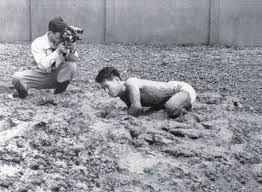
Shiraga Kazuo
Challenging Mud:
1955, action event
Context: A cornerstone of the Gutai movement, which emphasized the physical engagement of the artist's body with the medium.
Meaning: The artist wrestled with a pile of mud using his entire body; the work is about the struggle between the human spirit and raw matter, where the "art" is the act of the struggle itself rather than a finished object.
is the art the action or the muds appearance after disruption?
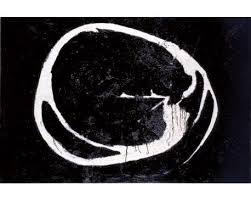
Yoshihara Jiro
Untitled (1962) oil on canvas
Jiro was the founder and leader of the Gutai group, often pushing members to "do what has never been done before".
Meaning: Known for his "circle" paintings, this work represents a meditative and spiritual pursuit of perfection and the void, moving away from traditional representation toward pure abstraction.
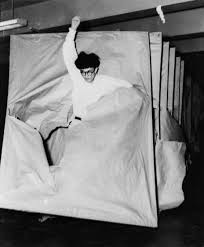
Murakami Saburo
At One Moment Opening Six Holes, 1955, action event
Context: A famous Gutai performance where the artist physically ran through several layers of paper stretched over frames.
Meaning: It represents the breaking of barriers and the destruction of the traditional "canvas" to reveal the space and energy behind it.
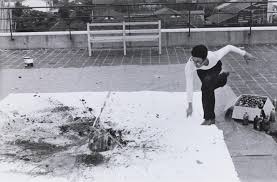
Shimamoto Shozo
Breaking Open the Object, 1956, action event
Context: Another key Gutai figure who experimented with "bottle crashes," throwing glass bottles of paint at canvases.
Meaning: The work focuses on the beauty of the "accident" and the energy released during the moment of destruction, highlighting the life of the material beyond the artist's control.
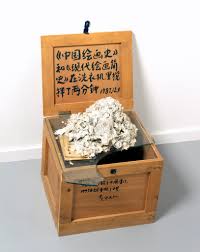
Huang Yong Ping
The History of Chinese Painting and the History of Modern Western Art Washed in the Washing Machine for Two Minutes, mixed media, 1987
Context: Created by a leader of the Xiamen Dada movement in China.
Meaning: By literally washing two influential art history books together, the artist creates a pulpy mess that symbolizes the "cleaning" or erasure of cultural boundaries and the absurdity of rigid historical narratives.
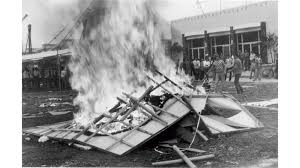
Xiamen Dada
Burning Event, 1986, event
Context: A radical event where artists in Xiamen, China, burned their own works after an exhibition.
Meaning: It was a protest against the commercialization of art and the "sacredness" of the art object, asserting that the idea and the act are more important than the physical remains.
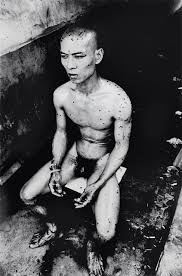
Zhang Huan
12 square Meters performance, 1994
Context: A grueling performance piece in a public latrine in a village in Beijing.
Meaning: The artist sat covered in honey and fish oil, attracting swarms of flies; the piece reflects on the endurance of the human body and the harsh, neglected living conditions of the rural poor in China.
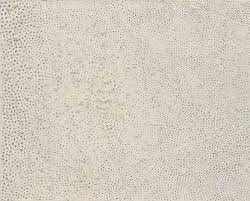
Yayoi Kusama
No. F , 1959, oil on canvas
Context: Part of Kusama’s early "Infinity Net" series painted after she moved to New York.
Meaning: The repetitive, obsessive dots reflect her hallucinations and a psychological need to "self-obliterate" into a pattern that has no beginning or end.
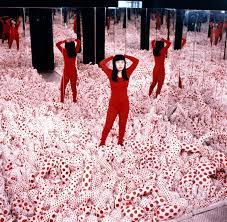
Yayoi Kusama,
Infinity Mirror Room - Phalli's Field
1965, installation
Context: Her first mirror room installation.
Meaning: By using mirrors and stuffed fabric shapes, she creates an immersive environment that forces the viewer to confront her obsessions with sex and food, while experiencing a sense of being lost in an infinite space.
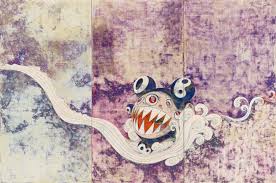
Takashi Murakami,
727, 1996, acrylic on canvas
Context: Features his recurring character "Mr. DOB" against a background inspired by traditional Japanese Nihonga painting.
Meaning: It explores the "Superflat" aesthetic—the flattening of high art and low pop culture—while referencing Japan’s post-war identity and the influence of American animation.
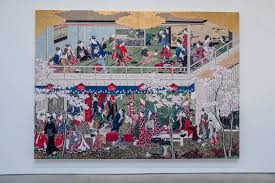
Takashi Murakami
Kitigawa Utamaro's 'Flowers of Yoshiwara', 2025, acrylic, gold leaf and platinum on canvas
Context: A modern reinterpretation of a classical ukiyo-e woodblock print.
Meaning: It bridges the gap between Edo-period "pleasure quarters" and modern consumer culture, using precious materials like gold and platinum to elevate contemporary anime-style aesthetics to the level of high-classical art.

Nam June Paik
Piano Performance 1962-63, performance
Context: Paik was a pioneer of the Fluxus movement and video art.
Meaning: These performances often involved the destruction or "preparation" of pianos to challenge the traditional, elitist expectations of classical music and sound.
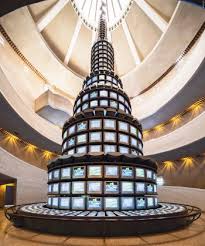
Nam June Paik,
The More the Better, 1988, TV sets and metal structure
Context: A massive tower of 1,003 TV monitors built for the Seoul Olympics.
Meaning: It celebrates the global "electronic superhighway" and the power of media to connect different cultures, turning technology into a modern-day monument.
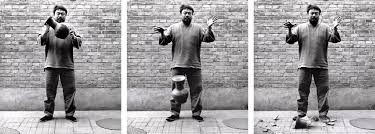
Ai Weiwei,
Dropping a Han Dynasty Urn 1995, photographs
Context: A series of three black-and-white photographs.
Meaning: By destroying a 2,000-year-old artifact, Ai Weiwei critiques the destruction of heritage during China's Cultural Revolution and questions how we assign value to historical objects versus modern ideas.
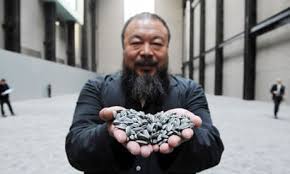
Ai Weiwei
Sunflower Seeds 2008, installation
Meaning: Consists of millions of porcelain seeds, each hand-painted by specialists; it comments on "Made in China" mass production, the individual versus the masses, and the memories of hunger during the Mao era.
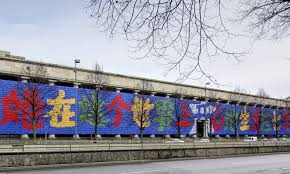
Ai Weiwei
So Sorry 2009, installation
Meaning: An installation created in Munich that used thousands of children's backpacks to remember students who died in the Sichuan earthquake; the title mocks the government's refusal to take responsibility for poorly built "tofu-dreg" schools.
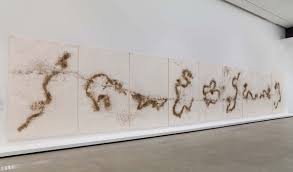
Cai Guo Qiang,
Nine Dragon Wall 1996, gunpowder and ink on paper
Meaning: Uses gunpowder, a Chinese invention, to create "paintings" through explosions; it links ancient Chinese mythology with modern energy and destructive power.
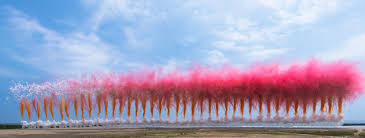
Cai Guo Qiang,
When the Sky Blooms with Sakura, 2023, explosion event
Meaning: An explosion event that creates "firework blossoms" in the sky, reflecting on the fleeting nature of life and beauty, as well as the healing relationship between humans and nature.
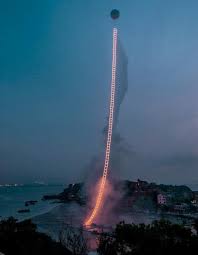
Cai Guo-Qiang
Firework Ladder to the Sky 2015, explosion event
Meaning: A 500-meter ladder of fire suspended by a balloon; it symbolizes a connection between the earth and the heavens and served as a personal gift to the artist's grandmother in his hometown.
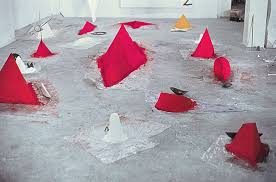
Anish Kapoor
1,000 names, 1979-980, installation
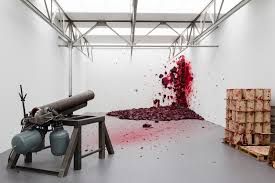
Anish Kapoor
Shooting Into the Corner, 2008-2009, installation
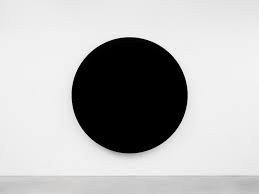
Anish Kapoor
Black Absence, 2021, vantablack and resin
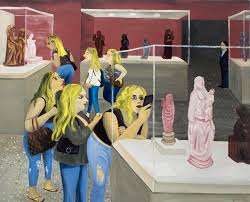
Hai-Hsin Huang
Blondes circa 2018, 2018, oil on canvas
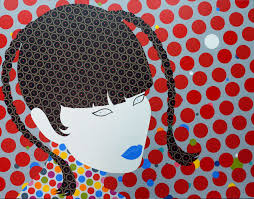
Chamnan Chongpaiboon
Beauté No. 13, 2013, Acrylic on canvas
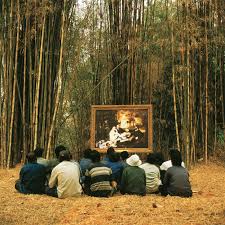
Araya Rasdjarmrearnsook
The Two Planets, 2007-2008, video