Particle physics
 Call Kai
 Learn
Learn Practice Test
 Spaced Repetition
 Match
Match Flashcards
 Knowt Play
1/26

There's no tags or description
Looks like no tags are added yet.
Name | Mastery | Learn | Test | Matching | Spaced | Call with Kai |
|---|
No analytics yet
Send a link to your students to track their progress
27 Terms
What is an isotope?
Nuclei of the same element that have the same number of protons but different numbers of neutrons
What is an atomic mass unit?
One atomic mass unit is one-twelfth the mass of a neutral carbon-12 atom
What is the symbol for the atomic mass unit?
u
What graph shows how the strong nuclear force varies with the separation of nucleons? Graph should have a scale for the separation.
1 fm = 1×10-15 m
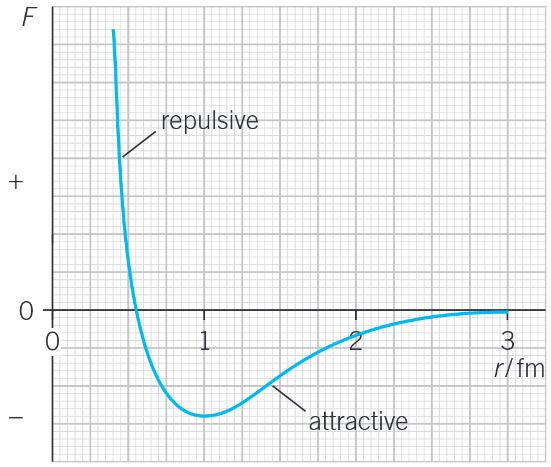
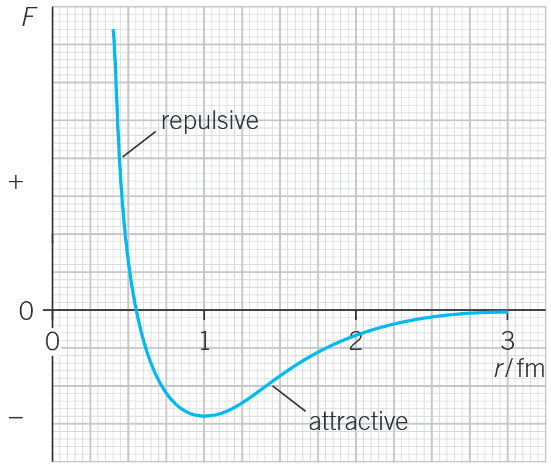
Explain the shape of the graph showing how the strong nuclear force varies with the separation of nucleons
The strong force can only act over very short distances < ~3 fm. When r is 3 fm the nucleons are too far apart for the strong nuclear force to act, so the force is 0
As the seperation r decreases, the nucleons become close enough for the gluons to carry the strong force, so the nucleons experience an attractive force, which is negative.
The force becomes more negative (attraction becomes stronger) as the particles get closer, down to a minimum.
As the nucleons get closer (r decreases), the strong nuclear force eventually becomes repulsive and so positive (distances < ~0.5 fm)
What is the proton number?
The number of protons in a nucleus
What is the atomic number?
The number of protons in a nucleus
What is the nucleon number?
The total number of protons and neutrons in a nucleus
What is the equation for the radius of a nucleus, and what is the meaning of each term?
R = r0 A1/3
R is the radius of the nucleus
r0 is a constant and is roughly 1.2 fm = 1.2×10⁻¹⁵ m
A is the nucleon number
Why do large nuclei have more neutrons than protons?
In larger nuclei, the range of the strong nuclear force for each nucleon is smaller than the size of the nucleus, as the strong force is short ranged.
The electrostatic repulsion from all protons in the nucleus reaches all the others, as it is long ranged.
If large nuclei had the same number of protons and neutrons, the electrostatic repulsion would add to overcome the strong nuclear attraction.
So more neutrons than protons are need to provide the extra strong force needed for equilibrium
What particle is the force carrier for the strong force?
gluons
What is the mean density of nuclei?
1017 kg m-3
What is the mean density of atoms?
103 kg m-3 - same as water
What are the principal features of the nuclear model of the atom suggested by Rutherford.
nucleus is very small compared with atom
nucleus contains most of mass of atom
nucleus has positive charge
electrons surround the nucleus
electrons are negative and have small mass
What are the observations and conclusions of Rutherford’s alpha-scattering experiment?
Most alpha particles went through without deflection, hence the atom is mostly empty space
Some alpha particles were scattered through large angles, hence there must be a nucleus at the centre of the atom
Nucleus must have positive charge to repel the alpha particles
Nucleus must be small and dense as it most of atom is empty
What is r0 in the equation R = r0 A1/3?
The radius of a proton which ≈ 1.2 fm
What is the radius of a proton?
~1.2 fm = 1.2 × 10⁻¹⁵ m
Derive an equation for the density of the nucleus
radius of nucleus R = r0 A1/3. If we assume nucleus is a sphere, V = 4/3 π r3 = 4/3 π (r0 A1/3)3 = 4/3 π r03 A = (4 π r03 A) / 3
density ρ = m / v = m / [ (4 π r03 A) / 3 ] = 3m / (4 π r03 A)
Describe the nature of the strong nuclear force
One of the four fundamental forces in nature
Acts on hadrons and holds nuclei together
Very short ranged - only acts at distances < ~3 fm
Attractive at distances > ~0.5 fm and < ~3 fm
Repulsive at distances < ~0.5 fm
What is a fundamental particle?
A particle that has no internal structure and hence cannot be split into smaller particles
What is a hadron?
A particle or antiparticle that is affected by the strong nuclear force
What are the two types of hadron?
Baryon
Meson
What is a baryon?
A hadron made with a combination of three quarks
What is a meson?
Any hadron comprising of a combination of a quark and an anti-quark
What is a lepton?
A fundamental particle or antiparticle that is not affected by the strong nuclear force
How do you write an electron in a decay equation?

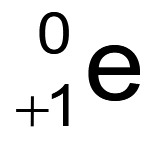
How do write a positron in a decay equation?