8: astigmatic decomposition & obliquely crossed cylinders.
 Call Kai
 Learn
Learn Practice Test
 Spaced Repetition
 Match
Match Flashcards
 Knowt Play
1/25

There's no tags or description
Looks like no tags are added yet.
Name | Mastery | Learn | Test | Matching | Spaced | Call with Kai | Chat |
|---|
No analytics yet
Send a link to your students to track their progress
26 Terms
obliquely crossed cylinders
power of a cylindrical lens along an axis other than the principal meridians
plano/+6.00 × 90
= power along the axis of the cylinder is plano
power along the meridian at 90 degrees to the axis is +6.00D
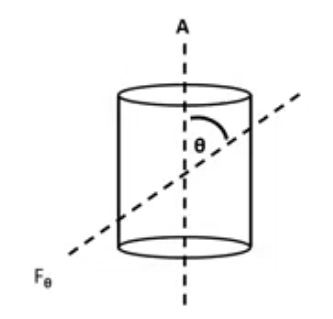
how is the power along some other meridian worked out?
plano/+6.00 × 90
F feta is oriented at an angle feta from the axis of the cylinder
F feta = F x sin feta ²
( sin feta, and then square this)
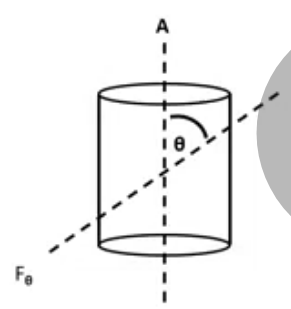
what is the F feta for plano/+6.00 × 90
= +6.00 x sin ² 45
= +6.00 × 0.5
= +3.00D
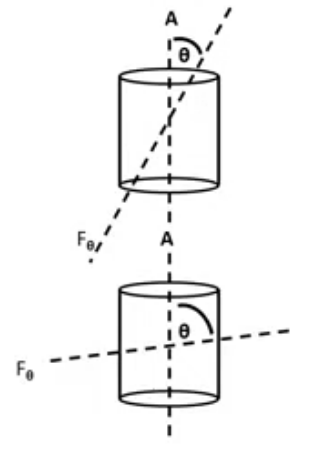
plano/ +6.00 × 90
feta = 10 degrees
= +6.00 x sin² 10
= +0.18D
sin feta is 80 degrees
= +6.00 x sin²80
= +5.82D
obliqquely crossed cylinders- graphical representation
plots the power of the whole lens as it is moved around
the angle is with respect to the axis of the cylinder not the trial frame notation
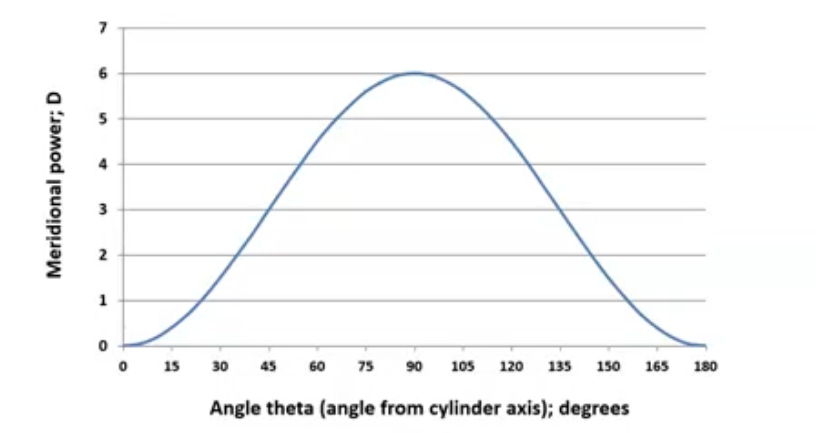
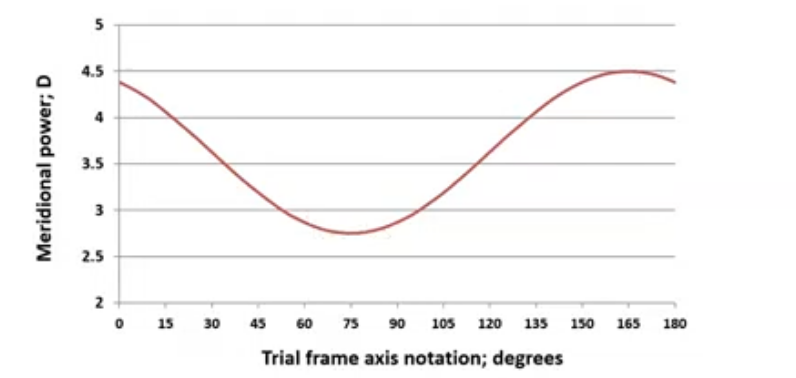
+4.50 / -1.75 × 165 ; graphical representation
shows change in meridional power ( ie power along a given axis) of the lens according to standard trial frame notation
combining cylinders
if the axes are the same:
-1.00/-0.50 × 175 + -1.25 / -1.00 × 175 = -2.25 / -1.50 × 175
if axes are not the same;
eg -1.00/-0.50 × 175 + -1.25/-1.00 × 165 : harder to combine
axis 5 and 175 is 5 degrees apart
what methods of calculations are used to calculate resultant power from the combination of prescriptions where the cylinder axes are obliqye with respect to eachother
graphical method: storkes construction
astigmatic decomposition
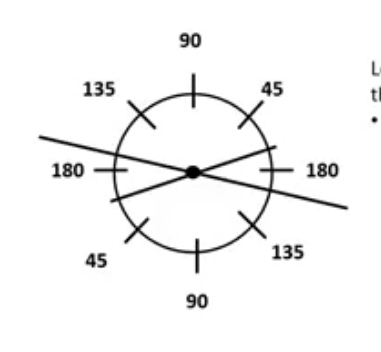
graphical solution for the combination of 2 lenses
-1.00 × 20 + -2.00 × 160
1 line at 20, other at 160 , an and the length of the lines represent the power of the cyl
graphical solution steps ( not needed)
transpose the lenses so that theyre in positive sphero cylindrical form
choose the lens with smaller numerical axis ( 180 is 0 )
draw a line to scale - length and axis direction which represents the first cylinder power F1 (OA)
draw second line F2 to scale at an angle to the first line of twice the difference in axis; AR
draw third line to complete triangle. the length in this lie represents the power of the resultant cyl
bisect the angle between the 1st line drawn and resultant.
new sphere power will be ( f1 + f2 - C) / 2
astigmatic decomposition
dividing up a prescription so that it can be represented by 3 terms
M = mean spherical power : S + ½ C
J180 = a cross cylinder at 90/180
J45 = a crossed cylinder at 45/135
work out M from +4.25 / -1.50 × 20
M = S + ½ C
M = +4.25 + -0.75 = +3.50
work out J180 from +4.25 / -1.50 - x 20
= - 0.5C x cos(2A) A being the axis
take the axis of cl, and double it, then take cosiine of this
multiply it by minus half the cyl
= -0.5 x (-1.50) x cos(40) = 0.75 × 0.7660 = 0.575D
usualy cross cyl is around a half of the cyl power
work out J45 from +4.25 / -1.50 × 20
-0.5C x sin (2A)
-0.5 x -1.50 . sin (40)
= 0.75 × 0.6428 = +0.482D
the J180 cross cyl component is bigger than 45; 180 is closer to 20 than 45
for both J180 and J45 to be exactly the same axes would need to be 22.5: midpoint
how is the resultant sphere worked out
take the sum of all the J180 terms and square it, do same for J45, then add the two together
take square root of this and add the sum of the M terms

how is the resultant cylinder worked out
take the sum of all J180 terms and square it, do the same for J45, add the two together, then square root this
multiply this by -2.00

how is resultant axis worked out
divide the sum of all the j45 terms by the sum of j180 terms. calc 0.5 the arctan of this

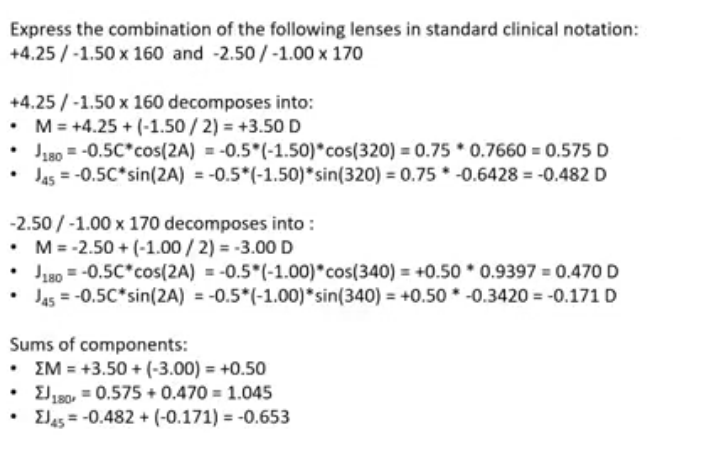
express the combination of the lenses in standard clinical notation
+4.25/-1.50 × 20 & -2.50/-1.00 × 10 (1)
+4.25 / -1.50 × 20
M = +4.25 + - 1.50/2 = +3.50D
J180= -0.5 x -1.50 x cos(40) = +0.575D
J45= -0.5 x -1.50 x sin(40) = 0.482 D
-2.50 / -1.00 × 10
M = -3.00
J180 = 0.470 D
J45= 0.171 D
sum of all components
M= +3.50 + - 3.00 = +0.50
J180 = +1.045
J45 = +0.653
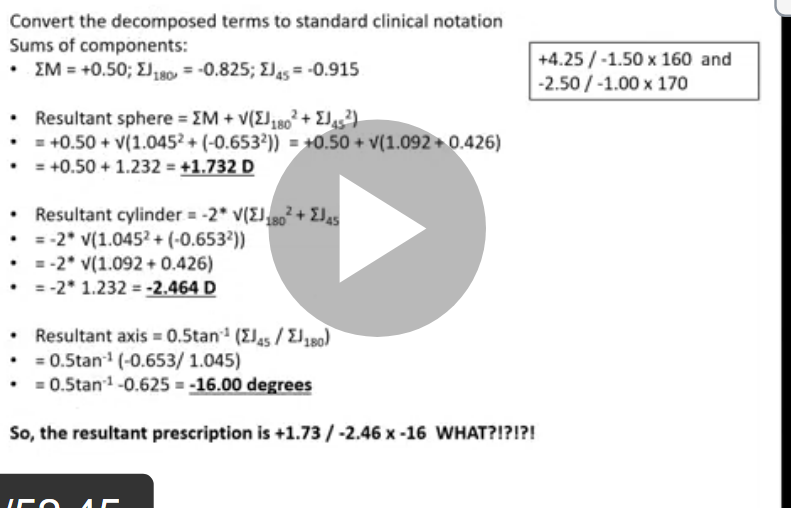
resultant sphere power (2)

resultant cylinder power (3)
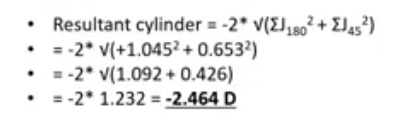
resultant axis (4)
= leaves the prescription as +1.73 / -2.46 × 16
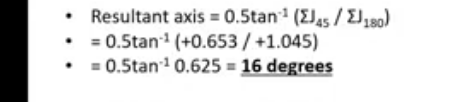

(1)
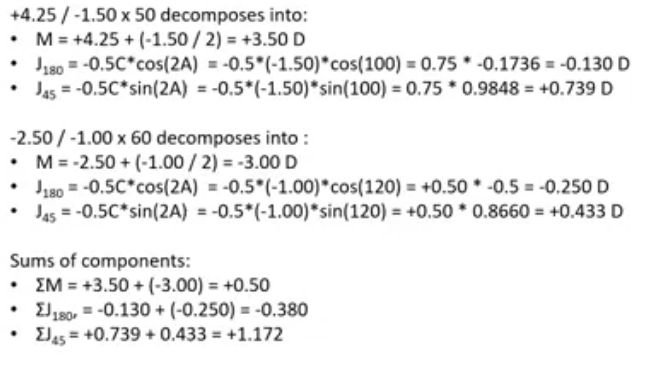
(2) resultant
if have an axis that isnt near either of the 2 axes in question , needs adjusting by 90 degrees
so resultant axis would be 54
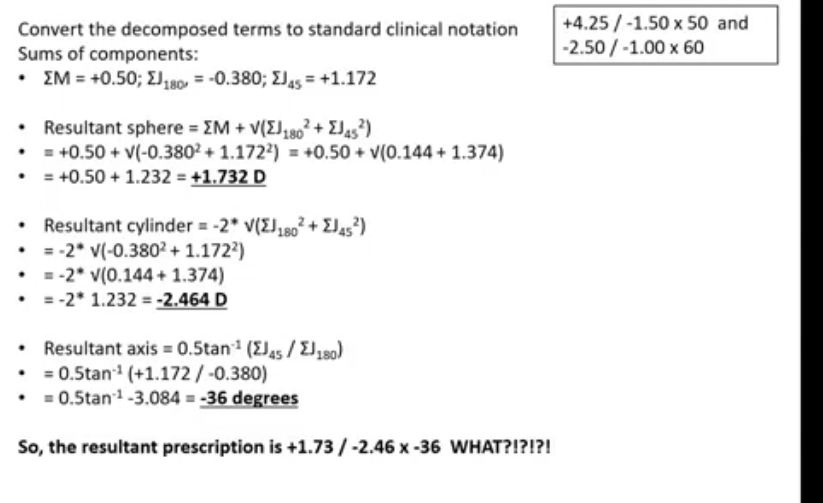
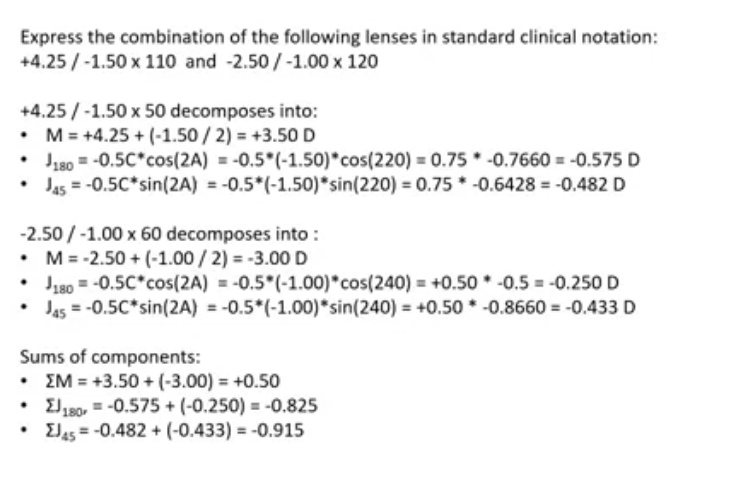
(1)
axis is different- not between the 2 axes
so adjust 90 degrees
so 24 + 90 = 114 is the new axis
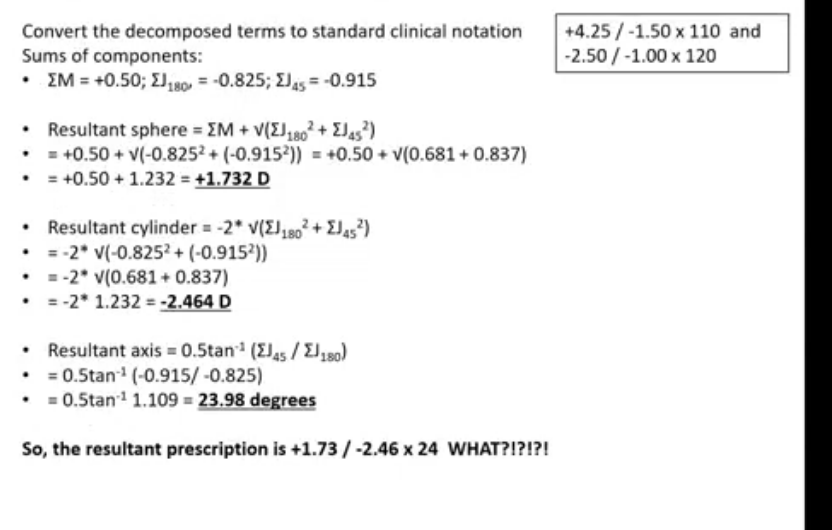
(1)
axis isnt between 160 and 170
so add 180 to it to get it in between the 2 axis
= new axis is 164
what are the fixes for cylinder axis
for resultant axes less than 45 : use calculated value
for resultant axes greater than 45 and less than 135, add 90 to calculated value
for resultant axes greater than 135, add 180 to calculated value