Block 7 Lesson 2
 Call Kai
 Learn
Learn Practice Test
 Spaced Repetition
 Match
Match Flashcards
 Knowt Play
1/21

Earn XP
Description and Tags
The Sun: Sunspots and Solar Wind
Name | Mastery | Learn | Test | Matching | Spaced | Call with Kai |
|---|
No analytics yet
Send a link to your students to track their progress
22 Terms
Where are sunspots found on the Sun?
Sunspots are found between 40° North and South of the Equator in the Photosphere.
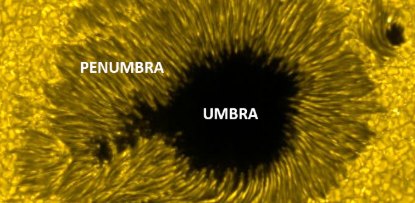
What is umbra and penumbra?
The umbra (dark shadow) is darker and cooler (4000K). The penumbra (light shadow) is the lighter bit and is a bit hotter than the umbra (5600K).
How are sunspots formed?
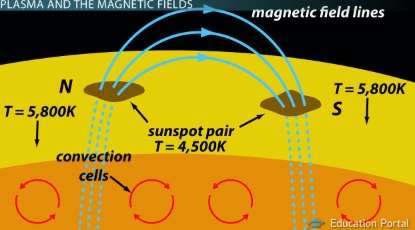
The sun rotates. It also has a magnetic field.
As the Sun goes round, its magnetic field gets bent out of shape because its North and South poles spin at a different rate to the equator (the equator is faster).
The magnetic field gets more and more tightly wound up and eventually they snap.
This causes tubes to form in the magnetic field, which rise to the surface and prevent convection of superheated gases underneath.
This results in regions of lower temperature.
These sunspots form in pairs.
How long do sunspots last?
They last from several days to months. They contract and expand until they decay and are no longer visible.
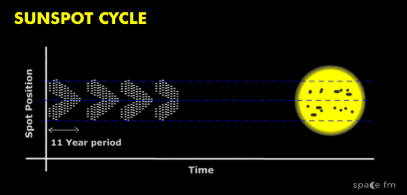
Do sunspots (how many there are) have a cycle?
They have 11 year cycles where the amount of sun spots increases and decreases. By observing this, we can predict when the next solar maximum will occur. Can be visualised using a butterfly diagram.
How does the Sun rotate?
The Sun doesn’t rotate like a terrestrial planet does, since the Sun is made of plasma.
It rotates slower at the poles because of its size/structure.
Rotation varies from 25 days to 36 days at the equator, all of which can be observed by observing movement of sunspots across the photosphere.
What is solar wind?
Solar wind is a constant flow of charged protons and electrons flowing outward from the Sun.
They can reach a velocity of 400 km per second.
These particles escape the gravity of the Sun because they have too much energy.
What are CMEs?
CMEs or ‘Coronal Mass Ejections’ are violent outbursts of particles.
If one is aimed at Earth, scientists should be able to find it at least 24 hrs before they might hit Earth.
What is Earth’s magnetic field produced by?
Its iron core.
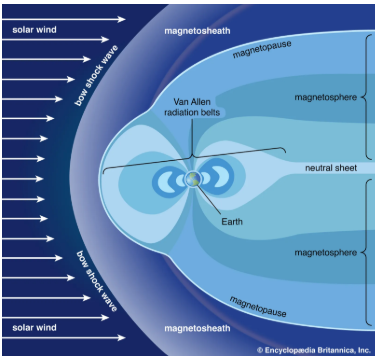
What do we call Earth’s magnetic field.
The magnetosphere.
In which direction does the magnetosphere go to?
It goes in both directions from the Earth but mostly goes behind, with the front one (facing the Sun) being squashed by the solar wind (it deflects the solar wind).
What happens to some of the charged particles from solar wind?
They get trapped in the two magnetic belts - one inner, one outer. The outer belt is 5,000 - 6,000 km away and contains the electrons from the solar wind while the inner is 1,000 - 3,000 km away and contains the protons.
Who are the belts named after?
They’re named after Dr James Van Allen who discovered them in 1958.
How are aurorae made?
The particles that get caught in the Van Allen belts move to the magnetic north and south poles of Earth. They manifest as displays of light and colour in the sky called aurorae.
What are aurorae named in the northern and southern hemisphere?
In the northern hemisphere, this is called Aurora Borealis and in the southern hemisphere it’s called Aurora Australis.
What does the intensity of an aurora depend on?
The intensity of the aurora depends on how intense the solar wind is, which in turn depends on solar activity.
Where are aurorae best seen?
Near the magnetic poles.
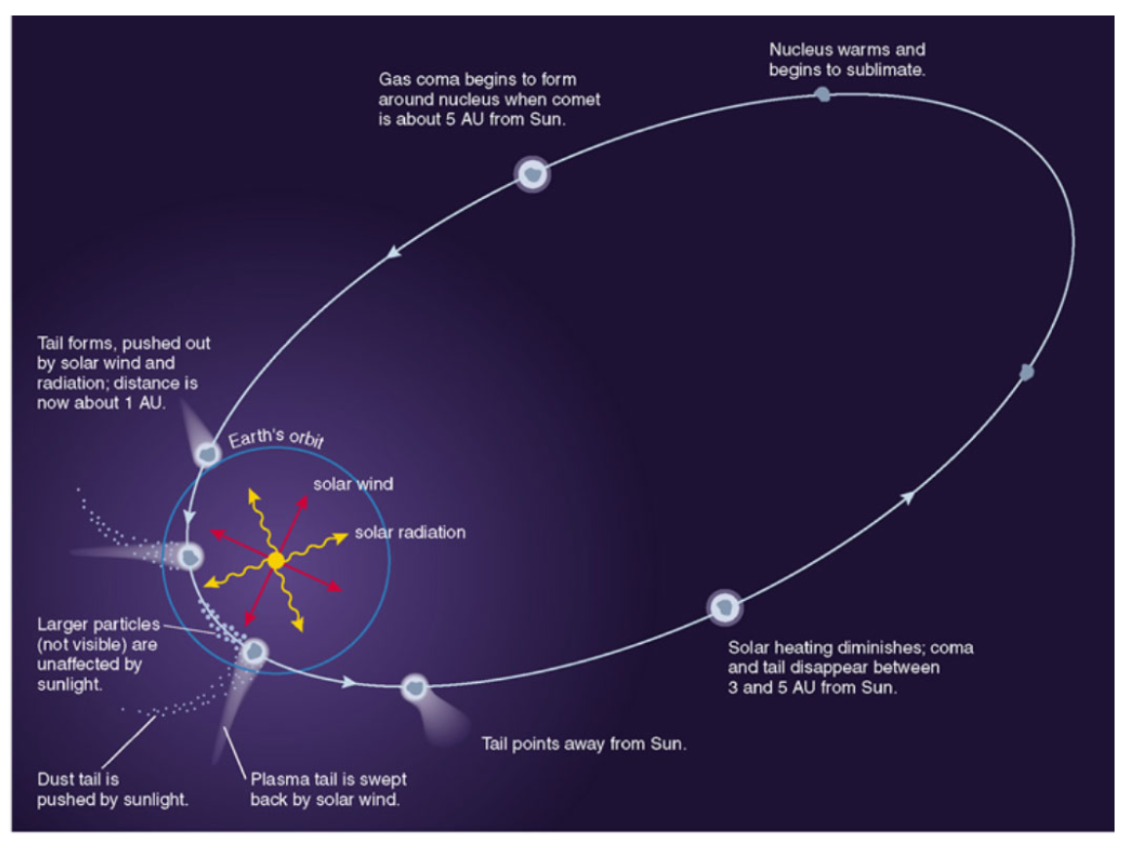
What forms the ion and dust tail of a comet?
As a comet gets closer to the sun, the solar wind and radiation heats the coma and makes an ion tail.
The dust tail is pushed by the sunlight/wind.
What are geomagnetic storms?
Geomagnetic storms are what happen when an abnormal amount of plasma hits Earth after a violent CME from the Sun.
What is an example of a geomagnetic storm and how was it noticed?
An example is the Carrington Event that happened in 1859.
It was noticed because observatories saw an increase in sunspots and telegraphs noticed an increase in voltage. Aurorae were also seen at lower latitudes in the north and south hemispheres.
How are satellites affected by solar wind?
Satellites are very vulnerable to solar wind. The upper layer of the Earth’s atmosphere (ionosphere) is the layer radio signals use. This makes them vulnerable to solar wind and makes radio communication very difficult.
How are manned space missions affected by solar wind?
High energy particles can also cause radiation poisoning in astronauts and when an eruption happens, the astronauts are advised to move inside.