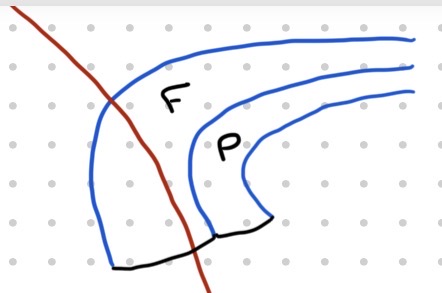
6.1 - TTT/CCT diagrams of steel
 Call Kai
 Learn
Learn Practice Test
 Spaced Repetition
 Match
Match Flashcards
 Knowt Play
1/11

There's no tags or description
Looks like no tags are added yet.
Name | Mastery | Learn | Test | Matching | Spaced | Call with Kai |
|---|
No analytics yet
Send a link to your students to track their progress
12 Terms
What’s heat treatment?
Process involving controlled heating & cooling to alter the physical & mechanical properties of a material w/ changing its shape
What’s steel?
Steel is an iron-carbon alloy with low carbon content (< 2.06% by mass)
What’s the limit of phase diagrams?
less practical for real-world application
→ phases are in thermodynamic equilibrium <=> assume infinite slow cooling/heating
→ don’t take time into account
→ BUT technical processes take place in shorter periods of time
What do we use to overcome the limit of phase diagrams?
We use TTT or CCT diagrams
→ consider time as a parameter
→ consider incomplete diffusion processes (atoms don’t have enough time to fully disuse & reach uniform distribution during heating/cooling == not enough time to reach thermodynamic equilibrium)
→ reflect real-world conditions where transformations occur over finite periods of time
→ high technical relevance
What’s the difference between TTT & CCT diagrams?
TTT: isothermal transformation → transformation at constant temperature after rapid cooling (quickly cooled to a certain temperature which is held for a period of time during which the material transforms into other phases)
CCT: continuous cooling → transformation at different temperatures with constant cooling rate
What’s the limit of TTT diagrams?
Isothermal transformations are not always practical because rapid changes in temperature are not always possible
Why don’t we see some phases in the iron-carbon phase diagram that we see in the CCT diagram?
phase diagrams are equilibrium diagrams
→ represent stable phases that exist under equilibrium conditions (assume infinitely slow cooling/heating)
Some phases are non-equilibrium phases
→ form during rapid cooling (not extremely rapid but more than infinitely slowly)
→ incomplete diffusion, equilibrium phases are not reached because not enough time
What’s the difference between unalloyed and alloyed steel?
Steel is already an alloy in itself but…
unalloyed steel → carbon is the primary alloying element, no other alloying elements are present or only in minor amounts
alloyed steel → contains carbon & other alloying elements intentionally added in sufficient quantities to affect mechanical properties
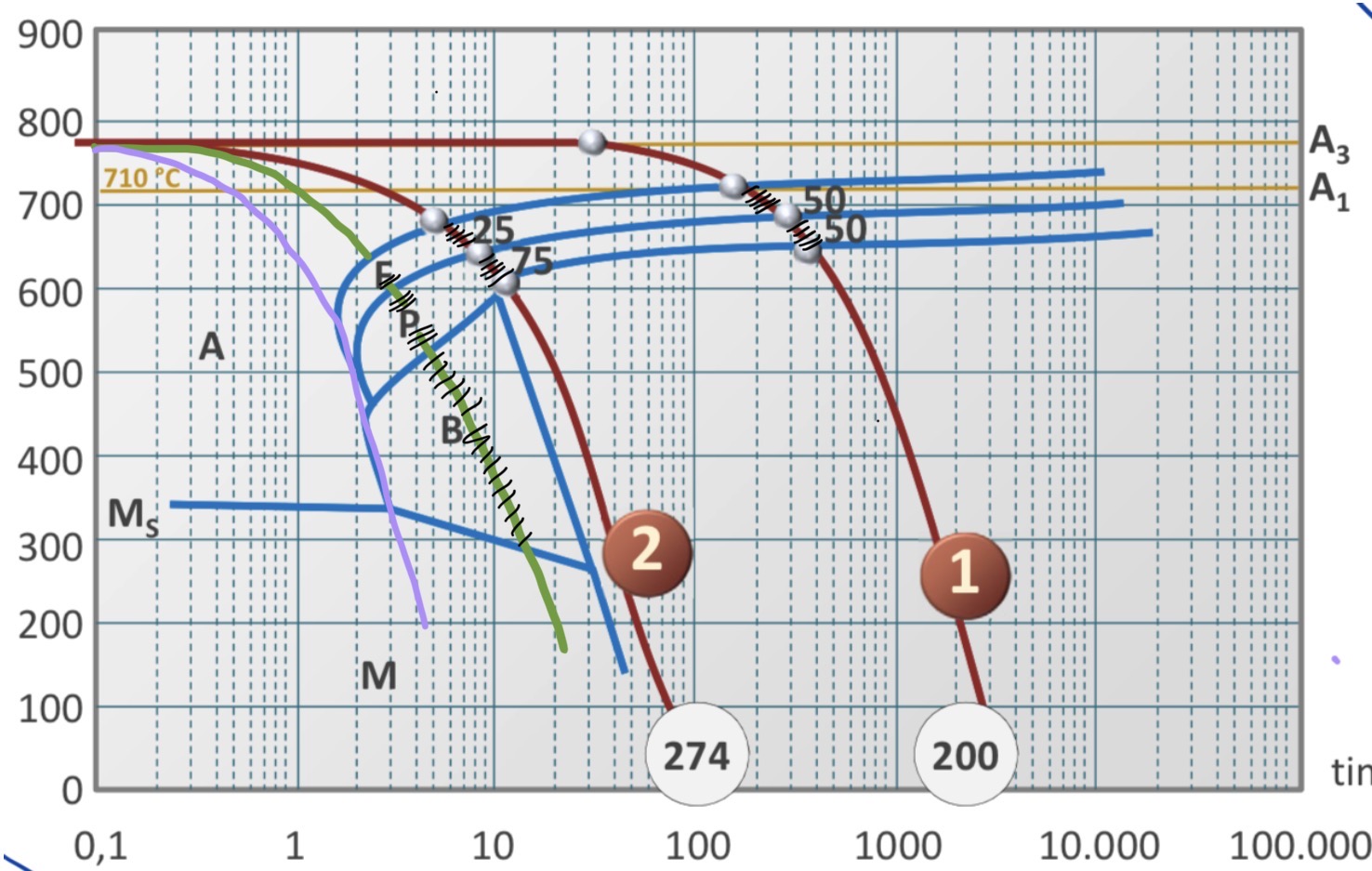
Explain how to read this CCT diagram
Curve 1: final microstructure = 50% ferrite / 50% pearlite
(When we enter the pearlite region, 50% of the material has already transformed into ferrite)
Curve 2: final microstructure = 25% ferrite / 75% pearlite
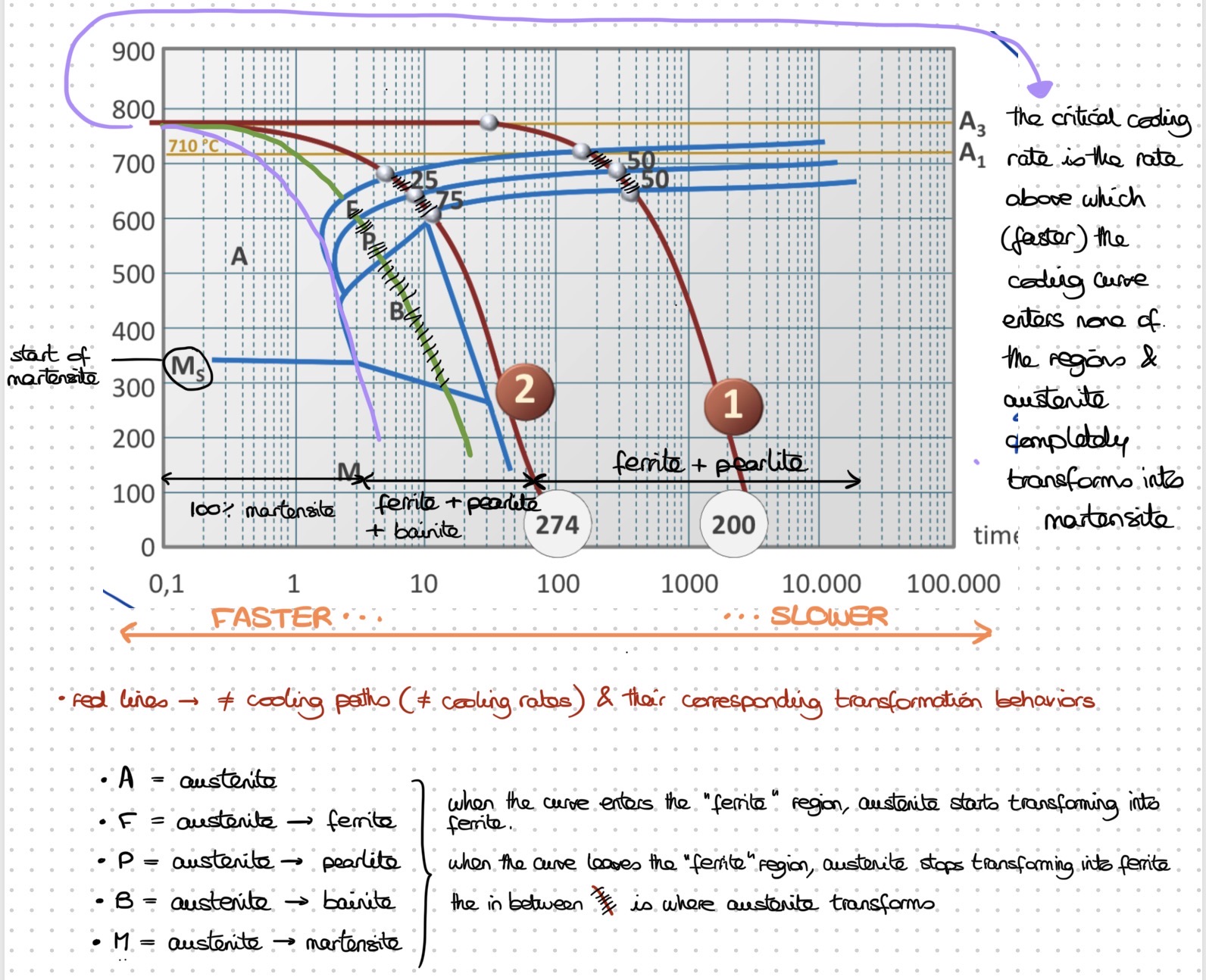
What’s the critical cooling rate? What happens for steel?
The rate above which (faster rate) the cooling curve enters none of the regions except martensite & thus, austenite completely transforms into martensite
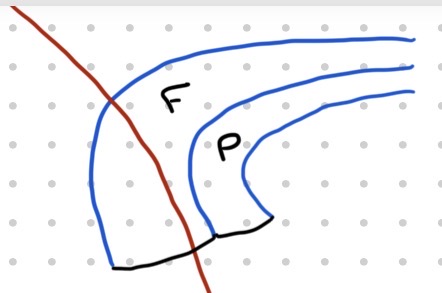
What happens when the cooling curve is looking like this?
The transformation of austenite into another phase (here ferrite) is incomplete
→ the cooling curve enters none the ferrite region but never crosses its “end line”
→ crosses the black line but never enters the pearlite region
→ ferrite forms but not 100% and the remaining austenite will transform into martensite in the lower part
Draw a cooling curve where the transformation of austenite into another phase is incomplete