altering material properties
 Call Kai
 Learn
Learn Practice Test
 Spaced Repetition
 Match
Match Flashcards
 Knowt Play
1/16

There's no tags or description
Looks like no tags are added yet.
Name | Mastery | Learn | Test | Matching | Spaced | Call with Kai |
|---|
No analytics yet
Send a link to your students to track their progress
17 Terms
Grain size reduction
size of grains in polycrystalline metal influences mechanical properties
slip or dislocation motion during deformatio must occur across common boundary
yield strength variation by grain size
as grain size decreases, yield strength increases.
yield strength in terms of grain size
yield strength = constant + constant/sqrt average grain size
strain hardening
basically cold working, a metal becomes stronger as it is plastically deformed
degree of plastic deformaton defined by amount of cold working
but there is a reduction in ductility due to increased tenisle strenght
strain hardening increases dislocation density meaning its harder to deform
rolling effect on grains
grains are elongated and sistorted, so more grainoundaries so dislocation density increased
precipitation hardening
hardness of some alloys enhanced by forming extremely small and uniformly dispersed particles of a second phase in original pjhase
solution heat treatment
1) heat to T0 (single alpha phase)
2) quench (rapidly cool) to T1 (alpha and beta phase)
3) so fast that diffusion of beta is prevented
4) this creates non-equilibrium structure of alpha phase with super saturated beta phase
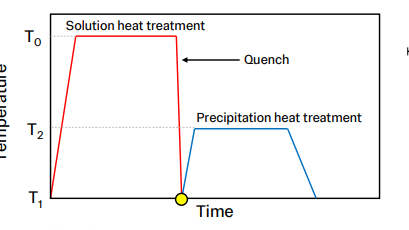
precipitation heat treatment
supersaturated alpha is heated to alpha+beta region where diffusion is faster
beta starts to form
it is cooled after a set time
overaging
if heated for too long, 2nd phase grows and strength increase is lost
fine and coarse pearlite
full annealing forms coarse pearlite (equilibrium) which is very slow cooling, normalsing which is faster cooling forms finer pearlite and less time for atoms to diffuse so they diffuse a shorter distance leadning to dinal structure
bainite
transformation of austenite
consists of two phases ferrite and cementite, like pearlite
structure is very fine, resolved by microscope
bainite forms as needles or plates and at lower temps than pearlite
martensite
if quenched then there will be no time for atoms to diffuse through structure
hard and brittle
martensite can be tempered to restore ductility (heated)
non equilibrium phase structures of steel
full annealing (very slow cooling): leads to coarse pearlite
normalising (fast cooling): leads to fine pearlite
forced air cooling: leads to finer ferrite and cementite layers called bainite
quenching (fast cooling in opil:: gives no time for carbon to diffuse so austenite leads to hard martensite
solid solution hardening
high purity metals are always softer than their alloys
increasing impurities increases tensile and yield strength
impurities cause lattice strains which impede dislocations
higher dislocation density means higher strength
tensile lattice strain
caused by smaler substitution
compressive lattice strain
caused by larger substitution
shape memory alloys
ablity to remember initial shape after deformation when heated
nickel - titanium alloy